IJSLP ranked an A journal by the Australian Government
International Journal of Speech-Language Pathology has been ranked as an A journal in the Excellence for Research in Australia (ERA) rankings released this month. Journals are ranked as A*, A, B, C, or unranked, so this ranking places IJSLP amongst the top speech-language pathology journals in the world according to the Australian government. For the complete list of journals see: www.arc.gov.au/era/era_journal_list.htm.
This ranking follows shortly after the inclusion of IJSLP in SCOPUS and the ISI Social Sciences Citation Index. These accolades are very important for the longevity of the journal in today’s very competitive academic climate.
February 25, 2010
Publications in 2010
2010 has been a good year so far for publications:
JOURNAL ARTICLES
JOURNAL ARTICLES
- Yavaş, M. & McLeod, S. (2010). Acquisition of /s/ clusters in English speaking children with phonological disorders. Clinical Linguistics and Phonetics, 24(3), 169-176.
- McLeod, S., Press, F., & Phelan, C. (2010). The (in)visibility of children with communication impairment in Australian health, education, and disability legislation and policies. Asia Pacific Journal of Speech, Language, and Hearing, 13(1), 67-75.
- McCormack , J., McLeod, S., Harrison, L. J., McAllister, L., & Holliday, E. L. (2010). A different view of talking: How children with speech impairment picture their speech. ACQuiring Knowledge in Speech, Language, and Hearing, 12(1), 10-15.
- Barr, J. & McLeod, S. (2010). They never see how hard it is to be me: Siblings’ observations of strangers, peers and family. International Journal of Speech-Language Pathology, 12(2), 162-171.
- Williams, A. L., McLeod, S. & McCauley, R. J. (Eds.) (2010). Interventions for speech sound disorders in children. Baltimore, MA: Paul H. Brookes Publishing.
- McLeod, S. (2010). Laying the foundations for multilingual acquisition: An international overview of speech acquisition. In M. Cruz-Ferreira (Ed). Multilingual norms (pp. 53-71). Frankfurt: Peter Lang Publishing.
- McLeod, S. & Searl, J. (2010). Adaptation to an electropalatograph palate: Acoustic, impressionistic, and perceptual data. In T. W. Powell & M. J. Ball (Eds). Clinical linguistics: Critical concepts in linguistics (Vol. 2, pp. 195-221). Oxford: Routledge.
- Baker, E. & McLeod, S. (2010). Evidence-based management of phonological impairment in children. In T. W. Powell & M. J. Ball (Eds). Clinical linguistics: Critical concepts in linguistics (Vol. 4, pp. 446-469). Oxford: Routledge.
- Williams. A. L., McLeod, S. & McCauley, R. J. (2010). Direct speech production interventions. In A. L. Williams, S. McLeod, & R. J. McCauley (Eds.) Interventions for speech sound disorders in children. Baltimore, MA: Paul H. Brookes Publishing.
- McLeod, S., McCauley, R. J., & Williams, A. L. (2010). Speech interventions in broader contexts. In A. L. Williams, S. McLeod, & R. J. McCauley (Eds.) Interventions for speech sound disorders in children. Baltimore, MA: Paul H. Brookes Publishing.
- McCauley, R. J., Williams, A. L., & McLeod, S. (2010). Interventions for achieving speech movements. In A. L. Williams, S. McLeod, & R. J. McCauley (Eds.) Interventions for speech sound disorders in children. Baltimore, MA: Paul H. Brookes Publishing.
- McCauley, R. J., Williams, A. L. & McLeod, S. (2010). Interventions for speech sound disorders in children: Future directions. In A. L. Williams, S. McLeod, & R. J. McCauley (Eds.) Interventions for speech sound disorders in children. Baltimore, MA: Paul H. Brookes Publishing.

International perspectives on clinical linguistics and phonetics
The first issue of International Journal of Speech-Language Pathology for 2010 has as its theme: International perspectives on clinical linguistics and phonetics.
www.informahealthcare.com/ijslp
This issue highlights the internationalization of the journal with the publication of manuscripts by authors from: UK, Spain, Belgium, Netherlands, Norway, Ireland, Hong Kong SAR, Hungary, USA, and Australia.
It was a pleasure and a challenge to edit this issue - the Chinese characters and phonetic symbols kept both myself and the typesetters on their toes.
Assessing prosodic skills in five European languages: Cross-linguistic differences in typical and atypical populations
Sue J. E. Peppé, Pastora Martínez-Castilla, Martine Coene, Isabelle Hesling, Inger Moen, and Fiona E. Gibbon
A database for investigating the logographeme as a basic unit of writing Chinese
Hoi-Ming Lui, Man-Tak Leung, Sam-Po Law, and Roxana Suk-Yee Fung
Production of tense marking in successive bilingual children: When do they converge with their monolingual peers?Theodoros Marinis and Vasiliki Chondrogianni
Temporal parameters of spontaneous speech in Alzheimer’s disease
Ildikó Hoffmann, Dezso Nemeth, Cristina D. Dye, Magdolna Pákáski, Tamás Irinyi, and János Kálmán
Assessing frequency effects on verb inflection use by Spanish-speaking individuals with agrammatism: Theoretical and clinical implicationsJosé G. Centeno and Helen Smith Cairns
Verbal repetition skill in language impaired children: Evidence of inefficient lexical processing?Neville W. Hennessey, Suze Leitão, and Kate Mucciarone
Through the magnifying glass: Underlying literacy deficits and remediation potential in Childhood Apraxia of SpeechElena Zaretsky, Shelley L. Velleman, and Kristina Curro
Phonetic and phonological errors in children with high functioning autism and Asperger syndrome
Joanne Cleland, Fiona E. Gibbon, Sue J. E. Peppé, Anne O’Hare and Marion Rutherford
www.informahealthcare.com/ijslp
This issue highlights the internationalization of the journal with the publication of manuscripts by authors from: UK, Spain, Belgium, Netherlands, Norway, Ireland, Hong Kong SAR, Hungary, USA, and Australia.
It was a pleasure and a challenge to edit this issue - the Chinese characters and phonetic symbols kept both myself and the typesetters on their toes.
Assessing prosodic skills in five European languages: Cross-linguistic differences in typical and atypical populations
Sue J. E. Peppé, Pastora Martínez-Castilla, Martine Coene, Isabelle Hesling, Inger Moen, and Fiona E. Gibbon
A database for investigating the logographeme as a basic unit of writing Chinese
Hoi-Ming Lui, Man-Tak Leung, Sam-Po Law, and Roxana Suk-Yee Fung
Production of tense marking in successive bilingual children: When do they converge with their monolingual peers?Theodoros Marinis and Vasiliki Chondrogianni
Temporal parameters of spontaneous speech in Alzheimer’s disease
Ildikó Hoffmann, Dezso Nemeth, Cristina D. Dye, Magdolna Pákáski, Tamás Irinyi, and János Kálmán
Assessing frequency effects on verb inflection use by Spanish-speaking individuals with agrammatism: Theoretical and clinical implicationsJosé G. Centeno and Helen Smith Cairns
Verbal repetition skill in language impaired children: Evidence of inefficient lexical processing?Neville W. Hennessey, Suze Leitão, and Kate Mucciarone
Through the magnifying glass: Underlying literacy deficits and remediation potential in Childhood Apraxia of SpeechElena Zaretsky, Shelley L. Velleman, and Kristina Curro
Phonetic and phonological errors in children with high functioning autism and Asperger syndrome
Joanne Cleland, Fiona E. Gibbon, Sue J. E. Peppé, Anne O’Hare and Marion Rutherford
February 23, 2010
Websites about bilingual speech acquisition
Here are some websites that are relevant to the consideration of bilingual speech acquisition
- Bilingual therapies: http://blog.bilingualtherapies.com
- The right to be bilingual: http://www.francoisgrosjean.ch/the_right_en.html
The Future Fellowship officially begins
My Future Fellowship officially began on Monday 8th February, 2010.

What a privelidge it is to think about research full time!
My first weeks have been a productive and collegial time. Here are a few highlights:
1. Dr. Karla Washington and I submitted a grant application titled: Investigating children's acquisition of Jamaican Creole (Patois). While I was working in the Australian summer heat, Karla was in the Canadian snow (below)
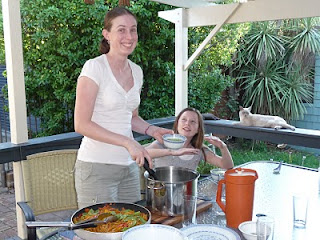
2. Kate Crowe came to Bathurst for a week and worked on her PhD proposal titled: Multilingual children with hearing loss: Communication choices and outcomes. Kate cooked a lovely Chinese meal to inspire us (below).
3. Jane McCormack and I have been invited to co-author a book chapter on Communication measures for the ICF-CY:
McLeod, S., McCartney, E. & McCormack, J. (in process). Communication (d310-d369). In A. Majnemer (Eds). Measures for children with developmental disabilities: Framed by the ICF-CY. London: Mac Keith Press.
4. I attended the christening of Xander Watts Pappas. Xander's mum is my colleague and ex-PhD student. The celebration was wonderful Greek family event and enabled me to participate in an important aspect of bicultural Australia.
5. This week Isabelle Simard is visiting from Montréal Canada. She speaks many languages (including French, English, Spanish, German, Italian, Portuguese, Arabic and Greek!) and her SLP clinic specialises in working with multilingual children.
December 22, 2009
CRiCS Summer School, Bathurst, Dec 2009

I was invited to close the Centre for Research in Complex Systems biennial summer school with a 1 hour presentation titled "Speech sounds around the world". The audience spoke many languages including French, German, Spanish, Turkish, Cantonese, Putonghua, and Bengali so they provided many examples and were enthusiastic participants.
The CRiCS December newsletter recorded: "The summer school concluded with a dynamic, interactive presentation from Sharynne McLeod on speech sounds around the world."
The CRiCS December newsletter recorded: "The summer school concluded with a dynamic, interactive presentation from Sharynne McLeod on speech sounds around the world."
December 13, 2009
LSAC Research Conference, Melbourne, Dec 2009
The 2nd Longitudinal Study of Australian Children (LSAC) Research Conference was held in Melbourne in December, 2009. My colleagues, Linda Harrison and Jane McCormack presented papers based on our ARC Discovery Project (2007-2009). The methods and findings from the Disovery Project are foundational for the ARC Future Fellowship.
Presentations:
Presentations:
- Harrison, L. J., McLeod, S., Berthelsen, D. & Walker, S. (2009, December). Impact of speech and language impairment at 4- to 5-years on literacy, numeracy, and learning at 6- to 7-years. 2nd Growing Up in Australia: Longitudinal Study of Australian Children (LSAC) Research Conference, Melbourne.
- McLeod, S., Harrison, L. J., McAllister, L. & McCormack, J. (2009, December). Correspondence between direct assessment of speech and language impairment in 4- to 5-year-olds and LSAC measures of parent and teacher reported concern. Poster presented at the 2nd Growing Up in Australia: Longitudinal Study of Australian Children (LSAC) Research Conference, Melbourne.
Korean

My daughter received an award from the Korean Government for "outstanding accomplishment in Korean language study" through her local public school in rural Australia. Her school class has regular videoconferences with their sister class in Korea.
HCSNet Conference, Sydney, Dec 2009
The Human Communication Science Network Conference was held in Sydney in December 2009. It included the Australian Language and Speech Conference, Building the Australian National Corpus workshop, OzPhon and other events related to Human Communication Science.
 Kate Crowe and Sharynne at the HCSNet Conference at University of NSW, Sydney
 Kate Crowe and Sharynne at the HCSNet Conference at University of NSW, Sydney
Presentations
- McLeod, S., Harrison, L. J., McAllister, L. & McCormack, J. (2009, December). Prevalence of communication impairment in 4- to 5-year-old Australian children. Australian Language and Speech Conference, Sydney.
November 27, 2009
Difference vs. disorder: Indigenous Australian children
 Bethany Toohill submitted her honours thesis titled: Childhood speech impairment: Co-occurrence with language, hearing, pre-literacy, and oro-motor impairment in Indigenous and non-Indigenous Australian children. Her thesis was undertaken as part of her Bachelor of Health Science (Speech Pathology) (Honours) degree and was co-supervised by Jane McCormack and myself.
Here is the abstract of her thesis:
Speech impairment is the most commonly identified communication impairment in children. Within Australia and other Western nations, speech-language pathologists (SLPs) typically implement an impairment framework to identify communication difficulties in children. Speech impairment has been found to co-occur with other impairments, such as language, hearing, pre-literacy and oro-motor impairment; however, there is no consensus within the literature as to the extent of co-occurrence. Clinical practice is changing with the introduction of a social framework, focused on children’s social, personal and environmental factors. The current study is guided by both the impairment framework and one aspect of the social framework, cultural and linguistic diversity.
Data from speech, language, hearing, pre-literacy and oro-motor assessments with 151 Australian preschool children (143 non-Indigenous and 15 Indigenous children), were analysed using an impairment framework to determine rates of co-occurrence. Additionally, a social framework was applied via a contrastive analysis to determine the effect of dialectal difference on identification and severity of speech impairment, for the Indigenous children who may speak Australian Aboriginal English.
The co-occurrence rates were high for children with speech and language impairment (46.5%), speech and hearing loss (39.5%), and speech and pre-literacy impairment (68.1%). Speech and oro-motor impairment was identified in fewer children (11.9%).
The contrastive analysis resulted in a statistically significant increase in all Indigenous children’s percent consonants, vowels and phonemes correct. For seven children, their speech impairment severity category improved following the contrastive analysis and one child moved from being considered as having speech impairment to being within the typical range after consideration of dialect.
Childhood speech impairment can co-occur with language, hearing, pre-literacy and oro-motor impairment. These combined difficulties can impact an individual not only through childhood but into adult life. SLPs must consider more than a child’s speech errors when deciding on areas for intervention. Additionally, SLPs should consider the integration of both the impairment and social frameworks to ensure a more holistic assessment of children with speech impairment. For children of culturally and linguistically diverse backgrounds, it is imperative that SLPs consider the social contexts within which children communicate to offer culturally and linguistically relevant and appropriate services.
Afrikaans: South Africa
Afrikaans is the language of the Afrikaner and originated in South Africa when Dutch Settlers were required to communicate with the native Khoi Khoi people, French Protestant refugees, (known as the Huguenots), Portuguese sailors and slaves from Malaysia and Madagascar. Afrikaans is spoken worldwide by 6.2 million people and remains one of the most frequently used home languages in South Africa (UCLA, 2009).

Inge Aldum is a fluent speaker of Afrikaans and English and a speech pathologist working in Perth, Australia. Inge is my honours student and we are researching speech acquisition of bilingual Afrikaans-English speaking children in Australia.
Inge Aldum is a fluent speaker of Afrikaans and English and a speech pathologist working in Perth, Australia. Inge is my honours student and we are researching speech acquisition of bilingual Afrikaans-English speaking children in Australia.
Jamaican Creole: Jamaica
 Dr Karla Washington was born in Jamaica and currently lives in Canada. I am a co-supervisor on her postdoctoral research program. We are working on a paper to describe Jamaican Creole (Patois) for use by speech-language pathologists so that we can undertake speech acquisition research in the future.
Auslan: Australian Sign Language

Auslan: Australian Sign Language is spoken by people with hearing loss in Australia.
Kate Crowe, my PhD student, is fluent in Auslan. Her PhD research is addressing language choices for multilingual children with hearing loss. One choice that families make is whether they will use Auslan; however, for multilingual children, they also choose whether they will continue to use their home langauge(s) as well as English.
Kate is a research speech pathologist on the LOCHI team. This is a very large study considering longitudinal outcomes for children with hearing impairment.
Interventions for Speech Sound Disorders in Children
Williams, A. L., McLeod, S. & McCauley, R. J. (Eds.) (2010). Interventions for speech sound disorders in children. Baltimore, MA: Paul H. Brookes Publishing.
This book contains chapters on 23 interventions for children with speech sound disorders (speech impairment). More details, and a video sample is available here.

Sharynne McLeod and Lynn Williams at the Brookes Publishing stand at ASHA
Many of the international authors of chapters in the book met for lunch in New Orleans at the ASHA convention - thanks Paul H. Brookes Publishing for inviting us!

Chapter authors, editors and Brookes staff at ASHA in New Orleans, November 2009
November 25, 2009
Cajun French and Cajun English: Louisiana USA
 Sharynne bravely holding an alligator during the Cajun Encounters swamp tour
Captain Mike of Cajun Encounters, a speaker of Cajun English, described the origins of Cajun French while on a swamp tour in November, 2009. He gave permission for this video to be uploaded to this website.
Cajun French - YouTube Video
ASHA Convention, New Orleans, Nov 2009
The 2009 American Speech-Language-Hearing Convention was held in New Orleans (noo-or-lenz) with 10,000 speech pathologists (SLPs) and audiologists in attendance. The convention was a time to meet with SLP colleagues from around the world.
 |
| Prof. Ilknur Mavis (Turkey), Noel McPherson (UK), Prof. Seyhun Topbas (Turkey), Brian (USA), Sharynne McLeod, Angie Singh (USA) at the Plural Publishing meet the author. |
My current and past students were able to meet and discuss SLP issues from around the world. Students at ASHA included my postdoctoral student Dr Karla Washington, PhD student Jane McCormack and Anna O'Callaghan.
 Dr Karla Washington (Canada), Prof Sharynne McLeod and Jane McCormack (CSU) at the ASHA convention closing party at Mardi Gras World
ASHA Presentations:
Dr Karla Washington (Canada), Prof Sharynne McLeod and Jane McCormack (CSU) at the ASHA convention closing party at Mardi Gras World
ASHA Presentations:
- McLeod, S. (2009, November). Speech-language pathologists’ understanding and practices regarding tongue/palate contact in speech assessment and intervention. Invited co-presenter in 2 hour seminar titled Clinical tools for representing speech productions: Transcription & beyond. American Speech-Language-Hearing Association Convention, New Orleans, USA.
- McLeod, S. (2009, November). Teaching speech sound disorders: Keeping up with research and reality. Invited co-presenter in 1 hour seminar American Speech-Language-Hearing Association Convention, New Orleans, USA.
- McCormack, J., McLeod, S., McAllister, L., & Harrison, L. J. (2009, November). The experience of everyday life for children with speech impairment. Technical paper presented to American Speech-Language-Hearing Association Convention, New Orleans, USA.
Diversity Champion
I received a Diversity Champion award at the 2009 ASHA Convention in New Orleans and was featured on a Wall of Fame display in the Ernest N. Morial Convention Centre throughout the Convention.


The Diversity Champion award is “to recognize ASHA and NSSLHA members who have worked to advance multicultural infusion in our professions and ASHA, served as an advocate or championed the cause of multicultural issues, demonstrated respect and value for differing backgrounds and points of view, and/or have highlighted the impact of culture and/or language on speech-language pathology, audiology, or speech-language or hearing science”
ASHA Diversity Champion website
ASHA Diversity Champion website
November 2, 2009
Wiradjuri: Australian Aboriginal language


Wiradjuri is an Aboriginal language spoken by the Wiradjuri people.
The Wiradjuri land extends from Gilgandra and Dubbo (north), Lithgow (east), Albury/Wodonga (south) to Hillston and Griffith (west). Wiradjuri children speak Australian Aboriginal English, standard Australian English, and know some Wiradjuri.
I have been learning Wiradjuri from Diane McNaboe at Charles Sturt University (Dubbo campus) throughout 2009. During a weekend class we were invited by the Wiradjuri elders to visit them on the Talbragar reserve to talk about their language and culture. We also learned to throw boomerangs.
Celebration at Parliament House, Canberra
 A/Prof Gary Luck and Prof Sharynne McLeod
ARC Future Fellows from Charles Sturt University
On 28th October, the 2009 Future Fellows were invited to attend the Prime Minister's Science Prizes Dinner in the great hall at Parliament House hosted by the Prime Minister, Kevin Rudd and Senator the Hon Kim Carr, Minister for Innovation, Industry, Science and Research.
CSU media release
https://grants.innovation.gov.au/SciencePrize/Pages/Home.aspx
Future Fellowship announced
Australian Research Council Future Fellowship (FT0990588)
Project title:
Speaking my languages: International speech acquisition in Australia
Awarded to:
Professor Sharynne McLeod, Charles Sturt University
Years: awarded for 2009-2013; implemented 2010-2014
Summary of the project:
In Australia over 3 million people speak languages other than English. The prevalence of communication impairment is unknown for children who speak languages other than English (LOTE), yet overall prevalence in Australian children is estimated to be 12-13%. This landmark study will a) estimate the prevalence of communication impairment in Australian children who speak LOTE, b) critique current professional practices for identifying speech impairment in children who speak LOTE and c) develop an international speech assessment to facilitate accurate diagnoses to support children’s short and longterm social, educational and occupational outcomes.
Summary of national benefit:
It is important to differentiate between children who have communication impairment (difficulty learning all languages) from those who only have difficulty learning subsequent language(s). Communication impairment in multilingual children is both undiagnosed and over-diagnosed due to lack of culturally-sensitive measurement tools. Early intervention can ameliorate communication impairment in children and can reduce subsequent educational, social and occupational outcomes of untreated communication impairment. By working with people around the world, this Fellowship will result in the development of the International Speech Assessment designed to differentially identify children and to specify holistic early intervention goals.
Australian Government announcement
Sydney Morning Herald news story
Project title:
Speaking my languages: International speech acquisition in Australia
Awarded to:
Professor Sharynne McLeod, Charles Sturt University
Years: awarded for 2009-2013; implemented 2010-2014
Summary of the project:
In Australia over 3 million people speak languages other than English. The prevalence of communication impairment is unknown for children who speak languages other than English (LOTE), yet overall prevalence in Australian children is estimated to be 12-13%. This landmark study will a) estimate the prevalence of communication impairment in Australian children who speak LOTE, b) critique current professional practices for identifying speech impairment in children who speak LOTE and c) develop an international speech assessment to facilitate accurate diagnoses to support children’s short and longterm social, educational and occupational outcomes.
Summary of national benefit:
It is important to differentiate between children who have communication impairment (difficulty learning all languages) from those who only have difficulty learning subsequent language(s). Communication impairment in multilingual children is both undiagnosed and over-diagnosed due to lack of culturally-sensitive measurement tools. Early intervention can ameliorate communication impairment in children and can reduce subsequent educational, social and occupational outcomes of untreated communication impairment. By working with people around the world, this Fellowship will result in the development of the International Speech Assessment designed to differentially identify children and to specify holistic early intervention goals.
Australian Government announcement
Sydney Morning Herald news story
Subscribe to:
Posts (Atom)