Showing posts with label LSAC. Show all posts

August 17, 2023

Epidemiological papers considering children with low language skills

This newly published paper reviews epidemiological papers considering children with low language 

Hill, E., Calder, S., Candy, C., Truscott, G., Kaur, J., Savage, B., & Reilly, S. (2023). Low language capacity in childhood: A systematic review of prevalence estimates. International Journal of Language & Communication Disorders. https://doi.org/10.1111/1460-6984.12944

Our paper that reports data from the Longitudinal Study of Australian Children (LSAC) was included in the analysis - and was rated as "high quality".

McLeod, S., & Harrison, L. J. (2009). Epidemiology of speech and language impairment in a nationally representative sample of 4- to 5-year-old children. Journal of Speech, Language, and Hearing Research, 52(5), 1213–1229. https://doi.org/10.1044/1092-4388(2009/08-0085)


December 15, 2021

SBS podcast interview

Today I was interviewed by Dr Van Tran for her weekly SBS podcast. We talked about the impact of having speech, language and communication needs on children's educational and social outcomes. I talked about the research we have undertaken using the Longitudinal Study of Australian Children (LSAC). Thanks Van for the opportunity to speak with your Vietnamese listeners.
Dr Van Tran interviewing Sharynne

September 23, 2021

Reading with 1-2 year olds impacts later academic achievement at 8-11 years

Congratulations to Michelle Brown who has had her important paper accepted for publication:
Brown, M. I., Wang, C., & McLeod, S. (in press). Reading with 1-2 year olds impacts later academic achievement at 8-11 years. Early Childhood Research Quarterly.

Here is the abstract:

Parent-child book reading with infants is widely recommended and considered one of the most effective parent-child activities for promoting language and literacy development; however, there is limited evidence that reading books with infants (1-2 years) strengthens later literacy skills. The present study examined the long-term impact of parent-child book reading at 1-2 years with literacy, language, and numeracy skills at 8-11 years. Participants were 3,547 infants and their caregivers from a nationally representative study. The number of minutes caregivers reported reading books with their infants (1-2 year) were examined with literacy, language, and numeracy skills on a national assessment program in Grades 3 (8-9 years) and 5 (10-11 years). Covariates included sex, age, race, language background, socioeconomic position, and cognition. Small and positive relationships were found between parent-child book reading at 1-2 years and reading, spelling, grammar, and numeracy scores in Grade 3 (8-9 years) and reading, writing, spelling, and grammar scores in Grade 5 (10-11 years). Infants (1-2 years) whose parents read with them for 11 mins or more per day had stronger reading, spelling, and grammar skills in Grades 3 and 5.

Highlights

  • Long-term benefits from parent-child book reading with 1-2 year olds was examined 
  • 3547 infants and their parents from a nationally representative study participated 
  • Book reading predicted reading, spelling, grammar, and numeracy skills at Grade 3 
  • Book reading predicted reading, writing, spelling, and grammar skills at Grade 5 
  • Higher levels of book reading each day supported long-term literacy development

Michelle undertook this study with Audrey and myself during her postdoc. Congratulations Michelle!

May 26, 2020

Research on a small budget: Free longitudinal data

One of the largest costs of undertaking research is data collection. The Australian Government’s Department of Social Services has been collecting longitudinal data on thousands of Australians for many years. While a lot of the data are numerical, requiring quantitative techniques, they also collect textual data that can be analysed using qualitative techniques. Data sets for up to 10,000 people  (adults or children) are available for free. Here is information from their website (https://www.dss.gov.au/about-the-department/national-centre-for-longitudinal-data):
The NCLD provides access to new release of data for our four longitudinal studies through the Australian Data Archive Dataverse(link is external) platform. Dataverse provides no cost data access and allows authorised data users to download the datasets to their password-protected PC, secure network or approved cloud.
All four NCLD studies are now available on Dataverse:
Additionally, the Australian Government provides access to national census data.

Researchers from CSU's FOAE who have been publishing research using these studies include: Amy Macdonald, Graham Daniel, Sharynne McLeod, Audrey Wang, Michelle Brown and our HDR students and colleagues. Here are some of our papers:

  1. Blake, H. L., Bennetts Kneebone, L., & McLeod, S. (2017). The impact of oral English proficiency on humanitarian migrants’ experiences of settling in Australia. International Journal of Bilingual Education and Bilingualism, Advance online publication. doi:10.1080/13670050.2017.1294557
  2. Blake, H. L., McLeod, S., Verdon, S., & Fuller, G. (2018). The relationship between spoken English proficiency and participation in higher education, employment and income from two Australian censuses. International Journal of Speech-Language Pathology, 20(2), 202-215. doi:10.1080/17549507.2016.1229031
  3. Brown, M. I., Wang, C., & McLeod, S. (2019). Reading with 1-2 year olds impacts later academic achievement at 8-11 years. Manuscript in submission.
  4. Harrison, L. J., & McLeod, S. (2010). Risk and protective factors associated with speech and language impairment in a nationally representative sample of 4- to 5-year-old children. Journal of Speech, Language, and Hearing Research, 53(2), 508-529. doi:10.1044/1092-4388(2009/08-0086
  5. Harrison, L. J., McLeod, S., Berthelsen, D., & Walker, S. (2009). Literacy, numeracy, and learning in school-aged children identified as having speech and language impairment in early childhood. International Journal of Speech-Language Pathology, 11(5), 392-403. doi:10.1080/17549500903093749
  6. McCormack, J., Harrison, L. J., McLeod, S., & McAllister, L. (2011). A nationally representative study of the association between communication impairment at 4-5 years and children's life activities at 7-9 years. Journal of Speech, Language and Hearing Research, 54(5), 1328-1348. doi:10.1044/1092-4388(2011/10-0155
  7. McLeod, S. (2011). Cultural and linguistic diversity in Australian 4- to 5-year-old children and their parents. ACQuiring Knowledge in Speech, Language, and Hearing, 13(3), 112-119.
  8. McLeod, S., & Harrison, L. J. (2009). Epidemiology of speech and language impairment in a nationally representative sample of 4- to 5-year-old children. Journal of Speech, Language, and Hearing Research, 52(5), 1213-1229. doi:10.1044/1092-4388(2009/08-0085)
  9. McLeod, S., & Verdon, S. (2015). Longitudinal patterns of language use, diversity, support, and competence. In Department of Social Services. (Ed.), Footprints in Time: The Longitudinal Study of Indigenous Children. Report from Wave 5 (pp. 66-70). Canberra, Australia: Commonwealth of Australia.
  10. McLeod, S., Harrison, L. J., & Wang, C. (2019). A longitudinal population study of literacy and numeracy outcomes for children identified with speech, language, and communication needs in early childhood. Early Childhood Research Quarterly, 47, 507-517. doi:10.1016/j.ecresq.2018.07.004
  11. McLeod, S., Harrison, L. J., Whiteford, C., & Walker, S. (2016). Multilingualism and speech-language competence in early childhood: Impact on academic and social-emotional outcomes at school. Early Childhood Research Quarterly, 34, 53-66. doi:10.1016/j.ecresq.2015.08.005
  12. McLeod, S., Verdon, S., & Bennetts Kneebone, L. (2014). Celebrating young Indigenous Australian children's speech and language competence. Early Childhood Research Quarterly, 29(2), 118-131. doi:10.1016/j.ecresq.2013.11.003
  13. Shahaeian, A., Wang, C., Tucker-Drob, E., Geiger, V., Bus, A. G., & Harrison, L. J. (2018). Early shared reading, socioeconomic status, and children’s cognitive and school competencies: Six years of longitudinal evidence. Scientific Studies of Reading, 22(6), 485-502. doi:10.1080/10888438.2018.1482901
  14. Verdon, S., & McLeod, S. (2015). Indigenous language learning and maintenance among young Australian Aboriginal and Torres Strait Islander children. International Journal of Early Childhood, 47(1), 153-170. doi:10.1007/s13158-015-0131-3
  15. Verdon, S., McLeod, S., & Winsler, A. (2014a). Linguistic diversity among Australian children in the first 5 years of life. Speech, Language and Hearing, 17(4), 196–203. doi:10.1179/2050572814Y.0000000038
  16. Verdon, S., McLeod, S., & Winsler, A. (2014b). Language maintenance and loss in a population study of young Australian children. Early Childhood Research Quarterly, 29, 168-181. doi:10.1016/j.ecresq.2013.12.003
  17. Wang, C., Harrison, L. J., McLeod, S., Walker, S., & Spilt, J. L. (2018). Can teacher–child relationships support human rights to freedom of opinion and expression, education and participation? International Journal of Speech-Language Pathology, 20(1), 133-141. doi:10.1080/17549507.2018.1408855

April 6, 2020

Publications using data from LSAC, LSIC, and BNLA

Our SLM team have published the following papers using data from the Australian Government Longitudinal Studies (CSU authors are in bold). It has been an amazing source of data to answer many fundamental questions about children's speech and language and has been used to inform policy and practice over the past decade.

1. LSAC, LSIC and BNLA studies
Book chapter
McLeod, S., McCormack, J., & Blake, H. L. (2019, in press December). Communication, participation and cohort studies. In J. Law, S. Reilly & C. McKean (Eds.). Handbook of language development in a social context. Cambridge, UK: Cambridge University Press.  

2. Longitudinal Study of Australian Children (LSAC)
Book chapter
Daniel, G., Wang, C., Murray, E., Harrison, L. J. (2017). School choice and parent involvement among Australian children starting school.  In S. Dockett., W. Griebel., & B. Perry (Eds). Families and Transition to School (pp. 131-143). Dordrecht: Springer.
Journal articles 
Daniel, G.,Wang, C. (2017). Inclusion and the practice of repeating Kindergarten in Australia. Australian Journal of Learning Difficulties, 22, 57-69. doi: 10.1080/19404158.2017.1367152  
Daniel, G., Wang, C., & Berthelsen, D. (2016). Early school-based parent involvement, children’s self-regulated learning and academic achievement: An Australian longitudinal study. Early Childhood Research Quarterly, 36, 168-177. doi: 10.1016/j.ecresq.2015.12.016  
Harrison, L. J. & McLeod, S. (2010). Risk and protective factors associated with speech and language impairment in a nationally representative sample of 4- to 5-year-old children. Journal of Speech, Language, and Hearing Research, 53(2), 508-529.
Harrison, L. J., McLeod, S., Berthelsen, D., & Walker, S. (2009). Literacy, numeracy and learning in school-aged children identified as having speech and language impairment in early childhood. International Journal of Speech-Language Pathology, 11(5), 392-403.
McCormack, J., Harrison, L. J., McLeod, S. & McAllister, L. (2011). A nationally representative study of the association between communication impairment at 4-5 years and children's life activities at 7-9 years. Journal of Speech, Language, and Hearing Research, 54(5), 1328-1348.  doi:10.1044/1092-4388(2011/10-0155)
McLeod, S. & Harrison, L. J. (2009). Epidemiology of speech and language impairment in a nationally representative sample of 4- to 5-year-old children. Journal of Speech, Language, and Hearing Research, 52(5), 1213-1229.
McLeod, S., Harrison, L. J.,Wang, C. (2019). A longitudinal population study of literacy and numeracy outcomes for children identified with speech, language, and communication needs in early childhood. Early Childhood Research Quarterly, 47, 507-517doi:10.1016/j.ecresq.2018.07.004 
McLeod, S., Harrison, L. J., Whiteford, C., & Walker, S. (2016). Multilingualism and speech-language competence in early childhood: Impact on academic and social-emotional outcomes at school. Early Childhood Research Quarterly, 34, 53-66. doi:10.1016/j.ecresq.2015.08.005
Shahaeian, A., Wang. C., Tucker-Drob, E., Geiger, V., Bus, A., & Harrison, L. (2018). Early shared reading, socioeconomic status, and children’s cognitive and school competencies: Six years of longitudinal evidence. Scientific Studies of Reading, 22, 485-502. doi: 10.1080/10888438.2018.1482901 
Wang, C., Harrison, L., McLeod, S., Walker, S., & Spilt, J. (2018). Can teacher-child relationships support human rights to freedom of opinion and expression, education, and participation? International Journal of Speech-Language Pathology20, 133-141. doi:10.1080/17549507.2018.1408855 
Wang, C., Hatzigianni, M., Shahaeian, A., Murray, E., & Harrison, L. (2016). The combined effects of teacher-child and peer relationships on children’s social-emotional adjustment. Journal of School Psychology, 59, 1-11. doi:10.1016/j.jsp.2016.09.003  
Wang, C., Williams, K., Shahaeian, A., & Harrison, L. (2018). Early predictors of escalating internalizing problems across middle childhood. School Psychology Quarterly, 33, 200-212. doi:10.1037/spq0000218   

3. Longitudinal Study of Indigenous Children (LSIC)
Journal articles
McLeod, S., Verdon, S., & Bennetts Kneebone, L. (2014). Celebrating young Indigenous Australian children’s speech and language competence. Early Childhood Research Quarterly, 29(2), 118-131. doi:10.1016/j.ecresq.2013.11.003
Verdon, S., & McLeod, S. (2015). Indigenous language learning and maintenance among young Australian Aboriginal and Torres Strait Islander children. International Journal of Early Childhood, 47(1), 153-170. doi:10.1007/s13158-015-0131-3
Verdon, S., McLeod, S., & Winsler, A. (2014b). Linguistic diversity among Australian children in the first five years of life. Speech, Language, and Hearing, 17(4), 196-203. doi:10.1179/2050572814Y.0000000038
Verdon, S., McLeod, S., & Winsler, A. (2014a). Language maintenance and loss in a population study of young Australian children. Early Childhood Research Quarterly, 29, 168-181. doi:10.1016/j.ecresq.2013.12.003
Government reports
McLeod, S. & Verdon, S. (2015). Longitudinal patterns of language use, diversity, support, and competence. In Department of Social Services (Ed.). Footprints in Time: Longitudinal Study of Indigenous Children Report from Wave 5 (pp. 66-70). Canberra, Australia: Commonwealth of Australia. ISBN: 978-1-925007-73-2

4. Building New Life in Australia (BLNA)
Blake, H. L., Bennetts Kneebone, L. & McLeod, S. (2019). The impact of oral English proficiency on humanitarian migrants’ experiences of settling in Australia. International Journal of Bilingual Education and Bilingualism, 22(6), 689-705, doi:10.1080/13670050.2017.1294557

April 14, 2018

Media attention regarding our teacher-child relationships paper

The following journal article has been profiled by Charles Sturt University's media department this week:

Wang, C., Harrison, L. J., McLeod, S., Walker, S., & Spilt, J. L. (2018). Can teacher–child relationships support human rights to freedom of opinion and expression, education and participation? International Journal of Speech-Language Pathology, 20(1), 133-141. doi:10.1080/17549507.2018.1408855

It is freely available (open access) here:
https://www.tandfonline.com/doi/full/10.1080/17549507.2018.1408855

The CSU media release is here: http://news.csu.edu.au/latest-news/education/teacher-education/early-teacher-child-relationships-vital-to-a-childs-ability-to-effectively-communicate-in-life

Cen (Audrey) has been interviewed about the journal article here:
The article and media release also has received attention on social media too:

Here is Audrey's summary of our findings that she presented on the radio (and available at Kudos https://goo.gl/uAZzMD):
Communication is a fundamental human right. We believe it is important for children, especially children with speech and language difficulties to have the ability to express themselves and debate in the public domain. Therefore, we wanted to study what factors are helpful for children with speech and language difficulties to overcome these challenges. In this particular research, we studied teacher-child relationships. We all remember or know teachers who made us feel valued, loved, warm and safe. We are more likely to share our feelings/experience with them and have a warm affectionate relationship. This positive relationship provides children a wonderful language context to freely express themselves and develop language skills. This can be especially important for children with speech language difficulties.

We analysed the data from a government collected dataset called Growing Up in Australia: The Longitudinal Study of Australian Children. It is a study that spanned a number of years. In this study, we were able to examine teacher-child relationships when children were 4-5 years, then  6-7 years, then again 8-9 years and finally 10-11 years. The total number of participants is over 4000.

We found a few interesting findings:
  1. First of all, we have good news.  For both children with speech language difficulties and children without speech language difficulties, the majority had consistently higher levels of closeness and consistently lower levels of conflict with their teachers over time.
  2. However, children with speech and language difficulties tend to have slightly higher levels of conflict and lower levels of closeness with their teachers over time, compared to children without speech language difficulties.
  3. An important and interesting finding is that children with speech and language difficulties who had positive relationships with teachers did better on all the outcomes compared to children who had NO speech language difficulties but had negative relationships with their teachers. This suggests that teacher-child relationship quality matters and a positive relationship is an important buffer against the negative effects associated with speech and language difficulties. The outcomes we examined in this study include children’s literacy and language skills, their sense of school belongingness, their peer relationship quality and their school engagement.
There are a few suggestions for teachers, parents and schools:
  1. Forming positive relationships need to start early. This is because early close relationships with teachers can put children at a low conflict trajectory with their teachers; equally importantly, it helps children who started school with moderate/high initial levels of conflict to be on a trajectory of decreasing conflict.
  2. One aspect to note is that children with speech language difficulties may have difficulties expressing themselves, understanding concepts and social cues. They have also been shown to have reduced capacity to understand their emotional experiences, express their needs effectively, and regulate their behaviours. Therefore, some of these children may appear more disruptive and show behavioural issues in the school environment. It is important to look beyond the behaviour issues and investigate whether the underlying cause could be speech and language difficulties. There are certain tools out there for teachers and family to make this identification.  My colleagues Prof. Sharynne McLeod and Prof. Linda Harrison have developed a very short, easy to use checklist, called Intelligibility in Context scale to help with early identification. This scale can be found at CSU’s website: http://www.csu.edu.au/research/multilingual-speech/ics
  3. There are free speech pathology services provided at local hospitals and community health centres that families can access. Families and schools can also go to the Speech Pathology Australia website to type in their postcode to locate local speech pathology service.

December 12, 2017

A long and productive research partnership

Today Linda Harrison and I worked together on revisions of an important paper that we hope will be published next year some time. Linda and I have had a very long partnership beginning when I was allocated an office across the hallway from Linda. Together we received one research excellence award, 5 grants (including an Australian Research Council Discovery Grant), co-supervised 3 research students, and written 27 publications (book chapters and articles) as well as presented many conference papers. We have undertaken research and writing  about children's speech and language that has been highly cited.

Here are some of the papers about children's speech and language we have published together:
  1. Harrison, L. J., & McLeod, S. (2010). Risk and protective factors associated with speech and language impairment in a nationally representative sample of 4- to 5-year-old children. Journal of Speech, Language, and Hearing Research, 53(2), 508-529. doi:10.1044/1092-4388(2009/08-0086)
  2. Harrison, L. J., McLeod, S., Berthelsen, D., & Walker, S. (2009). Literacy, numeracy, and learning in school-aged children identified as having speech and language impairment in early childhood. International Journal of Speech-Language Pathology, 11(5), 392-403. doi:doi:10.1080/17549500903093749
  3. Harrison, L. J., McLeod, S., McAllister, L., & McCormack, J. (2017). Speech sound disorders in preschool children: Correspondence between clinical diagnosis and teacher and parent report. Australian Journal of Learning Difficulties, 22(1), 35-48. doi:10.1080/19404158.2017.1289964
  4. Holliday, E. L., Harrison, L. J., & McLeod, S. (2009). Listening to children with communication impairment talking through their drawings. Journal of Early Childhood Research, 7(3), 244-263. doi:10.1177/1476718x09336969
  5. McAllister, L., McCormack, J., McLeod, S., & Harrison, L. J. (2011). Expectations and experiences of accessing and participating in services for childhood speech impairment. International Journal of Speech-Language Pathology, 13(3), 251-267. doi:10.3109/17549507.2011.535565
  6. McCormack, J., Harrison, L. J., McLeod, S., & McAllister, L. (2011). A nationally representative study of the association between communication impairment at 4-5 years and children's life activities at 7-9 years. Journal of Speech, Language and Hearing Research, 54(5), 1328-1348. doi:10.1044/1092-4388(2011/10-0155)
  7. McCormack, J., McAllister, L., McLeod, S., & Harrison, L. J. (2012). Knowing, having, doing: The battles of childhood speech impairment. Child Language Teaching and Therapy, 28(2), 141-157. doi:10.1177/0265659011417313
  8. McCormack, J., McLeod, S., Harrison, L. J., & McAllister, L. (2010). The impact of speech impairment in early childhood: Investigating parents' and speech-language pathologists' perspectives using the ICF-CY. Journal of Communication Disorders, 43(5), 378-396.
  9. McCormack, J., McLeod, S., McAllister, L., & Harrison, L. J. (2009). A systematic review of the association between childhood speech impairment and participation across the lifespan. International Journal of Speech-Language Pathology, 11(2), 155-170.
  10. McCormack, J., McLeod, S., McAllister, L., & Harrison, L. J. (2010). My speech problem, your listening problem, and my frustration: The experience of living with childhood speech impairment. Language, Speech, and Hearing Services in Schools, 41(4), 379-392. doi:10.1044/0161-1461(2009/08-0129)
  11. McLeod, S., & Harrison, L. J. (2009). Epidemiology of speech and language impairment in a nationally representative sample of 4- to 5-year-old children. Journal of Speech, Language, and Hearing Research, 52(5), 1213-1229. doi:10.1044/1092-4388(2009/08-0085)
  12. McLeod, S., Harrison, L. J., & McCormack, J. (2012). Intelligibility in Context Scale: Validity and reliability of a subjective rating measure. Journal of  Speech, Language, and Hearing Research, 55, 648-656. doi:10.1044/1092-4388(2011/10-0130)
  13. McLeod, S., Harrison, L. J., McAllister, L., & McCormack, J. (2013). Speech sound disorders in a community study of preschool children. American Journal of Speech-Language Pathology, 22(3), 503-522. doi:10.1044/1058-0360(2012/11-0123)
  14. McLeod, S., Harrison, L. J., Whiteford, C., & Walker, S. (2016). Multilingualism and speech-language competence in early childhood: Impact on academic and social-emotional outcomes at school. Early Childhood Research Quarterly, 34, 53-66. doi:10.1016/j.ecresq.2015.08.005
  15. McLeod, S., McAllister, L., McCormack, J., & Harrison, L. J. (2014). Applying the World Report on Disability to children’s communication. Disability and Rehabilitation, 36(18), 1518-1528. doi:10.3109/09638288.2013.833305
  16. McLeod, S., McCormack, J., McAllister, L., Harrison, L. J., & Holliday, E. L. (2011). Listening to 4- to 5-year-old children with speech impairment using drawings, interviews and questionnaires. In S. Roulstone & S. McLeod (Eds.), Listening to children and young people with speech, language and communication needs. (pp. 179-186). London: J&R Press.
  17. Phạm, B., McLeod, S., & Harrison, L. J. (2017). Validation and norming of the Intelligibility in Context Scale in Northern Viet Nam. Clinical Linguistics and Phonetics, 31(7-9), 665-681. doi:10.1080/02699206.2017.1306110
  18. Wang, C., Harrison, L. J., McLeod, S., Walker, S., & Spilt, J. L. (2017). Can teacher–child relationships support human rights to freedom of opinion and expression, education and participation? International Journal of Speech-Language Pathology, Advance online publication. doi:10.1080/17549507.2018.1408855
     

March 6, 2017

Understanding children’s communication and educational needs using Australia’s longitudinal datasets

Today Linda Harrison, Audrey Wang and I presented an invited seminar at the Department of Social Services (DSS) in Canberra. The presentation was titled "Understanding children’s communication and educational needs using Australia’s longitudinal datasets". The audience included people from the National Centre for Longitudinal Data (DSS) and the Department of Prime Minister and Cabinet. The audience asked many questions and some asked for additional information following the presentation. It is great to see that our work is of relevance to members of the government who are responsible for developing policy.

Here is the abstract:
The Australian Government has funded research to create longitudinal datasets that provide valuable insights into children’s communication and educational needs:
  • Growing up in Australia: Longitudinal Study of Australian Children (LSAC) 
  • Footprints in Time: Longitudinal Study of Australian Children (LSIC) 
Researchers from Charles Sturt University have analysed these datasets, learning many valuable insights that have informed policy and practice. Insights to be profiled during the seminar, include:
  • Indigenous Australian children spoke between one and eight languages including: English, Indigenous languages, creoles, foreign languages, and sign languages. Children who spoke an Indigenous language were more likely to live in moderate to extreme isolation. 
  • Multilingualism did not contribute to poorer educational and social-emotional outcomes at school. 
  • The main predictor of academic difficulties at school was concern about 4- to 5-year-old children’s speech and language (regardless of monolingual or multilingual status). 
  • Children with speech and language problems in early childhood achieved significantly lower scores on every NAPLAN test (reading, writing, spelling, grammar and numeracy) at years 3, 5 and 7 compared to students without these problems. 
  • Most children with speech and language problems had not seen a speech pathologist. 
The profiled research has been funded by Australian Research Council Discovery and Future Fellowship grants and Speech Pathology Australia. Insights from Australian Government’s longitudinal datasets have been profiled in the national media, published in high profile international academic journals, and used to inform government submissions including:
  • Productivity Commission Inquiry into the Education Evidence Base (2016) 
  • Senate Education and Employment References Committee into Inquiry into the current levels of access and attainment of students with disabilities (2015) 
  • Senate Community Affairs References Committee into Prevalence of different types of speech, language and communication disorders and speech pathology in Australia (2014)

September 25, 2015

Australian Government Senate Inquiry on students with disability in the school system

Today Gaenor Dixon (President of Speech Pathology Australia) and I were invited to give evidence to the Australian Government Senate  Standing Committee on Education and Employment  addressing Current levels of access and attainment for students with disability in the school system, and the impact on students and families associated with inadequate levels of support. The terms of reference of the Senate  Standing Committee on Education and Employment are here
Gaenor Dixon (SPA President) and Sharynne McLeod presenting at the Senate Inquiry
As part of the submission Linda Harrison, Cen (Audrey) Wang and I were commissioned by Speech Pathology Australia to undertake research into the NAPLAN outcomes for children with communication impairment.
  • Speech Pathology Australia's submission is here 
  • Speech Pathology Australia's news release is here
  • Charles Sturt University's news release is here
Australia's media covered our presentation in most of the major newspapers (164 Australian newspapers on 25th September):
 Here is an excerpt from Speech Pathology Australia's submission


NAPLAN results were analysed for 4,332 children within the K cohort of LSAC whose parents responded to questions about children’s speech and language when children were 4-5 years and 6-7 years and who had linked data to NAPLAN... For this research, the Kindergarten (K) cohort’s NAPLAN results for years 3, 5 and 7 were analysed" (p. 22)

"Analysis showed significant differences in the NAPLAN outcomes for children with speech/language problems compared to children without these problems. This was even after controlling for sex, SEP [socio-economic position], LBOTE [language background other than English], disability and hearing problems. Children with speech/language problems had poorer NAPLAN outcomes for every NAPLAN test at every year of testing. Importantly, the results indicate that both groups of students’ NAPLAN outcomes did improve over time – however the children with speech/language problems had consistently lower scores and did not ‘close the gap’ in their NAPLAN outcomes over time" (p. 24)
 
Dr Ronelle Hutchinson (SPA policy), Senator Sue Lines (Chair),
Gaenor Dixon (SPA President) and Sharynne McLeod (CSU)


August 16, 2015

Multilingualism and speech-language competence in early childhood: Impact on academic and social-emotional outcomes at school

The following paper has been accepted today. This is my 100th journal article to be accepted for publication, so is an important milestone for me. Even more important is the content of the paper. 
McLeod, S., Harrison, L. J., Whiteford, C., & Walker, S. (2015, in press). Multilingualism and speech-language competence in early childhood: Impact on academic and social-emotional outcomes at school. Early Childhood Research Quarterly. 
Here is the link to the article.
Here are the highlights

  • Academic and social-emotional outcomes were examined for a population sample of 4,983 children followed from 4-5 years to 8-9 years.
  • Multilingualism was not found to contribute to poorer educational and social-emotional outcomes at school.
  • The main predictor of academic difficulties at school was concern about 4- to 5-year-old children’s speech and language (regardless of whether they spoke English-only or were multilingual).
Here is the abstract
This large-scale longitudinal population study provided a rare opportunity to consider the interface between multilingualism and speech-language competence on children’s academic and social-emotional outcomes and to determine whether differences between groups at 4 to 5 years persist, deepen, or disappear with time and schooling. Four distinct groups were identified from the Kindergarten cohort of the Longitudinal Study of Australian Children (LSAC) (1) English-only + typical speech and language (n = 2,012); (2) multilingual + typical speech and language (n = 476); (3) English-only + speech and language concern (n = 643); and (4) multilingual + speech and language concern (n = 109). Two analytic approaches were used to compare these groups. First, a matched case-control design was used to randomly match multilingual children with speech and language concern (group 4, n = 109) to children in groups 1, 2, and 3 on gender, age, and family socio-economic position in a cross-sectional comparison of vocabulary, school readiness, and behavioral adjustment. Next, analyses were applied to the whole sample to determine longitudinal effects of group membership on teachers’ ratings of literacy, numeracy, and behavioral adjustment at ages 6 to 7 and 8 to 9 years. At 4 to 5 years, multilingual children with speech and language concern did equally well or better than English-only children (with or without speech and language concern) on school readiness tests but performed more poorly on measures of English vocabulary and behavior. At ages 6 to 7 and 8 to 9, the early gap between English-only and multilingual children had closed. Multilingualism was not found to contribute to differences in literacy and numeracy outcomes at school; instead, outcomes were more related to concerns about children’s speech and language in early childhood. There were no group differences for socio-emotional outcomes. Early evidence for the combined risks of multilingualism plus speech and language concern was not upheld into the school years.

May 22, 2014

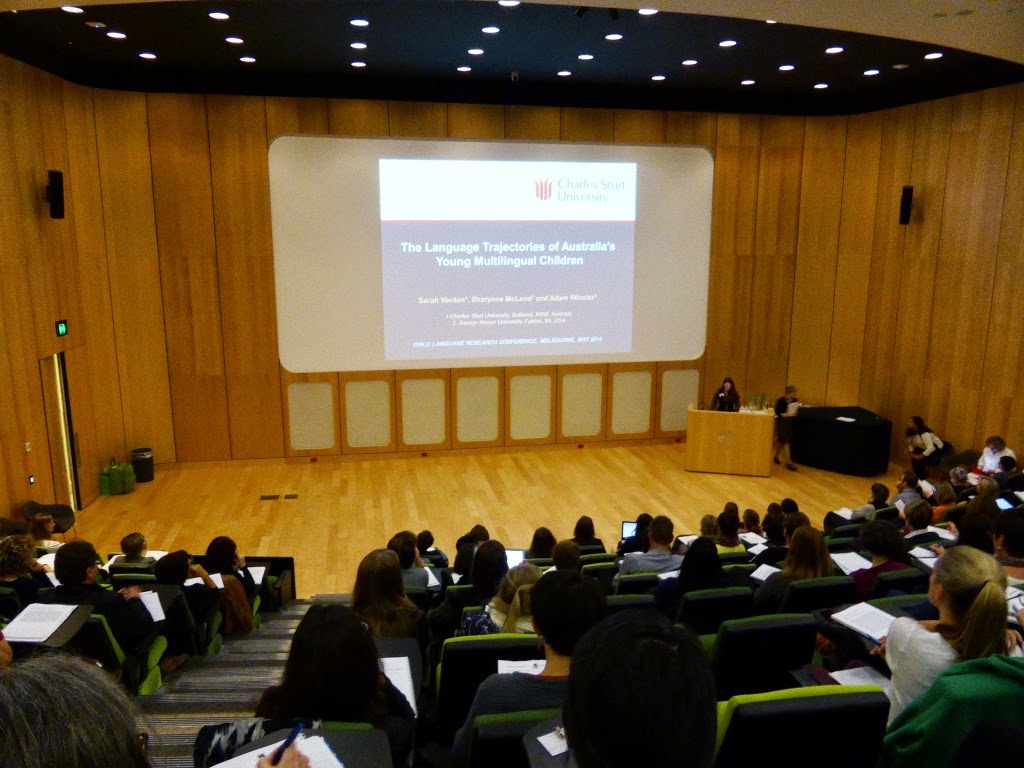
The language trajectories of Australia’s young multilingual children

The Murdoch Childrens Research Centre in Melbourne hosted a 2-day Child Language Research Conference titled Discoveries and New Directions. Sue Roulstone, James Law, and Cate Taylor were invited speakers and Sarah Verdon, my PhD student presented the following paper based on data from the Longitudinal Study of Australian Children:
Verdon, S., & McLeod, S. The language trajectories of Australia’s young multilingual children.
Thursday concluded with a fun debate to discuss whether "specific" should remain in specific language disorders.
Sarah Verdon presenting her paper
Suzanne Hopf, James Law, and Sarah Verdon

April 15, 2014

Linguistic diversity among Australian children in the first five years of life

The following manuscript was accepted for publication yesterday:
Verdon, S., McLeod, S., & Winsler, A. (2014, in press April). Linguistic diversity among Australian children in the first five years of life. Speech, Language, and Hearing. 

The manuscript forms part of Sarah Verdon's PhD. Here is the abstract:
Like many English-dominant nations, Australia has a rich history of cultural and linguistic diversity. This diversity is the result of a melting pot of languages including languages spoken by Australia’s Indigenous people and languages added by European settlement and subsequent waves of migration from various parts of the world. Despite this rich history of linguistic diversity, little has been documented on the languages spoken by Australian children. The first three waves of data from 5,107 children in the nationally representative Longitudinal Study of Australian Children (LSAC) were analyzed to consider language diversity among Australian children in the first 5 years of life. Data were collected from birth at two-year intervals. At 0 to 1 years of age, 10.8% of children were reported to have a language other than English used as the main language in their home. When children were 2- to 3-years-old, 16.7% were spoken to and/or used a language other than English, and 15.3% were spoken to and/or used a language other than English at 4 to 5 years of age. The most common languages spoken by Australian children at age 4 to 5 years after English were Arabic, Italian, Greek, Spanish, and Vietnamese. Personal and environmental factors significantly associated with use of a language other than English at 4 to 5 years were parental use of a language other than English, and being a first- or second-generation migrant.