Showing posts with label SOE. Show all posts

June 10, 2025

Presentation - School-Based Play Beyond Early Childhood: Status Quo or Time to Overthrow?

Today we enjoyed a joint School of Education Research Working Group and Children’s Voices Centre presentation by Associate Professor Brendon Hyndman:
 
School-Based Play Beyond Early Childhood: Status Quo or Time to Overthrow?

A provocation is a series of questions or statements that stimulate a reaction, response or deeper thought. Provocations may challenge existing beliefs, challenge understanding, inspire new ideas and be a catalyst for change or review of existing practices. 
In this provocation presentation, A/Prof. Brendon Hyndman will encourage us to think about the concept of play design and its role in both Australian primary and secondary schools. The presentation is to challenge conventional ideas and norms related to the consideration of play ‘outside of early childhood contexts’ and emerging research to provoke thought and inspire new educational perspectives. 
The presentation can help form reconsiderations of the boundaries of play beyond early childhood, as a vital component of young people’s personal and collective growth, well-being, and creativity.


October 15, 2024

Farewell to Dr Graham Daniel

This morning we had a farewell to Dr Graham Daniel. He was my office next-door-neighbour for 20 years. Over this time I was his PhD supervisor, colleague, and research collaborator. We co-supervised honours and PhD students and wrote research together. He was the Associate Head of School. His contributions will be missed but his legacy will continue. Thanks Graham.


Here are some of our joint publications:
  • Barr, J., McLeod, S., & Daniel, G. (2008). Siblings of children with speech impairment: Cavalry on the hill. Language, Speech, and Hearing Service in Schools, 39(1), 21–32. https://doi.org/10.1044/0161-1461(2008/003)
  • Daniel, G., & McLeod, S. (2011). ‘I can’t say words much’: Listening to school-aged children’s experiences of speech impairment. In S. Roulstone & S. McLeod (Eds.), Listening to children and young people with speech, language and communication needs. (pp. 195–202). J&R Press. http://www.jr-press.co.uk/communication-needs.html
  • McLeod, S., Daniel, G., & Barr, J. (2013). “When he's around his brothers … he's not so quiet”: The private and public worlds of school-aged children with speech sound disorder. Journal of Communication Disorders, 46(1), 70–83. https://doi.org/10.1016/j.jcomdis.2012.08.006
  •  Daniel, G. R., & McLeod, S. (2017). Children with speech sound disorders at school: Challenges for children, parents and teachers. Australian Journal of Teacher Education, 42(2), 81–101. https://doi.org/10.14221/ajte.2017v42n2.6

October 1, 2024

Navigating the Scholarly Forest: Crafting a 5-year research plan

This afternoon I attended the School of Education Research Workshop, by Dr Leanne Gibbs titled:
"Navigating the Scholarly Forest: Crafting a 5-year research plan"

Do you love dreaming up great research projects but feel like you’re wandering through the scholarly forest without a map? Join this interactive session and find your direction! We’ll explore a structured approach to crafting a 5-year research plan where you’ll map out your aims, methodology, ethics applications, outputs, and impact, all while weaving the golden thread of research through your work to ensure coherence and purpose. This approach might not be for everyone, but who can resist a few tips?


June 3, 2024

Congratulations Dr Belinda Downey on your graduation

 Last week Dr Belinda Downey graduated with her PhD in Bathurswhile I was in Perth at the Speech Pathology Australia National Conference. I celebrated with her before I left for my 7-week trip - and was so pleased to see the photos and congratulate her this week on my return.

DVC-A Gavin Brown and Dr Belinda Downey

Dr Kelly Tribolet, Dr Andi Salamon, Dr Belinda Downey, Dr Doreen Rorrison, Dr Shukla Sikder

Belinda's PhD was titled: Staying in the Early Childhood Education and Care Profession: Struggle, Hope and Connection

Her supervisors were: A/Prof Will Letts, Prof Sharynne McLeod, Dr Tamara Cumming, Dr Leanne Gibbs and Dr Doreen Rorrison.

Abstract:

Retention of early childhood educators (ECEs) has become a ‘wicked problem’ with estimates that more than 39,000 ECEs are currently required to meet workforce demands and projections that an additional 24,000 ECEs may be needed by 2025. Attrition or turnover of ECEs can negatively affect the relationships held with children and families, the quality of care and education and the educators’ workload. Wages and working conditions have been identified as one concern, but additional complex issues affecting retention, include professional recognition, administrative and regulatory burden and the intensity of the ECE role as well as compounding effects from these issues on those ECEs’ who remain. Retention in ECEC, specifically focused on the Northern Territory of Australia, provides a unique perspective regarding complex issues affecting retention in the ECEC sector. Therefore, this research investigates factors that enable or constrain ECEs’ retention in the Northern Territory.
The 34 participants were recruited through purposive random sampling across the ‘top end’ of the Northern Territory in Australia. Yarning sessions (cf. focus groups) were undertaken that discussed the ECEC profession, national sector reforms and retention. A constructivist grounded theory approach was used, and constant comparative analysis of the data was undertaken. This process led to the generation of a substantiative grounded theory to explain attrition and retention in the ECEC field, building connection builds retention. The relationships that educators built with the children, families, colleagues, their wider professional networks and their profession were identified as supporting retention.
The research findings generated one core category that was central to the data, adjusting practices and accommodating values, and two properties, struggle and hope. A basic social process of attrition and retention was identified that formed a three-stage process that became the basis of this thesis. In the first stage (becoming a professional), second stage (belonging in an organisation) and third stage (engaging with policy and legislation), participants either found hope in the connections developed and were retained, or they struggled to build connections through these stages, which led to turnover or attrition. The findings identified that ECEC retention could be supported when becoming a professional through the development of trusted, collaborative relationships, practice-level mentors and scaffolded examples of documentation and assessment. Similarly, belonging in an organisation was fostered through leadership that encouraged and supported inclusive practices and values-based approaches through robust conversations that encouraged professional autonomy and agency. Participants who engaged with the policy and legislation found that their understanding of practice and the terminology provided in the policies assisted participants’ ability to articulate and advocate for their profession.
The factors that increased ECEs’ retention was enabled through the connections these ECEs developed, which increased their motivation to ensure high-quality care and education and the probability of their retention. These findings supported the substantive grounded theory that building connection builds retention, which provides a possible solution moving into the future of the ECEC field’s ‘wicked problem’ of retention.


June 19, 2023

"The Sustainable Development Goals, Communication and You" - presentation at CSU

The Sustainable Development Goals, Communication and You 

Professor Sharynne McLeod, School of Education 

19 June 2023 1-2pm

The United Nations’ Sustainable Development Goals (SDGs https://sdgs.un.org/goals) “provides a shared blueprint for peace and prosperity for people and the planet, now and into the future” (UN, 2015). Each of the 17 SDGs impacts the world’s citizens and the United Nations encourages strong commitment by all stakeholders, to achieve these goals. Communication is central to the accomplishment of the SDGs and requires action from communication professionals, researchers, people with communication disability, their families and communities. This presentation will address the role of communication across the 17 SDGs by summarizing 36 papers published in a 2023 special issue of International Journal of Speech-Language Pathology (open access - https://www.tandfonline.com/toc/iasl20/25/1). The 36 papers were written by authors who work in Australia, Austria, Benin, Cambodia, Cameroon, Canada, China, Columbia, Denmark, Egypt, Ethiopia, Ghana, Greece, Iceland, India, Iraq, Ireland, Italy, Jordan, Kenya, Lebanon, Maldives, Mozambique, Nepal, New Zealand, Nigeria, State of Palestine, Peru, Philippines, Rwanda, Serbia, South Africa, Uganda, UK, USA, Vietnam. Innovations by communication professionals and researchers have focussed on poverty, hunger, health, education, work, innovation, climate, cities, land, oceans, justice, and partnerships. This research supports the international call for SDG 18: Communication for All. Communication for all is essential for the achievement of the SDGs and everyone has a role.
Professor Sue Green gave this insightful feedback

May 1, 2023

Morning tea for School of Education colleagues

This morning I organised a morning tea to say thank you and farewell to School of Education colleagues: Greg Auhl, Donna Bateup and Lana McCarthy. It was lovely to celebrate their contributions and to spend time with colleagues.


April 18, 2023

Vice Chancellor's visit with School of Education staff

Today CSU's Vice Chancellor Renée Leon met with School of Education staff on the Bathurst campus. She spoke about our key goals

  • Student success
  • Student experience/satisfaction
  • Research income/quality
  • Stakeholder satisfaction
  • Staff engagment

We appreciated her time to discuss issues with us.

October 17, 2022

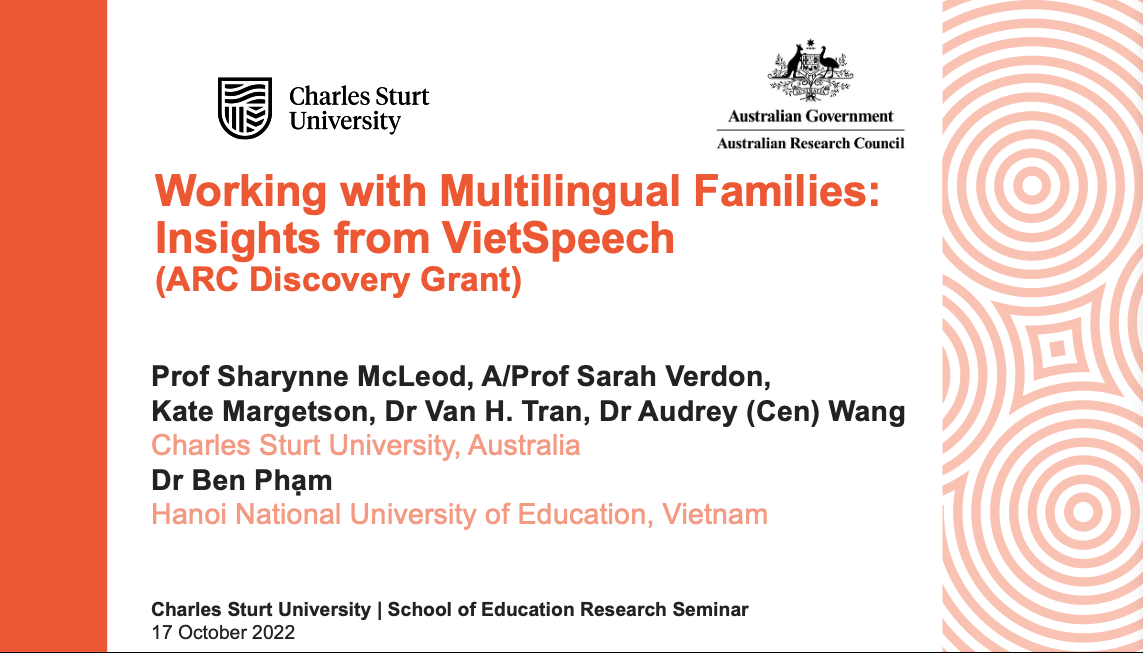
CSU School of Education Research Seminar: Working with Multilingual Families

Today our VietSpeech team presented the CSU School of Education Research Seminar. Our title was: “Working with Multilingual Families: Insights from VietSpeech (ARC Discovery Grant)” Presenters: Professor Sharynne McLeod, A/Prof Sarah Verdon, Kate Margetson, Dr Van Tran and supported by Dr Audrey Wang and Dr Ben Pham.

Here is the recording of our presentation:https://charlessturt.zoom.us/rec/share/e5QhLac3mruLQjUz26YXWt1UmXcQOqwhhnOlG2-udO0BWzaqUBOg9geiplnMlRMj.iBwuo8tqd2Pu3MnN  

More information about the project can be found here: https://www.csu.edu.au/research/vietspeech/overview

Thanks Dr Kate Smithers and Dr Andi Salamon for organising this session.

August 29, 2022

Participatory approaches to ethical (infant) research and pedagogy

Today I attended a fascinating presentation in the School of Education Research Seminar titled "Intentional research: Participatory approaches to ethical (infant) research and pedagogy" by Dr Andi Salamon. 

Abstract: Participatory research approaches aim to break down distinctions between researchers and those being ‘researched’. Such approaches have been critiqued in relation to very young children with the suggestion that the participation of children under three in research (and often pedagogical practice) is an illusion (Palaiologou, 2014). It is argued, however, that possibilities exist to consider infant research participants in ethically symmetrical ways to adult participants, and by not doing so we can ‘other’ very young children (Salamon, 2015). Such seemingly conflicting perspectives highlight the inherent challenges of including people with the least power as research participants. This week’s SoE Research Seminar presents the innovative methodological shifts of a research project that documented and deconstructed infants’ evocative emotional communication. Framed through a theory of practice architectures lens the project afforded babies opportunities to participate, enabled by methodological choices, critical reflection on the ‘happening-ness’ of practices and considered as ‘intentional research’. The presentation aligns this approach with intentional teaching pedagogy in Australian early childhood education contexts, and discusses implications for high quality practices in pedagogy with infants, in qualitative research and in any educational system more broadly.


June 22, 2022

2022 is a challenging year for so many people

Today I attended the School of Education School Board meeting. Here is a sentence from the agenda documents:

We have received an enormous number of requests for ... assessment extensions as well as approved withdrawals this session. In addition to COVID health issues, mental health, financial and personal circumstances have been strong reasons for these student applications.

In Australia, 2022 has been a challenging year, including that we have the highest numbers of COVID cases in the world (since we were in lockdown when other countries experienced this in 2020 and 2021). In previous years when someone had difficulties, others were available to step up and support. This year, many people have things going on, so there are fewer people who can step up to enable life to keep going.

March 10, 2022

Welcoming new staff and mentoring for 2022

I love my role as a formal and informal mentor across my faculty, university, and the world. Over the past few months I have had the opportunity to welcome new staff to the School of Education and to Charles Sturt University and to discuss their research. Today I had a lovely coffee chat with Leanne Gibbs and Kate Smithers who have joined our school this year. Yesterday I had the opportunity to provide advice to Karen Sinclair from the CSU Research Office regarding how to capture research mentoring.

Welcome to CSU Leanne and Kate!

October 14, 2021

School of Education virtual morning tea

Thanks to Tamara Cumming the School of Education had another lovely catchup via Zoom