Showing posts with label Fulbright. Show all posts

September 6, 2023

Fulbright application conversations

I have had a number of wonderful conversations with Dr Chelsea Sommer about her Fulbright Scholarship application to come to visit our team at Charles Sturt University. She is an amazing scholar with expertise in Spanish and children with cleft palate. Her project fits so well into our multilingual children's speech research. I hope her application is successful. We really want her to visit!

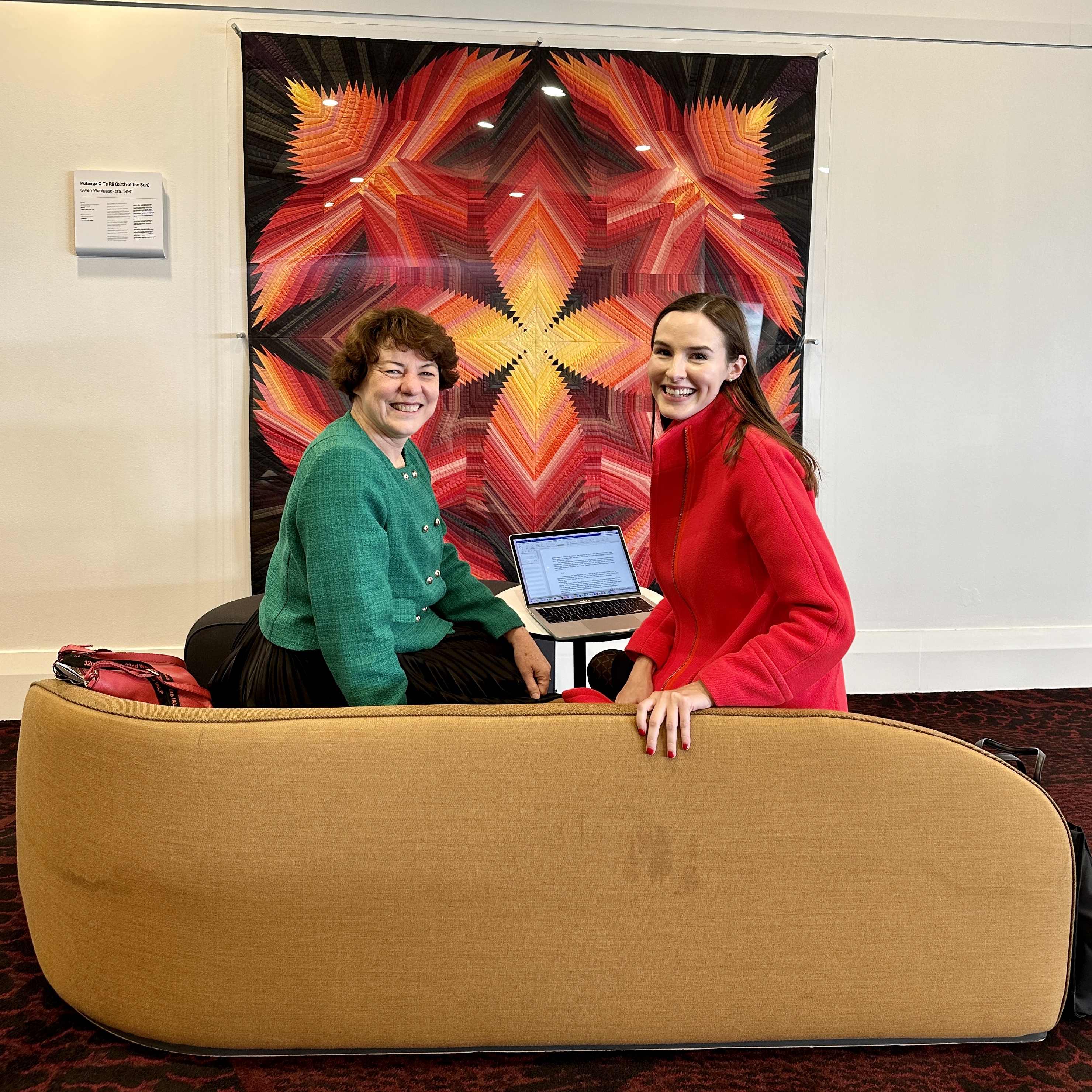
Sharynne and Chelsea in NZ at the IALP congress in August 2023

Sharynne and Chelsea in US and Australia on Zoom

UPDATE - 15th September - APPLICATION SUBMITTED! 

Best wishes Chelsea - we really want you to come to CSU as a Fulbright Future Postdoctoral Scholar (funded by The Kinghorn Foundation) in 2025


May 25, 2018

CSU promotes the conclusion of Dr Kate Crowe's Fulbright Scholarship

Today, Charles Sturt University media have released a statement celebrating the end of Dr Kate Crowe's Fulbright Scholarship. The statement is here. Congratulations Kate.

August 23, 2017

Achievement, language, and technology use among college-bound deaf learners

Today Kate Crowe's first publication from her Fulbright Postdoctoral Scholarship was published online. Congratulations Kate!

Crowe, K., Marschark, M., Dammeyer, J., & Lehane, C. (in press). Achievement, language, and technology use among college-bound deaf learners. Journal of Deaf Studies and Deaf Education. doi:10.1093/deafed/enx029 
Here is the abstract:
Deaf learners are a highly heterogeneous group who demonstrate varied levels of academic achievement and attainment. Most prior research involving this population has focused on factors facilitating academic success in young deaf children, with less attention paid to older learners. Recent studies, however, have suggested that while factors such as early cochlear implantation and early sign language fluency are positively associated with academic achievement in younger deaf children, they no longer predict achievement once children reach high school age. This study, involving data from 980 college-bound high school students with hearing loss, examined relations between academic achievement, communication variables (audiological, language), and use of assistive technologies (e.g., cochlear implants [CIs], FM systems) and other support services (e.g., interpreting, real-time text) in the classroom. Spoken language skills were positively related to achievement in some domains, while better sign language skills were related to poorer achievement in others. Among these college-bound students, use of CIs and academic support services in high school accounted for little variability in their college entrance examination scores. 

July 5, 2017

Fulbright Fellowship Lecture at CSU by Dr Kate Crowe

Dr Kate Crowe has just returned from the US following her Fulbright Fellowship. She has been a PhD student, postdoctoral scholar, and sessional lecturer at Charles Sturt University (CSU) over a number of years.

Today Kate presented a lecture to CSU titled:
Why potatoes aren’t vegetables: Things I’ve learnt from my Fulbright Fellowship 
Participants attended in person in Bathurst, and via video conference from Albury, Shepparton, Newcastle, Blue Mountains, and other parts of the state.

Head of School Carol Burgess presenting Dr Kate Crowe with
a gift from CSU to congratulate her on her Fulbright Fellowship
Here is the abstract of her presentation
Dr Kate Crowe left Charles Sturt University in August 2016 to become a Fulbright Postdoctoral Scholar at the National Technical Institute for the Deaf, Rochester Institute of Technology (NY). The Fulbright program is the flagship international educational exchange program of the U.S. government and is designed to increase mutual understanding between the people of the United States and the people of other countries. After spending nearly a year immersed in U.S. culture, Kate has returned to share her experiences of life and research. In this talk she will describe the research she has conducted to better understand how students with hearing loss process language and how the Fulbright program encourages collaborative research and understanding. She will also share stories about creating cultural bridges, and what happens when these bridges don’t quite meet in the middle. For example, why a potato may not be a vegetable (and how this confuses your research results)? What happens to squirrels in winter? What exactly is a cheesehead?
Kate is an Adjunct Research Fellow at Charles Sturt University (Australia) and a member of the International Expert Panel on Multilingual Children’s Speech. Kate has worked as a speech pathologist, academic, and researcher in a range of early childhood, school, and tertiary settings. Her research and clinical interests include communication choice and development for children with hearing loss, particularly children who use sign, live in multilingual environments, and/or have complex communication needs. Kate currently works with college-aged students who are deaf and is exploring linguistic and cognitive factors which inform how we teach deaf learners.
June 5, 2017

Kate Crowe's Fulbright Postdoctoral Scholar Program has finished

Last week Kate Crowe finished her Fulbright Postdoctoral Scholar Program working with Professor Marc Marschark at the Rochester Institute of Technology (RIT).
Here are the details about her Fulbright Program: https://www.fulbright.com.au/alumni/profiles/2016-alumni/
Kate's Fulbright blog is here: http://katesfubrightlife.blogspot.com
Prof Marc Marschark and Dr Kate Crowe at Rochester Institute of Technology
At the conclusion of her Fulbright she wrote:
I wasn’t sure where my Fulbright journey would take me, but at the outset I imagined that it would end at a tangible destination. A list of submitted journal papers. Conference papers to present. Future research projects in preparation. A checklist of tasks to indicate a successful scholarship. However, as I check the final items off the list, I am overwhelmed by a feeling that these tangible outcomes are not the destination that I thought they were. As Henry Miller said, “one’s destination is never a place, but a new way of looking at things”. That is where my Fulbright journey has taken me. To a world that is bigger and brighter, more challenging and more rewarding than I knew. A world full of new friends, new ideas, and of exciting possibilities that I will be exploring for the rest of my life.  
During her Fulbright program she:
  • collected data for five studies examining: 1. Semantic fluency skills of students who were Deaf or Hard-of-Hearing (DHH), hearing, and users of English and/or American Sign Language. 2. Students’ perceptions of word typicality related to category membership. 3. Students’ categorization skills and their cognitive flexibility in re-categorizing words. 4. The speech intelligibility of DHH college students. 5. The sign intelligibility of American Sign Language users
  • engaged with university research staff in project planning, data collection, analysis, and dissemination for other research projects, some involving international collaboration
  • attended American Sign Language 1 and 2 subjects (non-credit subjects)
  • attended the Fulbright Enrichment seminar hosted in San Diego
  • gave presentations at the American Speech-Language-Hearing association conference (Philadelphia), and keynote presentations at the Teaching Deaf Learners conference (Amsterdam) and the European Cochlear Implant Users association symposium (Helsinki).
Congratulations Kate - we are really proud of your achievements - and the fact that RIT has invited you back for next year.
Kate, Prof Marc Marschark and the RIT team

April 30, 2017

Hei! 你好! !مرحبا: Language acquisition in a multilingual world

Last week Kate Crowe was a keynote speaker at the European Cochlear Implant Users Symposium in Helsinki. Details of the conference are here: http://www.euro-ciu2017.fi/en/
The title of her presentation was: Hei! 你好! !مرحبا: Language acquisition in a multilingual world
The link to her presentation is: here
Here is the abstract:
The growing diversity of D/deaf and hard-of-hearing (DHH) learners creates challenges for educators and clinicians. With close to 8,000 language spoken in the world and increasing levels of mobility, the linguistic diversity of DHH learners accessing education and therapy services has never been greater. This presentation will describe parental and professional perspectives on choices about communication mode and language use for DHH children. Current perspectives on multilingualism, focusing on spoken language multilingualism, will be described and related to DHH learners and their families, and the educators and clinicians who work with them. The available research describing the speech and language outcomes for DHH children living and learning in multilingual environments will also be summarized. The need for interdisciplinary collaboration for supporting, assessing, and monitoring the speech and language development of DHH multilingual learners will be discussed.
Papers were presented in either spoken Finnish, spoken English or Finnish Sign Language (there was also a short presentation in spoken Spanish). There was simultaneous interpreting into spoken Finnish, spoken English, Finnish Sign Language, with captioning in written Finnish and English!
Kate presenting her keynote speech
 Kate also met up with Sari Kunnari and Taina Välimaa at the University of Oulu.
Taina Välimaa, Sari Kunnari and Kate Crowe

March 25, 2017

Kate's invited presentation in Amsterdam

This week Kate Crowe was a keynote speaker at the tri-annual International Conference on Teaching Deaf Learners conference in Amsterdam, The Netherlands.
http://www.kentalis.nl/Teaching-Deaf-Learners
Her presentation was titled: DHH multilingual learners: Language acquisition in a multilingual world. Here is the abstract
Multilingual Deaf and Hard-of-Hearing (DHH) learners are a group who are both incredibly diverse and under-represented in the literature. However, DHH learners who are acquiring two or more spoken languages, with or without the co-acquisition of signed language/s, are increasingly present in education and therapy services. When working with these learners and their families it is important to consider the differing perspectives of families and professionals on language choices and family language policy and evidence of the advantages and disadvantages of multilingualism in both typically hearing and DHH learners. The majority of evidence currently available describing DHH learners from spoken language multilingual environments suggests that there are no clear advantages of disadvantages of multilingualism on learners’ speech and language outcomes.
Her invited presentation was captioned in real time, and relayed by three sign language interpreters. Congratulations Kate! We were cheering for you from Australia.


December 3, 2016

Kate Crowe's Fulbright adventures

Kate Crowe has been updating her blog: http://katesfubrightlife.blogspot.com.au/
with all of her Fulbright adventures. It is a good read!

November 15, 2016

Meeting with Kate Crowe in Philadelphia

Over the past 2 days Kate Crowe and I have enjoyed each others' company in Philadelphia. Kate lives in the US while she is on her Fulbright Postdoctoral Scholarship and I am visiting her prior to the American Speech-Language-Hearing Association Convention. We have worked together on revisions to a paper titled "A cross-linguistic review of consonant acquisition across 27 languages", discussed data from pilot projects she is undertaking in order to write a new grant next year, and visited some of Philadelphia's famous landmarks.
Kate and Sharynne at the famous LOVE statue in Philadelphia
Sharynne and Kate at the Liberty Bell
Sharynne and Kate working on the 29th floor looking at William Penn's statue on top of City Hall
Squirrels are exciting for people who live in Australia!

September 16, 2016

Kate Crowe's Fulbright Blog

Kate Crowe has created her own blog to document her Fulbright Postdoctoral Scholarship adventures: http://katesfubrightlife.blogspot.com
Here is a video about Rochester (click on the CC button for captions if you don't use American Sign Language fluently) https://www.youtube.com/watch?v=aQztxAqcVYs

August 31, 2016

Kate begins her Fulbright Scholar program in the US

This week Kate Crowe began her Fulbright Postdoctoral Scholar Program working with Professor Marc Marschark at the Rochester Institute of Technology (RIT) in Rochester, NY. She is excited about the opportunity to combine her two passions: research with people with hearing loss and iceskating!
Kate with the RIT tiger
One of the on-campus ice skating rinks


August 19, 2016

RIPPLE Effect Winter 2016 edition

The RIPPLE Effect profiles the work of researchers and PhD students within the Research Institute for Professional Practice Learning and Education. The Winter 2016 edition profiles the work of our team:
  • Kate Crowe - Fulbright Scholar and postdoctoral scholar
  • Anna Cronin - Churchill Scholar and commencing PhD student
  • Children's Speech - new book published by Pearson (USA)
Read the stories here:
http://www.csu.edu.au/research/ripple/news (scroll down to ‘Newsletter’ to view the edition either as a magazine or PDF).

July 13, 2016

Kate's Bathurst farewell

Kate Crowe will head to the US for her Fulbright postdoctoral scholarship in less than a month. She visited Bathurst this week to say farewell. She began her visit skating at the Bathurst winter festival (here), she had lunch with some of her Bathurst friends, and finished her visit by submitting a paper that we have been working on for a number of years that summarizes children's consonant acquisition across 27 languages. While in Bathurst, Kate has been profiled in the CSU Thrive Alumni magazine here. Thanks for coming to Bathurst Kate - and best wishes for your adventures in the US.
Sharynne, Kate and Jess on the ice
Kate Crowe, Audrey Wang, Grear McAdam, Linda Harrison, Ben Pham, and Minh
Hundreds of kangaroos came out to say goodbye...
...including this mother and joey

April 11, 2016

Fulbright Senior Scholar's visit to CSU

Over the past few days we have been honoured to have Professor David Lee, Fulbright Senior Scholar, and his wife Heidi visiting Charles Sturt University. His visit was supported by the School of Teacher Education and the Research Institute for Professional Practice, Learning and Education (RIPPLE). Professor Lee is a member of the faculty of the University of Miami and his Fulbright Scholarship is to The University of Sydney during 2016. 

While at CSU, Professor Lee presented a public lecture titled: Mindfulness: What is all the Fuss About? OR Medical and Public Health Applications of Mindfulness Practices. The lecture was simultaneously broadcasted to 4+ cities in Australia and Fiji. He also presented a session for people interested in applying for the Fulbright scheme, and met with Vice Chancellor Andy Vann.
Professor Lee and members of his public lecture audience
 Here are more details about his work:

Dr. Lee is a tenured Professor in the Department of Public Health Sciences within the Miller School of Medicine. Currently, he is the Project Director of the Florida Cancer Data System Cancer Registry, the Co-Founder and Leader of the University of Miami Mind-Body Medical Workgroup (http://www.umindbody.org), and the Director of the Department of Public Health Sciences Graduate Programs.  Dr. Lee is also a member of the National Deafness and Other Communication Disorders Advisory Council at National Institutes of Health.  He has published book chapters and monographs, over 200 peer reviewed journal articles as well as other works and abstracts.  Dr. Lee has been involved in the mentoring of students including service on 25 dissertation committees Additionally, students are active members of his research teams contributing to the 50+ student-led publications in leading biomedical journals including the American Journal of Public Health, Preventive Medicine, Cancer, Circulation, Diabetes Care, and the American Journal of Ophthalmology. He is a chronic disease and occupational epidemiologist and has been continuously funded as Principal Investigator on various grants from the National Institutes of Health and the Centers for Disease Control and Prevention since 1993. Dr. Lee’s current research interests include: public health applications of mindfulness practices (e.g., yoga, meditation) for the prevention and management of chronic disease, enhancing the health of the US workforce, population approaches toward the reduction of eye disease, and cancer surveillance and prevention.

February 26, 2016

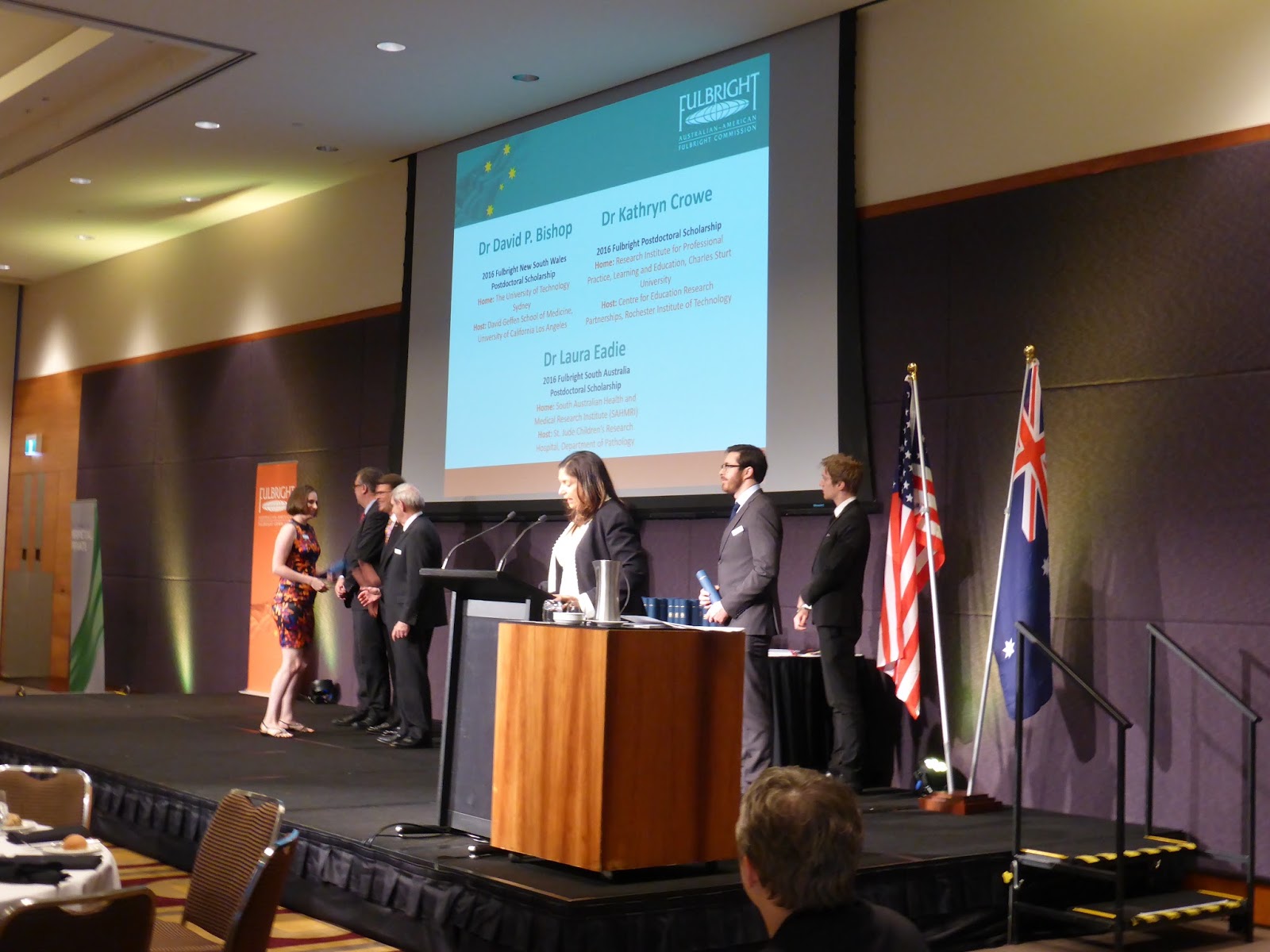
Australian-American Fulbright Commission Scholar Showcase and Presentation Dinner

Last night the Australian-American Fulbright Commission Scholar Showcase and Presentation Dinner was held in Melbourne. Dr Kate Crowe was presented as one of the 46 2016 Fulbright Australian Scholars by His Excellency John Berry, Ambassador of the USA to Australia and Professor Don DeBats, Chair of the Australian-American Fulbright Commission Board. Charles Sturt University was a silver sponsor of the evening, and was represented by Vice Chancellor Andy Vann, Deputy Vice Chancellor (Research, Development and Industry) Mary Kelly. Kate's family and friends were also in attendance to celebrate her accomplishment. More details are here and a video is here.


2016 Fulbright Postdoctoral Scholars with His Excellency John Berry,
the Ambassador of the USA to Australia and Professor Don DeBats

Kate with VC Andy Vann, DVC Mary Kelly, her family and friends

February 8, 2016

Fulbright Postgraduate Scholarship awarded to Kate Crowe

Kate Crowe has been awarded a prestigious  Fulbright Postgraduate Scholarship to study in the US with Professor Marc Marschark at Rochester Institute of Technology. Her project is titled Semantic network structure and use in Deaf and Hard of Hearing learners. Here is the Fulbright announcement and the CSU news release is here and Speech Pathology Australia's tweet is here. She is one of two Fulbright Postdoctoral Scholarship awardees (the four others received state awards).
Here is the abstract:
The purpose of this project is to investigate Deaf and Hard of Hearing (DHH) learners’ semantic networks to improve the effectiveness of approaches to language and literacy learning. The overarching goal of the proposed research is to extend knowledge of semantic networks in DHH learners through three related studies to be undertaken at Rochester Institute of Technology. Specifically, the aims of this project are to (1) examine the within-category structure of semantic networks of DHH learners, (2) understand facilitators and barriers to DHH learners’ access to their semantic networks, and (3) observe the impact of instruction on DHH learners’ use of semantic networks.
Congratulations Kate!