Showing posts with label journals. Show all posts

December 8, 2021

Scholarly journal publishing in Australia by Dr Hamid R. Jamali

Today I went to a really interesting presentation titled "Scholarly journal publishing in Australia" by Dr Hamid R. Jamali from Charles Sturt University. 

Abstract. Australia currently has 600+ peer-reviewed scholarly journals, some of which started a century ago. Most of these journals belong to or are affiliated with universities or non-profit organisations (e.g. learned societies). As journal publishing has increasingly become challenging due to a competitive market and various business models, some of these journals face uncertain futures. In the last decade alone 150+ Australian journals ceased publication. This presentation reports the findings of two recent studies on journal publishing in Australia and looks at the distribution of journals by owner, publisher, Field of Research, and publishing model. The presentation also reports the findings of a survey of discontinued journals on what circumstances resulted in the discontinuation of journals. The session will be an opportunity to discuss the value of having local/national journals and the role they play in research. 

Biography. Dr Hamid R. Jamali is an Associate Professor in the School of Information and Communication Studies at Charles Sturt University. He received his PhD in Information Science from University College London in 2008, and before joining CSU he worked as an Associate Professor at Kharazmi University in Iran. Hamid’s current research interests broadly cover the area of scholarly communication which includes reading, citing and publishing behaviour, journal publishing, open access, and research evaluation. He has been involved in multiple international projects including two recent projects on the scholarly communication of early career researchers.


It seems that my experience as Editor-in-Chief of International Journal of Speech-Language Pathology, published by Speech Pathology Australia has been uncommon, with many Australian journals closing rather than internationalising while retaining their Australian influence and reach. I was the editor when we changed the name. Here is the publication history: https://www.tandfonline.com/action/journalInformation?journalCode=iasl20 

  • Currently known as: • International Journal of Speech-Language Pathology (2008 - current) 
  • Formerly known as • Advances in Speech Language Pathology (1999 - 2007) • Australian Journal of Human Communication Disorders (1973 - 1996) • Journal of the Australian College of Speech Therapists (1951 - 1972)

February 8, 2021

First day in the office for 11 months - more zoom meetings with a different background

Today was my first day back in my office since March 2020 due to COVID restrictions (https://staff.csu.edu.au/home/news-and-events/coronavirus-updates).

Despite being oncampus, all of my meetings were still on zoom. I had 5 excellent meetings today - and have provided photos of two.

The second meeting was to farewell Kate Margetson as she goes on maternity leave until 31 August. It was a very helpful handover meeting of all of her tasks to the rest of the VietSpeech team.

In the fourth meeting Dr Nicole McGill, Dr Audrey Wang and I met to discuss requested revisions to a journal article. It was very productive and we should have the revisions finished soon.

Dr Nicole McGill, Sharynne and Dr Audrey Wang

Dr Van Tran, Sharynne, Katherine White, Kate Margetson, Dr Sarah Verdon

April 9, 2020

2019 publications entered by Charles Sturt University

The following chapters, encyclopedia articles and journal articles were included in my 2019 publication outputs for Charles Sturt University. It is great to work with so many productive students and colleagues whose work focuses on the right to communicate (bolded names are people who were CSU staff, students and adjuncts at the time of writing the articles).
  1. Merrick, R., McLeod, S., & Carroll, C. (2019). Innovative methods. In R. Lyons, & L. McAllister (Eds.), Qualitative research in communication disorders: An introductory guide for students and clinicians (pp. 387-405). J and R Press.
  2. McLeod, S., & Masso, S. (2019). Speech sound disorders in children. In J. S. Horst, & J. von Koss Torkildsen (Eds.), International handbook of language acquisition (1st ed., pp. 362-386). Routledge.
  3. Cronin, A., & McLeod, S. (2019). Cleft-lip and palate: Speech effects. In J. S. Damico, & M. J. Ball (Eds.), The SAGE encyclopedia of human communication sciences and disorders (pp. 348-351). Thousand Oaks, CA.: SAGE Publications Ltd. https://doi.org/10.4135/9781483380810.n120
  4. Cronin, A., & McLeod, S. (2019). Craniofacial anomalies. In J. S. Damico, & M. J. Ball (Eds.), The SAGE encyclopedia of human communication sciences and disorders (pp. 515-519). Thousand Oaks, CA.: SAGE Publications Ltd. https://doi.org/10.4135/9781483380810.n169
  5. Blake, H., & McLeod, S. (2019). Intelligibility enhancement. In J. S. Damico, & M. J. Ball (Eds.), The SAGE encyclopedia of human communication sciences and disorders (pp. 926-928). Thousand Oaks, CA.: SAGE Publications Ltd. https://doi.org/10.4135/9781483380810.n310
  6. McLeod, S. (2019). International classification of functioning, disability and health. In J. S. Damico, & M. J. Ball (Eds.), The SAGE encyclopedia of human communication sciences and disorders (pp. 939-942). Thousand Oaks, CA.: SAGE Publications Ltd. https://doi.org/10.4135/9781483380810.n315
  7. McLeod, S., & Verdon, S. (2019). Multilingualism and speech sound disorders. In J. S. Damico, & M. J. Ball (Eds.), The SAGE encyclopedia of human communication sciences and disorders (pp. 1203-1206). Thousand Oaks, CA.: SAGE Publications Ltd. https://doi.org/10.4135/9781483380810.n398
  8. McLeod, S. (2019). Prevalence of communication disorders. In J. S. Damico, & M. J. Ball (Eds.), The SAGE encyclopedia of human communication sciences and disorders (pp. 1461-1464). Thousand Oaks, CA.: SAGE Publications Ltd. https://doi.org/10.4135/9781483380810.n477
  9. Pham, B., & McLeod, S. (2019). Tone languages and communication disorders. In J. S. Damico, & M. J. Ball (Eds.), The SAGE encyclopedia of human communication sciences and disorders (pp. 1977-1980). Thousand Oaks, CA.: SAGE Publications Ltd. https://doi.org/10.4135/9781483380810.n639
  10. McLeod, S., Harrison, L. J., & Wang, C. (2019). A longitudinal population study of literacy and numeracy outcomes for children identified with speech, language, and communication needs in early childhood. Early Childhood Research Quarterly, 47, 507-517. https://doi.org/10.1016/j.ecresq.2018.07.004
  11. McGill, N., & McLeod, S. (2019). Aspirations for a website to support families? active waiting for speech-language pathology. International Journal of Speech-Language Pathology. Advance online publication. https://doi.org/10.1080/17549507.2019.1604802
  12. Hopf, S., McDonagh, S., Wang, C., & McLeod, S. (2019). English language and literacy proficiency of students in an urban Fiji primary school. Language, Culture and Curriculum, 32(2), 223-238. https://doi.org/10.1080/07908318.2018.1541999
  13. Blake, H. L., Verdon, S., & McLeod, S. (2019). Exploring multilingual speakers? perspectives on their intelligibility in English. Speech, Language and Hearing, Advance online publication https://doi.org/10.1080/2050571X.2019.1585681
  14. Blake, H. L., McLeod, S., & Verdon, S. (2020). Intelligibility Enhancement Assessment and Intervention: a single-case experimental design with two multilingual university students. Clinical Linguistics and Phonetics, 34(1-2), 1-20. https://doi.org/10.1080/02699206.2019.1608470
  15. McLeod, S., Verdon, S., Wang, A., & Tran, V. (2019). Language proficiency, use, and maintenance among people with Vietnamese heritage living in Australia. Journal of Monolingual and Bilingual Speech, 1(1), 55-79. https://doi.org/10.1558/jmbs.10973
  16. Crowe, K., Marschark, M., & McLeod, S. (2019). Measuring intelligibility in signed languages. Clinical Linguistics and Phonetics, 33(10-11), 997-1008. https://doi.org/10.1080/02699206.2019.1600169
  17. Howland, C., Baker, E., Munro, N., & McLeod, S. (2019). Realisation of grammatical morphemes by children with phonological impairment. Clinical Linguistics and Phonetics, 33(1-2), 20-41. https://doi.org/10.1080/02699206.2018.1518487
  18. McLeod, S., & Masso, S. (2019). Screening children's speech: The impact of imitated elicitation and word position. Language, Speech, and Hearing Services in Schools, 50(1), 71-82. https://doi.org/10.1044/2018_LSHSS-17-0141
  19. Blake, H. L., & McLeod, S. (2019). Speech-language pathologists' support for multilingual speakers' English intelligibility and participation informed by the ICF. Journal of Communication Disorders, 77, 56-70. https://doi.org/10.1016/j.jcomdis.2018.12.003
  20. Blake, H. L., Bennetts Kneebone, L., & McLeod, S. (2019). The impact of oral English proficiency on humanitarian migrants? experiences of settling in Australia. International Journal of Bilingual Education and Bilingualism, 22(6), 689-705. https://doi.org/10.1080/13670050.2017.1294557
  21. Masso, S., McLeod, S., Cronin, A., & Pham, B. (2019). Transcription of Vietnamese adults' and children's consonants by English-speaking speech-language pathologists. Folia Phoniatrica et Logopaedica. Advance online publication https://doi.org/10.1159/000500245
  22. Pham, B., & McLeod, S. (2019). Vietnamese-speaking children's acquisition of consonants, semivowels, vowels, and tones in northern Viet Nam. Journal of Speech, Language, and Hearing Research, 62(8), 2645-2670. https://doi.org/10.1044/2019_JSLHR-S-17-0405
  23. McCormack, J., McLeod, S., & Crowe, K. (2019). What do children with speech sound disorders think about their talking? Seminars in Speech and Language, 40(2), 94-104. https://doi.org/10.1055/s-0039-1677760

March 14, 2013

Tips on publishing from ECRQ editor

Today the School of Teacher Education research committee invited Professor Adam Winsler, editor of Early Childhood Research Quarterly to present a workshop titled:  "Publishing and reviewing in top-flight peer-reviewed journals: A mentoring workshop for early-career (and seasoned researchers)". The workshop was attended by students and academics who learned a lot of information and strategies for publishing in high quality journals. Here are  Adam's top 10 tips for why quantitative and qualitative papers don't get published in ECRQ (and other journals):
"1. Not enough methodological detail or clarity provided 
2. No clear focused, specific, research questions/goals articulated
3. Literature review doesn’t set up the questions/hypotheses
4. Problems with spelling, grammar, writing, English, and APA style
5. No policy/educational/practice implications given
6. Conclusions don’t follow from the data (could have made the points in the discussion without doing the study)
7. Contribution to the literature unclear
8. Bad fit between research goals and method/design/analysis
9. Poor fit between content of paper and scope of journal
10. Poor data analyses or design" (Winsler, 2013)

November 22, 2012

Disseminating research: Reading, writing, and publishing

The following book chapter has been published:

McLeod, S. (2013). Disseminating research: Reading, writing, and publishing. In N. Müller & M. J. Ball (Eds). Research methods in clinical linguistics and phonetics: A practical guide (pp. 288-309). Chichester: Wiley-Blackwell.

The opening paragraphs read:
The previous chapters have provided guidelines for undertaking research in the field of clinical linguistics and phonetics. Once new knowledge has been generated through research it is important to disseminate findings with others to change understanding and practice. Dissemination of findings can occur within public, professional and academic contexts via the internet, presentations and publications. Ultimately, publishing research in journal articles and books enables the creation of a permanent and accessible record. Longevity of research is typically achieved through such avenues and once work is published, people from across the globe can draw on these findings to create new ideas, understandings and directions. Therefore, researchers should think about the message they wish to convey through their research: “What is your dialogue with the future?”  This chapter outlines how to read and critique research, then how to write for publication in order to disseminate research findings…

One of the tables within the chapter lists English-language journals that publish papers in the field of clinical linguistics and phonetics as well as details about these journals. Here is the list:
1.      American Journal of Speech-Language Pathology
2.      Aphasiology
3.      Applied Psycholinguistics
4.      The ASHA Leader
5.      Asia Pacific Journal of Speech, Language and Hearing
6.      Augmentative and Alternative Communication
7.      Child Language Teaching and Therapy
8.      Clinical Linguistics and Phonetics
9.      Communication Disorders Quarterly
10.  Communication Disorders Review
11.  Contemporary Issues in Communication Science and Disorders
12.  Evidence-Based Communication Assessment and Intervention
13.  Folia Phoniatrica et Logopaedica
14.  International Journal of Language and Communication Disorders
15.  International Journal of Speech-Language Pathology
16.  Journal of Child Language
17.  Journal of Clinical Practice in Speech-Language Pathology
18.  Journal of Communication Disorders
19.  Journal of Interactional Research in Communication Disorders
20.  Journal of the International Phonetic Association
21.  Journal of Linguistics
22.  Journal of Medical Speech-Language Pathology
23.  Journal of Speech, Language, and Hearing Research
24.  Language, Speech, and Hearing Services in Schools
25.  Logopedics Phoniatrics Vocology
26.  New Zealand Journal of Speech-Language Therapy
27.  Seminars in Speech and Language
28.  South African Journal of Communication Disorders, Die Suid-Afrikaanse Tydskrif vir Kommunikasie-afwykings
29.  Topics in Language Disorders
30.  Topics in Stroke Rehabilitation

June 29, 2011

International Journal of Speech-Language Pathology's first ISI impact factor

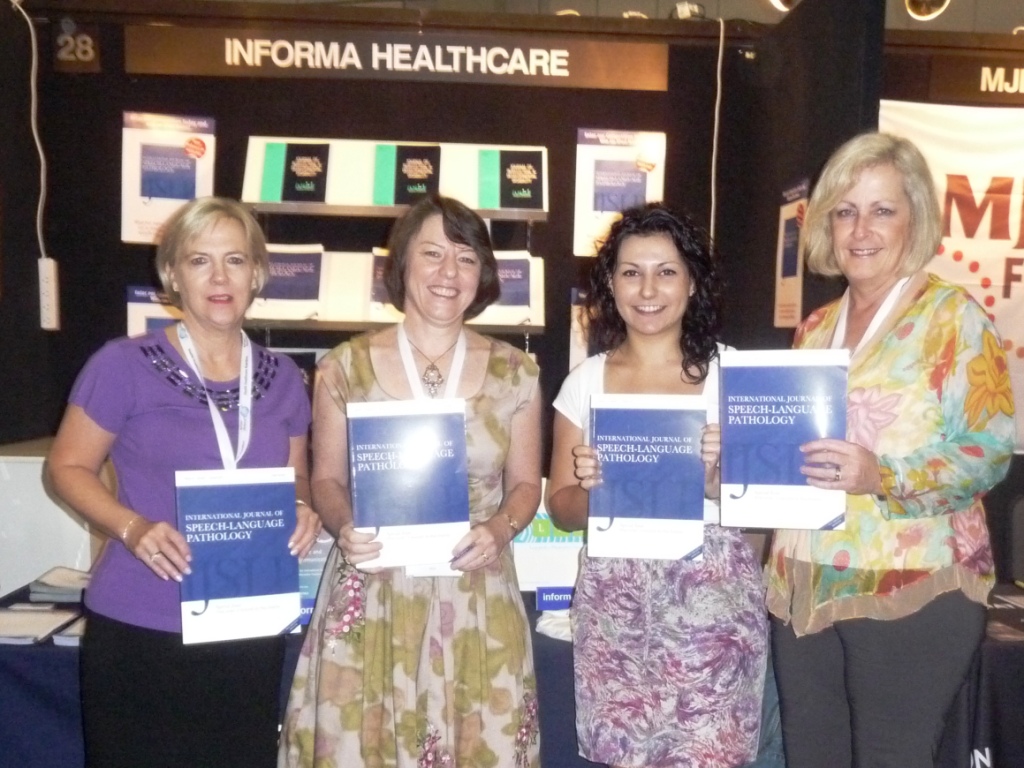
Today the International Journal of Speech-Language Pathology received it's first ISI Web of Knowledge Journal Citation Index impact factor. Our impact factor is 1.12 and it has been ranked 28th (of 62) in the world for all rehabilitation journals.
Speech Pathology Australia, informahealthcare and the editorial board have been working on this for 6+ years, so this ranking is a great achievement.
Thank you to EVERYONE who has supported the journal in so many ways (as authors, readers, citers, reviewers, board members etc).


Professor Fiona Gibbon (Ireland) described how the day progressed as the news was learned by the speech pathology community: "it was like a slow-motion Mexican wave of congratulatory emails as people turned on their computers around the world!"

L-R Prof Deborah Theodoros, Prof Sharynne McLeod (current editor),
Alla Kaploun (informa), Prof Beth Armstrong (previous editor)

October 7, 2010

Perspectives on Global Issues in Communication Sciences and Related Disorders

I have been invited to be an inaugural editorial board member of Perspectives on Global Issues in Communication Sciences and Related Disorders. The American Speech-Language-Hearing Association have created a new special interest division called Global Issues in Communication Sciences and Related Disorders, and this journal is part of the membership benefits after joining the special interest division.
Sharynne and Prof. Dolores Battle

"It is the mission of the Division on Global Issues in Communication Sciences and Related Disorders to provide international leadership related to audiology and speech-language pathology services by promoting research, networking, collaboration, education, and mentoring for its affiliates, students, and other service providers in the global marketplace."