Showing posts with label endorsement. Show all posts

February 6, 2025

Congratulations Sarah B

Congratulations Sarah Bartlett on passing your PhD endorsement requirements. It is exciting that you are able to finalise your ethics application then start data collection. Sarah's PhD title is: "Implications of Caregiver-implemented Intervention for Underserved Communities".

Sarah celebrating with her supervisors - Sharynne  and Carolyn Gregoric


November 7, 2024

Sarah Bartlett's PhD endorsement

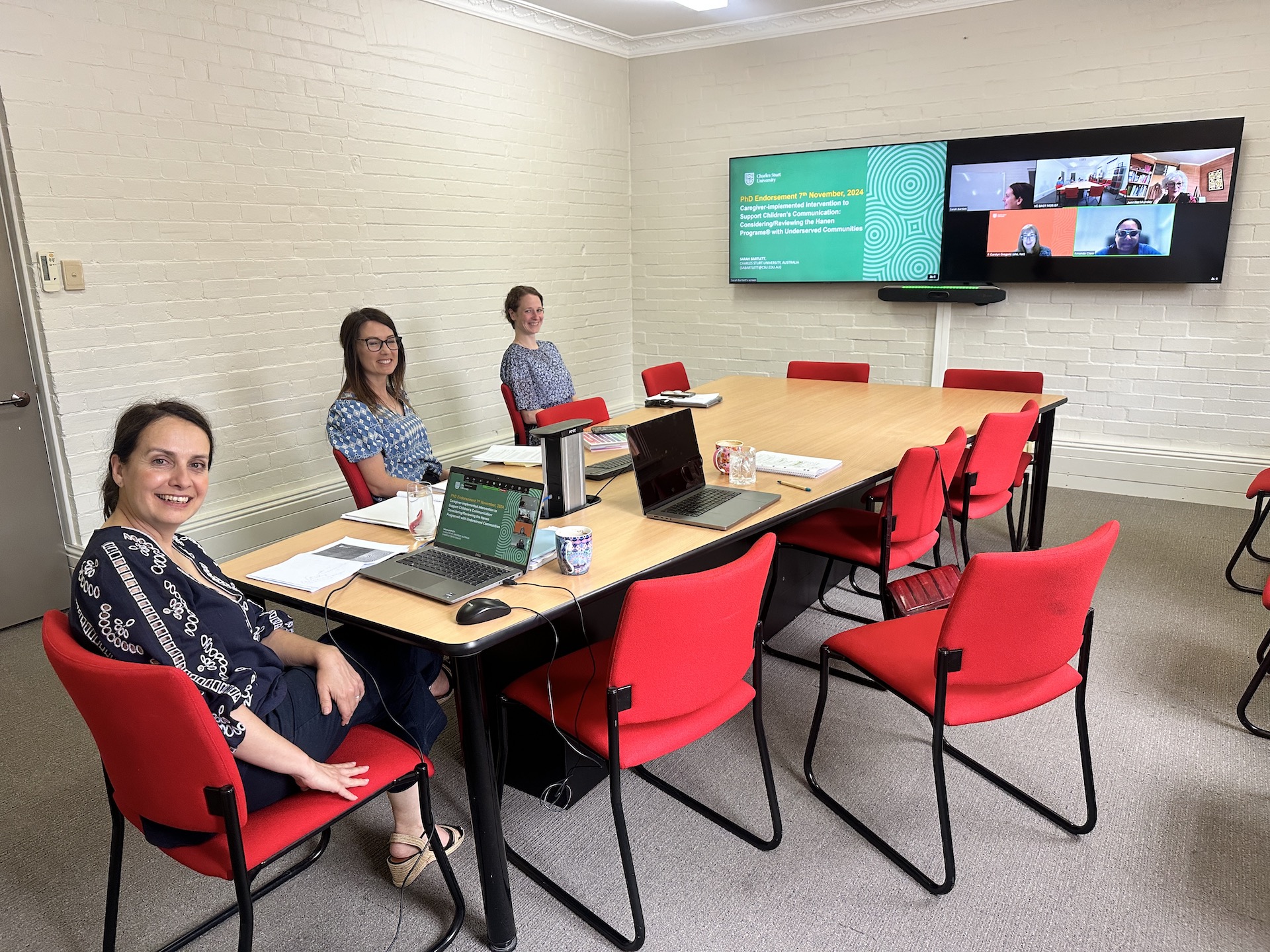
Congratulations to my PhD student Sarah Bartlett who traveled to Bathurst to present her PhD proposal. Her topic is: Caregiver-implemented Intervention to Support Children’s Communication: Considering the Hanen Programs® with Underserved Communities

Sarah presenting her endorsement in Bathurst and online

Prof Sharynne McLeod, Sarah Bartlett, A/Prof Will Letts (Head, School of Education)

Background. Children’s ability to communicate is supported by family and caregivers during children’s development. Some children have difficulty communicating and have speech, language and communication needs (SLCN). Caregiver-implemented interventions are family centred and focus on empowering caregivers to support children’s communication development. Hanen® programs are a common exemplar of an evidence-based caregiver-implemented intervention with 57 studies from 15 countries demonstrating the programs’ efficacy, effectiveness and perceived effectiveness. Hanen® programs were developed in Canada and evidence supporting their use largely reflects perspectives of Western, educated, industrialised, rich and democratic (WEIRD) researchers and participants. Hanen® programs have potential for supporting underserved communities in Australia including families who multilingual, humanitarian migrants, or Indigenous; however, the applicability has not been examined.
Aim. This study aims to understand if caregiver-implemented interventions are suitable or can be modified to be responsive to the communication needs of children and families in underserved communities in Australia.
Method. This PhD program will comprise three parts. A scoping/narrative review will be undertaken to document current evidence for Hanen® programs and the demography of researchers and participants. The PhD candidate received invitations to work with three underserved communities to undertake research regarding the applicability of the Hanen programs: families who are asylum seekers, migrant families from low SES communities, and a rural Indigenous community. Conversations have been undertaken with the communities to consider the acceptability and feasibility of the Hanen® program. If appropriate, the communities will co-develop and adapt elements of Hanen® programs to support caregivers of children who have SLCN. Quantitative and qualitative tools will be identified to measure outcomes of the adapted Hanen® programs during trials in the communities. In response to consultation with the Indigenous community, a Hanen® program will not be implemented. Instead, an international scoping review of services and resources for supporting children with SLCN from Indigenous communities will be undertaken to inform their future community-driven support.
Conclusions. Professionals routinely support families from a range of different cultures. Much of the evidence for interventions typically reflects the values and beliefs of WEIRD communities. It is essential for professionals to provide culturally safe and responsive practices for all families. This PhD program will contribute to co-designing and understanding the acceptability and feasibility of a caregiver-implemented intervention (adapted Hanen® program) to support children’s communication across three underserved communities.
Sharynne and Sarah on the Bathurst campus


April 11, 2024

Cathie's endorsement of candidature

Today was Cathie Matthews' endorsement of candidature for her MPhil research titled: “Supporting 2-year-olds’ communication: Collaborations between rural health professionals and early childhood education services” 

  • Chair - Dr James Deehan
  • Supervisors – Professor Sharynne McLeod, Professor Julian Grant and Associate Professor Elizabeth Murray 
  • Reviewers – Associate Professor Sarah Verdon and Dr Suzanne Hopf 

Thursday the 11th of April (12:00pm to 2:00pm)

Here is her abstract:

Early identification of communication delay is important to increase the likelihood of children communicating successfully now and, in the future, and to reduce the risk of poorer outcomes in literacy, academic success, social-emotional wellbeing, and employment. The current quantitative study sought to assess the feasibility of the Early Communication Measures (ECM) to identify communication risk in 48 2-year-old children by eight early childhood educators, eight child and family health nurses, and 48 caregivers. The Early Communication Measures comprised the Early Language Identification Measure-Shortened (ELIM-S) and the Intelligibility in Context Scale (ICS). The Early Communication Measures was found to be feasible and acceptable to monitor 2-year-old children’s communication development. Feasability (Bowen et al., 2009) and acceptability (Sekhon et al., 2017) frameworks were used to consider feasibility constructs such as demand, acceptability, expansion, and preliminary outcomes; and acceptability constructs such as affective attitude, burden, ethicality, intervention coherence, opportunity costs, perceived effectiveness, self-efficacy. Following the ECM almost half of the caregivers (43.5%) were recommended that their child should see a speech-language pathologist for further assessment and almost a third (30.4%) were referred to other local service and resources to support their child’s development. It promoted early and appropriate referrals for speech-language pathology assessments and provided more detail for staff compared to standard monitoring practices. This research supports interdisciplinary collaborative practices for early identification of young children’s communication development risk.

Congratulations Cathie! 


March 13, 2023

Holly's PhD confirmation of candidature

Today is Holly McAlister's confirmation of candidature (endorsement). 

Her proposed title is "Experiences of communication and speech-language pathology for children and families with Pacific Islander heritage". 

In her documentation she has written: 

"This research aims to build on the PhD student’s prior research about multilingual Fijian children (McAlister, 2020) to understand the experiences of children and families with Pacific Island heritage and the SLPs who provide services to them. The outcomes of this program of research will provide culturally responsive recommendations for communication specialists, communities, and families to support speech and language development of children with Pacific Island heritage."

Holly has published two papers from her honours thesis that was also supervised by Dr Suzanne Hopf with myself as co-supervisor. We are so pleased to be continuing to work with Holly as she undertakes her PhD. 

  • McAlister, H., Hopf, S. C., & McLeod, S. (2022). Effect of dialect on identification and severity of speech sound disorder in Fijian children. Speech, Language and Hearing, Advance online publication. https://doi.org/10.1080/2050571X.2022.2052506 
  • McAlister, H., McLeod, S., & Hopf, S. C. (2022, 2022/05/04). Fijian school students’ Fiji English speech sound acquisition. International Journal of Speech-Language Pathology, 24(3), 260-270. https://doi.org/10.1080/17549507.2022.2044905

Holly McAlister, Sharynne McLeod, Suzanne Hopf

December 12, 2022

Kate Margetson's PhD endorsement

Today, School of Education PhD student Kate Margetson presented her PhD research proposal at an Endorsement of Candidature session. 

Kate’s thesis title is: Supporting English-Speaking Professionals to Work with Bilingual Vietnamese-English-Speaking Children. Her study is supervised by Professor Sharynne McLeod and Associate Professor Sarah Verdon 

Proposal Abstract: Culturally responsive practice that values multilingualism is needed for education and health professionals to provide equitable service to multilingual children and their families. Extensive studies have identified that professionals lack knowledge and skills for assessing multilingual children’s speech, especially when they do not speak the same languages. While assessing children in all the languages that they speak is recommended, often professionals rely on English assessments. There are no guidelines for how professionals can transcribe multilingual children’s speech, which likely contributes to speech sound disorders being under- or over-diagnosed in multilingual children. The proposed research aims to investigate how English-speaking professionals can assess and diagnose speech sound disorders in bilingual Vietnamese-English-speaking children, using a mixed methods research design. A research protocol for multilingual speech transcription will be designed and tested with Vietnamese-English-speaking children and adults. Speech profiles of bilingual Vietnamese-English-speaking children will be used to explore the interaction between Vietnamese and English, the impact of ambient phonology on acquisition, characteristics of typical acquisition versus speech sound disorder, and the subsequent importance of assessing both Vietnamese and English. An implementation science approach will be adopted to develop and test an online tool for professionals to learn how to assess and transcribe children’s speech in Vietnamese. This body of work seeks to bridge the gap between research and practice by equipping professionals with practical guidelines and transcription skills so that they can provide a culturally responsive, equitable service when assessing multilingual children’s speech.

Congratulations Kate!


August 23, 2017

Nicole's PhD endorsement session

Today Nicole McGill presented her PhD endorsement session (a week after Anna Cronin's endorsement session). Nicole's PhD topic is: ‘Wait’ lifting: Active waiting for services by children with speech and language difficulties and her abstract is below.

Kate Crowe and I were her proud supervisors as she presented her research to an expert panel. While Nicole and most of the panel were in Bathurst, Kate dialed in from Germany for the presentation and  other members of the audience dialed in from across Australia.
Abstract: Children with speech and language difficulties typically wait for up to 12 months for speech-language pathology services in Australia, meaning that they may miss out on the benefits of early intervention. One of three areas of concern highlighted in the 2014 Australian Government Senate Inquiry into speech-language pathology services was “the long waiting lists in the public system” (Commonwealth of Australia, 2014, p. 5). In other areas of health care, individuals can experience feelings of stress, fear, and disempowerment while waiting. There is a lack of research around speech-language pathology waiting lists, including the experiences and impact that waiting has on children and families, how children are prioritised on waiting lists, and how to best support children and families on waiting lists. The proposed research comprises five studies aimed to address these gaps. Study 1 will explore experiences of waiting for speech-language pathology through analysing public submissions to the 2014 Australian Government Senate Inquiry. Study 2 will explore the experiences of parents/caregivers of children who have been on waiting lists for speech-language pathology. Study 3 will investigate how speech-language pathologists (SLPs) in Australia prioritise and support children with speech and language difficulties and their families on waiting lists. Study 4 will involve the development of an evidence-based, parent-friendly active waiting website to provide practical strategies and support to those on speech-language pathology waiting lists. Study 5 will compare the effectiveness of providing the website to families (intervention condition: active waiting) and standard practice (control condition: passive waiting) using a randomised controlled trial design. The findings of this research will inform practice regarding appropriate care for children and their families who are waiting for services, and empower children and families to engage in active waiting.

Nicole practiced her endorsement session with the Bathurst and Dubbo speech pathologists

August 15, 2017

Anna's PhD endorsement session

Today Anna Cronin presented her PhD endorsement session. This is a requirement of Charles Sturt University's PhD program - and I believe that it is a really beneficial time for gaining expert opinion/advice from others outside of the PhD supervisory team. Anna's PhD topic is: Speech and participation of toddlers with cleft palate and her abstract is below.
Sarah Verdon and I were her proud supervisors as she presented her research to an expert panel. In true CSU style, Anna was in Brisbane, Sarah was in Albury, and the panel and myself in Bathurst, with other members of the audience dialing in from across Australia. Her reviewers were Professor Jennifer Sumsion and A/Professor Sandie Wong.
Abstract: Toddlers with cleft palate are at risk of speech, language, velopharyngeal and hearing difficulties. That is, having a cleft palate may impact on many areas of a child’s life. One model that has been used to holistically describe how a child may be affected by a cleft palate is the World Health Organization’s International Classification of Functioning, Disability, and Health – Child and Youth version (ICF-CY). Previous studies have applied the ICF-CY to children with speech impairment, as an assessment framework for working with young children with cleft palate, and to older children with cleft palate speech; however, no studies have investigated the experiences of toddlers with cleft palate in the context of this framework. The research so far has shown the extensive impact of the difference in the Body Structure (i.e., cleft palate) on children’s Body Functions (e.g., speech), Activities and Participation (e.g., communication, relationships). What has not been investigated is the impact of cleft palate early in children’s lives, as they participate in their homes and early childhood education centres.

The proposed research consists of three studies. Study 1 will describe the speech and language characteristics of 2-year-olds with cleft palate, using direct assessment of the children’s speech and language as well as play-based observations. Study 2 will investigate the impact of cleft palate on the lives of toddlers and their families. It will investigate the Activities and Participation of toddlers with cleft palate, and the experiences of their families and educators in caring for a child with a cleft through semi-structured interviews and questionnaires with families and educators of children with cleft palate. It will make use of the ICF-CY as a theoretical framework for the initial organisation of qualitative data before new themes are generated within the components of the ICF-CY. Study 3 will examine the current practices and aspirations of speech-language pathologists working with young children with cleft palate through semi-structured interviews, with a focus on those themes described by the families and educators in Study 2. The findings of this work will contribute to the research on the speech characteristics of young children with cleft palate, understanding the experiences of families of children with cleft palate, and how this understanding may be applied to provide holistic care for children with cleft palate, and their families by health and education professionals.

October 12, 2015

Enhancing English intelligibility to support participation of multilingual speakers in Australia.

Today Helen Blake had her PhD endorsement session. Helen's PhD proposal is titled: Enhancing English intelligibility to support participation of multilingual speakers in Australia. Sarah Verdon and I are her PhD supervisors. The purpose of Helen's research is to investigate the impact of multilingual speaker’s intelligibility in English on their participation in Australian society and to provide insight into whether intelligibility enhancement has an effect on that participation. 
Helen about to present her endorsement session with her supportive audience

Helen's PhD will consist of 8 papers which have been designed to address the following research questions:

  1. What is the relationship between spoken English proficiency and participation in Australian society (e.g., employment, education and access to services)?
  2. What are multilingual speakers’ perceptions of the impact of their English proficiency on their participation in society?
  3. Which multilingual speakers seek intelligibility enhancement?
  4. Can an intervention for intelligibility enhancement improve multilingual speakers’ intelligibility in English?
  5. What are the experiences of multilingual speakers who participate in intervention for intelligibility enhancement?
  6. What recommendations for practice in intelligibility enhancement can be made as a result of the preceding studies? 
Helen's proposed research is significant because it will provide insight into multilingual speaker’s participation in Australian society at a time when Australia’s economy is benefiting from international students, Australia’s multilingualism is increasing and international asylum seekers escaping conflict and persecution and government policies on immigration are renewing debate around migration, assimilation and cultural diversity in Australia and around the world. Over half a million (503,081) migrants arrived in Australia between the 2006 and 2011 censuses and 67% of them reported speaking a language other than English at home (Australian Bureau of Statistics, 2013b). 
Helen's research also addresses three of five priorities identified in the government’s Strategic Research Priorities: Planning framework for research in Australia’s national interest:

  • Priority 2. Promoting population health and wellbeing: Identify strategies to maximise social and economic participation in order to build resilient communities.
  • Priority 4. Securing Australia’s place in a changing world: Develop a comprehensive understanding of the Asia Pacific region including cultural, demographic and social change.
  • Priority 5. Lifting productivity and economic growth: Identify the skills required to effectively engage with our region and the world and how to develop them. (Department of Industry and Science, 2013). 
Helen's celebratory lunch with fellow PhD student Ben Pham
and supervisors Sarah Verdon and Sharynne


September 4, 2015

PhD endorsement - Children's speech acquisition in Northern Viet Nam

On Wednesday Ben Pham (Phạm Thị Bền) presented her PhD proposal titled "Children's acquisition of consonants, semivowels, vowels and tones in Northern Viet Nam". There were many supporters in attendance on 8 sites: in person, via video conference, and telephone. She received very positive feedback from the official readers and audience. The next steps will be to complete her ethics application and receive approval from the CSU ethics committee.  She plans to begin data collection in Viet Nam in a few months' time. Congratulations Ben. 
Ben (left) at her PhD Endorsement session in Bathurst


April 22, 2014

Supporting Fijian children’s speech, language, and literacy: PhD endorsement

Today Suzanne Hopf successfully presented her PhD proposal at her endorsement session. Her proposal was titled: Supporting Fijian children’s speech, language, and literacy. A summary of her 102 page proposal document is below. The endorsement session was conducted via Adobe connect across 2 countries and 5 sites (in typical CSU fashion). Suzanne presented from Fiji, the session was chaired by Brian Hemmings in Wagga Wagga, with panel members in Sydney, Bathurst, and Melbourne, and audience members on computers in other sites. Her proposal was heralded as "very impressive" and will benefit children of Fiji. We all wish Suzanne well with the next phases of her PhD.

Children in Fiji are much like children elsewhere in the world, in that, they contribute to, and have obligations to, the communities in which they live; and, when given the opportunity to, they have potential to learn and participate in a diverse range of activities in their everyday lives. However, as a consequence of being born in Fiji, a Majority World Country, much of Fijian children’s opportunities and experiences are unique to the context in which they live. Unfortunately, we know little about these children or their context. What we do know is that Fijian children are a heterogeneous group. They are multi-racial, multi-ethnic, multi-cultural, and multi-lingual. How these factors, and others, interact to influence development and create the daily experience of Fijian children, including participation in school life, remains much of a mystery. How disability influences these experiences even more so.
This study, through the use of the International Classification of Functioning, Disability and Health - Child and Youth version (ICF-CY, World Health Organization, 2007) as an overarching conceptual framework,  aims to demystify one critical area of Fijian children’s development; namely, the language factors that may influence a Fijian child’s educational outcomes.  Through, firstly describing Fijian children’s multilingual oral language and literacy usage and proficiency in a range of contexts (home, school, community) at two critical junctures of their primary school journey (year 1 entry and after 3 years of English instruction); and, secondly describing the availability and accessibility of supportive services to help Fijian children on that journey, the author will work to achieve 8 aims.

Aim 1
. To describe multilingual Fijian children’s spoken and written language use at school; and, to determine whether there are differences in language usage between children’s school year, geographic location, and home language.
Aim 2
. To describe multilingual Fijian children’s spoken and written language proficiency at school as reported by children and teachers; and, to determine whether there are differences in language proficiency between children’s school year, geographic location, and home language.
Aim 3
. To describe multilingual Fijian children’s speech, language and literacy proficiency during direct assessment in English; and, to determine whether there are differences in that proficiency between children’s school year, geographic location, and home language.
Aim 4
. To determine the correspondence between direct assessment and reported (child, caregiver, teacher) measures of Fijian children’s speech, language and literacy proficiency in English.
Aim 5­
. To determine risk and protective factors for speech, language and literacy difficulties.
Aim 6
. To determine the current and historical services available to support Fijian children’s multilingual oral language and early literacy development.
Aim 7
. To determine facilitators and barriers to service development for people with speech, language, and communication needs in Fiji.
Aim 8
. To describe the beliefs, attitudes and support for Fijian children with speech language and literacy needs as identified by members of the Fijian community.
To achieve these aims, two studies will be undertaken (each will generate a number of papers as outlined in tables 9 and 11). The studies will focus on recording four perspectives (children, caregivers, teachers, and community members) using mixed methods of investigation (quantitative and qualitative). Together both studies will create a more complete picture of the speech, language and literacy skills of Fijian children from the home context, gained within the classroom context, and applied within the broader community context. Study 1 (papers 1 to 4) will seek information from students, caregivers and educators about children’s multilingual speech, language and literacy skills in the educational context, in addition to, quantifying these skills, through direct assessment, upon school entry (year 1, age 6) and after three years of classroom-based English language instruction (year 4, age 9). Outcomes of study 1 will provide an overview of how Fijian children’s context influences their speech, language and literacy performance.  Study 2 (papers 5 to 7) will look outside the educational context to provide a record of societal expectations of, and beliefs about, speech, language and literacy proficiency in Fiji. Investigations performed within study 2 will inform our understanding of current and historical Fijian practices concerning the community supports provided to Fijian children with a range of speech, language and literacy skills and outline the preferred methods for intervention with this population.
 
In achieving these aims, a profile of Fijian children’s speech, language and literacy skills will emerge, based on the framework of the ICF-CY (WHO, 2007). This profile will create a picture of Fijian children’s typical speech, language and literacy development expected at two critical points of entry into Fijian education: upon school entry, and three years later, when English language instruction changes from “second language instruction” to the “language of classroom instruction”. Additional data collection from the Fijian community, will inform how contextual factors influence these children’s skills and their subsequent educational outcomes. New data gained in these studies will add to the historical information on Fiji, its many languages and how the teaching of these is approached within the education system, as outlined in the following literature review of this proposal. Such an understanding will help to inform future teaching and clinical practices and Fijian education policy development.