Showing posts with label intervention. Show all posts

October 7, 2025

Just published - Children’s drawings of intervention for childhood apraxia of speech

How exciting - this paper has just been published.

McCormack, J., Cronin, A., McLeod, S., Ireland, M., Wang, C., & Tiong, C. (2025). Children’s drawings of intervention for childhood apraxia of speech: Place, people, activity, and emotion. Child Language Teaching and Therapy. https://doi.org/10.1177/02656590251375340

Exiting for two reasons - summarises our Once Upon a Time research grant + first paper to be accepted for our Child Language Teaching and Therapy special issue! 

Here are the drawings that have been included as figures in our paper. These depict the participants' insights into undertaking DTTC intervention.


September 23, 2025

Creating a new intervention - Context therapy

Today I shared my vision for a new intervention with Helen Blake and Lynn Williams. They then shared their insights and suggestions. We have begun to fill a gap in interventions for children with speech sound disorder by creating Context Therapy.


September 18, 2025

Tutorial article with International Expert Panel on Multilingual Children's Speech

The International Expert Panel on Multilingual Children's Speech has been working on a tutorial article addressing multilingual speech intervention for about a decade. There have been many papers published providing evidence for speech interventions for monolingual children in many languages; however, very few papers providing evidence for speech interventions for multilingual children.

We have been working on the tutorial paper at

  • ICPLA in Greece
  • IALP in Malta

and today have been creating checklists, tables, and content at the Children's Voices Centre with Prof Lynn Williams (visiting scholar), Helen L. Blake, and Sarah Verdon. We are getting close to having it ready to submit.

Helen, Sharynne  and Lynn creating the checklist

Sarah, Sharynne, Helen and Lynn


September 10, 2025

Thinking in Action: Strengthening Clinical Reasoning to Deliver High-Impact, Individualized Interventions

Today our Children's Voices Centre Visiting Scholar - Professor Lynn Williams  - presented a whole day workshop titled "Thinking in Action: Strengthening Clinical Reasoning to Deliver High-Impact, Individualized Interventions".

We had 16 people attend in person in Bathurst, 65 people attend session 1 online, 96 people attend session 2 online, and 62 people attend session 3 online!   

9:30-11:30 | Session 1: Thinking in Action: Strengthening Clinical Reasoning to Deliver High-Impact, Individualized Interventions (2 hours)
11:30-12:00 | COFFEE BREAK
12:00-1:00 | Session 2: The Evolution of the Multiple Oppositions Approach: From Theory to Global Practice (1 hour)
1:00-2:00 | LUNCH (Own expense at CSU café or BYO) 
2:00-3:00 | Session 3: Thinking in Action (1 hour)

Professor A. Lynn Williams, PhD, CCC-SLP 
A. Lynn Williams is Professor in the Department of Audiology and Speech-Language Pathology at East Tennessee State University (ETSU), USA. She was founding Dean of ETSU’s College of Health Sciences, and 2021 President of the American Speech-Language-Hearing Association (ASHA). An internationally recognized expert in speech sound disorders, she has led innovative interprofessional education initiatives and currently serves as Vice President of the National Academies of Practice, advancing collaboration to improve education, research, and patient care.


Sessions 1 and 3: 
Thinking in Action: Strengthening Clinical Reasoning to Deliver High-Impact, Individualized Interventions

Clinical reasoning is the bridge between research and real-world practice that allows clinicians to honour evidence-based interventions while adapting to each client’s needs. These interactive sessions will explore how clinical reasoning guides moment-to-moment decision-making during intervention, particularly in modifying teaching moments such as cues and feedback, and how clinicians may “tailor it, mix it, or wing it.” Using case examples, we will unpack the critical differences between tailoring, hybrid methods, and eclecticism, and their impact on treatment fidelity and outcomes. Attendees will gain practical strategies to strengthen their clinical reasoning skills, maintain intervention fidelity, and elevate confidence in delivering effective, individualized care.

Session 2: 
The Evolution of the Multiple Oppositions Approach: From Theory to Global Practice

First described in Williams (2000), the Multiple Oppositions approach offers a contrastive intervention for children with severe speech sound disorders. Grounded in systemic phonology, it targets multiple error sounds simultaneously to maximize change in a child’s speech system. This one-hour presentation will chart its development over 25 years from theoretical origins to adoption across languages. Participants will gain practical insights into applying the approach to improve intelligibility and participation for children.
Williams, A. L. (2000). Multiple oppositions: Theoretical foundations for an alternative contrastive intervention approach. American Journal of Speech-Language Pathology, 9, 282–288. https://doi.org/10.1044/1058-0360.0904.282

Some of the online audience

Speech-language pathologists brought along their books for Lynn to sign


July 25, 2025

Updating Children's Speech (2nd edition) - Effectiveness of orofacial myofunctional therapy for speech sound disorders in children: A systematic review

I was interested to read this paper as it informs what we write in the intervention chapters of the second edition of our Children's Speech book (McLeod & Baker)

Merkel-Walsh, R., Carey, D., Burnside, A., Grime, D., Turkich, D., Tseng, R. J., & Smart, S. (2025). Effectiveness of orofacial myofunctional therapy for speech sound disorders in children: A systematic review. International Journal of Orofacial Myology and Myofunctional Therapy, 51(1), 4. https://www.mdpi.com/2694-2526/51/1/4 

Here is the key takeaway "Findings from high quality studies showed no improvement to speech that could be directly attributed to OMT, and lower quality studies yielded mixed results. This review found no conclusive evidence supporting the use of OMT as a standalone treatment for the effective remediation of SSDs."

Here is the full abstract

Orofacial myofunctional therapy (OMT) is an intervention approach used to remediate orofacial myofunctional disorders (OMDs). OMDs are abnormal patterns involving the oral and orofacial musculature that can subsequently interfere with the normal growth, development, or function of orofacial structures, including speech production. Historically, articulation therapy is used to remediate speech sound disorders (SSDs). Currently, there is a dearth of literature on the use of OMT to treat non-developmental (organic) SSDs in children. The aim of this systematic review is to examine the effectiveness of OMT in treating organic SSDs in children and adolescents between 4 and 18 years of age. A search of five electronic databases (ProQuest, Scopus, Ovid, CINAHL, and Embase) was conducted, including backward (identifying and reviewing references from earlier studies from sources) and forward searching (reviewing newer studies that have cited a source). Only primary research including OMT with post-treatment outcome measures for speech production were included. Thirteen studies were reviewed, including a total of 397 participants between 4 and 17 years of age. A range of study designs, diagnoses, and intervention approaches were discussed. Studies yielded mixed results on the effectiveness of OMT to treat organic SSDs. OMT alone, and in combination with articulation therapy, was not found to be more effective than articulation therapy alone. The methodological quality of the studies ranged from limited to strong. Findings from high quality studies showed no improvement to speech that could be directly attributed to OMT, and lower quality studies yielded mixed results. This review found no conclusive evidence supporting the use of OMT as a standalone treatment for the effective remediation of SSDs. This is attributed to significant variability in speech outcomes, small sample sizes, limited comparison groups, diverse participant diagnoses, and inconsistent methodologies and treatment protocols, yielding mixed results. In addition, while the term OMT was used in the papers to designate treatment methodology, an analysis of the exercise descriptions revealed that some reported OMT exercises were non-speech oral motor exercises (NSOMEs) and oral motor therapies. Overall, many of the techniques utilized across studies did not provide speech-like movements in their therapeutic interventions based on their description. Finally, traditional articulation therapy, including speech drills to work on articulation disorders, was not included in many of the included studies. SLPs using OMT as a modality would typically combine this with articulation practice to treat the SSD. This study highlights the need for robust future studies including prospective cohort studies to compare OMT, combined OMT and articulation therapy, and articulation therapy alone to provide clearer guidance for future clinical practice.


July 1, 2025

Sarah's family data collection is finishing this week

Sarah Bartlett has been working hard running Hanen language groups with three groups of children and families in Sydney and the Central West. This week the data collection finishes. She has worked so well with the families - and it was a pleasure to discuss their gains during her PhD meeting today.


June 25, 2025

International Expert Panel on Multilingual Children's Speech meeting in Patras, Greece

This morning members of the International Expert Panel on Multilingual Children's Speech met for 3 hours in Patras, Greece to advance our tutorial paper titled "Speech interventions for multilingual children who do not speak the same language(s) as the speech-language pathologist". We began this paper a number of years ago, and we were able to progress the work significantly this morning. Our thoughtful and robust discussions explored ways to work with children and families in different contexts, countries, cultures and languages. We look forward to sending an updated draft to the rest of the panel members in a month's time, so that we can finalise and submit the paper. 


October 4, 2024

Multilingual Children's Speech website - Updates and new pages

Today the CSU webteam (Alex Moore and Lindsey Ting) launched new pages and updates on the Multilingual Children's Speech website.

Dr Helen Blake and I have been updating information and creating new pages based on research undertaken by authors of The Oxford Handbook of Speech Development in Languages of the World. There are completely new pages - and the other pages are being updated with hundreds of new entries! Here are some of the new pages that we have launched (more to come):

Dr Helen L. Blake and Sharynne working on the
Multilingual Children's Speech website


September 14, 2024

Brazilian Portuguese speech assessments and resources

While in Brazil I was able to purchase two of Brazilian Portuguese speech assessments and discuss their development and use with the authors:

Authors of TESF Luciana de Oliveira Pagan-Neves, Danira Tavares Francisco, and Haydée Fiszbein Wertzner

Speech assessment component of the ABFW: Teste de Linguagem Infantilm


 Some of the other resources available at the FORL conference from BookToy https://www.booktoy.com.br/

March 12, 2024

Once Upon a Time - Children's perspectives of DTTC intervention - Data are arriving

Our Once Upon a Time - Children's perspectives of DTTC intervention research team met today and had the first look at some of the submitted data. What a great milestone!

A/Prof Jane McCormack, Prof Sharynne McLeod, Dr Marie Ireland, Dr Anna Cronin


November 9, 2023

Once Upon A Time grant and meeting

Next week I head to Fort Worth, TX, USA for a meeting with the Once Upon A Time Foundation to discuss our grant to consider children's perspectives of speech intervention. Today I had a meeting with Dr Anna Cronin and A/Prof Jane McCormack from ACU who are leading the grant. It's an exciting project.

October 7, 2023

Child Perspectives of DTTC Study

I was excited to receive an email this morning to indicate that we have been funded to undertake a study with the Once Upon a Time Foundation in the US to undertake a study titled "Child Perspectives of DTTC Study". The grant will be led by Dr Anna Cronin and A/Prof Jane McCormack from ACU with in partnership with myself and CSU. This is an exciting study.

April 27, 2023

Reprint of Interventions for Speech Sound Disorders in Children, Second Edition

Paul H. Brookes Publishing are preparing for a reprint of Interventions for Speech Sound Disorders in Children, Second Edition. https://products.brookespublishing.com/Interventions-for-Speech-Sound-Disorders-in-Children-Second-Edition-P1223.aspx This book has been so well received by speech-language pathologists around the world. Each chapter is written by the author who created the intervention (or an emminent researcher) and is accompanied by a video of the author and a child undertaking the intervention.

August 24, 2022

Therapy approaches for speech sound disorders

Here is a great summary of lots of our research in The Informed SLP: https://www.theinformedslp.com/review/everything-you-want-to-know-about-treatment-approaches-for-speech-sound-disorders

This is a helpful summary: https://tislp-bucket-assets.s3.amazonaws.com/SSD_Tx_Approaches_538b547e54.pdf 

"Where can I go to learn more? Check out the research and resources linked above under each approach and in our downloadable chart. You can also consider: 

  • Textbooks! They are your friends here. We consulted this 2021 textbook edited by Williams, McLeod & McCauley heavily when putting together this piece, but we also love this one from McLeod & Baker. This one from Bernthal, Bankson, & Flipsen is another good option. 
  • ASHA’s Practice Portal for Articulation and Phonology 
  • This cool interactive resource for clinical decision-making from Ulster University in the UK 
  • Check out episodes 34 and 36 of the SeeHearSpeak podcast where guest host Dr. Kelly Farquharson (who consulted on this review), talks complexity and treatment approaches."

October 10, 2021

Twenty Interventions for Speech Sound Disorders: A Guide for Selection and Implementation

This weekend I finalised and uploaded our very ambitious 1-hour seminar for the forthcoming American Speech-Language-Hearing Association Annual Convention to be held both virtually and online in November 2021 in Washington DC. Our seminar was titled "Twenty Interventions for Speech Sound Disorders: A Guide for Selection and Implementation" and included a 1 minute presentation and 30 second video for each of the 20 interventions. The 20 presenters from US, UK, Canada, New Zealand, South Africa and Australia sent files for me to combine - and I am really pleased with the result. Lynn Williams presented the clincal decision-making model, Elise Baker presented the logic model and Paul H. Brookes publishing organised the 30 second video clips of intervention sessions from our recent book. It is going to be a fantastic resource for clinicians and students.

Here is the abstract:

This oral seminar will provide an overview of 20 evidence-based intervention approaches for speech sound disorders in children. A brief overview of each approach and short video clip will be presented by each intervention author or reviewer. These quick introductions will enable clinicians to learn more about a number of different approaches. A clinical decision-making model that considers Child Characteristics, Intervention Characteristics, and Clinician Characteristics will be presented. Finally, a Logic Model will be presented to guide clinicians in developing a professional development program to learn a new intervention approach and implement it with fidelity.

Here is the link to the presentation: https://charlessturt.zoom.us/rec/share/8rtq_tZr5icbcWwvP9XecKmjo3ML4LLaFYcDZ1mPNxv1M8DpHSRlG2R9PznuT5sF.iP3UsSg8hDUA76B2 

September 8, 2020

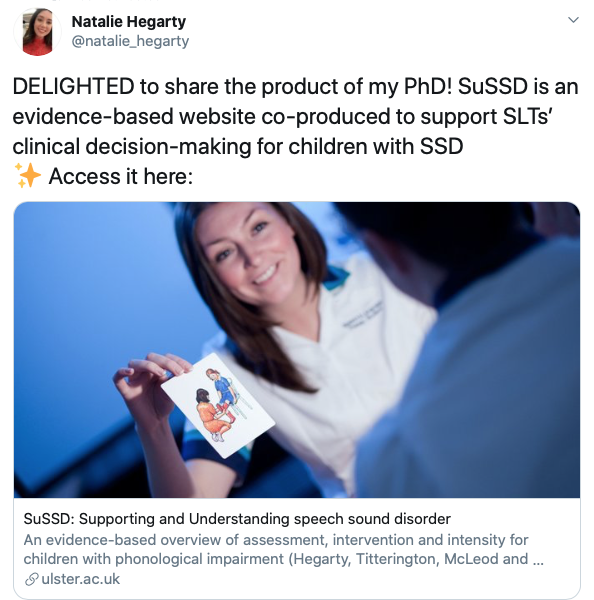
Supporting and Understanding Speech Sound Disorder (SuSSD) has been launched

Supporting and Understanding Speech Sound Disorder (SuSSD) has been launched this week: https://www.ulster.ac.uk/research/topic/nursing-and-health/intellectual-and-developmental-disabilities/projects/ssd/about-this-website.

It was a pleasure to be Natalie Hegarty's co-supervisor for her PhD and to work with Dr Jill Titterington and Dr Laurence Taggart at Ulster University (Northern Ireland, UK) on the research that lead to the creation of the SuSSD.

"This resource was developed to support SLTs [speech and language therapists] to use research in practice when working with children with phonological impairment. This resource was produced through Natalie Hegarty's PhD Studentship in Ulster University, Northern Ireland, funded by the Department for Employment and Learning (DEL). This resource was informed by the evidence-base and was co-produced with speech and language therapists from each of the Health and Social Care Trust’s in Northern Ireland. The research team were: Natalie Hegarty, Jill Titterington (Ulster University), Sharynne McLeod (Charles Sturt University) and Laurence Taggart (Ulster University)."

April 2, 2020

New ways of supporting children with SSD

Today Emily Davies (Western NSW Health), Prof Kirrie Ballard (University of Sydney) and I had a wonderful 1.5-hour brainstorm about new ways of supporting children with speech sound disorders during these challenging times. Kirrie and I had another brainstorm earlier in the week sharing new knowledge we have been creating in separate research projects.

April 15, 2019

Intelligibility Enhancement Assessment and Intervention: A single-case experimental design with two multilingual university students

The following manuscript has been accepted for publication:
Blake, H. L., McLeod, S. & Verdon, S. (2019, in press April). Intelligibility Enhancement Assessment and Intervention: A single-case experimental design with two multilingual university students. Clinical Linguistics and Phonetics. doi:10.1080/2050571X.2019.1585681

This manuscript is part of Helen Blake's PhD.
Here is the abstract:
Speech-language pathologists (SLPs) may be approached by multilingual speakers wishing to improve their intelligibility in English. Intelligibility is an essential element of spoken language proficiency and is particularly important for multilingual international students given their need to express complex ideas in an additional language. Intelligibility Enhancement aims to improve the intelligibility and acceptability of consonants, vowels, and prosody with multilingual speakers who are learning to speak English. This study aimed to describe the Intelligibility Enhancement Assessment and Intervention Protocols and determine whether the intervention changes multilingual university students’ English intelligibility. A multiple-baseline single-case experimental design was applied with direct inter-subject replication across two female participants whose home languages were Vietnamese and Putonghua (Mandarin). English intelligibility was assessed at multiple intervals pre, post, and during intervention. The intervention protocol consisted of 11 weekly 1-hour sessions with an SLP targeting English consonants, vowels, and prosody. Following intervention, both participants displayed increased performance across most measures. For example, the Vietnamese participant’s percentage of consonants correct (PCC) increased from 62.5% to 85.0% in probe keywords. Effect sizes, when comparing baseline and withdrawal phases, were 5.5 for PCC, 4.6 for final consonants, 2.3 for consonant clusters, and 1.6 for syllables indicating improvements in all variables measured. Her speech rate reduced, word stress increased in accuracy, and she perceived less difficulty communicating in English. These promising results suggest further testing of Intelligibility Enhancement Protocols is warranted to determine its effectiveness as an intervention for multilingual speakers.

March 14, 2019

Congratulations Dr Natalie Hegarty

This week Natalie Hegarty completed her PhD viva and passed with minor changes. She undertook her PhD at the University of Ulster in Northern Ireland. I have thoroughly enjoyed working with Natalie and the other members of her PhD supervisory team (Dr Jill Titterington and Dr Laurence Taggart) over the past few years. We had a virtual celebration via Skype this week. Here are the blogposts I have written during her PhD journey: https://speakingmylanguages.blogspot.com/search?q=Natalie+Hegarty
Congratulations Dr Hegarty!

June 30, 2018

Intervention for children with phonological impairment: Knowledge, practices and intervention intensity in the UK

The following manuscript has just been accepted for publication.
Hegarty, N., Titterington, J., McLeod, S., Taggart, L. (2018, in press June). Intervention for children with phonological impairment: Knowledge, practices and intervention intensity in the UK. International Journal of Language and Communication Disorders.

It forms part of Natalie Hegarty's PhD (She is studying at the Ulster University and I am co-supervisor). Congratulations Natalie

Here is the abstract
Background Across the world, research has shown that intervention for children with phonological impairment can be both effective and efficient. However, research has also raised concerns about the translation of this evidence to practice, highlighting questions around clinician knowledge and understanding of approaches, and the intensity of intervention provided within real-life clinical contexts.
Aim To investigate the clinical management of phonological impairment by speech and language therapists (SLTs) in the United Kingdom (UK).
Methods & Procedures An anonymous, UK-wide, online survey was developed using Qualtrics. The target audience were UK-based SLTs who worked with children with phonological impairment. The following topics were explored: (1) SLTs’ understanding of intervention approaches, (2) SLTs’ use of intervention approaches to treat phonological impairment, (3) SLTs’ provision of intervention intensity for children with phonological impairment.
Outcomes & Results A total of 166 responses were analysed. To remediate phonological impairment, SLTs most commonly used speech discrimination (79.5%), conventional minimal pairs (77.3%), phonological awareness therapy (75.6%) and traditional articulation therapy (48.4%). Participants least frequently used the complexity approaches targeting the empty set (82.9%) and 2/3-element clusters (75%) as well as the cycles approach (75.6%). Results also showed that some SLTs were uncertain of what the empty set and 2/3-element clusters approaches entailed. In terms of intervention intensity, participants predominantly provided intervention once per week (69%) for a total of 9-12 sessions (ranging from 5-30 sessions, 71.5%) and elicited targets 10-30 times in single words per session (59.4%) in sessions lasting 21-30 minutes (41.4%).
Conclusions & Implications The most commonly used intervention approaches identified in the current survey (i.e., speech discrimination, conventional minimal pairs and phonological awareness therapy) may be used eclectically by SLTs, which could impact upon the effectiveness and efficiency of treatment for phonological impairment. The current study also highlighted that almost half of participants always/often used traditional articulation therapy to remediate phonological impairment, even though this approach has been found to be less effective for this difficulty. Additionally, it appears that the currently provided intervention intensity for phonological impairment in the UK is significantly lower than what is indicated in the literature. Therefore, a research-practice gap exists for SLTs in the UK working with children with phonological impairment.