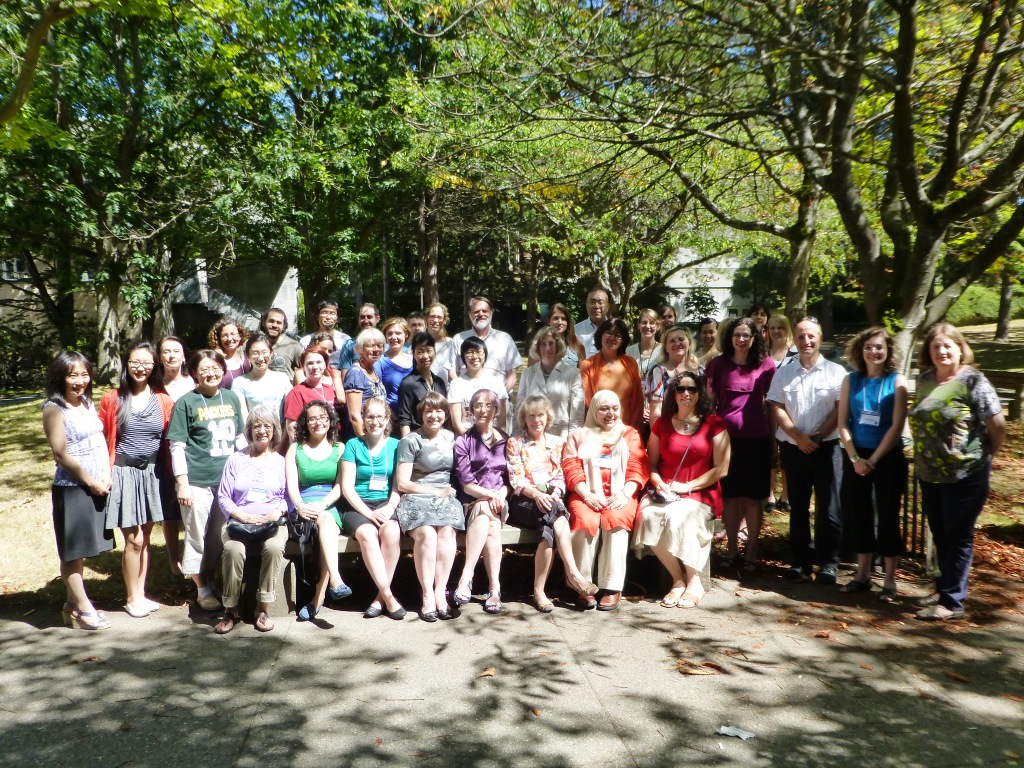
Emeritus Professor Barbara May Bernhardt from UBC, Canada has supported researchers across the world to undertake research into children's speech development (see https://speakingmylanguages.blogspot.com/2013/08/international-meeting-about-speech.html). Consequently, she is a co-author on numerous chapters in The Oxford Handbook of Speech Development in Languages of the World. We met yesterday to discuss her contribution, and also some more ideas of how we can continue to collaborate on committees and at conferences. She is a wonderful colleague.
Showing posts with label UBC. Show all posts
August 10, 2022
May 29, 2015
International Phonological Development website
The International Phonological Development website has been developed by researchers at the University of British Columbia. http://phonodevelopment.sites.olt.ubc.ca/. It includes:
- free assessment tools in many languages
- nonlinear scan analysis tutorials with English, French (in French) and Spanish examples
- fun-ological therapy activities
- feature and phonetic transcription tutorials by Joe
- links
- long words analysis by Glenda Mason
-
secret bonus footage
Labels:
assessment,
nonlinear,
UBC
August 9, 2013
Phon: Computer software for analyzing children's speech
Today at the University of British Columbia, Yvan Rose presented an overview of Phon, (https://www.phon.ca/) computer software for analyzing children's speech. Children's speech corpora can be transcribed using International
Phonetic Alphabet symbols and linked to audio or video data. The resulting transcription can be analyzed and searched. Phon is being used by speech researchers around the world and Yvan supported attendees at the Knowledge Mobilization seminar at UBC to ensure that it was running optimally on their computers.
Phon works in association with the CHILDES database, so that children's speech samples can be uploaded and shared throughout the world (http://childes.psy.cmu.edu/phon/).
Future versions of Phon will include acoustic analysis via Praat within the Phon program.
Phon works in association with the CHILDES database, so that children's speech samples can be uploaded and shared throughout the world (http://childes.psy.cmu.edu/phon/).
Future versions of Phon will include acoustic analysis via Praat within the Phon program.
| Yvan Rose presenting a paper on Phon and PhonBank |
Labels:
data,
Phon,
presentations,
speech acquisition,
UBC
International meeting about speech development at University of British Columbia, Canada
This week I attended a meeting titled: Knowledge Mobilization for an International Crosslinguistic Study of Children's Speech Development, held at the University of British Columbia, Vancouver, Canada. The meeting, lead by Professors May Bernhardt and Joe Stemberger has brought together 60 people from across the globe who have been involved in an international study of children's speech development.
The meeting commenced with an international dinner and musical presentations from around the world including First Nations songs, Slovenian dancing, Appalachian fiddle music, English clogging, songs sung in Spanish, Portuguese, and Slovenian, and Japanese and Australian children's songs.
The week has included interesting presentations about children's acquisition of Icelandic, Slovenian, French (Manatoba, Quebec, European), Portuguese, Spanish (Spain, Chile, Mexico), Japanese, Korean, Arabic (Kuwait), and German. We learned to apply Phon, speech analysis software to our data (see additional blog entry). I presented an invited session on knowledge mobilization based on my Future Fellowship in a session on dissemination of knowledge. The meeting concluded with clinical applications of the shared international speech data.
The meeting commenced with an international dinner and musical presentations from around the world including First Nations songs, Slovenian dancing, Appalachian fiddle music, English clogging, songs sung in Spanish, Portuguese, and Slovenian, and Japanese and Australian children's songs.
The week has included interesting presentations about children's acquisition of Icelandic, Slovenian, French (Manatoba, Quebec, European), Portuguese, Spanish (Spain, Chile, Mexico), Japanese, Korean, Arabic (Kuwait), and German. We learned to apply Phon, speech analysis software to our data (see additional blog entry). I presented an invited session on knowledge mobilization based on my Future Fellowship in a session on dissemination of knowledge. The meeting concluded with clinical applications of the shared international speech data.
| Conxita Lleo (University of Hamburg), May Bernhardt (UBC), Sharynne McLeod, Joe Stemberger (UBC) |
| International Crosslinguistic Study of Children's Speech Development group |
|
Martina Ozbič and Damjana Kogovšek from University of Ljubljana, Slovenia |
| Slovenian dancing at the welcome dinner |
| Hadeel Ayyad (Kuwait University) presenting a paper about Kuwaiti Arabic preschoolers' speech |
|
Sharynne and Þóra Másdóttir (The National Hearing and Speech
Institute of Iceland)
|
Labels:
Canada,
Children,
multilingual,
speech acquisition,
travel,
UBC
August 8, 2013
Children’s speech development in many languages: Strategies for telling the world what we have learned
On 9th August I will present an invited paper titled "Children’s speech development in many languages: Strategies
for telling the world what we have learned" to the Knowledge Mobilization for an International Crosslinguistic Study of Children's Speech Development Meeting at the University of British Columbia, Vancouver, Canada.
Here is the abstract:
Recent publications
Here is the abstract:
This presentation will outline lessons learned from a 4-year research fellowship titled “Speaking my languages: Multilingual speech acquisition in Australia”. The aims of this fellowship were to: describe Australian children’s multilingualism, consider the association between multilingualism and communication impairment, review and re-imagine international speech-language pathology practices for working with multilingual children, and develop resources for the assessment of multilingual children. Knowledge translation has been an important component of this research. Traditional knowledge translation strategies have included dissemination within books, book chapters, journal articles, and conference presentations. The Multilingual Children’s Speech website (www.csu.edu.au/research/multilingual-speech) was created via collaboration with researchers from around the world and includes free resources for speech-language pathologists. Additionally, knowledge translation has been enhanced by using: radio, newspapers, Twitter, blogs, listservs, emails, handouts, and conversations. Participants will be invited to reflect on how knowledge translation strategies can be used to tell the world about the International Crosslinguistic Study of Children’s Speech Development.
Here are some of the weblinks that will support my presentation.
Recent publications
- Influence of bilingualism on speech production: A systematic review
- Children's acquisition of Hong Kong Cantonese
consonants, vowels, and tones
- Factors that enhance English-speaking speech-language pathologists’ transcription of Cantonese-speaking children’s consonants
- International aspirations for speech-language pathologists’ practice with multilingual children with speech sound disorders: Development of a position paper
- Speech-language pathologists’ assessment and intervention practices with multilingual children
-
- Multilingual children’s speech position paper
- Multilingual children’s speech acquisition
- Comparison between the speech sounds of English and other languages
- Multilingual and multicultural considerations in speech-language pathology
-
World Report on Disability and people with communication disability
Labels:
Canada,
Invited presentations,
travel,
UBC
Subscribe to:
Posts (Atom)