Showing posts with label seminar. Show all posts

January 22, 2025

SACHL 2025

Dr Kate Margetson and I have a grant through the Rural Health Research Institute to develop the Speech Assessment of Children’s Home Languages (SACHL, Margetson & McLeod, 2025) https://www.csu.edu.au/research/multilingual-speech/speech-assessments/sachl and to ensure it is relevant to all speech pathologists including in rural and remote settings.

This morning we

  • reflected on our presentation at the American Speech-Language-Hearing Association (Nov 2024)
  • prepared our presentation for the (rural) Central West Speech Pathologists (7 Feb 2025)
  • worked on our chapter for a book to be published in Italian
  • looked at speech assessments in languages other than English (including the HKCAT that just arrived by mail from Prof Carol To in Hong Kong).

We have already been productive in our first week back from holidays!


June 12, 2024

AARE seminar - Impact of Cultural-Historical Activity Theory (CHAT) on STEM

I learned a lot from attending the Australian Association of Research in Education (AARE) seminar titled "Impact of Cultural-Historical Activity Theory (CHAT) on STEM (Science, technology, Engineering and Mathematics) Research and Education Practice from Early to Primary years" 

Here is the description: 

STEM education research has received enormous attention all over the world because the 21st century requires STEM-skilled humans. CHAT emphasises that children’s learning and development process, from lower form to higher mental functions, requires valued social or cultural experiences (Vygotsky, 1997). While STEM education has been researched in many ways, CHAT offers a unique/ valuable theoretical perspective because it helps to understand children’s conceptual (STEM) learning and development as a dynamic process (Vygotsky, 1987) where conceptual learning occurs in everyday contexts. To provide participants with insight into the value of using CHAT in STEM education research, this seminar (finishing with a Q&A), will provide: a background on CHAT examples of how this theory can be used when researching STEM education. The seminar combines presentations from a research expert and two PhD students to offer diverse perspectives on using CHAT in STEM education research. 

  • Presentation 1: Laureate Professor Marilyn Fleer, Monash University, Australia Rising to the concrete: Concept development of children from infancy to end of primary school in Conceptual PlayWorlds (Laureate Professor Marilyn Fleer) 


  • Presentation 2: Ms Jenny Dwyer, Charles Sturt University, Australia How can children’s mathematical graphics provide a steppingstone for children’s development of everyday and scientific (mathematical) concepts? (Ms Jenny Dwyer, PhD Candidate) 

  • Presentation 3: Ms Winnie Chen, University of Canterbury, New Zealand Exploring the potential use of cultural-historical activity theory to unpack early childhood teachers pedagogical practices regarding children’s digital play. (Ms Winnie Chen, PhD Candidate) 
  • Moderators: Dr Shukla Sikder, Senior Lecturer, Charles Sturt University, Australia and Dr John Cripps Clark, Senior Lecturer, Deakin University, Australia 

September 26, 2023

Strengthening creative thinking: A presentation by Dr Ross Anderson from the Creative Engagement Lab

I really enjoyed this online presentation this morning by Dr Ross Anderson who talked about the recent research projects of the Creative Engagement Lab. Dr Anderson is currently assisting and consulting in a project with the Curriculum & Pedagogy Research Group and the Education Course Directors in the Faculty of Arts & Education. The website for the Creative Engagement Lab has the following introduction:
Creative Engagement Lab is dedicated to revealing and strengthening the creative capacities of people and organizations.We passionately believe in the power of creative work as a tool for connecting people, transforming organizations, expanding perspectives, and furthering social justice imperatives. The experiences we design are responsive to the unique social environments and needs of each client. We rely on insights from the international field of creativity research, including our own research into arts integrated practice for learning and wellbeing. Our intention is always to help individuals and groups identify, cultivate and apply their unique creative resources. https://creativeengagementlab.com/


July 19, 2023

Day 2: Presentations and meetings at Manchester Metropolitan University

Today Prof Julie Marshall and I gave a MMU Communication Disability and Participation research webinar. We presented a hybrid seminar (online and face-to-face) titled "Using the Sustainable Development Goals to advocate for communication and swallowing disability services: Evidence from a special edition of the International Journal of Speech-Language Pathology"

Here is the abstract

The Sustainable Development Goals (SDGs https://sdgs.un.org/goals) consist of 17 Goals aimed at planet and people and cover many aspects of life on earth. McLeod and Marshall guest edited a Special Issue of the International Journal of Speech-Language Pathology, focused on the SDGs and Communication/ Swallowing Disability. Thirty-six papers, by authors from 36 countries, between them addressed all of the SDGs, demonstrating the importance of communication and swallowing to their achievement (open access - https://www.tandfonline.com/toc/iasl20/25/1). In this presentation and workshop the presenters will summarise the SDGs and key learning from this special edition. Participants will be invited to consider the application of the SDGs to their personal and professional lives
Prof Sharynne McLeod and Prof Julie Marshall at MMU
Manchester Metropolitan University

October 17, 2022

CSU School of Education Research Seminar: Working with Multilingual Families

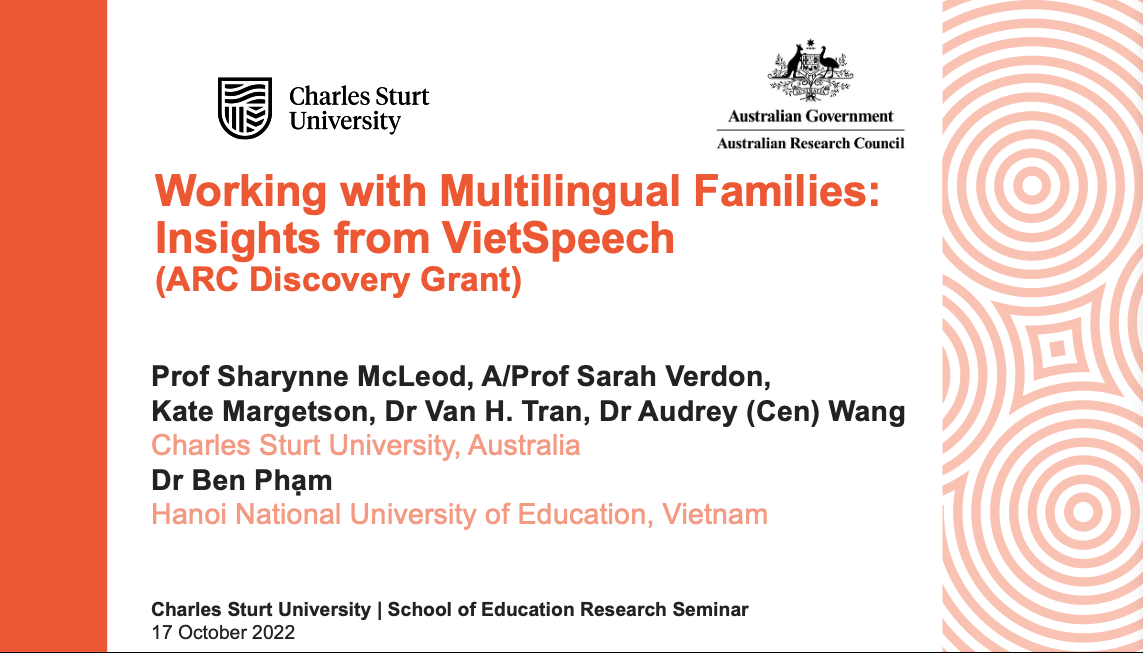
Today our VietSpeech team presented the CSU School of Education Research Seminar. Our title was: “Working with Multilingual Families: Insights from VietSpeech (ARC Discovery Grant)” Presenters: Professor Sharynne McLeod, A/Prof Sarah Verdon, Kate Margetson, Dr Van Tran and supported by Dr Audrey Wang and Dr Ben Pham.

Here is the recording of our presentation:https://charlessturt.zoom.us/rec/share/e5QhLac3mruLQjUz26YXWt1UmXcQOqwhhnOlG2-udO0BWzaqUBOg9geiplnMlRMj.iBwuo8tqd2Pu3MnN  

More information about the project can be found here: https://www.csu.edu.au/research/vietspeech/overview

Thanks Dr Kate Smithers and Dr Andi Salamon for organising this session.

September 28, 2022

Preprints - Seminar by Elsevier

An interesting online seminar

Preprints: A New Way to Publish Your Research Results 

Presented by 

  • Michael Magoulias, Director of Operations and Product Fulfillment, Elsevier SSRN
  • Dr. Rui Dai, Senior research director at Wharton Research Data Services\
 
Here is the published information about the presentation

Preprints are a rapidly growing piece of scholarly communication. Compared with traditional academic papers, preprints allow fast publication and instant citation of research results. As a complement to journal publication, they allow the research community to share information or research results, provide the direction of development for research, and help facilitate international and interdisciplinary collaboration. Preprints are also a positive way for early-career researchers to receive feedback ahead of submitting articles to journals. As evidence mounts on their importance, we’re seeing preprints increasingly included in formal evaluation processes for grant proposals and faculty reviews. In recent years there has seen a surge in use and need for preprints in the research community. SSRN data shows that the fastest growing disciplines over the last year on its platforms were in economics and medical research. The rapid rise in medical research preprints has helped play a crucial part in advancing and accelerating understanding of SARS-CoV-2. SSRN is an open access online preprint community. A searchable online library, it enables authors to post their papers and abstracts easily and free of charge providing an online database of early scholarly research. With over 2.2 million users, it lists 806,000 full-text documents and an additional 134,000 abstracts. Elsevier data reveals that over the last five years, there has been a 148% increase in the number of researchers publishing preprints on SSRN. There has also been a 50% increase in the number of downloads of preprints on SSRN over the same period with downloads hitting 17.9 million at the end of 2020. 

The session will cover in detail: Michael Magoulias, SSRN Overview of preprints in the scientific communication landscape What is the main purpose and who are the key players? Deep Dive into SSRN as an example that covers the widest number of disciplines How to submit a paper? What happens to a paper after submission? How is accessibility maximized by the platform? What metrics are available to demonstrate impact? Overview of APAC policies on preprints Thoughts about future development and relationship between preprints and peer review 

Dr. Rui Dai, Wharton Research Data Services What are the benefits of using preprint server? Why are researchers using them in disciplines such as economics and finance? What should you consider before you post a preprint? How does a preprint relate to a journal publication? Analysis of research posted on preprint server SSRN Join this webinar to learn and discuss how SSRN, the world’s most interdisciplinary early research platform, benefits researchers by improving the discoverability of the pre-print content. This makes it easier for researchers to identify potential collaboration partners, read and assess another researcher’s most recent work, and demonstrate impact to funders through early forms of scholarly output. It can inform decision-making and serve as an effective repository for demonstrating your organization’s expertise to an international community of thought-leaders and policymakers.

August 29, 2022

Participatory approaches to ethical (infant) research and pedagogy

Today I attended a fascinating presentation in the School of Education Research Seminar titled "Intentional research: Participatory approaches to ethical (infant) research and pedagogy" by Dr Andi Salamon. 

Abstract: Participatory research approaches aim to break down distinctions between researchers and those being ‘researched’. Such approaches have been critiqued in relation to very young children with the suggestion that the participation of children under three in research (and often pedagogical practice) is an illusion (Palaiologou, 2014). It is argued, however, that possibilities exist to consider infant research participants in ethically symmetrical ways to adult participants, and by not doing so we can ‘other’ very young children (Salamon, 2015). Such seemingly conflicting perspectives highlight the inherent challenges of including people with the least power as research participants. This week’s SoE Research Seminar presents the innovative methodological shifts of a research project that documented and deconstructed infants’ evocative emotional communication. Framed through a theory of practice architectures lens the project afforded babies opportunities to participate, enabled by methodological choices, critical reflection on the ‘happening-ness’ of practices and considered as ‘intentional research’. The presentation aligns this approach with intentional teaching pedagogy in Australian early childhood education contexts, and discusses implications for high quality practices in pedagogy with infants, in qualitative research and in any educational system more broadly.


December 8, 2021

Scholarly journal publishing in Australia by Dr Hamid R. Jamali

Today I went to a really interesting presentation titled "Scholarly journal publishing in Australia" by Dr Hamid R. Jamali from Charles Sturt University. 

Abstract. Australia currently has 600+ peer-reviewed scholarly journals, some of which started a century ago. Most of these journals belong to or are affiliated with universities or non-profit organisations (e.g. learned societies). As journal publishing has increasingly become challenging due to a competitive market and various business models, some of these journals face uncertain futures. In the last decade alone 150+ Australian journals ceased publication. This presentation reports the findings of two recent studies on journal publishing in Australia and looks at the distribution of journals by owner, publisher, Field of Research, and publishing model. The presentation also reports the findings of a survey of discontinued journals on what circumstances resulted in the discontinuation of journals. The session will be an opportunity to discuss the value of having local/national journals and the role they play in research. 

Biography. Dr Hamid R. Jamali is an Associate Professor in the School of Information and Communication Studies at Charles Sturt University. He received his PhD in Information Science from University College London in 2008, and before joining CSU he worked as an Associate Professor at Kharazmi University in Iran. Hamid’s current research interests broadly cover the area of scholarly communication which includes reading, citing and publishing behaviour, journal publishing, open access, and research evaluation. He has been involved in multiple international projects including two recent projects on the scholarly communication of early career researchers.


It seems that my experience as Editor-in-Chief of International Journal of Speech-Language Pathology, published by Speech Pathology Australia has been uncommon, with many Australian journals closing rather than internationalising while retaining their Australian influence and reach. I was the editor when we changed the name. Here is the publication history: https://www.tandfonline.com/action/journalInformation?journalCode=iasl20 

  • Currently known as: • International Journal of Speech-Language Pathology (2008 - current) 
  • Formerly known as • Advances in Speech Language Pathology (1999 - 2007) • Australian Journal of Human Communication Disorders (1973 - 1996) • Journal of the Australian College of Speech Therapists (1951 - 1972)