Showing posts with label #SpeakUp4CommRights. Show all posts

December 9, 2024

Communication is a human right

During the American Speech-Language-Hearing Association convention I was delighted to spend time with Lynn Williams  - and to share our passion and commitment for communication as a human right.


Lynn mentioned to me that while she was ASHA President she promoted communication rights based on the special issue of the International Journal of Speech-Language Pathology that I edited:

McLeod, S. (2018). Communication rights: Fundamental human rights for all. International Journal of Speech-Language Pathology, 20(1), 3–11. https://doi.org/10.1080/17549507.2018.1428687

It is exciting to see communication rights on ASHA t-shirts and merchandise and now mentioned in ASHA's mission/masthead

American Speech-Language-Hearing Association
Making effective communication, a human right, accessible and achievable for all.

October 10, 2020

Exciting statistics regarding our special issue of IJSLP on Communication Rights

I have just recieved the following exciting statistics from Melody Harris at Taylor & Francis regarding our special issue of the International Journal of Speech-Language Pathology (IJSLP) on Communication Rights (Volume 20, no 1, 2018):

...the number of downloads your issue received were extremely high when compared to regular issues of both the International Journal of Speech-Language Pathology and a standard issue of other Taylor & Francis audiology journals. I have included the numbers for your special issue below:

  • Downloads of 20(1) in 2018: 49,500 (for reference the next highest downloaded issue in the journal received 15,569 downloads) 
  • Downloads of 20(1) in 2019: 63,637 (the next highest downloaded issue in the journal received 14,363 downloads) 
  • Downloads of 20(1) in 2020 YTD: 53,087 ( the next highest downloaded issue in the journal received 12,397 downloads)

 Communication Rights was viewed 168,911 times (2/10/20) and my lead article, “Communication Rights: Fundamental human rights for all” (McLeod, 2018) had 16,855 views and the top Altmetric score of 170 for IJSLP in 2019.

August 18, 2020

The rights of children with speech, language and communication needs in early childhood education and care

The following book chapter has been accepted for publication: Cronin, A., McLeod, S., & Wren, Y. (2020, in press). The rights of children with speech, language and communication needs in early childhood education and care. In F. Press & S. Cheeseman (Eds.). (Re)conceptualising children’s rights in infant-toddler early childhood care and education: Transnational conversations. Dordrecht, The Netherlands: Springer. 

Here is the abstract 

This chapter reviews international literature on communication rights and applies it to young children particularly in early childhood education and care (ECEC) settings. Communication rights within the United Nations Convention on the Rights of the Child encompass: freedom of expression and opinion (Articles 12 and 13) and the language(s) in which children communicate (Articles 2, 29, 30 and 40). Accommodating and upholding communicative rights for children may require flexibility and creativity, depending on the modality of the children’s communication, and the language that they use. Thought and consideration to children’s right to communicate is imperative given communication is necessary for protection of many other rights. The second part of the chapter expands the discussion to specific considerations relating to communication rights for young children with speech, language and communication needs (SLCN), in particular, those with cleft lip and palate. A commentary is presented by Dr Yvonne Wren focusing on the rights of children with SLCN (including those with cleft lip and palate) in the United Kingdom (UK). Dr Wren draws on information from the Cleft Collective Cohort Studies, a large-scale national cohort study of over 2,000 children born with cleft lip and/or palate in the UK, with a particular focus on the early childhood experiences of education and care for children in the cohort.

October 10, 2019

Communication and human rights in speech pathology


"Communication and human rights in speech pathology" was the title of the James Cook University Speech Pathology Student Society's Inaugural Lecture. Congratulations to the JCU Speech Pathology Student Society, Gareth Lloyd, and Bill Mitchell (Townsville Community Legal Service) for addressing this important topic tonight. Thank you for inviting me to introduce the evening outlining some of the work we have been able to undertake to speak up for communication rights.
Speech-language pathologists are human rights defenders and cross-cutting enablers. We also need to "speak up" to be human rights advocates.
Speech-language pathologists are "canaries in the coal mine". We are first identifiers - unlocking communication to enable positive health, educational and social outcomes ~ Bill Mitchell

September 11, 2019

A guide to speaking at the United Nations

Today I presented a seminar to the School of Teacher Education titled "A guide to speaking at the United Nations" where I listed 10 steps:
  1. Have an important message to share 
  2. Read everything you can about the United Nations 
  3. Work closely with an organisation 
  4. Attend meetings at the Australian Human Rights Commission 
  5. Submit your side event proposal and write your speech 
  6. Prepare to travel 
  7. Read pre-briefing material and write 3 minute “interventions” 
  8. Spend the week at the UN: Timetable 
  9. Present at the UN 
  10. Follow up: Australian Mission to the UN briefing, media


August 9, 2019

June 12, 2019

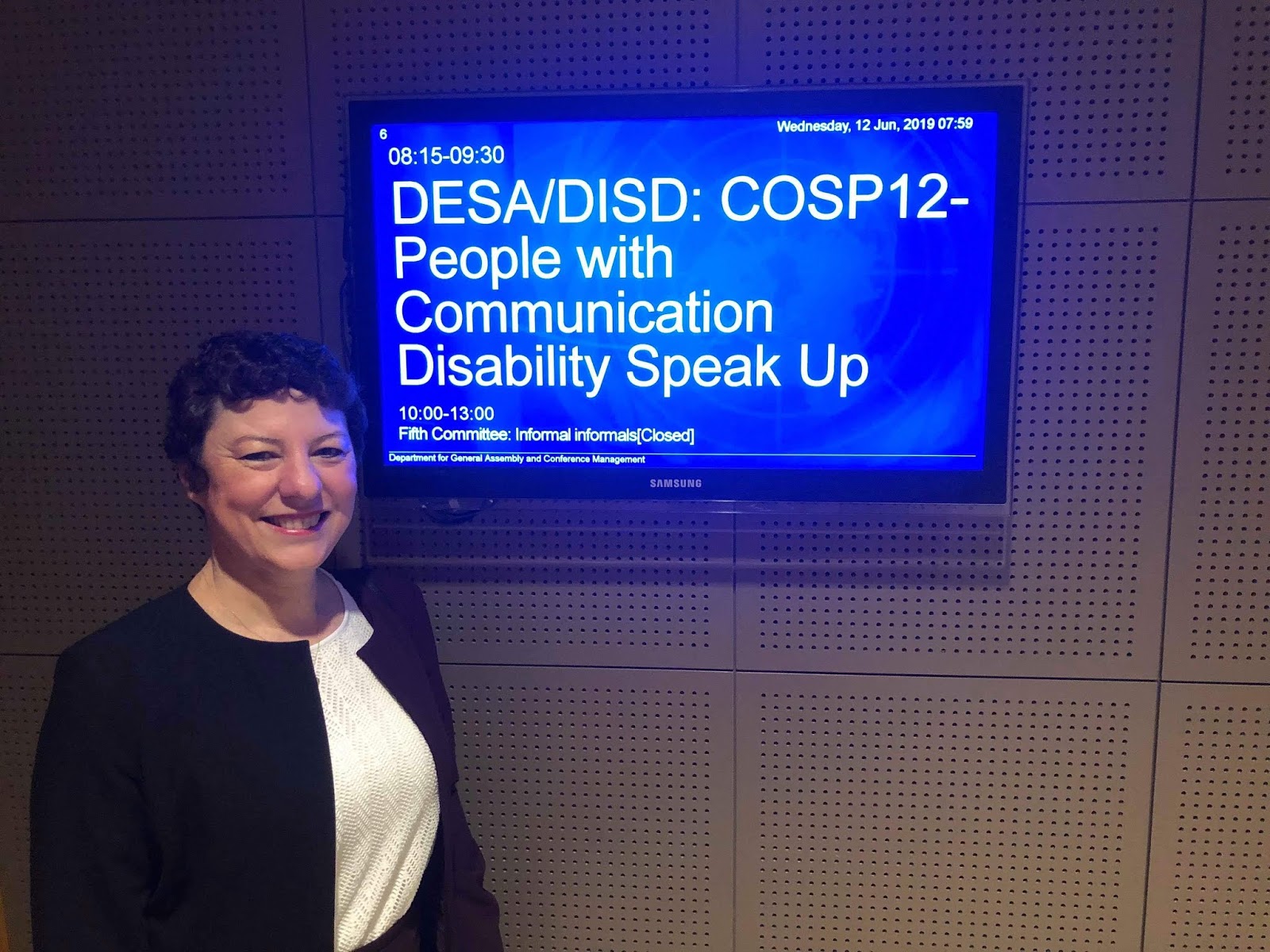
Presentation at the United Nations in NY

I spoke today at the United Nations.
I spoke for communication rights for all.
I spoke for those who cannot speak up.
I spoke for children and adults with
speech, language and communication needs
(including my parents).
I fulfilled a dream. What an honour.

Link to the UN TV recording
Presenters and representatives from Speech Pathology Australia and the International Communication Project

    Media releases
    According to the ASHA Director of Public Relations, the ICP media release was picked up by 160 outlets worldwide and had an audience reach of 73 million.

    May 22, 2019

    Preparation for the Conference of States Parties to the Convention on the Rights of Disabled Persons

    It is not long until we will be attending the United Nations 12th session of the Conference of States Parties to the Convention on the Rights of Disabled Persons (CRPD) on 10-13 June 2019 at the UN Headquarters, New York.

    The International Communication Project will be presenting a side event during the Conference. Our presentation is titled: "People with Communication Disability Speak Up for Inclusion and Participation: How the Implementation of the CRPD and the SDGs (Sustainable Development Goals) can Support this Right". Our side event will be held on Wednesday 12th June 8:15 am - 9:30 am and live streamed throughout the world. The speakers are: Gail Mulcair (CEO, Speech Pathology AUstralia), Sharynne McLeod (Charles Sturt University), Meredith Allan, and Miles Forma, chaired by Derek Munn (RCSLT) (see concept note). The event will be sponsored by the Australian Government.

    We have been working towards this event for a long time.

    May 10, 2019

    Planning for our presentation to the United Nations Conference of States Parties (CoSP) to the Convention on the Rights of Disabled Persons

    This morning the International Communication Project met via teleconference (Australia, UK, US) to prepare our presentation to the United Nations 12th session of the Conference of States Parties to the Convention on the Rights of Disabled Persons (CRPD) on 10-13 June 2019 at the UN Headquarters, New York. Our presentation is titled: "People with Communication Disability Speak Up for Inclusion and Participation: How the Implementation of the CRPD and the SDGs (Sustainable Development Goals) can Support this Right" and will be held on Wednesday 12th June 8:15 am - 9:30 am.
    Details are here: https://www.un.org/development/desa/disabilities/conference-of-states-parties-to-the-convention-on-the-rights-of-persons-with-disabilities-2/cosp12.html

    April 19, 2019

    Planning to attend the Conference of States Parties (CoSP) at the United Nations

    In June I will be attending the Conference of States Parties (CoSP) to the Convention on the Rights of Persons with Disabilities at the United Nations in New York. Last Wednesday I attended the Pre-CoSP event at the Australian Human Rights Commission in Sydney to gain an understanding of the roles of government, civil society and National Human Rights Institutes at CoSP. We also began planning logistics and activities for CoSP. It was great to meet others from Australia who will be attending this important meeting in New York.
    Attendees at the Pre-CoSP event
    Robert Strike from CID created an Easy Read guide for attending CoSP

    December 10, 2018

    70th anniversary of the Universal Declaration of Human Rights

    Today (10th December, 2018) is the 70th anniversary of the Universal Declaration of Human Rights. Over the past year, we have promoted this day, and particularly Article 19, celebrating communication rights in many ways. Here are some of the highlights:

    December 6, 2018

    What kind of public good is language maintenance?

    Yesterday (5th December), Dr Van Tran, Dr Suzanne Hopf and I were able to attend the Michael Clyne lecture given by Professor Jo Lo Bianco at The University of Sydney. The lecture was titled: "What kind of public good is language maintenance?" It was an honour to hear Prof Lo Bianco speak, since he has had such an influence on language policy throughout Australia for so many years.  It was also interesting to listen to him speak about  language rights and to hear about the Salzburg Statement for a Multilingual World (2017).

    He ended by saying "...there is a potentially deep conceptual change underway, involving a radical reconfiguring of what counts as normal communication". I believe that the work undertaken with multilingual and multimodal children and families by our SLM team in Australia, Fiji, Vietnam, Denmark, The Netherlands, UK, and other countries is contributing to this "radical reconfiguring of what counts as normal communication"
    Prof Jo Lo Bianco
    Dr Van Tran, Sharynne, Dr Suzanne Hopf
     Here is the description of the event from the Sydney Institute of Community Languages Education site:
    Joseph Lo Bianco, Professor of Language and Literacy Education at the University of Melbourne joins the SICLE Seminar Series to deliver its annual Michael Clyne lecture. Professor Lo Bianco is author of Australia’s formal language policy, the National Policy on Languages, adopted in 1987, the first multilingual language policy in an English-speaking country.
    In this year’s Michael Clyne lecture, Professor Lo Bianco will be looking at how the term ‘language education’ has a diverse range of activities whose essential differences are often overlooked by policy makers and even researchers. The teaching of languages foreign to their learners is a radically different activity from efforts to maintain spoken community languages across generations. Sociologically and therefore pedagogically, socio-linguistically and therefore in identity terms, teaching and maintaining a community language has its own unique value which needs to be considered in a broader context.
    Using a multidisciplinary approach, this lecture draws upon thinking from public good theory in economics, restorative justice reasoning in ethics and law, as well from pedagogical efficiency and equity rationales, to develop a robust account of why Australian language education efforts should make intergenerational language maintenance a central feature of language policy. Should it be a right to learn one’s heritage language? Professor Lo Bianco will also distinguish a case for language rights and discuss the evolution of language rights thinking in international instruments. Specific reference will be made to the turbulent history of indigenous bilingual education for language maintenance of languages spoken by children in the Northern Territory, and the case of language reclamation by urban Aboriginal people, and intergenerational maintenance of immigrant community languages.
    The lecture will be followed by a Q&A session. Please join us explore and discuss current themes in the world of community languages education.

    November 15, 2018

    American Speech-Language-Hearing Association Convention in Boston, MA

    My PhD students, Helen Blake and Nicole McGill, at the ASHA convention in Boston
     The American Speech-Language-Hearing Association Convention in Boston, MA was held from 15-17 November. Over 19,000 people registered to attend.

    Our team had eight presentations: 
    3-hour short course
    • Farquharson, K., Storkel., H., & McLeod, S. (2018). Evolution of speech sound norms: Revolutionizing assessment (invited) 
    1-hour seminars
    • Baker, E., Williams, A. L., McLeod, S., & McCauley, R. J. (2018). The Phonological Intervention Taxonomy: How do phonological interventions differ from one another? 
    • McLeod, S., Mulcair, G., Pietranton, A., Williams, C., Wofford, M., Tibi, S., Hemsley, B., Lyons, R., Carroll, C. & Hersh, D. (2018). The right to communicate: Celebrating the 70th anniversary of the Universal Declaration of Human Rights (invited) 
    Technical research papers
    • Blake, H., Verdon, S., & McLeod, S. (2018). Intelligibility in English: Multilingual speakers' perspectives
    • Crowe, K., Marschark, M., & McLeod, S. (2018). Intelligibility in American Sign Language
    • McGill, N. & McLeod, S. (2018). Designing a website to support children and families who are waiting for speech-language pathology services
    Posters
    • Blake, H., Verdon, S., & McLeod, S. (2018). English proficiency, intelligibility and participation of multilingual university students
    • Deutenberg, C., Loebick, K. Wright, R., Washington, K. N., McLeod, S. (2018). Using drawings to understand Jamaican children's talking
    UDHR Seminar: Bronwyn Hemsley, Claire Wofford, Deb Hersh, Rena Lyons, Arlene Pietranton


    Also at the convention our Sound Start Study team received the Journal of Speech, Language, and Hearing Research Editor's Award.

    Additionally, Corrine Deutenberg was selected to receive a Student Research Travel Award to attend the ASHA Convention. She was selected for this award because she was the first author on our poster titled Using Drawings to Understand Jamaican Children’s Talking, which was the "highest-rated, student-authored paper in its Convention topic area”.  Congratulations Corrine!
    Corrine Deutenberg, Dr Karla Washington, and co-authors on the award winning poster

    Unfortunately I couldn't attend the convention, but had prepared videos for two of the sessions and am grateful to my students and colleagues for presenting the others.
    Gina Olwoch (2nd from right) and the ASHA team (Ellen Shortill, Erinn Gorey, and Deena Thompson) who organize the entire convention
    Australians at ASHA: Cori Williams, Kate Crowe, Helen Blake, Nicole McGill

    November 7, 2018

    Communication Rights presentation

    I have created a 13 minute video presentation titled "Communication rights: Celebrating the 70th anniversary of the Universal Declaration of Human Rights". This presentation was created to celebrate the 70th anniversary of the Universal Declaration of Human Rights in 2018.
    It can be downloaded here: https://cloudstor.aarnet.edu.au/plus/s/mylsgcvZqzj2Htf (note - 52MB file)
    The presentation profiles papers from the special issue of the International Journal of Speech-Language Pathology that can be downloaded from bit.ly/IJSLP-CommRights
    A summary of the special issue is presented in the following paper: https://www.tandfonline.com/doi/full/10.1080/17549507.2018.1428687
    The presentation was played at the International Clinical Phonetics and Linguistics Association conference in Malta and will be played at the American Speech-Language-Hearing Association convention in Boston next week.

    October 23, 2018

    International Clinical Phonetics and Linguistics Association (ICPLA) Conference in Malta

    The 17th International Clinical Phonetics and Linguistics Association (ICPLA) Conference was held in Malta (23-25 October) https://www.um.edu.mt/events/icpla2018

     Our team presented the following papers:
    • Blake, H. L. & McLeod, S. - Intelligibility Enhancement in English in a multilingual university student 
    • Crowe, K., Marshark, M. & McLeod, S. - More than a matter of skill: Exploring the concept of intelligibility in sign language 
    • Hegarty, N., Titterington, J., McLeod, S. & Taggart, L. - The research-practice gap when working with children with phonological impairment 
    • McLeod, S. & Crowe, K. - A cross-linguistic review of children’s consonant acquisition in 27 languages 
    • Van Doornik, A., Gerritts, E., McLeod, S., & Terband, H. - Self-evaluation of the communicative attitude of children with speech sound disorders 
    Dr Kate Crowe
    Natalie Hegarty
    Additionally, I organised a special seminar titled: "The right to communicate: Celebrating the 70th anniversary of the Universal Declaration of Human Rights" that included the following presentations:
    • Communication as a fundamental human right for all – Sharynne McLeod, Australia (via video)
    • Citizenship, politics, coffeeshops, restaurants, and the role of the speech-language pathologist in supporting human rights – Rena Lyons and Clare Carroll, Ireland
    • Human rights and aphasia – Deborah Hersh, Australia
    • Creating human rights-driven guidelines for South African speech-language pathologists – Michelle Pascoe, Mikateko Ndhambi, Daleen Klop, and Thandeka Mdlalo, South Africa
    • Listening to people with a history of childhood communication disorder regarding their human right to communicate – Kathryn Crowe, Jane McCormack and Elise Baker, Australia/USA/Denmark
    • Bilingualism: Lessons from California about communication as a human right – Gabriela Simon-Cereijido, USA
    • Human rights in a communicative exchange: Discussing the stakeholder model of voice research – Catherine Madill, Australia 
    Panel presenters: Michelle Pascoe, Mikateko Ndhambi, Gabriella Simon-Cereijido, Kate Crowe, Sharynne McLeod (video), Antonia Chacon (for Cate Madill), Rena Lyons, Deborah Hersh

    Members of our team attending ICPLA in Malta (with friends)

    September 10, 2018

    UTS seminar on communication rights

    On 10 September, the University of Technology Sydney hosted a seminar to celebrate communication rights. Professor Bronwyn Hemsley organised the day, and it was attended by Alastair McEwan, the Disability Discrimination Officer from the Australian Human Rights Commission as well as speakers who had papers published in our special issue of IJSLP on communication rights. I was unable to attend, so my speech was presented via video. It was a very successful day.
    Bronwyn Hemsley, Cate Madill, Gaenor Dixon, Alastair McEwan, Megan, Gail Mulcair, Jane McCormack
    Sharynne presenting via video
    There was a lot of Twitter activity during the event


    August 30, 2018

    Profiling communication rights in Australia and the US

    Over the past few days our work on communication rights has been profiled by Speech Pathology Australia (SPA) during Speech Pathology week in social media and by promoting the Speak Up for Communication Rights website: http://www.speechpathologyaustralia.org.au/SpeakUp
    The website now includes a video from my SPA presentation in May: https://www.youtube.com/watch?v=NXG8kaQrrNc&feature=youtu.be

    The American Speech-Language-Hearing Association also has profiled our work in the ASHA Leader Blog: https://blog.asha.org/2018/08/27/speak-up-for-communication-rights-speakup4commrights/

    June 28, 2018

    Communication rights presentation to CSU Centre for Law and Justice

    Today I gave an invited seminar at the CSU Centre for Law and Justice titled:'Communication rights: Celebrating the 70th anniversary of the Universal Declaration of Human Rights'. The presentation was attended by people in Bathurst as well as online across the country. I profiled the special issue of the International Journal of Speech-Language Pathology on communication rights, including the paper by Emily Howie titled "Protecting the human right to freedom of expression in international law".
    Attendees at the CSU Centre for Law and Justice presentation
    (the people who joined virtually are not pictured)

    June 25, 2018

    United Nations NGO Accreditation Status for Speech Pathology Australia

    Following on from our work to celebrate communication rights and the 70th anniversary of the Universal Declaration of Human Rights, Speech Pathology Australia has just been granted NGO Accreditation Status by the United Nations.

    Here is the announcement on Facebook by Speech Pathology Australia:
    Speech Pathology Australia has just been granted NGO (Non-Government Organisation) Accreditation Status by the United Nations! The Association’s application for new NGO accreditation to the Conference of States Parties to the CRPD (Convention on the Rights of Persons with Disability) was recently approved by consensus at the first meeting at the CoSP 11th session on 12 June in New York.
    What this means is that Speech Pathology Australia can send delegations to the CRPD Conference of State Parties and participate in UN meetings and the Civil Society forum concerning the implementation of the Convention. The Association can now also host a side event at future CRPD Conferences of States Parties. Such a proposition has been under active consideration by the International Communication Project, as well as the Australian Department of Foreign Affairs and Trade and the Australian Human Rights Commission.
    It is pleasing that the RCSLT has also just been granted accreditation status, providing further support for possible future ICP activities to promote communication as a human right. Additionally, the Association is aiming to apply for Consultative Status with United Nations Department of Economic and Social Affairs, which will provide further opportunities for consultation at this global level.
    Gail Mulcair Chief Executive Officer

    June 11, 2018

    Speech Pathology Australia's support for communication as a human right

    Gaenor Dixon (President, SPA), Gail Mulcair (CEO, SPA), Prof Kirrie Ballard (Editor, IJSLP), Prof Sharynne McLeod (Guest Editor, IJSLP). Photo credit: Louise Hutchinson
    At the Speech Pathology Australia (SPA) National Conference we celebrated the 70th anniversary of the Universal Declaration of Human Rights, focusing on communication as a human right. The photograph of the audience showing their support for communication rights is below. I was the editor of the special issue of the International Journal of Speech-Language Pathology (volume 20, issue 1) that contains 31 open access papers discussing communication as a human right is available here. The foreword is written by Alastair McEwan (Australian Disability Discrimination Commissioner) and Ed Santow (Australian Human Rights Commissioner) and is titled "The importance of the human right to communication".
    Speech Pathology Australia delegates celebrating 70th anniversary of the Universal Declaration of Human Rights and communication as a human right (Article 19). Photo credit: Louise Hutchinson

    Authors and editors of the special issue of IJSLP celebrating communication as a human right L-R: A/Prof Jane McCormack, Prof Sharynne McLeod (Guest Editor, IJSLP), Gail Mulcair (CEO, SPA), Hayley Tancredi, Prof Kirrie Ballard (Editor, IJSLP), Prof Bronwyn Hemsley, Prof Lindy McAllister, A/Prof Deborah Hersh, Dr Bea Staley. Photo credit: Louise Hutchinson
    Natalie Davall (Taylor & Francis), A/Prof Anne Whitworth (Editor, IJSLP), Prof Kirrie Ballard (Editor, IJSLP), Prof Sharynne McLeod (Guest Editor, IJSLP), A/Prof Deborah Hersh (author), Hayley Tancredi (author). Photo credit: Louise Hutchinson