Showing posts with label Vietnamese Speech Assessment. Show all posts

February 24, 2024

Development of children's speech assessments

I have just been invited to advise someone internationally about her development of a speech assessment. Here are a few of our published resources I have just sent: 

Appendix C of this paper is designed to support people’s test development: 

  • McLeod, S., & Crowe, K. (2018). Children’s consonant acquisition in 27 languages: A cross-linguistic review. American Journal of Speech-Language Pathology, 27(4), 1546–1571. https://doi.org/10.1044/2018_AJSLP-17-0100 1. 

Here are some general papers - with assessments available on the Multilingual Children's Speech website: https://www.csu.edu.au/research/multilingual-speech/speech-assessments

  • McLeod, S. (2012). Multilingual speech assessment. In S. McLeod & B. A. Goldstein (Eds.), Multilingual aspects of speech sound disorders in children (pp. 113–143). Multilingual Matters. 
  • McLeod, S. (2012). Translation to practice: Creating sampling tools to assess multilingual children’s speech. In S. McLeod & B. A. Goldstein (Eds.), Multilingual aspects of speech sound disorders in children (pp. 144–153). Multilingual Matters. 
  • McLeod, S., & Verdon, S. (2014). A review of 30 speech assessments in 19 languages other than English. American Journal of Speech-Language Pathology, 23(4), 708–723. https://doi.org/10.1044/2014_AJSLP-13-0066 
A few years ago I worked with Dr Ben Pham and Xuan Le to create a speech test for Vietnam - and Ben's subsequent papers show how well her test development worked: 
  • Phạm, B., McLeod, S., & Le, X. T. T. (2016). Development of the Vietnamese Speech Assessment. Journal of Clinical Practice in Speech-Language Pathology, 18(3), 126–130. 
  • Phạm, B., & McLeod, S. (2016). Consonants, vowels and tones across Vietnamese dialects. International Journal of Speech-Language Pathology, 18(2), 122–134. https://doi.org/10.3109/17549507.2015.1101162
  • Phạm, B., McLeod, S., & Harrison, L. J. (2017). Validation and norming of the Intelligibility in Context Scale in Northern Viet Nam. Clinical Linguistics & Phonetics, 31(7-9), 665–681. https://doi.org/10.1080/02699206.2017.1306110
  • Phạm, B., & McLeod, S. (2019). Vietnamese-speaking children's acquisition of consonants, semivowels, vowels, and tones in Northern Viet Nam. Journal of Speech, Language, and Hearing Research, 62(8), 2645–2670. https://doi.org/10.1044/2019_JSLHR-S-17-0405 
  • Phạm, B., & McLeod, S. (2023). Considerations of dialect on the identification of speech sound disorder in Vietnamese-speaking children. International Journal of Language & Communication Disorders. https://doi.org/10.1111/1460-6984.12992
  • McLeod, S., Margetson, K., Wang, C., Tran, V. H., Verdon, S., White, K., & Phạm, B. (2022). Speech acquisition within a 3-generation Vietnamese-English family: The influence of maturation and ambient phonology. Clinical Linguistics & Phonetics, 36(4-5), 470-493. https://doi.org/10.1080/02699206.2020.1862915 
We also have a lot of papers outlining the development of the ICS. Here are two:
  • McLeod, S., Harrison, L. J., & McCormack, J. (2012). Intelligibility in Context Scale: Validity and reliability of a subjective rating measure. Journal of Speech, Language, and Hearing Research, 55, 648–656. https://doi.org/10.1044/1092-4388(2011/10-0130) 
  • McLeod, S. (2020). Intelligibility in Context Scale: Cross-linguistic use, validity, and reliability. Speech, Language and Hearing, 23(1), 9–16. https://doi.org/10.1080/2050571X.2020.1718837

April 17, 2023

International collaboration to support children with hearing loss in Vietnam

This evening I met with Dr Ben Pham in Vietnam and Dr Kate Crowe in Iceland. Ben has collected speech, intelligiblity and attitudinal data from children with hearing loss. We had a fascinating conversation about the difference about the cultural groups of people who recognise themselves as d/Deaf and hard of hearing (DHH). I look forward to working together on the analysis and write up of this interesting study.

Dr Kaate Crowe (Iceland), Sharynne (Australia), Dr Ben Pham (Vietnam)

March 17, 2021

Data analysis in Vietnam

Yesterday I worked with Dr Ben Pham and our masters students in Vietnam to analyse data from 30 children with speech sound disorders. This will be the largest study in the world of Vietnamese children with speech sound disorders and will provide useful information for the emerging SLP/SLT profession in Vietnam as well as across the world.


February 4, 2021

Consonant accuracy and intelligibility of Southern Vietnamese children

The following manuscript has been accepted for publication: 

Le, X. T. T., McLeod, S. & Phạm, B. (2021, in press). Consonant accuracy and intelligibility of Southern Vietnamese children. Speech, Language and Hearing

It will be published in this journal: https://www.tandfonline.com/loi/yslh20

Here is the abstract: 

Understanding typically developing children’s speech acquisition is useful to assist speech-language pathologists’ diagnosis and intervention planning for children with speech sound disorders. The aim of this research was to investigate Southern Vietnamese-speaking children’s speech accuracy and intelligibility. Participants were 132 children aged 3;0-5;11 living in Southern Vietnam (Ho Chi Minh City) whose consonants, semivowels, vowels, and tones were assessed using the Vietnamese Speech Assessment (VSA) and parent-reported intelligibility was assessed using the Vietnamese version of the Intelligibility in Context Scale (ICS-VN). Participants’ percentage of consonants correct (PCC) was significantly lower for the younger children compared with the other age groups. Mean PCC was 89.19 (SD = 7.83) at 3;0-3;5 years and 99.31 (SD = 1.33) at 5;6-5;11 years. Percentage of semivowels correct was higher than the percentage of initial and final consonants correct. Participants produced tones and vowels accurately even from the youngest age group. On average, the participants were reported to be usually to always intelligible and were more intelligible with their parents than other communication partners. There was a positive, weak correlation between speech accuracy (PCC) and intelligibility (ICS-VN). There was no sex effect for PCC and no significant effect for age or sex on intelligibility. These data provide information about typical speech acquisition to support the emerging speech-language pathology profession in Vietnam. 

This work was supported by a grant from Trinh Foundation Australia to the first author, an Australian Research Council Discovery Grant (DP180102848) to the second author, an Australian Awards Scholarship to the third author, Charles Sturt University, and Ninh Dang Vu who provided data entry support. 

We began working on this paper in 2017. 

https://speakingmylanguages.blogspot.com/2017/11/xuans-visit-re-southern-vietnamese.html

The work had to be put on hold in 2018 due to my health issues as well as a few other reasons - so it is really exciting to have it accepted for publication today.


Xuan Le, Ninh Dang Vu, Ben Pham and Sharynne McLeod in 2017

I have just learned that our paper was accepted on "Kitchen God Day" which is just before Tet: https://vietnamtimes.org.vn/how-vietnamese-people-celebrate-kitchen-god-day-across-the-regions-27895.html


February 1, 2021

Vietnamese Masters students' research about children with SSD

Today Dr Ben Phạm and I had my first supervisory meeting for 2021 with Mrs Hằng Nguyen and Mrs Vấn Phạm who are the Masters students in Vietnam. 

Dr Ben Phạm, Professor Sharynne McLeod, Mrs Hằng Nguyen and MrsVấn Phạm

Today, as Vietnam has just gone into lockdown again for COVID they have completed assessing 48 children with speech sound disorders. This is a huge achievement as the only other English-language paper written about children with SSD had four participants: 

  • Tang, G., & Barlow, J. (2006). Characteristics of the sound systems of monolingual Vietnamese-speaking children with phonological impairment. Clinical Linguistics and Phonetics, 20(6), 423-445. https://doi.org/10.1080/02699200500100910 

Recently there has been a Vietnamese-language paper written about 65 children in Southern Vietnam undertaking a retrospective file analysis, including a description of results from the Intelligibility in Context Scale. Congratulations Mr Quyên and team from Children's Hospital No. 1.

  • Hoang, V. Q., Tra, T. T., Nguyen, T. T. H., Tran, T. M. D., & Cao, P. A. (2019). Đặc điểm âm lời nói của trẻ bị rối loạn âm lời nói đến khám tại bệnh viện nhi đồng 1 và trường đại học y khoa Phạm Ngọc Thạch từ tháng 1 đến tháng 6 năm 2018 [Speech sound characteristics of children with speech sound disorders at Children’s Hospital 1 and University Of Medicine Pham Ngoc Thach from January 2018 to June 2018]. Y Học TP. Hồ Chí Minh [Ho Chi Minh City Journal of Medicine], 23, 202-207. 

Here is the English translation of the abstract

Objectives: Describing the clinical characteristics of speech sounds of children with speech sound disorders from 4 to 7 years old receiving intervention at Children Hospital 1 and at the clinic of Pham Ngoc Thach University of Medicine in Hochiminh City from January to June of 2018. 

Methods: A retrospective research on secondary data which were 65 Speech therapy case files. A research describes the speech sound characteristics of patients presented in the specialty case files. 

Results: The outcomes recorded the occurrence of 5/9 phonological processes, which were stopping, gliding, glottal replacement, backing and fronting. The other processes were initial consonant deletion 12/65, nasalisation 9/65 and devoicing 2/65. 

Conclusions: A retrospective research has provided us a general picture of the pronunciation errors and phonological processeses found in children speaking Vietnamese language. Speech sound disorder issue can affect communication quality, learning quality of children, especially the quality of reading – writing subject at elemenetary school.

Our Masters students (Hằng Nguyen and Vấn Phạm) have prospectively assessed children in Northern Vietnam using the Vietnamese Speech Assessment and the Intelligibility in Context Scale and will be undertaking more extensive analysis. So, the two papers will be very complementary and will add to the literature base for Vietnam and provide a more nuanced understanding of children with SSD in Vietnam. It is exciting to see this field is emerging.

December 8, 2020

Speech acquisition within a 3-generation Vietnamese-English family

The following article has been accepted for publication: 

McLeod, S., Margetson, K., Wang, C., Tran, V. T., Verdon, S., White, K., & Phạm, B. (2020, in press December). Speech acquisition within a 3-generation Vietnamese-English family: The influence of maturation and ambient phonology. Clinical Linguistics and Phonetics

Here is the abstract: 

The emergence approach to speech acquisition (Davis & Bedore, 2013) theorises the influence of intrinsic capabilities (e.g. maturation), interactional capabilities, and extrinsic contexts (e.g. ambient phonology). Intrinsic and extrinsic influences were examined via a case study of a 3-generation Vietnamese-English family with two brothers (C1 aged 5;6 and C2 aged 3;10), their mother (M), grandfather (GF) and grandmother (GM). Their speech was assessed using the Diagnostic Evaluation of Articulation and Phonology (DEAP, Dodd et al., 2002) and the Vietnamese Speech Assessment (VSA, Phạm et al., 2016). Standard Australian English/Standard Vietnamese productions were defined as ‘correct’, even though the adults spoke different Vietnamese dialects. Their percentage of standard consonants correct (PSCC) was: C1 (English:92.27%, Vietnamese:89.05%), C2 (E:86.47%, VN:86.13%), M (E:90.34%, VN:96.35%), GF (E:82.61%, VN:97.81%), GM (VN:99.27%). Percentages were higher when dialectal variants were included. C1 and C2 had more pronunciation matches with English (86.96%) than Vietnamese (79.56%). C1’s pronunciation matched: M (E:85.02%, VN:83.94%), GF (E:79.23%, VN:77.37%), GM (VN:73.72%) and C2’s pronunciation matched: M (E:79.23%, VN:73.72%), GF (E:73.91%, VN:75.18%), GM (VN:72.26%). There was evidence of ambient phonology influences and cross-linguistic transfer. For example, in Vietnamese ‘r’ is produced as /ʐ/ or /r/, but was produced by C1 as [ɹ] (English approximant) and by C2 [w] (age-appropriate /ɹ/ substitution). The children demonstrated maturation influences for late-occurring English consonants (e.g. English /θ/→[f]). This study found evidence for the emergence approach and recommends knowledge of the ambient phonology augments traditional child-focused understandings of children’s speech acquisition.

September 8, 2020

Meeting with Ben and Xuan in Vietnam regarding operationalisation of the Vietnamese Speech Assessment

Recently Dr Ben Pham has received a grant from the Vietnamese Ministry of Education to undertake additional research to operationalise  the Vietnamese Speech Assessment by assessing 80 children from the North, Center and South of Viet Nam (n = 240). Today I was able to meet with Ben and Ms Xuan Le to discuss our Vietnamese Speech Assessment operationalisation. Eventually we will combine the data from all of our studies within the VSA manual:

  1. Study 1 - Ben's PhD - data from Northern Vietnam (n = 195)
  2. Study 2 - Xuan's data collection - data from Southern Vietnam (n = 132)
  3. Study 3 - Sharynne's VietSpeech - data from bilingual children in Australia (n = 61 children and 77 adults)
  4. Study 4 - Ben's Vietnamese Ministry of Education grant - data from Northern, Central and Southern Vietnam (n = 240)
  5. We may even collect more data before we finalise the VSA manual!

August 28, 2020

Book chapter proposal submission "Supporting communication with underserved children: A case study of Viet Nam"

 Today Dr Ben Pham, Dr Sarah Verdon and I wrote a book chapter proposal titled "Supporting communication with underserved children: A case study of Viet Nam" to be considered for submission to a new book being organised by the Task Force on Underserved and Underserved Populations for IALP (International Association of Communication Sciences and Disorders).


August 14, 2020

Grant to study speech acquisition of 1,000 Vietnamese-speaking children in Vietnam

Congratulations to Dr Ben Pham who has just received a grant from the Vietnam National Foundation for Science and Technology Development (NAFOSTED). 

The project is titled "Speech acquisition of Vietnamese-speaking children" (August 2020 - August 2022) 

Here is the summary:

Studying children’s speech acquisition has attracted researchers for a long time, across languages and countries. Theoretical and clinical importance of understanding the typical course of children’s speech acquisition has been well explained in many studies. In addition to reviewing previous studies and creating theoretical foundation, the overarching aim of this project is to describe speech acquisition of Vietnamese-speaking children aged 2;0-5;11 (years; months) and will be achieved through following aims: children’s intelligibility scores, percentage of phoneme correct; age of acquisition; phoneme inventory; common phonological processes; clinical markers to identify children with speech sound disorders from typically developing children; and factors associated with Vietnamese-speaking children’s speech acquisition. Systematic review will be used through searching, collecting, and selecting relevant references to the research then applying content analysis to draw a systematic review on speech acquisition studies across the world and in Vietnam. In order to achieve the overarching aim, quantitative methodology will be applied through cross-sectional design using different data collection methods (including Questionnaire, Delphi method, and Testing or direct speech assessment). Children’s speech samples will be analyzed by Phon software and the project's data will be analyzed by using SPSS including descriptive and inferential statistics. 

Here is link of the annoucement: https://nafosted.gov.vn/thong-bao-phe-duyet-danh-muc-de-tai-nccb-thuoc-linh-vuc-khxhnv-do-quy-phat-trien-khoa-hoc-va-cong-nghe-quoc-gia-tai-tro-dot-2-nam-2020/ 

The grant is for 990 million VND to collect data from 1,000 children including children with speech sound disorders in Bac Giang, Hai Phong and Ninh Binh provinces (three regions representative for three sub-dialects of the northern dialect).

This grant will extend the work that Ben began during her PhD. Congratulations Ben!


August 5, 2020

VietSpeech Study 2 data milestone

This week we
  • finished the main analyses of the VietSpeech Study 2 English (adult and child) data analysis - Cen (Audrey) Wang and myself
  • finished entering all of the VietSpeech Study 2 Vietnamese (adult) data so it is ready for analysis - Kate Margetson and Katherine White
Not long ago we finished the VietSpeech Study 2 inter-rater reliability - and were extremely pleased with the high level of reliability amongst raters.

We are writing a series of journal articles that we hope to submit later this year.

Once data collection is over there is a LOT to do!


May 28, 2020

Vietnamese Masters students' thesis proposals

Congratulations to all of the 14 Masters students at HO CHI MINH CITY MEDICINE AND PHARMACY UNIVERSITY who submitted their thesis proposals today. Dr. Ben Phạm and I have been supervising Ms Vấn and Ms Hằng. Their thesis titles are as follows:
  • Phạm Thị Vấn: Speech Sound Characteristics of Children With Speech Sound Disorders in Northern Vietnam
  • Nguyễn Thị Hằng: Speech Intelligibility of Children with Speech Sound Disorders in Northern Vietnam
Next week they will have 15 minutes to present their proposal orally and 30 - 45 minutes to receive feedback from the committee. Then they will be able to begin the research.

March 11, 2020

VietSpeech Study 2 data analysis

Over the past 2 days Kate Margetson and I have worked systematically through the processes for transcription, reliability, consensus, and expert checking for the data from Study 2. Audrey Wang has begun transferring some of the data into SPSS. This is an exciting - but extensive phase in our study.
Sharynne, Kate and lots of VietSpeech files in Sydney

February 10, 2020

Supervising Masters students in Viet Nam

This year I have the honour of co-supervising two Masters' students with Dr Ben Phạm who is the primary supervisor. The students (Hang Nguyen and Vấn Phạm) are studying in the Masters of Speech and Language Therapy at the University of Medicine and Pharmacy in Ho Chi Minh City, Viet Nam. They will be researching the use of the Intelligibility in Context Scale with preschool children with speech sound disorders in Northern Viet Nam. We had our first meeting via Skype today. The students had prepared excellent questions, and I think we are going to be a great team. I hope to meet them face-to-face in the middle of this year.
Skype meeting with Hang Nguyen,  Vấn Phạm, and Dr Ben Phạm in Viet Nam

July 22, 2019

VietSpeech Study 2 data meeting

Today Kate Margetson, Van Tran and I had a very productive VietSpeech meeting in Sydney. Kate and Van have begun assessing the speech of children and their parents (+ other adults who live in the children's homes). Each participant has been assessed in Vietnamese and English. We aim to provide the first data regarding Vietnamese-English speech acquisition and the influence of ambient phonology. We are very grateful to the families who have participated and plan to continue assessments throughout 2019.
Dr Van Tran, Sharynne, Kate Margetson

July 20, 2019

Congratulations Dr Ben Phạm on your significant publication about Vietnamese children's speech

Today Dr Ben Phạm's journal article was published in the Journal of Speech, Language, Hearing Research. The 26-page article is titled: Vietnamese-Speaking Children's Acquisition of Consonants, Semivowels, Vowels, and Tones in Northern Viet Nam. It is the most comprehensive study of Vietnamese children's speech ever undertaken, and longer than most JSLHR papers. It will influence the education and speech therapy professions in Viet Nam, as well as speech-language pathology practice throughout the world.
 Here are a series of summary tweets I just posted about Dr Phạm's work

Tweet 1:
Just published: First comprehensive study of Vietnamese-speaking children's acquisition of consonants, semivowels, vowels, and tones. Congratulations Dr Ben Phạm on your contribution to the education and speech therapy professions in Viet Nam @TrinhTFA https://doi.org/10.1044/2019_JSLHR-S-17-0405

Tweet 2:
Vietnamese-speaking 2-year-olds produce correctly: 46% consonants, 92% vowels, 91% tones; 5-year-olds: 93% consonants, 98% vowels, 96% tones. Most difficult: /ɲ, s, z, x/, tone 3 (creaky), tone 4 (dipping–rising). https://doi.org/10.1044/2019_JSLHR-S-17-0405

Tweet 3:
Vietnamese children (aged 2;0-5;11) were “usually” to “always” intelligible (4.43/5) on the Intelligibility in Context Scale. Scores differed by child age, parent speech and language concerns, occupation and education. https://www.tandfonline.com/doi/full/10.1080/02699206.2017.1306110 http://www.csu.edu.au/research/multilingual-speech/ics

Tweet 4:
Western calendar age (tuổi tây) is different from Vietnamese age (tuổi ta) that is calculated by the lunar year and includes time in the womb. Children may be 1–2 years older using #Vietnamese age (Phạm & McLeod, 2019, p.6) https://doi.org/10.1044/2019_JSLHR-S-17-0405

Tweet 5:
Vietnamese pronunciation differs per dialect
Initial consonants: Standard=23, northern=20, central=23, southern=21
Final consonants: Standard=6, northern=10, central=10, southern=8
Tones: Standard=6, northern=6, central=5, southern=5
https://doi.org/10.3109/17549507.2015.1101162

Here is the abstract:
Purpose The aim of this study was to investigate children's acquisition of Vietnamese speech sounds.
Method Participants were 195 children aged 2;2–5;11 (years;months) living in Northern Viet Nam who spoke Vietnamese as their 1st language. Single-word samples were collected using the Vietnamese Speech Assessment (Phạm, Le, & McLeod, 2016) to measure accuracy of consonants, semivowels, vowels, and tones.  
Results Percentage of consonants correct for children aged 2;0–2;5 was 46.39 (SD = 7.95) and increased to 93.13 (SD = 6.13) for children aged 5;6–5;11. The most difficult consonants were /ɲ, s, z, x/. Percentage of semivowels correct for children aged 2;0–2;5 was 70.74 (SD = 14.38) and increased to 99.60 (SD = 1.55) for children aged 5;6–5;11. Percentage of vowels correct for children aged 2;0–2;5 was 91.93 (SD = 3.13) and increased to 98.11 (SD = 2.79) for children aged 5;6–5;11. Percentage of tones correct for children aged 2;0–2;5 was 91.05 (SD = 1.42) and increased to 96.65 (SD = 3.42) for children aged 5;6–5;11. Tones 1, 2, 5, and 6 were acquired by the youngest age group, whereas Tone 3 (creaky thanh ngã) and Tone 4 (dipping–rising thanh hỏi) did not achieve 90% accuracy by the oldest age group. Common phonological patterns (> 10%) were fronting, stopping, deaspiration, aspiration, and semivowel deletion for children aged 2;0–3;11 and were fronting and deaspiration for children aged 4;0–5;11.  
Conclusion This is the 1st comprehensive study of typically developing Northern Vietnamese children's speech acquisition and provides preliminary data to support the emerging speech-language pathology profession in Viet Nam.

April 9, 2019

Vietnamese-speaking children’s acquisition of consonants, semivowels, vowels, and tones in Northern Viet Nam

The following manuscript has been accepted for publication today:
Phạm, B. & McLeod, S. (2019, in press April). Vietnamese-speaking children’s acquisition of consonants, semivowels, vowels, and tones in Northern Viet Nam. Journal of Speech, Language, and Hearing Research.
It was written as part of Dr Ben Phạm's PhD and is the first research to comprehensively describe Vietnamese children's speech acquisition.
Congratulations Ben!

Here is the abstract
Purpose: To investigate children’s acquisition of Vietnamese speech sounds.
Method: Participants were 195 children aged 2;2-5;11 living in Northern Viet Nam who spoke Vietnamese as their first language. Single-word samples were collected using the Vietnamese Speech Assessment (Phạm, Le, & McLeod, 2016) to measure accuracy of consonants, semivowels, vowels, and tones.
Results: Percentage of consonants correct for children aged 2;0-2;5 was 46.39 (SD=7.95) and increased to 93.13 (SD=6.13) for children aged 5;6-5;11. The most difficult consonants were /ɲ, s, z, x/. Percentage of semivowels correct for children aged 2;0-2;5 was 70.74 (SD=14.38) and increased to 99.60 (SD=1.55) for children aged 5;6-5;11. Percentage of vowels correct for children aged 2;0-2;5 was 91.93 (SD=3.13) and increased to 98.11 (SD=2.79) for children aged 5;6-5;11. Percentage of tones correct for children aged 2;0-2;5 was 91.05 (SD=1.42) and increased to 96.65 (SD=3.42) for children aged 5;6-5;11. Tones 1, 2, 5, and 6 were acquired by the youngest age group; whereas, tone 3 (creaky thanh ngã) and tone 4 (dipping-rising thanh hỏi) did not achieve 90% accuracy by the oldest age group. Common phonological patterns (>10%) for children aged 2;0 to 3;11 were: fronting, stopping, deaspiration, aspiration, and semivowel deletion and for children aged 4;0 to 5;11 were: fronting and deaspiration.
Conclusion: This is the first comprehensive study of typically developing Northern Vietnamese children’s speech acquisition and provides preliminary data to support the emerging speech therapy profession in Viet Nam.

November 21, 2017

Xuan's visit re Southern Vietnamese children's speech acquisition

This week Xuan Le (Lê Thị Thanh Xuân) is visiting Bathurst to work with Ben Pham and myself to analyse and write up speech acquisition data collected with children from Southern Vietnam. Xuan is a co-author of the Vietnamese Speech Assessment (VSA, Pham, Le, & McLeod, 2016) and we have been collecting data from the north and south of Viet Nam to finalise our examiner's manual for the VSA and write a supporting journal article. The data from the south were collected with support from a Trinh Foundation Australia grant. This is the fourth time Xuan has visited me in Bathurst.
Xuan Le, Ninh Dang Vu, Ben Pham and Sharynne working together in Bathurst
Celebrating Xuan's birthday in Bathurst
At the end of the week we submitted an article to be considered by an international journal
x

November 9, 2017

Presentations at the American Speech-Language-Hearing Association Convention in LA

Ben Pham, Helen Blake, Suzanne Hopf, Anna Cronin and Sharynne at ASHA
My students, post docs and I are presenting eleven papers and posters at the at the American Speech-Language-Hearing Association Convention in LA from 9-11 November:
  1. Blake, H. L., Bennetts Kneebone, L. & McLeod, S. - Humanitarian migrants’ oral English proficiency and self sufficiency. Poster. 
  2. Blake, H. L., & McLeod, S. (2017, November). Intelligibility enhancement for multilingual university staff and students: A retrospective record review. Oral paper.
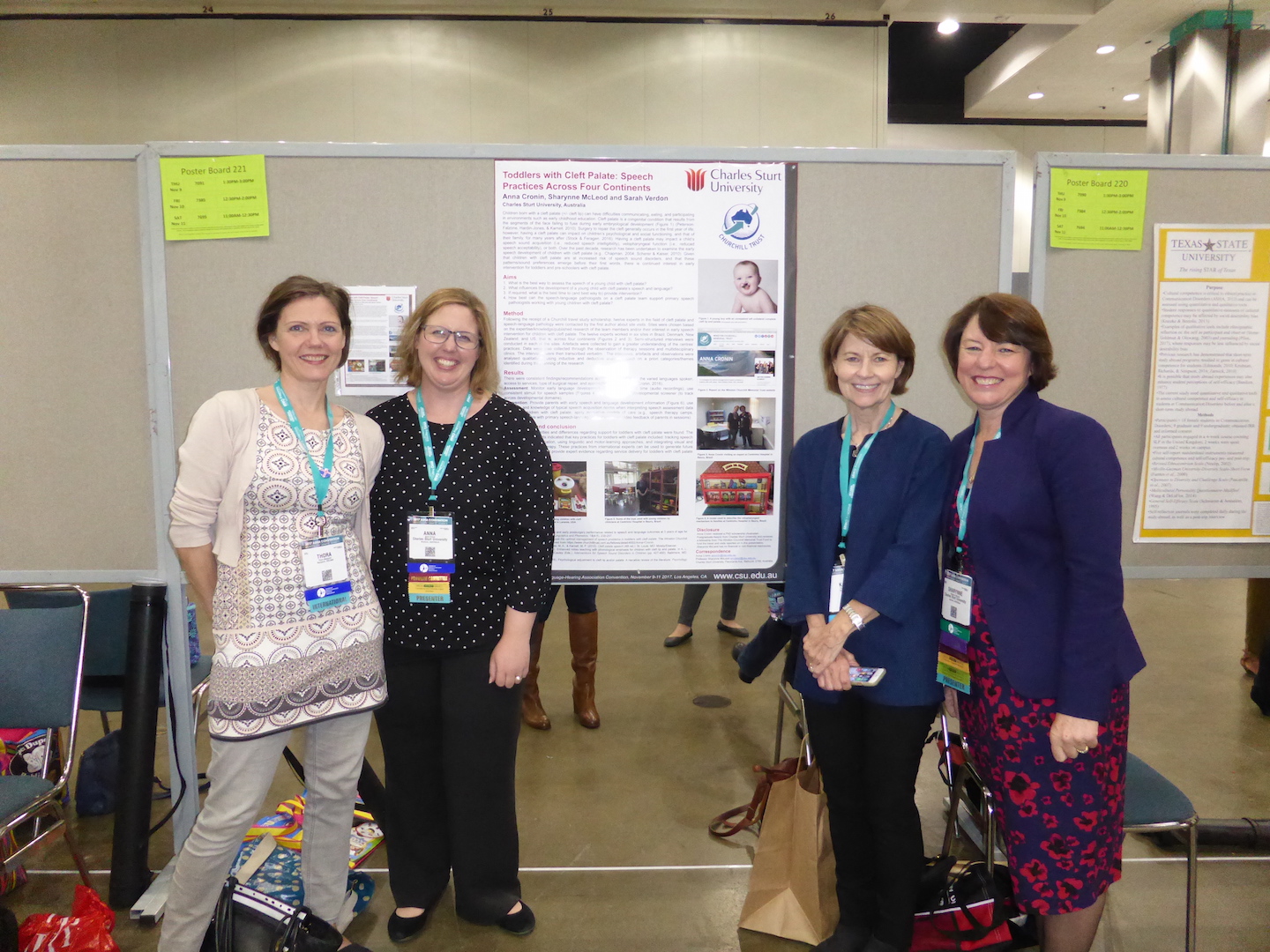
  3. Cronin, A., McLeod, S., & Verdon, S. - Toddlers with cleft palate: Speech practices across four continents. Poster. 
  4. Hopf, S. C., McLeod, S., & McDonagh, S. H. - Validation of the Intelligibility in Context Scale for multilingual Fijian school children. Poster. 
  5. Hopf, S. C., McLeod, S., McDonagh, S. H., & Wang, C. - Culturally-sensitive practices supporting children's communication in Majority World countries: A Fijian perspective. Poster.
  6. Masso, S., McLeod, S., Baker, E., & McCormack, J. - Polysyllables and emergent literacy development in preschool children with speech sound disorders. Oral paper. 
  7. McGill, N., - Animation for education: The Speech-Language Pathology Referrals project. Poster.
  8. Phạm, B., McLeod, S., & Harrison, L. J. - Assessing Vietnamese children’s intelligibility. Poster. 
  9. Pham, G., Phạm, B., & McLeod, S. - Vietnamese children’s speech and language: Latest clinical research. Invited 1 hour seminar.
  10. Verdon, S., McLeod, S., & Wong, S. - The Principles of Culturally Competent Practice for speech-language pathologists. Oral paper. 
  11. Washington, K. N., & McLeod, S. - Global tools and resources for pediatric SLPs: Supporting children around the world. Invited 1 hour seminar. 
Helen Blake's presentation
Ben Pham's presentation
Ben's poster: Sharynne, Thanh and Ben Pham
Anna's poster: Thora Masdottir (Iceland), Anna Cronin, Kathy Chapman (USA), Sharynne
Suzanne's poster: Thora Masdottir, Suzanne Hopf (Fiji), Helen Blake, Anna Cronin, Tricia McCabe
Nicole's poster: Travis Threats (USA), Sharynne, Bernice Mathisen (Australia), Seyhun Topbas (Turkey), an SLP (USA)

Ben Pham's poster received a Most Meritorious Poster Award

September 19, 2017

Children's speech acquisition in Vietnamese and Cantonese

Today Ben Pham presented a paper titled "Acquisition of consonants, vowels and tones by children in Northern Viet Nam" at the 10th Asia Pacific Conference of Speech, Language, and Hearing (APCSLH) in Narita, Japan.
Sharynne, Ben Pham and A/Prof Kathy Lee from Chinese University of Hong Kong
Ben's work has been informed by a paper by A/Prof Carol To from the University of Hong Kong published in Journal of Speech, Language, and Hearing Research in 2013. Ben and Carol have had a number of opportunities to discuss their work while in Japan. Such collaboration and sharing strengthens research quality.
A/Prof Carol To (University of Hong Kong) and Ben Pham discussing
Cantonese and Vietnamese children's speech acquisition

September 17, 2017

Asia Pacific Conference of Speech, Language, and Hearing

The 10th Asia Pacific Conference of Speech, Language, and Hearing (APCSLH) is being held in Narita, Japan on 17-19 September.  There are 450+ attendees from 18 countries and 82 papers and 174 posters are being presented. I am presenting an invited paper and Ben Phạm is presenting two papers:
  • McLeod, S. - Identifying children with speech sound disorders across languages (invited)
  • Phạm, B., McLeod, S. & Harrison, L. J. - Validation of the Intelligibility in Context Scale with preschool children in Ha Noi, Viet Nam 
  • Phạm, B. & McLeod, S. - Acquisition of consonants, vowels and tones by children in Northern Viet Nam 
Keynote speakers include Dr Lilly Cheng,  Dr Loraine Ramig (LSVT),
and Dr Patty Prelock from USA
We are having a wonderful time networking with people from across the Asia Pacific region.
Vietnamese colleagues: Dr Sally Hewat, Sharynne, Mrs Loan, Ms Thanh,
Ben Pham, Sarah Day, Dr Cuong
Hong Kong colleagues: A/Prof Carol To, A/Prof Kathy Lee (with her new
Cantonese Spoken Word Recognition Test), Sharynne and Ben Pham
Taiwan/USA colleague: Sharynne, Prof. Lilly Cheng, Ben Pham
Thai colleagues: A/Prof Sumalai Maroonroge and Prof. Benjamas Prathanee
Ben Pham and I had fun at the Japanese cultural centre organised by the conference