 Italian
- Greek
- Cantonese
- Arabic
- Mandarin
- Vietnamese
- Spanish
- German
- Hindi
- Macedonian
- Croatian
- Australian Indigenous languages
- Korean
- Turkish
- Polish
- Tagalog
- Serbian
- French
- Indonesian
- Filipino
- Maltese
- Russian
- Dutch
- Other Chinese languages
- Japanese
- Tamil
- Sinhalese
- Samoan
- Portuguese
- Khmer
- Persian
- Hungarian
- Dari
- Other Iranic languages
- Other languages
April 28, 2010
Multilingual Australia
Australia is a very multilingual society. Of the languages other than English reported to be used at home, the most dominant languages are Italian (10.4%), Greek (8.0%), Cantonese (7.8%), Arabic (7.7%) and Mandarin (7.0%) (Australia Bureau of Statistics, 2006). In order the most frequent languages spoken are:


Amazing Australia


 As part of my Future Fellowship I have travelled to different places in Australia. Here are a few photos to show our amazing country.

Speech Pathology Australia National Tour
Speech Pathology Australia National Tour:
Working With Children From Multilingual Backgrounds
Presented by Associate Professor Cori Williams
Yesterday I had the pleasure of attending the Speech Pathology Australia (SPA) National Tour presented by Cori Williams. It was wonderful to listen and learn from Cori and to discuss these important issues with other SLPs including Kate Crowe, my PhD student who also went to Canberra for the day. A number of SLPs from Canberra work with children of diplomats, so conducting intervention in these children's home languages is very important for when they return to their home countries.
Cori and I have designed a questionnaire that is being given to each of the participants in the SPA National Tour workshops to find out about Australian SLPs' beliefs and practices about working with children from multilingual backgrounds. Cori has now finished two of her eight presentations, so we look forward to analysing the data when she is finished.
Working With Children From Multilingual Backgrounds
Presented by Associate Professor Cori Williams
Yesterday I had the pleasure of attending the Speech Pathology Australia (SPA) National Tour presented by Cori Williams. It was wonderful to listen and learn from Cori and to discuss these important issues with other SLPs including Kate Crowe, my PhD student who also went to Canberra for the day. A number of SLPs from Canberra work with children of diplomats, so conducting intervention in these children's home languages is very important for when they return to their home countries.
Cori and I have designed a questionnaire that is being given to each of the participants in the SPA National Tour workshops to find out about Australian SLPs' beliefs and practices about working with children from multilingual backgrounds. Cori has now finished two of her eight presentations, so we look forward to analysing the data when she is finished.
 |
| Associate Professor Cori Williams and Professor Sharynne McLeod thinking about multilingual speech in Canberra |
April 24, 2010
HCSNet Workshop: Advances in Speech Production
This week I attended the HCSNet Workshop: Advances in Speech Production: Tools, Techniques and Recent Research at University of Western Sydney, Milperra.
There were many distinguished speakers:
There were many distinguished speakers:
- Christian Kroos (MARCS Labs, UWS) Making speech production transparent: The AHAA and Face & Voice laboratories at MARCS
- Douglas Whalen (Haskins Laboratories, U.S.A.). Ultrasound investigation of speech articulation dynamics
- Mark Tiede (Haskins Labs & MIT, U.S.A.). Uses and abuses of ElectroMagnetic Articulometry (EMA)
- Andy Butcher (Flinders U) Electropalatography (EPG): Tracking the spatio-temporal patterns of tongue-palate contact.
- Eric Vatikiotis-Bateson (U British Columbia, Canada). Time to re-think temporal control of communicative behavior
- Roland Goecke (U Canberra). Tracking faces without artificial markers
- Adaptation to the electropalatograph (EPG) palate: Consonant acoustics, listener perceptions, and speaker rating (Sharynne McLeod and Jeff Searl)
- Combining ultrasound and electropalatography (EPG) for research into speech production (Sharynne McLeod and Alan Wrench)
CSU speech pathology graduation
On Thursday I went to Charles Sturt University in Albury to celebrate the graduation of:
- Bethany Toohill who graduated with BHlthSc(Sp Path)(Hons) and was supervised by Jane McCormack and myself
- Anna O'Callaghan who graduated with a PhD and was the first CSU undergraduate speech pathology student to graduate with a PhD
- Michelle Smith-Tamaray who also graduated with a PhD. Michelle and Anna were the CSU speech pathology course's first PhD graduates.
- The last cohort of CSU speech pathology undergraduate students that I taught (when they were in year 2).
 |
| Sharynne McLeod, Bethany Toohill and Jane McCormack: Proud supervisors celebrating Bethany's graduation. |
April 14, 2010
Big ASC: Big Australian Speech Corpus
Over the past 2 days I have been in Sydney to work with Australia's best linguists and phoneticians to develop protocols for the Big ASC: Big Australian Speech Corpus. The aim of the project is to collect high quality audio and video recordings of Australian adults' speech from across the country. The data will be loaded into the Australian National Corpus for people across the world to use in their research.
Future funding applications may enable the development of the Little ASC of Australian children.
Future funding applications may enable the development of the Little ASC of Australian children.
Multilingual Aspects of Speech Sound Disorders in Children
My latest book officially began today. Within 12 hours of inviting authors over a third have said yes! I am looking forward to working with Brian on this exciting project:
Title: Multilingual Aspects of Speech Sound Disorders in Children
Editors: Sharynne McLeod and Brian A. Goldstein
Publisher: Multilingual Matters
Synopsis: Multilingual Aspects of Speech Sound Disorders in Children aims to translate research into clinical practice for speech-language pathologists working with multilingual children with speech sound disorders. The book explores both multilingual and multicultural aspects of children with speech sound disorders. It is divided into three sections: I. Foundations, II. Multilingual speech acquisition, III. Speech-language pathology practice.
An introductory chapter will discuss general characteristics. Subsequent chapters will address speech acquisition, how the disorder manifests in different languages, cultural contexts, and speakers, and addresses diagnosis, assessment and intervention.
A unique feature of this book is the translation of research into clinical practice. There will be 14 research chapters that primarily focus on an identified topic and describe available research across a wide range of languages. These will be supplemented by application/translation chapters that translate research into practice providing vignettes for specific geographical or linguistic contexts.

Title: Multilingual Aspects of Speech Sound Disorders in Children
Editors: Sharynne McLeod and Brian A. Goldstein
Publisher: Multilingual Matters
Synopsis: Multilingual Aspects of Speech Sound Disorders in Children aims to translate research into clinical practice for speech-language pathologists working with multilingual children with speech sound disorders. The book explores both multilingual and multicultural aspects of children with speech sound disorders. It is divided into three sections: I. Foundations, II. Multilingual speech acquisition, III. Speech-language pathology practice.
An introductory chapter will discuss general characteristics. Subsequent chapters will address speech acquisition, how the disorder manifests in different languages, cultural contexts, and speakers, and addresses diagnosis, assessment and intervention.
A unique feature of this book is the translation of research into clinical practice. There will be 14 research chapters that primarily focus on an identified topic and describe available research across a wide range of languages. These will be supplemented by application/translation chapters that translate research into practice providing vignettes for specific geographical or linguistic contexts.

By including these two different styles of chapters authors will be drawn from across the globe to provide exemplars of the multitude of issues when working with multilingual children with speech sound disorders.
March 18, 2010
International trans-disciplinary perspectives on speech and language
On Wednesday 7th April, 2010 two renowned academics visited Charles Sturt University, Bathurst: Sara Howard, Reader in Clinical Phonetics, President, International Clinical Phonetics and Linguistics Association and Mick Perkins, Emeritus Professor of Clinical Linguistics both of the Department of Human Communication Sciences at The University of Sheffield, England.
The morning program consisted of a seminar and discussion
The afternoon program consisted of the following public lectures:
Mick Perkins: Pragmatic impairment: Cognitive deficit or interactional achievement?
Sara Howard:Analysing children's speech: From single words to connected speech
Ben Bradley: Infancy, language and thirdness
The aim of this day was to catalyse thinking and collaboration between practitioners and researchers who have interests in speech and language but have different disciplinary and ideological standpoints.
CSU news announcement
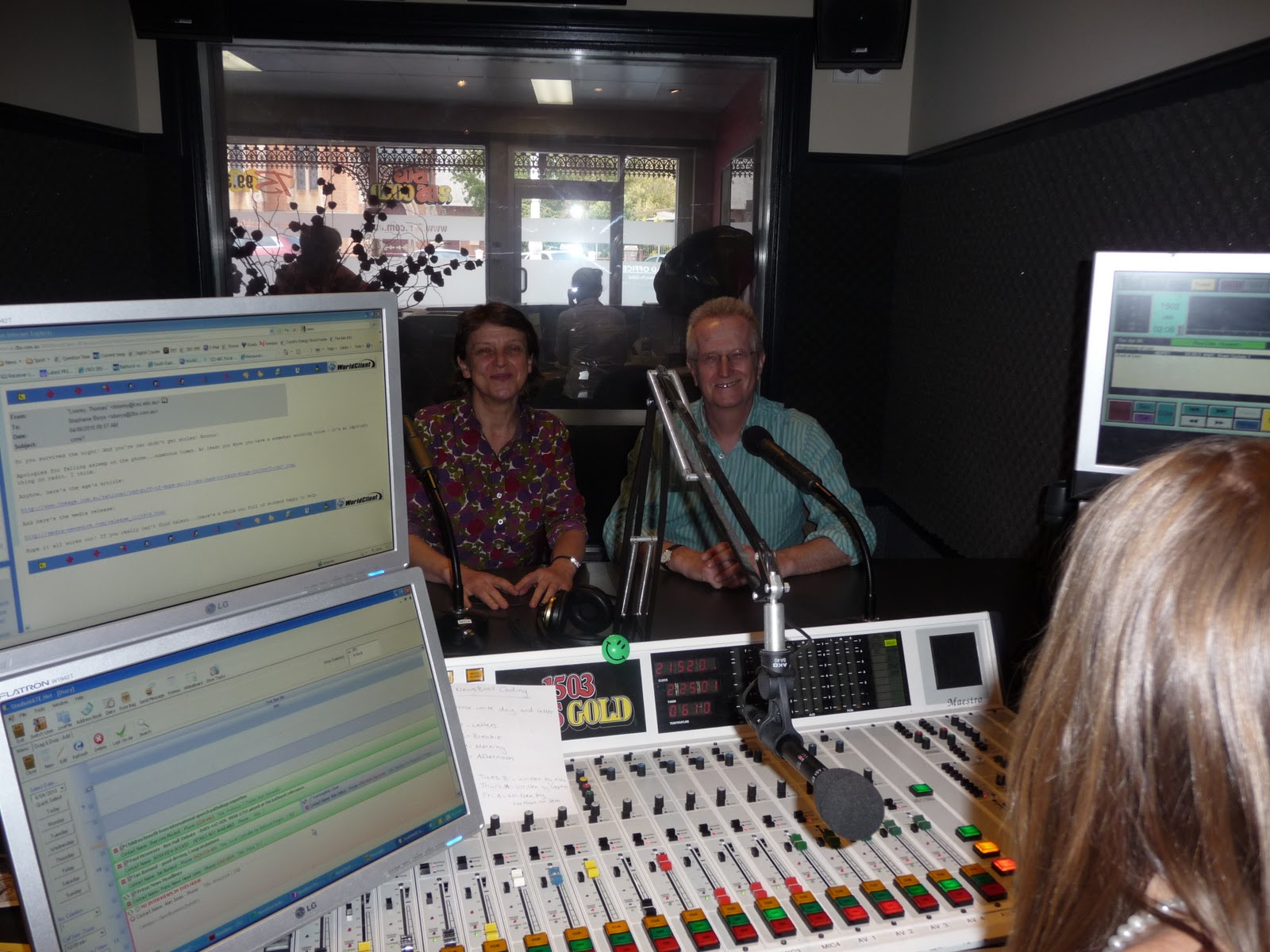 |
| Sara and Mick being interviewed at radio 2BS |
March 14, 2010
Japanese, Italian and Tongan
- This week I was invited by Margaret Crapp to give a presentation to the Inner Wheel Club titled "Supporting others to realize their full potential". Part of their mission is to provide friendship and international understanding.

- Hannah Wilkin and I worked on Japanese and Italian word lists for the International Speech Assessment (ISA).
- I went to a dinner for Japanese visitors from Toyo High School (Tokyo).
- I then went to a Tongan night hosted by 'Oto and Bella Faiva and their family and learned of the importance of the royalty, church and community to the Tongan people and how people wear a tapa to show their respect.

March 2, 2010
Vale Dr. Sadanand Singh
 I learned today that my friend, colleague and co-author, Dr. Sadanand Singh passed away on the weekend. Dr. Singh was the founder of both Singular Publishing and Plural Publishing. He was a giant in our profession, a visionary and a gracious gentleman. He will be greatly missed.
New York Times
Plural Publishing
March 1, 2010
Visit to Macquarie University, Sydney
Today I visited Macquarie University and met with:
Dr. Felicity Cox , Department of Linguistics: Felicity is going to be working with the electropalatography and ultrasound technology for recording speech production that I used to write Speech Sounds (McLeod & Singh, 2009). Felicity is also the founder of the the Australian Voices project and is working on building the Australian National Corpus (AusNC).
Professor Katherine Demuth, Department of Linguistics: Katherine wrote the chapter on Sesotho speech acquisition in the International Guide to Speech Acquisition (McLeod, 2007). Katherine give me advice regarding my visit to Mwandi in Zambia to work with children who speak Silozi.
 Katherine Demuth, Sharynne McLeod (wearing a helmet to stablize ultrasound recordings of the tongue) and Feliticy Cox
Professor Gail Whiteford, Pro Vice-Chancellor Social Inclusion. Prof. Whiteford showed me some of the work she is undertaking to promote social inclusion across the university.

February 25, 2010
IJSLP ranked an A journal by the Australian Government
IJSLP ranked an A journal by the Australian Government
International Journal of Speech-Language Pathology has been ranked as an A journal in the Excellence for Research in Australia (ERA) rankings released this month. Journals are ranked as A*, A, B, C, or unranked, so this ranking places IJSLP amongst the top speech-language pathology journals in the world according to the Australian government. For the complete list of journals see: www.arc.gov.au/era/era_journal_list.htm.
This ranking follows shortly after the inclusion of IJSLP in SCOPUS and the ISI Social Sciences Citation Index. These accolades are very important for the longevity of the journal in today’s very competitive academic climate.
International Journal of Speech-Language Pathology has been ranked as an A journal in the Excellence for Research in Australia (ERA) rankings released this month. Journals are ranked as A*, A, B, C, or unranked, so this ranking places IJSLP amongst the top speech-language pathology journals in the world according to the Australian government. For the complete list of journals see: www.arc.gov.au/era/era_journal_list.htm.
This ranking follows shortly after the inclusion of IJSLP in SCOPUS and the ISI Social Sciences Citation Index. These accolades are very important for the longevity of the journal in today’s very competitive academic climate.
Publications in 2010
2010 has been a good year so far for publications:
JOURNAL ARTICLES
JOURNAL ARTICLES
- Yavaş, M. & McLeod, S. (2010). Acquisition of /s/ clusters in English speaking children with phonological disorders. Clinical Linguistics and Phonetics, 24(3), 169-176.
- McLeod, S., Press, F., & Phelan, C. (2010). The (in)visibility of children with communication impairment in Australian health, education, and disability legislation and policies. Asia Pacific Journal of Speech, Language, and Hearing, 13(1), 67-75.
- McCormack , J., McLeod, S., Harrison, L. J., McAllister, L., & Holliday, E. L. (2010). A different view of talking: How children with speech impairment picture their speech. ACQuiring Knowledge in Speech, Language, and Hearing, 12(1), 10-15.
- Barr, J. & McLeod, S. (2010). They never see how hard it is to be me: Siblings’ observations of strangers, peers and family. International Journal of Speech-Language Pathology, 12(2), 162-171.
- Williams, A. L., McLeod, S. & McCauley, R. J. (Eds.) (2010). Interventions for speech sound disorders in children. Baltimore, MA: Paul H. Brookes Publishing.
- McLeod, S. (2010). Laying the foundations for multilingual acquisition: An international overview of speech acquisition. In M. Cruz-Ferreira (Ed). Multilingual norms (pp. 53-71). Frankfurt: Peter Lang Publishing.
- McLeod, S. & Searl, J. (2010). Adaptation to an electropalatograph palate: Acoustic, impressionistic, and perceptual data. In T. W. Powell & M. J. Ball (Eds). Clinical linguistics: Critical concepts in linguistics (Vol. 2, pp. 195-221). Oxford: Routledge.
- Baker, E. & McLeod, S. (2010). Evidence-based management of phonological impairment in children. In T. W. Powell & M. J. Ball (Eds). Clinical linguistics: Critical concepts in linguistics (Vol. 4, pp. 446-469). Oxford: Routledge.
- Williams. A. L., McLeod, S. & McCauley, R. J. (2010). Direct speech production interventions. In A. L. Williams, S. McLeod, & R. J. McCauley (Eds.) Interventions for speech sound disorders in children. Baltimore, MA: Paul H. Brookes Publishing.
- McLeod, S., McCauley, R. J., & Williams, A. L. (2010). Speech interventions in broader contexts. In A. L. Williams, S. McLeod, & R. J. McCauley (Eds.) Interventions for speech sound disorders in children. Baltimore, MA: Paul H. Brookes Publishing.
- McCauley, R. J., Williams, A. L., & McLeod, S. (2010). Interventions for achieving speech movements. In A. L. Williams, S. McLeod, & R. J. McCauley (Eds.) Interventions for speech sound disorders in children. Baltimore, MA: Paul H. Brookes Publishing.
- McCauley, R. J., Williams, A. L. & McLeod, S. (2010). Interventions for speech sound disorders in children: Future directions. In A. L. Williams, S. McLeod, & R. J. McCauley (Eds.) Interventions for speech sound disorders in children. Baltimore, MA: Paul H. Brookes Publishing.
International perspectives on clinical linguistics and phonetics
The first issue of International Journal of Speech-Language Pathology for 2010 has as its theme: International perspectives on clinical linguistics and phonetics.
www.informahealthcare.com/ijslp
This issue highlights the internationalization of the journal with the publication of manuscripts by authors from: UK, Spain, Belgium, Netherlands, Norway, Ireland, Hong Kong SAR, Hungary, USA, and Australia.
It was a pleasure and a challenge to edit this issue - the Chinese characters and phonetic symbols kept both myself and the typesetters on their toes.
Assessing prosodic skills in five European languages: Cross-linguistic differences in typical and atypical populations
Sue J. E. Peppé, Pastora Martínez-Castilla, Martine Coene, Isabelle Hesling, Inger Moen, and Fiona E. Gibbon
A database for investigating the logographeme as a basic unit of writing Chinese
Hoi-Ming Lui, Man-Tak Leung, Sam-Po Law, and Roxana Suk-Yee Fung
Production of tense marking in successive bilingual children: When do they converge with their monolingual peers?Theodoros Marinis and Vasiliki Chondrogianni
Temporal parameters of spontaneous speech in Alzheimer’s disease
Ildikó Hoffmann, Dezso Nemeth, Cristina D. Dye, Magdolna Pákáski, Tamás Irinyi, and János Kálmán
Assessing frequency effects on verb inflection use by Spanish-speaking individuals with agrammatism: Theoretical and clinical implicationsJosé G. Centeno and Helen Smith Cairns
Verbal repetition skill in language impaired children: Evidence of inefficient lexical processing?Neville W. Hennessey, Suze Leitão, and Kate Mucciarone
Through the magnifying glass: Underlying literacy deficits and remediation potential in Childhood Apraxia of SpeechElena Zaretsky, Shelley L. Velleman, and Kristina Curro
Phonetic and phonological errors in children with high functioning autism and Asperger syndrome
Joanne Cleland, Fiona E. Gibbon, Sue J. E. Peppé, Anne O’Hare and Marion Rutherford
www.informahealthcare.com/ijslp
This issue highlights the internationalization of the journal with the publication of manuscripts by authors from: UK, Spain, Belgium, Netherlands, Norway, Ireland, Hong Kong SAR, Hungary, USA, and Australia.
It was a pleasure and a challenge to edit this issue - the Chinese characters and phonetic symbols kept both myself and the typesetters on their toes.
Assessing prosodic skills in five European languages: Cross-linguistic differences in typical and atypical populations
Sue J. E. Peppé, Pastora Martínez-Castilla, Martine Coene, Isabelle Hesling, Inger Moen, and Fiona E. Gibbon
A database for investigating the logographeme as a basic unit of writing Chinese
Hoi-Ming Lui, Man-Tak Leung, Sam-Po Law, and Roxana Suk-Yee Fung
Production of tense marking in successive bilingual children: When do they converge with their monolingual peers?Theodoros Marinis and Vasiliki Chondrogianni
Temporal parameters of spontaneous speech in Alzheimer’s disease
Ildikó Hoffmann, Dezso Nemeth, Cristina D. Dye, Magdolna Pákáski, Tamás Irinyi, and János Kálmán
Assessing frequency effects on verb inflection use by Spanish-speaking individuals with agrammatism: Theoretical and clinical implicationsJosé G. Centeno and Helen Smith Cairns
Verbal repetition skill in language impaired children: Evidence of inefficient lexical processing?Neville W. Hennessey, Suze Leitão, and Kate Mucciarone
Through the magnifying glass: Underlying literacy deficits and remediation potential in Childhood Apraxia of SpeechElena Zaretsky, Shelley L. Velleman, and Kristina Curro
Phonetic and phonological errors in children with high functioning autism and Asperger syndrome
Joanne Cleland, Fiona E. Gibbon, Sue J. E. Peppé, Anne O’Hare and Marion Rutherford
February 23, 2010
Websites about bilingual speech acquisition
Here are some websites that are relevant to the consideration of bilingual speech acquisition
- Bilingual therapies: http://blog.bilingualtherapies.com
- The right to be bilingual: http://www.francoisgrosjean.ch/the_right_en.html
The Future Fellowship officially begins
My Future Fellowship officially began on Monday 8th February, 2010.

What a privelidge it is to think about research full time!
My first weeks have been a productive and collegial time. Here are a few highlights:
1. Dr. Karla Washington and I submitted a grant application titled: Investigating children's acquisition of Jamaican Creole (Patois). While I was working in the Australian summer heat, Karla was in the Canadian snow (below)
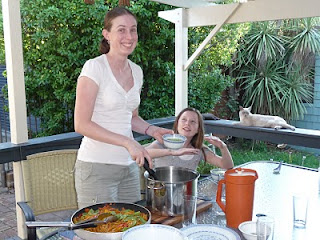
2. Kate Crowe came to Bathurst for a week and worked on her PhD proposal titled: Multilingual children with hearing loss: Communication choices and outcomes. Kate cooked a lovely Chinese meal to inspire us (below).
3. Jane McCormack and I have been invited to co-author a book chapter on Communication measures for the ICF-CY:
McLeod, S., McCartney, E. & McCormack, J. (in process). Communication (d310-d369). In A. Majnemer (Eds). Measures for children with developmental disabilities: Framed by the ICF-CY. London: Mac Keith Press.
4. I attended the christening of Xander Watts Pappas. Xander's mum is my colleague and ex-PhD student. The celebration was wonderful Greek family event and enabled me to participate in an important aspect of bicultural Australia.
5. This week Isabelle Simard is visiting from Montréal Canada. She speaks many languages (including French, English, Spanish, German, Italian, Portuguese, Arabic and Greek!) and her SLP clinic specialises in working with multilingual children.
December 22, 2009
CRiCS Summer School, Bathurst, Dec 2009

I was invited to close the Centre for Research in Complex Systems biennial summer school with a 1 hour presentation titled "Speech sounds around the world". The audience spoke many languages including French, German, Spanish, Turkish, Cantonese, Putonghua, and Bengali so they provided many examples and were enthusiastic participants.
The CRiCS December newsletter recorded: "The summer school concluded with a dynamic, interactive presentation from Sharynne McLeod on speech sounds around the world."
The CRiCS December newsletter recorded: "The summer school concluded with a dynamic, interactive presentation from Sharynne McLeod on speech sounds around the world."
December 13, 2009
LSAC Research Conference, Melbourne, Dec 2009
The 2nd Longitudinal Study of Australian Children (LSAC) Research Conference was held in Melbourne in December, 2009. My colleagues, Linda Harrison and Jane McCormack presented papers based on our ARC Discovery Project (2007-2009). The methods and findings from the Disovery Project are foundational for the ARC Future Fellowship.
Presentations:
Presentations:
- Harrison, L. J., McLeod, S., Berthelsen, D. & Walker, S. (2009, December). Impact of speech and language impairment at 4- to 5-years on literacy, numeracy, and learning at 6- to 7-years. 2nd Growing Up in Australia: Longitudinal Study of Australian Children (LSAC) Research Conference, Melbourne.
- McLeod, S., Harrison, L. J., McAllister, L. & McCormack, J. (2009, December). Correspondence between direct assessment of speech and language impairment in 4- to 5-year-olds and LSAC measures of parent and teacher reported concern. Poster presented at the 2nd Growing Up in Australia: Longitudinal Study of Australian Children (LSAC) Research Conference, Melbourne.
Korean

My daughter received an award from the Korean Government for "outstanding accomplishment in Korean language study" through her local public school in rural Australia. Her school class has regular videoconferences with their sister class in Korea.
HCSNet Conference, Sydney, Dec 2009
The Human Communication Science Network Conference was held in Sydney in December 2009. It included the Australian Language and Speech Conference, Building the Australian National Corpus workshop, OzPhon and other events related to Human Communication Science.
 Kate Crowe and Sharynne at the HCSNet Conference at University of NSW, Sydney
 Kate Crowe and Sharynne at the HCSNet Conference at University of NSW, Sydney
Presentations
- McLeod, S., Harrison, L. J., McAllister, L. & McCormack, J. (2009, December). Prevalence of communication impairment in 4- to 5-year-old Australian children. Australian Language and Speech Conference, Sydney.
Subscribe to:
Posts (Atom)