July 31, 2011

First Nations, Métis and Inuit People of Canada

While in Canada I have had the opportunity to learn about the First Nations, Inuit and Métis people of Canada. People I have learned from include:
  • Prof May Bernhardt who teaches a course at the University of British Columbia about working with First Nations people,
  • Heather Campbell who is undertaking research about bi-dialectal First Nations speakers, and
  • Deanne Zeidler who has worked as a speech-language pathologist (SLP) with the First Nations people north of Vancouver for 17 years. Deanne has co-authored a family program called Talk, Learn, and Grow.  She has also uses the Moe the Mouse phonological awareness program. She is going to co-present a 1 hour session on her work at the American Speech-Language-Hearing convention in November.
One important thing that I have learned is that individualised assessment often is not appropriate when working with First Nations people. Talking with the community about their dreams for the future (for the whole community including its children) is the most important place to start. Standardized testing is not relevant, so many SLPs ask parents and teachers to talk to the children so that language samples can be elicited, then discussed together. Some have suggested that amongst First Nations people, disability is accommodated, so there is not as much urgency about speech and language difficulties as there is within English-speaking contexts.
Prof Joe Stemberger, Prof May Bernhardt, and Sharynne
with the totem poles from different nations in Stanley Park, Vancouver
Inukshuk at Whistler (a wonderfully scenic location;
however, inukshuks are normally found amongst Inuit people in the Artic Circle)
First Nations Cultural Centre at Whistler
There are 16 dialects of the Coast Salish family. Two dialects are Squamish and Lil'wat. At Whistler, the Squamish and Lilwat Nations have cooperated and open Cultural Centre providing artefacts and narrative about the two Nations. I found this quote to be very powerful in the context of maintaining these languages, and ensuring that First Nations children continue to learn them:
"Without our language there is no culture; without our culture there is no language" Johnny S. Abraham, Lil'wat Nation.
Deanne Zeidler and Sharynne near Lilooet (home of Lil'wat people)

Vancouver, BC, Canada

Prof May Bernhardt and Prof Joe Stemberger have hosted my stay in Vancouver. While here I have presented a seminar at the University of British Columbia (UBC) titled International speech acquisition: An Australian perspective.

L-R: Prof May Berhnardt, Daniel Berube, Heather Campbell, Sharynne, Sandy Taylor,
Dr Stefka Marinova-Todd, Dr Donald Derrick
May, Joe, Stefka, and the team have been working on a large cross-linguistic study of typical speech acquisition. They have developed a speech assessment, and scan analysis in the following languages:
Kuwaiti Arabic, Bulgarian, Canadian English, Manatoba French, German, Slovanian, Icelandic, Shanghai Mandarin, Japanese, Hungarian, Swedish, Spanish, Portuguese, Korean, and Punjabi.
They also have tested 30 typical children in most of these languages. Their assessments and analyses will be made available on the UBC website in the future.
Meeting Dr Stefka Marinova-Todd who co-authored the chapter
on Filipino in the International Guide to Speech Acquisition

Bidialectal Jamaican speech

While in Toronto, Dr Karla Washington and I have been preparing to undertake research into Jamaican children's speech acquisition. Jamaican children are bi-dialectal, speaking the Jamaican English (for school and other more formal occasions) and Jamaican Patois (for other occasions).

Karla has written a chapter titled: Translation to Practice: Typical Bidialectal Speech Acquisition in Jamaica  in the forthcoming McLeod & Goldstein book. She has written: "In Jamaica, Jamaican English and Jamaican Creole are the two polar co-occurring language varieties. Jamaican English is putatively the “Queen’s English”, the acrolect, and is used formally both in oral and written forms (Irvine, 2004). Alternately, Jamaican Creole the basilect, is considered an oral language resulting from multiple etymologies, including English, West African, and French languages (Cassidy, 1966) that is used informally (Irvine, 2004; 2008). Jamaicans are typically introduced to Jamaican Creole and Jamaican English from birth (Irvine, 2004; Meade, 2001), making them simultaneous language learners. Jamaican children therefore enter the school system speaking both Jamaican English and Jamaican Creole; however, the language of instruction in schools is Jamaican English (Brown-Blake, 2008; Irvine, 2004). Jamaican Creole phonology consists of 33 different phonemes, comprising 21 consonants and 12 vowels (Devonish & Harry, 2004; Harry, 2006)..."

As part of the preparation, I have enjoyed eating Jamaican food, including ackee and salted codfish, the Jamaican national dish.
Top L- Lower R: Dumplings, ackee and salted codfish, plantains, boiled green bananas,
Text message written in Jamaican Creole


Learning in London and Toronto, ON, Canada

Dr Karla Washington has hosted my visit to Ontario, Canada.
During my stay we have visited the University of Western Ontario (in London, ON), and have met Prof Geneese Warr-Leeper, who developed TykeTalk and has published a book for parents in English and French titled: Helping Kids Discover and Develop Language.
Dr Karla Washington and Prof Geneese Warr-Leeper


Dr Karla Washington and Sharynne at University of Western Ontario
I also presented an invited seminar at Bloorview Research Institute in Toronto titled: Children's speech: Prevalence, risk and impact of speech sound disorder. While there, I met with Prof. Nancy Thomas-Stonell, who has created the FOCUS (Focus on Children under Six), an outcome measure based on the International Classification of Functioning, Disability and Health.

Sharynne, Prof Nancy Thomas-Stonell, and Dr Karla Washington

July 24, 2011

International Association for the Study of Child Language

From 19-23 July I attended the 12th meeting of the International Association for the Study of Child Language (IASCL) held at the Université du Québec à Montréal in Canada. The program included 63 thematic symposia (250 papers) and 343 posters. I had the opportunity to hear papers from many experts including
Fred Genesee: Myths and misunderstandings about dual language acquisition in young learners
Simon E. Fisher: Building bridges between genes, brains and language
Deb Roy: A study of language development in context (see here for YouTube video: http://www.youtube.com/watch?v=VwgkT34g61w)

I presented a poster titled: Linguistic diversity in a nationally representative sample of Australian 4- to 5-year-old children and their parents.

I also enjoyed meeting authors of chapters from the International Guide to Speech Acquisition (McLeod, 2007) on French and Finnish. Previously I had only corresponded with them via email. It has been exciting to see the additional research that has been undertaken since 2007 in French and Finnish regarding children's speech acquisition.

Tuula Savinainen-Makkonen, Sharynne, and Sari Kunnari

Sharynne and Prof Yvan Rose - Memorial University of Newfoundland

Listening to children and young people with speech, language and communication needs

While in Montreal, Prof Sue Roulstone (from the University of the West of England) and I have finished and submitted a book titled: Listening to children and young people with speech, language and communication needs. This book began last year, when I was visiting Bristol.

The book profiles the voice of the children and young people with speech, language and communication needs. Throughout the book, many examples of children’s opinions and thoughts are included, delivered via a range of frontiers, including art, photographs, and quotes.

Fifty people have contributed chapters to this book providing insights from speech and language therapists, social workers, psychologists, teachers, researchers, advocates, parents, and young people with speech, language and communication needs.
*Part I provides views about the importance of listening to children written by advocates for children with speech, language and communication needs.
*Part II unpacks the complexities and issues, providing theoretical perspectives about the listening process.
*Part III contains real life examples of listening to children and young people through structured reports of research and clinical projects. One of the aims of this part is to document a range of creative techniques and solutions for listening to children and young people. Additionally, Part III includes key messages from children and young people with speech, language and communication needs about their lives, and their insights into how services can be improved to better accommodate their needs.

It is our hope that book will provide direction for health, education, and social care services to enhance the lives of children and young people with speech, language and communication needs.
Prof Sue Roulstone and Sharynne with a sample version of their new book

Multilingual Montréal (Quebec, Canada)

Montréalers have impressed me with the ease that they switch between French and English. The 2006 census
indicated 59.9% of the population speaks French at home while 19.4% speaks English; however, many Montréalers are bilingual French-English.

In Quebec, if information is provided in a public place, then the English text should be 40% of the size of the French text.

While in Montréal I visited Isabelle Simard’s multilingual speech-language pathology clinic where she provides assessments and interventions in many languages.
I have also visited and talked with people from the two universities in Montréal that educates speech-language pathologists. McGill is an English university and the University of Montréal is a French university.

Isabelle Simard and Sharynne at Université de Montréal

I enjoyed meeting with Prof. Susan Rvachew and Prof. Elin Thordadottir of McGill University. We discussed multilingual perception and production of speech and language, and ideas for assessments. We also discussed Susan’s new book: Developmental Phonological Disorders: Foundations of Clinical Practice.
Prof Elin Thordardottir, Prof Susan Rvachew, Sharynne


July 23, 2011

AusTalk: A national treasure

The aim of AusTalk is to create a corpus of  high quality audio/videos of the speech of 1000 Australian adults. Each adult is recorded 3 times for an hour each time, resulting in a rich source of content that can be used in many applications, including forensics, computer science, hearing aid/cochlear implant technology, and speech pathology.
AusTalk is funded by the Australian Research Council and I have been honoured to oversee the Bathurst (Charles Sturt University) site of data collection. Rebekah Lockart is the extremely capable research assistant on the project. Bathurst is one of only 4 rural sites, the others are Geelong, Armidale, and Alice Springs. The University of Western Sydney is overseeing AusTalk.

For more information about AusTalk see: http://www.austalk.edu.au/
For the CSU media release see: here


Rebekah with the AusTalk equipment (black box)


Recording Australian speech
 

July 14, 2011

Developing quantitative research skills through longitudinal datasets

Researchers from Charles Sturt University, Queensland University of Technology and Monash University met in Bathurst for a 2-day research workshop titled "Children's development, learning and well-being in the early years: Developing quantitative research skills through longitudinal datasets". The workshop and presentations were lead by A. Prof Linda Harrison and the primary focus was on the Longitudinal Study of Australian Children. We learned about FLoSsE: the Australian Government's Department of Families, Housing, Community Services and Indigenous Affairs (FaHCSIA's) Longitudinal Surveys Electronic (FLoSse) Research archive that compiles research from:
  • Longitudinal Study of Australian Children (LSAC), (Growing Up in Australia)
  • Longitudinal Study of Indigenous Children (LSIC), (Footprints in Time)
  • Household, Income and Labour Dynamics in Australia (HILDA)(Living in Australia)
During the workshop I was author/coauthor on the following presentations:
  • Linguistic diversity in a nationally representative sample of Australian 4- to 5-year-old children
  • School outcomes for children identified with communication impairment in early childhood

July 2, 2011

Supporting monolingual speech pathologists' assessment of multilingual children

During 2011 I am very fortunate to be working with Rebekah Lockart, a masters student in the speech pathology program at Macquarie University. Her thesis is titled: "Factors that enhance Australian speech-language pathologists’ assessment of the speech of Cantonese-speaking children".
Rebekah and I will be working on the protocols and procedures for her research over the next few weeks. We are grateful for advice about Cantonese from Dr Carol To (Hong Kong University) and Dr Mun Yee Lai (Charles Sturt University).

Dr Mun Yee Lai, Rebekah Lockart, and Sharynne


June 30, 2011

Speech Pathology Australia National Conference in Darwin

This year's Speech Pathology Australia National Conference was held in Darwin from 26-29 June.
With the conference being held in Darwin, there were opportunities to learn from Aboriginal and Torres Straight Island people.

Keynote speakers at the conference were:
  • Dr Anne Lowell and her Yolngu colleagues Elaine Maypilama, Phyllis Batumbil and Helen Nyomba from the remote Indigenous Arnhem Land Community of Galiwin’ku. Their powerful presentation was titled: Closing the communication gap in Indigenous health: Working together to improve practice and outcomes
  • Prof Deborah Theodoros: A new era in speech pathology practice: Innovation and diversification
  • Prof Tim Sharp: Happiness at work...and beyond: Applying the principles of positive psychology!
My colleagues and I presented the following papers:
  • Williams, C. J. & McLeod, S. Working with children from multilingual backgrounds: Knowledge and practices of Australian speech pathologists.
  • McCormack, J., McLeod, S., McAllister, L., & Harrison, L. J. Living with speech impairment: Reflections on life from early childhood to adulthood.
  • McCormack, J., Harrison, L. J., McLeod, S., & McAllister, L. The Longitudinal Study of Australian Children: School outcomes for children identified with communication impairment in early childhood.

While at the conference, I enjoyed learning from Australia's speech pathology community, and also from people working as speech pathologists in New Zealand, UK, Vietnam, Uganda, and Senegal.
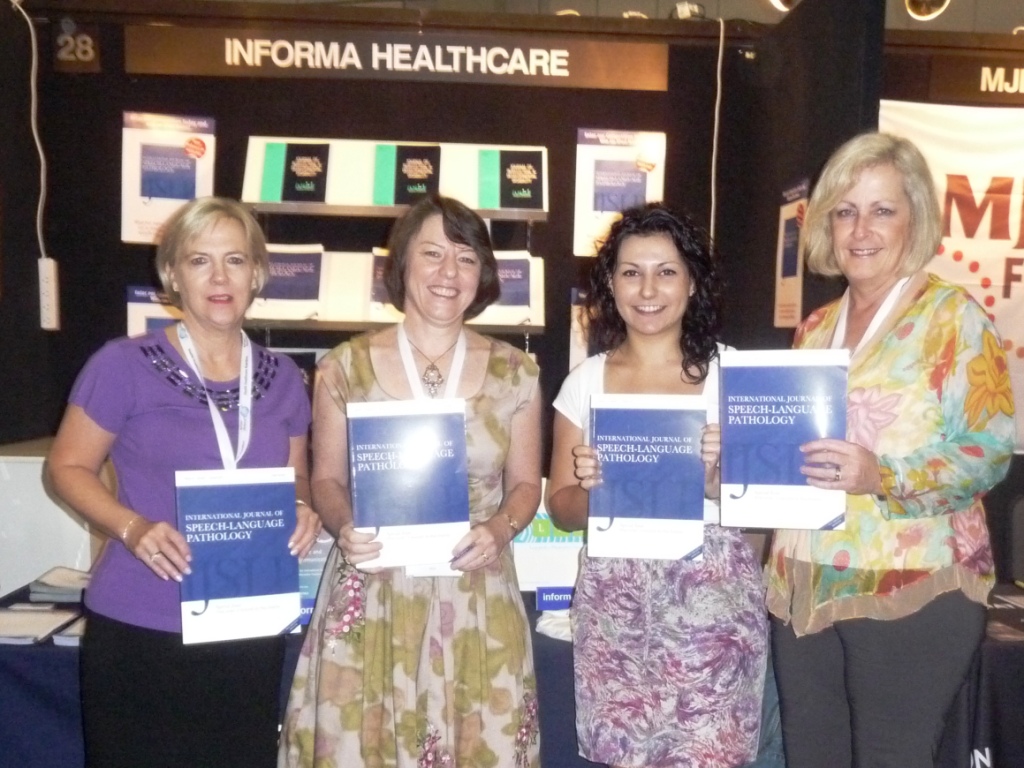
Also at the conference, I was busy in my role as the editor of Speech Pathology Australia's journal, International Journal of Speech-Language Pathology (see previous blog entry for exciting news!)

More information about the conference is here
Dr Caroline Bowen (centre) who was awarded life membership
of Speech Pathology Australia with Jane McCormack  and Sharynne

Sharynne, Dr Sally Hewat (U of Newcastle), Dr Diane Jacobs (LaTrobe University),
and Dr Emma McLaughlin (LaTrobe University)

Sharynne in Darwin with Dr Clare McCann and Dr Dean Sutherland
from University of Canterbury, Christchurch, New Zealand

June 29, 2011

International Journal of Speech-Language Pathology's first ISI impact factor

Today the International Journal of Speech-Language Pathology received it's first ISI Web of Knowledge Journal Citation Index impact factor. Our impact factor is 1.12 and it has been ranked 28th (of 62) in the world for all rehabilitation journals.
Speech Pathology Australia, informahealthcare and the editorial board have been working on this for 6+ years, so this ranking is a great achievement.
Thank you to EVERYONE who has supported the journal in so many ways (as authors, readers, citers, reviewers, board members etc).


Professor Fiona Gibbon (Ireland) described how the day progressed as the news was learned by the speech pathology community: "it was like a slow-motion Mexican wave of congratulatory emails as people turned on their computers around the world!"

L-R Prof Deborah Theodoros, Prof Sharynne McLeod (current editor),
Alla Kaploun (informa), Prof Beth Armstrong (previous editor)

June 15, 2011

Research Institute for Professional Practice, Learning and Education, CSU

The Research Institute for Professional Practice, Learning and Education (RIPPLE) Research Symposium was held in Wagga Wagga from 15-16 June. It was a time to celebrate the achievements of the researchers and to plan for the future of the Institute. I also spent time discussing my Future Fellowship progress and plans with Professor Tom Lowrie (Director of RIPPLE), Janet Wilks (RIPPLE), and Robert Doubleday (CSU Research Office). I really appreciate the support and encouragement from my CSU and RIPPLE colleagues.

Tom Lowrie, Sharynne, Janet Wilks and Jo-Anne Masters

June 10, 2011

Exciting news about early years education research at CSU


I participate within a team of early years education researchers at Charles Sturt University (CSU). Recently we received this exciting news. I have copied the announcement from our faculty's research bulletin:

CRN (Collaborative Research Network) Success!
News from the Charles Sturt University (CSU) Faculty of Education Research Bulletin
The University received the excellent news last week that its submission to the Department of Innovation, Industry, Science and Research (DIISR) for funding to establish an Early Years Education Collaborative Research Network (CRN) scheme was successful. The funding is for a total of $5.4m, for 3 years from mid 2011-mid 2014. CSU’s partners in the CRN are QUT (Queensland University of Technology) and Monash University…
As you can see from the project summary from the funding proposal, the CRN has ambitious aims:
Early childhood is a critical period in human development. Early Years Education (EYE) has life-long impacts on wellbeing, learning and socioeconomic outcomes. A Collaborative Research Network between Charles Sturt University (CSU), Queensland University of Technology (QUT) and Monash University (MU) would create one of the largest networks of research-productive EYE academics in the world. Structured collaboration would deliver world-class research capacity and enable the development of the next generation of international level researchers. The CRN will make possible landmark research on critical areas of childhood learning, establishing a cumulative base of knowledge to drive Australian and international policy and programs.
Achieving these aims will require sustained commitment from all involved! CSU’s leadership team consists of Prof Jennifer Sumsion (network co-leader) and Prof Sue Docket, Prof Bob Perry, and A/Prof Linda Harrison as respective co-leaders of the three research programs that will drive the CRN. In total, approximately 20 early childhood / early years academics and 10 doctoral students from the Faculty will be devoting their research energies to the CRN for the next 3 years.
The feedback from DIISR concerning CSU’s proposal was very positive: “The CRN assessment panel noted that the University’s proposed project was a good exemplar, with strong support from partners. The proposal presented a convincing case for practice-based research that could be applied as an example of research capacity building across the university. The proposal was well-focused in the field of early childhood education, which is an area of importance, nationally and regionally. The panel found that the proposal presented a convincing case in terms of its connectivity with the university's research plan and broader strategic priorities”...


June 9, 2011

January - June 2011 summary

AUSTRALIAN RESEARCH COUNCIL FUTURE FELLOWSHIP UPDATE
Written by Kim Woodland, Research Institute for Professional Practice, Learning and Education for the June 2011 RIPPLE  Update
Sharynne has commenced the second year of her Commonwealth-sponsored Future Fellowship, and we look forward to hearing about another busy and exciting twelve months of research into international speech acquisition in Australia. She began the year by collaborating with other researchers on a range of Fellowship-related research and publication projects, including Gail Fuller (CSU), Rebekah Lockart (Macquarie University), Elise Baker (University of Sydney), Yvonne Wren (University of West England), Sue Roulstone (University of West England), and Helen Grech (University of Malta). In late February, Sharynne delivered an aptly-titled presentation—‘International speech acquisition: A world tour’—at a one-day workshop in Sydney for Speech Pathology Australia. She then continued her research collaboration during March, receiving a visit at CSU Bathurst from Carol Kit Sum To (University of Hong Kong), with whom she is preparing a range of publications, presentations, and a grant. April then saw Sharynne working with Bill Hardcastle (Queen Margaret University, Edinburgh), on a co-authored book about electropalatography. This year, progress has also been made on a prototype computer program being developed in the United States, which will support the International Speech Assessment (ISA)—one of the outputs of Sharynne’s Fellowship. Finally, during May, Sharynne travelled to Vietnam to teach students in the Speech Therapy Training program at the Pham Ngoc Thach University of Medicine. In late May, she presented a workshop to speech therapists for the Hong Kong Association of Speech Therapists.

June 7, 2011

Defining speech sound disorder (SSD)

Dr Elise Baker from The University of Sydney recently visited Bathurst to work with me on our book titled: Children's speech. One of our major accomplishments was Elise's elegant definition of speech sound disorder:

"Children with speech sound disorder (SSD) have difficulty with:
• the representation of speech in the mind (phonology) and/or
• the production of speech in the mouth (articulation/motor speech)"

May 27, 2011

Variations in pronunciation: Acceptable or not?

 While travelling in Viet Nam and Hong Kong I have been made very aware of the need to think about 3 categories of pronunciation:
1. "Correct" pronunciation: this includes the official pronunciation of a language
2. Variants in pronunciation: this includes dialectal variants that are produced by adults and children, particularly from a region/cultural group
3. Errors in pronunciation: this includes productions by children with speech sound disorder, who are unable to produce a sound in the appropriate context.

Speech pathologists work with children and adults in the third group. They typically do not work with people in the second group.

For example, in Viet Nam there is an official pronunciation that is closely related to the Ha Noi dialect. This pronunciation is encouraged by the government, and within the schools (see story below from the Viet Nam News). However, within Viet Nam, many people use different pronunciations of consonants, vowels and tones (e.g., n/l, d/nh, d/z, tone 3/tone 4) that are typical variants within their province/region. It is important to differentiate between these variants in pronunciation and errors that are made by children and require speech therapy.

Pronounced improvement (from Viet Nam News, Monday 9th May, 2011)
"The Ha Noi Department of Education and Training said it had helped to improve pronunciation and spelling of Vietnamese in primary schools in the capital with its new teaching programme. Nguyen Tri Dung, deputy head of the Primary Education Department, said the authority had been running a pronunciation training programme since 2009 for both teachers and students in primary schools in thirteen suburban districts with some success. He said teachers and children for example often had trouble distinguishing between the sounds of "l" and "n".
"This is a long-term programme because the habit [of mispronouncing words] began long ago and cannot be easily eliminated in a day or two," Dung said... "Mispronunciation leads to misspelling, and misspelling will negatively affect the students' academic performance and cause problems in communication," Hang said.
'To reduce confusion between letters and promote accurate pronunciation, teachers have been asked to correct students' spelling and diction in non-language classes.
Pronunciation training also forms part of extra-curricular activities. Meanwhile, teachers are encouraged to meet regularly to boost their language skills.
Dung added that the programme was designed to promote standard Vietnamese not just at school but in society as a whole because students would interact with other members of the community.
Vu Thi Du, the principal of Quang Trung School in Phu Xuyen District, said the programme was implemented two years ago and had achieved positive results. Pronunciation and spelling training is now given in all classes... According to a survey conducted in thirteen suburban districts by the Department of Education and Training, the number of primary school teachers with poor diction had fallen markedly and now stood at 9 per cent as opposed to 12 per cent at the end of the 2010-11 school year. Meanwhile, the proportion of students mispronouncing words has fallen from 22 per cent to 18 per cent during the same period. The ministry surveyed about 11,000 teachers and 204,000 students in thirteen suburban districts for the study. — VNS"

Similarly in Hong Kong, there has been a “Proper articulation”正音運動 campaign to correct "lazy" pronunciation. It is possible that these lazy pronunciations are variants in pronunciation (category 2 above). In recent research, Carol To and Pamela Cheung have examined nine sound changes in Hong Kong Cantonese by eliciting single-word samples from 848 children (5;8-11;7) and 112 adults (18-45 years). Five of these sound changes (in syllable-initial and syllabic contexts) were found to be complete or common: (1) /n-/→[l-], (2) /ŋ-/→Ø-, (3) Ø-→[ŋ-], (4) /kwɔ-/→[kɔ-], and (5) syllabic /ŋ/→[m]; and four sound changes (in syllable-final contexts) were emerging: (6) /-ŋ/→[-n], (7) /-n/→[-ŋ], (8) /-k/→[-t], and (9) /-t/→[-k]. They concluded that the five sound changes relating to syllable-initial and syllabic consonants can be treated as acceptable variants in speech sound assessments. Furthermore, they suggested that although the four syllable-final sound changes are not yet used by the majority of the population, they may still be accepted as variants unless additional speech problems are indicated.

May 24, 2011

Cantonese speech and language assessments

A/Prof Kathy Lee demonstrating the soon to be released
Cantonese Tone Identification Test (CanTIT)
I spent time in Hong Kong talking about speech assessments with both Dr Carol To and A/Prof Kathy Lee. They both have great insights into test construction, validation, computerization, and norming. Here are the tests that they have been involved in constructing:
  • Cheung, P. S. P., Ng, A., & To, C. K. S. (2006). Hong Kong Cantonese Articulation Test (HKCAT). Hong Kong: Language Information Sciences Research Centre, City University of Hong Kong.
  • Lee, K. Y. S. (2006). Cantonese Basic Speech Perception Test. Hong Kong: The Chinese University of Hong Kong.
  • Lee, K. Y. S. (2011). Hong Kong Cantonese Tone Identification Test (CanTIT). Hong Kong: Department of Otorhinolaryngology, Head and Neck Surgery, The Chinese University of Hong Kong.
  • Lee, K.Y.S., Lee, L.W.T. & Cheung, P.S.P. (1996). Hong Kong Cantonese Receptive Vocabulary Test (HKCRVT). Hong Kong: The Hong Kong Society for Child Health and Development.
  • T’sou, B., Lee, T. H.-T., Tung, P., Chan, A. W. K., Man, Y. Y. H., & To, C. K. S. (2006). Hong Kong Cantonese Oral Language Assessment Scales (HKCOLAS). Hong Kong: Language Information Sciences Research Centre, City University of Hong Kong.

May 22, 2011

The Hong Kong Association of Speech Therapists

On Sunday 22nd May I presented a workshop to approximately 80 speech therapists for The Hong Kong Association of Speech Therapists. The workshop was titled: Working with children with speech sound disorders: International perspectives of speech acquisition, assessment and intervention  and we covered the following topics, that considered children of Hong Kong in the context of the world
  1. The world’s speech sounds
  2. Speech acquisition
  3. Assessment
  4. Evidence-based intervention
  5. Prevalence, risk, and impact of childhood speech and language impairment
Dr Carol To contributed to the presentation by speaking about sound change in Hong Kong Cantonese. In her presentation she described some of the research we have undertaken (currently under review in different journals):
  1. To, C. K. S., Cheung, P. S. P., & McLeod, S. (2010). Sound change in Hong Kong Cantonese: Implications for speech sound assessment.
  2. To, C. K. -S., Cheung, P. S. -P., & McLeod, S. (2011). Typical speech sound acquisition of Hong Kong Cantonese.
After the workshop I received a number of enthusiastic emails from the participants. Here is one of them: "Thank you very much indeed for your lecture yesterday- I really really enjoyed it. The empirical coverage of your work both within a language and across languages is awesome, and your dedication and enthusiasm to not only "data" but "the well-being of children" is highly respectful!"

Thank you Việt Nam

My 2 weeks in Việt Nam were a special time. I learned so much from the students, interpreters, and staff at Pham Ngoc Thach University. Marie Atherton (course coordinator) and Sarah Verdon also made my visit very special. On my last night in Việt Nam the students took us to dinner in the Vietnamese countryside.
Pham Ngoc Thach speech therapy students at the end of our 2 weeks together
During the two weeks I meet many important advocates for the speech therapy course and profession in Việt Nam, including Professor Nguyen Thi Ngoc Dung (President of the Vietnam Society of Otolaryngology and Director of the Ear Nose and Throat Hospital) and Vice Rector Nguyen The Dung.

I am excited to think about the future of speech therapy in Việt Nam.
Marie Atherton, Vice Rector Dung, and Sharynne


Lunch with Professor Dung, Marie Atherton, and Sarah Verdon