April 10, 2014
ASHA 2014 convention: The review process begins
I am co-chair of the Cultural and Linguistic Considerations Across the Discipline committee for the 2014 American Speech-Language-Hearing Association Convention. This week there were over 2900 abstracts submitted for the conference. Our task is now to allocate reviewers and work out the scheduling.

April 7, 2014
Providing feedback on the World Health Organization's ICD11
I have been invited to provide feedback on the World Health Organization's revisions to the International Classification of Diseases 11th revision. The revision is due for publication in 2017. I have been invited to critique the draft document on developmental speech disorders, and have offered recommendations from the International Expert Panel on Multilingual Children's Speech, as well as from other work I have undertaken.
March 29, 2014
Fiona Stanley Annual Forum
On Friday 28th March I attended the Fiona Stanley Annual Forum and the lecture (this year) was given by Fiona Stanley herself. It was titled "Australian children's wellbeing in 2034: Closing the gap between our aspirations and our effort". Professor Stanley was Australian of the Year in 2003 and continues to advocate for a better start for all Australian children. The lecture was sponsored by ARACY (Australian Research Alliance for Children and Youth) and was held at the Department of Education in Canberra.
 The outline of her lecture is below. Topics that were particularly important to my work were: the priority area of investing in a comprehensive early years system and the need for more evidence-based and prevention focused interventions.
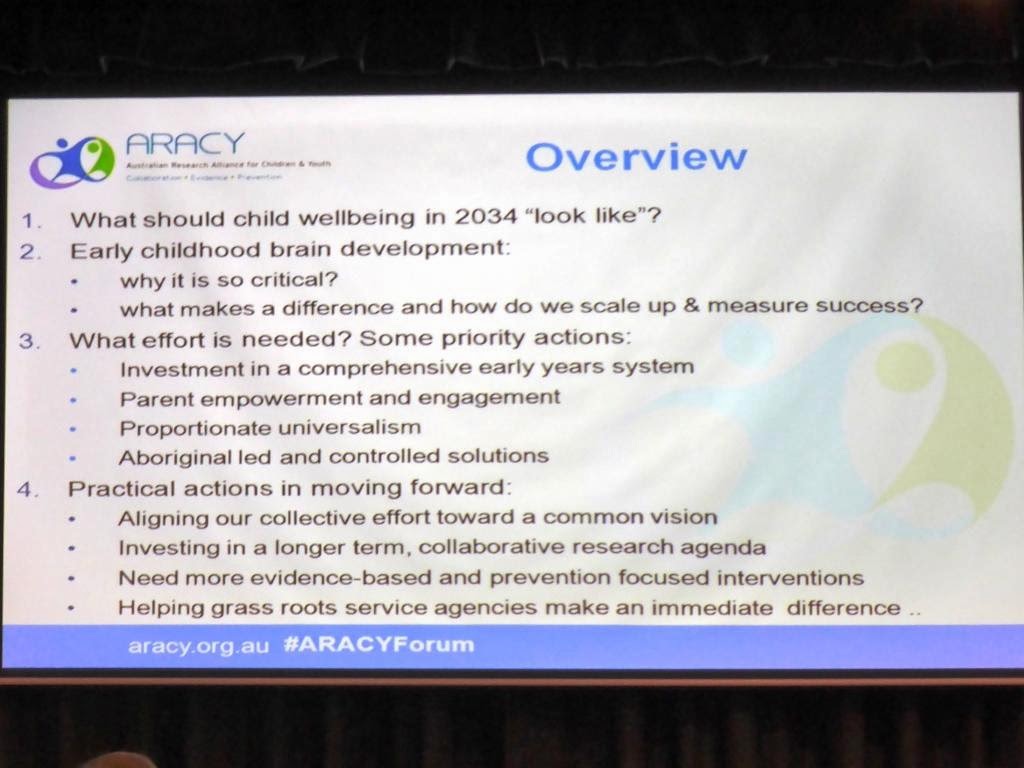 The vision of ARACY's The Nest agenda is as follows:
"Our shared vision for Australia's children and youth (aged 0-24) is an Australia where
All young people are loved and safe, have material basics, are healthy, are learning and participating and have a positive sense of identity and culture" (p.3).
March 28, 2014
2014 AIATSIS National Indigenous Studies Conference
This week Sarah Verdon and I have attended the 2014 AIATSIS National Indigenous Studies Conference in Canberra. AIATSIS stands for the Australian Institute of Aboriginal and Torres Strait Islander Studies. The theme of the conference is "Breaking barriers in Indigenous research and thinking". It has been an excellent conference with though provoking keynote speakers and session presenters.
We presented the following paper:
McLeod, S. & Verdon, S. (2014, March). Celebrating Indigenous Australian children's languages: Diversity, competence, and support. AIATSIS National Indigenous Studies Conference, Canberra, Australia.
Our presentation is available here
During the conference we have had the opportunity to tour the AIATSIS building and look at the manuscript, photographic and sound archives.

 |
| Sharynne, Fiona Skelton (LSIC), Laura Bennetts-Kneebone (LSIC), Sarah Verdon (CSU), Deborah Kikkawa (LSIC), Michael Walsh (AIATSIS), Christina Eira (VACL), Doug Marmion (AIATSIS) |
McLeod, S. & Verdon, S. (2014, March). Celebrating Indigenous Australian children's languages: Diversity, competence, and support. AIATSIS National Indigenous Studies Conference, Canberra, Australia.
Our presentation is available here
 |
| Sharynne presenting a paper at the AIATSIS conference |
 |
| AIATSIS Institute |
I have also been able to purchase a number of useful books about Indigenous education, Indigenous languages, Australian Aboriginal English, and some Indigenous children's literature as well.
March 25, 2014
Visiting the home of Footprints in Time
Today Sarah Verdon and I drove from Bathurst to Canberra to work with Deborah Kikkawa and Fiona Skelton to discuss papers and analyse data from the Footprints in Time: The Longitudinal Study of Indigenous Children (LSIC). We are very grateful for their generous advice and time. In the next week or so Sarah will submit a paper to a journal considering Indigenous children's language maintenance, we will present a paper at the AIATSIS conference , and we will submit a paper to the wave 5 LSIC report.
 |
| Our CSU car at the front of the Department of Social Services building in Canberra |
March 24, 2014
Indigenous children's rich language skills
The Charles Sturt University media office has just released a statement about the work that Sarah Verdon and I have been undertaking with the data from Footprints in Time, the Longitudinal Study of Indigenous Child. The media release is here.
The media release relates to our presentation at the AIATSIS national Indigenous studies conference this week and our recent publication in Early Childhood Research Quarterly.
McLeod, S., Verdon, S., & Bennetts Kneebone, L. (2014). Celebrating Indigenous Australian children’s speech and language competence. Early Childhood Research Quarterly, 29(2), 118-131. doi 10.1016/j.ecresq.2013.11.003
On 27th March I was interviewed by Jeni Enosa for Radio 4MW in the Torres Strait about this research. The link to the interview is here.
We were also featured in the First Nations Telegraph here (it takes a little while to download).
The media release relates to our presentation at the AIATSIS national Indigenous studies conference this week and our recent publication in Early Childhood Research Quarterly.
McLeod, S., Verdon, S., & Bennetts Kneebone, L. (2014). Celebrating Indigenous Australian children’s speech and language competence. Early Childhood Research Quarterly, 29(2), 118-131. doi 10.1016/j.ecresq.2013.11.003
On 27th March I was interviewed by Jeni Enosa for Radio 4MW in the Torres Strait about this research. The link to the interview is here.
We were also featured in the First Nations Telegraph here (it takes a little while to download).
 |
| Sarah Verdon and Sharynne McLeod |
March 23, 2014
A review of 30 speech assessments in 19 languages other than English
The following manuscript has been accepted for publication:
McLeod, S. & Verdon, S. (in press, March 2014). A review of 30 speech assessments in 19 languages other than English. American Journal of Speech-Language Pathology.
Here is the abstract:
McLeod, S. & Verdon, S. (in press, March 2014). A review of 30 speech assessments in 19 languages other than English. American Journal of Speech-Language Pathology.
Here is the abstract:
Purpose. To evaluate instruments designed to assess children’s speech production in languages other than English.Method. Ninety-eight speech assessments in languages other than English were identified: 62 were commercially published, 17 published within journal articles, and 19 informal assessments. A review was undertaken of 30 commercially published assessments that could be obtained.Results. The 30 instruments assessed 19 languages: Cantonese, Danish, Finnish, German, Greek, Japanese, Korean, Maltese-English, Norwegian, Pakistani-heritage languages (Mirpuri, Punjabi, Urdu), Portuguese, Putonghua (Mandarin), Romanian, Slovenian, Spanish, Swedish, and Turkish. The majority (70.0%) assessed speech sound production in monolingual speakers, 20.0% assessed one language of bilingual speakers, and 10.0% assessed both languages of bilingual speakers. All used single word picture elicitation. Approximately half (53.3%) were norm-referenced and the number of children in the normative samples ranged between 145 and 2,568. The remaining assessments were criterion-referenced (50.0%) (one fitted both categories). The assessments with English manuals met many of the psychometric criteria for operationalization; however, only two provided sensitivity and specificity data.Conclusions. Despite the varying countries of origin, there were many similarities between speech assessments in languages other than English. Few were designed for use with multilingual children so validation is required for use in English-speaking contexts.
March 21, 2014
Sound Start Study update
This has been an exciting week for the Sound Start Study.
New Team Member
We would like to welcome Charlotte Howland to the Sound Start team as our
new research assistant. Charlotte is a 3rd year speech pathology student at the
University of Sydney and met with myself, Elise, Sarah and Kate this week to
discuss the project. Charlotte will be working 4hrs per week for Sound Start and
is planning to focus on children's phonology for her honours project.  |
| Sarah, Charlotte, and Kate |
I visited the CSU Homebush site on Wednesday and met with Sarah, Kate, and Charlotte and had phonecalls with Elise and Jane. It was a day was full of discussion, data, and lots of good food and coffee!
Site Recruitment Update
It has been a big week in terms of site recruitment. We currently have 13 preschools who will be participating in the study this year. In total there are approximately 600 children within the eligible age range attending these schools. There are an additional 13 preschool that have said that they are interested in participating.
It has been a big week in terms of site recruitment. We currently have 13 preschools who will be participating in the study this year. In total there are approximately 600 children within the eligible age range attending these schools. There are an additional 13 preschool that have said that they are interested in participating.
March 13, 2014
Meetings - thank goodness for technology
This week has been filled with very interesting and helpful meetings across the nation and the world with the use of Skype and video conference. My meetings have been with informahealthcare (Sweden and Sydney), Pearson (US and Sydney), Oxford University Press (Melbourne and Albury), Charles Sturt University professors (Bathurst, Albury, Dubbo, Sydney, Wagga), my PhD students (Fiji, Sydney, Bathurst), and the Sound Start team (UK, Sydney, Albury). These collaborations would not have been possible from a rural Australian city prior to the availability of information technology.
The joys and challenges of a PhD undertaken on a tropical island
I am continually impressed at Suzanne's achievements as she undertakes
her PhD via distance education from Fiji. Over the past few weeks she
has had to accommodate flooding, cyclone warnings, and no electricity. Here is an email I received recently: "I've been luxuriating in the wonders of electricity for the last few hours. Very
much hoping the electricity stays on though no promises of that yet. Here's my latest version of the literature review..."
Suzanne has just learned that the first paper from her PhD will be published in the Journal of Clinical Practice in Speech-Language Pathology. Congratulations Suzanne! The title and abstract are below.
Suzanne has just learned that the first paper from her PhD will be published in the Journal of Clinical Practice in Speech-Language Pathology. Congratulations Suzanne! The title and abstract are below.
Services
for people with communication disability in Fiji: Clinical insights
In Fiji, the government has recognised the importance of services for people with communication disability (PWCD); however, the need for services still exceeds supply, and it is unclear who is providing services to this population. It has been suggested (Wylie et al., 2013) that agents of delivery of intervention can comprise seven groups: qualified speech-language pathologists (SLPs), mid-tier workers, already qualified professionals trained for an additional, new role, disability care workers, traditional healers and other professionals or family members guided by SLPs. In this paper, the role of each of these groups in the provision of services to PWCD in Fiji was reviewed. Results revealed that qualified SLP services in Fiji are restricted to those provided by international volunteer programs. Numerous other agents of delivery of intervention are available; however, their skill base and intervention methods remain largely unknown. There is a need to identify the skills and practices of non-SLP agents and to consider the potential for future direct SLP input, to ensure timely and adequate services are available to people with communication disability in Fiji.
Subscribe to:
Posts (Atom)