I love what I learn working amongst colleagues from different countries. Today is St Patrick's Day and one of my colleagues from Northern Ireland sent me this wish:
Mar a théann tú síos céimeanna an tsaoil, nach sínfeadh na sceilpe an treo mícheart.
“As we slide down the bannisters of life, may the splinters always point in the right direction”
March 17, 2016
March 16, 2016
Polysyllable productions in preschool children with speech sound disorders
The following article has
been accepted for publication. It is a part of Sarah Masso's PhD:
Masso, S., McLeod, S., Baker,
E., & McCormack, J. (2016, in press March). Polysyllable productions in
preschool children with speech sound disorders: Error categories and the Framework
of Polysyllable Maturity. International
Journal of Speech-Language Pathology. Here is the abstract
Purpose: Children with speech sound disorders (SSD) find polysyllables difficult; however, routine methods of sampling and measuring speech accuracy are insufficient to describe polysyllable accuracy and maturity. This study had two aims: (1) to compare two speech production tasks and, (2) to describe polysyllable errors within the Framework of Polysyllable Maturity. Method: Ninety-three preschool children with SSD from the Sound Start Study (4;0-5;5 years) completed the Polysyllable Preschool Test (POP; Baker, 2013) and the Diagnostic Evaluation of Articulation and Phonology (DEAP-Phonology; Dodd et al., 2002). Result: Consonant accuracy was similar, but vowel accuracy was significantly different between the POP and the DEAP-Phonology. Production errors were analysed according to the seven error categories of the Word-level Analysis of Polysyllables (WAP): (1) substitution of consonants or vowels (97.8% of children demonstrated common use), (2) deletion of syllables, consonants or vowels (65.6%), (3) distortion of consonants or vowels (0.0%), (4) addition of consonants or vowels (0.0%), (5) alteration of phonotactics (77.4%), (6) alteration of timing (63.4%), and (7) alteration of sequence (0.0%). The Framework of Polysyllable Maturity described five levels of maturity based on children’s errors. Conclusions: Polysyllable productions of preschool children with SSD can be analysed and categorised using the WAP, and interpreted using the Framework of Polysyllable Maturity.

Mehrsprachige Kinder mit Aussprachestörung: Internationales Positionspapier [Multilingual children with speech sound disorder: International position paper]
The following article has been
accepted for publication and is a result of collaboration with Dr. Sandra Neumann from the Universität zu Köln (University of Cologne) in
Germany.
Neumann, S., Meinusch, M., Verdon, S. & McLeod,
S. (2016, in press) Mehrsprachige Kinder mit
Aussprachestörung: Internationales Positionspapier [Multilingual children with
speech sound disorder: International position paper], Logos. doi: 10.7345/prolog-1602084.
Here is the English version of the abstract:
Some children have speech sound disorders (SSD) regardless of whether they speak one, two, or multiple languages. Speech-language pathologists (SLPs) across the world have indicated that they may not have adequate skills and resources to provide appropriate care for multilingual children with speech sound disorders.
This paper presents the first international position paper for working with multilingual children with SSD (IEPMCS, 2012). The position paper aims to provide direction and practical strategies for SLPs and related professionals working with children who are multilingual and/or multicultural, and to inform governments and policy makers in health care systems to provide optimal care internationally.
The position paper was developed in a five-step procedure by the International Expert Panel on Multilingual Children’s Speech/IEPMCS) comprising 57 researchers of speech-language pathology during face-to-face discussion (with 14 members) and additional online-discussions with additional participants.
A position paper of 5 pages was published, that incorporates the components of the ICF-CY and reflects the following contents: definitions, objectives in the framework of the ICF-CY (WHO, 2007), identified challenges to provide culturally competent and evidence-based services to multilingual children with speech sound disorders and recommended best practice.
The current position paper gives Germany guidance for best practice when working with children with SSD and their parents in a culturally and linguistically appropriate way. To implement the paper in research and practice will be an important goal for the future.
Lecturing CSU's dentistry students
Today I provided a 2-hour lecture to the CSU dentistry students. I discussed the role of a speech pathologist, guidelines for typical speech and language development in children as well as reasons for referral, and showed them some electropalatography and ultrasound images of tongue/palate contact. The students attended the lecture via videoconference in locations across the state: Bathurst, Orange, Albury, Port Macquarie, Wagga, Dubbo, Sydney, and 13 were on the phone in these and other locations. I enjoy talking with dentistry students, since there are many synergies with our work as speech pathologists.
March 12, 2016
Sarah's SPSS PhD visit
This week Sarah Masso was in Bathurst to work with Audrey Wang and myself on her next PhD paper. Sarah currently is exploring change in preschoolers' polysyllable maturity over 3 time points. Audrey worked with Sarah on her data using SPSS, and together they imputed data and statistically described change over time. During the visit Sarah also supported Ben's data entry and analysis, and we celebrated Sarah's PhD birthday. It was a very productive week.
 |
| Sarah and Audrey |
 |
| Sharynne, Sarah, and Ben |
March 7, 2016
Planning for 2030
Speech Pathology Australia is hosting a series of events titled Speech Pathology 2030 - Making futures happen. The purpose is "to engage members of the profession in the development of a shared vision for how the profession will successfully respond to change over the next decade and beyond". Conversations are being held across Australia including at CSU. Last week Sarah Masso co-hosted an event at CSU Homebush, and this week Chris Plant has invited me to participate in an event at CSU Albury. The Border Mail news story is here. Last week I also participated in an event with Life Members and Fellows. It is exciting to listen to colleagues dreams and aspirations for the future.
 |
| SPA2030 conversation via Adobe Connect between CSU Albury and Bathurst |
March 5, 2016
Anna's Churchill Fellowship begins
Anna Cronin, my newest PhD student, will embark on her Churchill Fellowship in less than two weeks. She will be visiting sites in New Zealand (Auckland), Brazil (Bauru), US (Atlanta, St Louis, Laramie, Salt Lake City), and Denmark (Copenhagen). The topic of her Fellowship is "The optimal management of speech problems in toddlers with cleft palate". The announcement of Anna's award is here. Enjoy your Fellowship Anna, and we look forward to hearing about all you have learned.

March 2, 2016
Welcome Franklin!
Today I had the honour of meeting the newest member of our research community: Franklin. He was born last week and the whole family are doing really well. I passed on the congratulatory messages from our research student community, CSU, RIPPLE, SOTE, and the International Expert Panel. Congratulations! (Thanks Sarah for allowing me to hold him for so long and to share this photo.)
 |
| Sarah Verdon, 1 week old Franklin, and lucky Sharynne |
February 26, 2016
Australian-American Fulbright Commission Scholar Showcase and Presentation Dinner
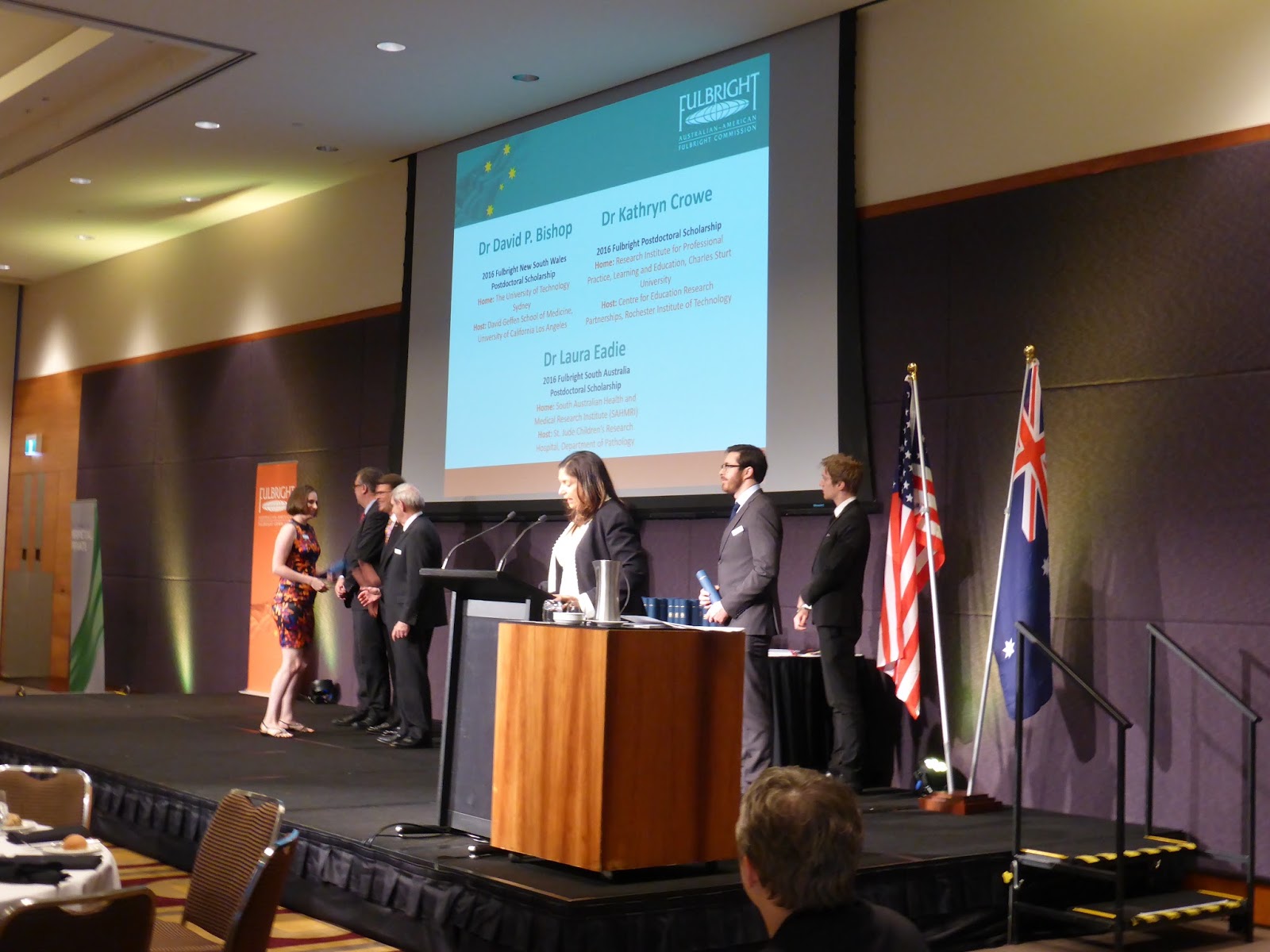
Last night the Australian-American Fulbright Commission Scholar Showcase and Presentation Dinner was held in Melbourne. Dr Kate Crowe was presented as one of the 46 2016 Fulbright Australian Scholars by His Excellency John Berry, Ambassador of the USA to Australia and Professor Don DeBats, Chair of the Australian-American Fulbright Commission Board. Charles Sturt University was a silver sponsor of the evening, and was represented by Vice Chancellor Andy Vann, Deputy Vice Chancellor (Research, Development and Industry) Mary Kelly. Kate's family and friends were also in attendance to celebrate her accomplishment. More details are here and a video is here.


 |
| 2016 Fulbright Postdoctoral Scholars with His Excellency John Berry, the Ambassador of the USA to Australia and Professor Don DeBats |
 |
| Kate with VC Andy Vann, DVC Mary Kelly, her family and friends |
February 22, 2016
Charles Sturt University Commencement Ceremony 2016
The Charles Sturt University Commencement Ceremony was held on Monday 22nd February to begin the academic year for 2016. This photo is of Ben Phạm my PhD student, Ninh Dang Vu my new professorial research assistant, and Rev. 'Oto Faiva who prayed the prayer for the staff and students at the commencement ceremony.
 |
| Ben Pham, Sharynne, Ninh Dang Vu, Rev. 'Oto Faiva |
February 21, 2016
Cyclone Winston's impact on Fiji
One of my PhD students, Suzanne Hopf, lives in Fiji (and undertakes her studies via distance education). It was devastating to learn of the impact of Cyclone Winston on Fiji this weekend described as "one of the southern hemisphere’s most powerful cyclones on record". The school Suzanne visited during her data collection was used as an evacuation centre, and it is likely that many of the children, families, and teachers who contributed to her PhD have been impacted. As well as rebuilding and cleaning up after the cyclone, electricity, internet, and daily supplies will be limited for some time.
February 20, 2016
Cross-cultural adaptation of the Intelligibility in Context Scale for South Africa
The following article has just been accepted for
publication.
Pascoe, M. & McLeod, S. (2016, in press February).
Cross-cultural adaptation of the Intelligibility in Context Scale for South
Africa. Child Language Teaching and
Therapy.
Here is the abstract
The Intelligibility in Context Scale (ICS) (McLeod, Harrison, & McCormack, 2012a) is a screening questionnaire that focuses on parents’ perceptions of children’s speech in different contexts. Originally developed in English, it has been translated into 60 languages and the validity and clinical utility of the scale has been documented in a range of countries. In South Africa, there are eleven official languages yet few assessment materials available in languages other than English. In this paper we describe the cross-cultural adaptation of the ICS into a screening tool encompassing all South Africa’s official languages in addition to English. Objectives were: (1) To describe the linguistic and conceptual equivalence of the ten translated versions compared to the original ICS. (2) To evaluate speech-language therapists’ (SLT) perceptions of the usability and value of the ICS translations in the languages of South Africa. Twenty-five participants translated the ICS into ten official languages of South Africa using forward and back translation and community checking. Next, a survey of 23 SLTs practicing in South Africa, and semi-structured interviews with five SLTs working in Cape Town, took place. The conceptual and linguistic equivalence of the adapted materials for each language was considered. Concepts that were challenging to translate from English into many of the Bantu languages included those relating to immediate/extended family, acquaintances, strangers and hearing/understanding. Linguistic challenges in translation related to dialectal differences and the use of pronouns. The SLTs in the sample found the ICS easy to use and saw it as a useful component of assessment especially when working with families who do not share a language with the SLT. Overall the study contributes to the development agenda of SLTs working in South Africa by creating and trialing the ICS in all the countries’ official languages to improve access and quality of services offered to all the families they serve.
February 19, 2016
Celebrating Lunar New Year
This Year of the Monkey, we held a picnic to celebrate Lunar New Year, sharing stories about the celebration from China and Vietnam.
 |
| Audrey Wang, Ben Pham, Sharynne, Helen Liu |
February 11, 2016
Bathurst speech pathologists' dinner
In 2003 when I moved in Bathurst there were very few speech pathologists and most worked with adults rather than children. Now there are many more speech pathologists in Bathurst and they work in schools, early intervention settings, community health centres, hospitals and private practices. Ben Pham and I enjoyed catching up with everyone over dinner last night.
 |
| L-R: Katrina, Meredith, Emily, Esther, Ben, Sharynne, Kathy, Angela, Christine, Jess, and Kate |
February 10, 2016
Second Most Prevalent Disability Category in the US
An email was sent to ASHA members from Dr. Lemmietta G. McNeilly, Chief Staff Officer, Speech-Language Pathology containing the following information:
Speech or Language Impairments, Second Most Prevalent Disability Category
"According to the recently released, "37th Annual Report to Congress on the Implementation of the Individuals with Disabilities Education Act, 2015," speech or language impairments (17.9%) was the 2nd most prevalent disability category in 2013 for students ages 6 through 21 served under IDEA, Part B. The most prevalent category continues to be specific learning disabilities at 39.5%. Other highlights of the report, data from reporting periods associated with fall 2013; include:
Speech or Language Impairments, Second Most Prevalent Disability Category
"According to the recently released, "37th Annual Report to Congress on the Implementation of the Individuals with Disabilities Education Act, 2015," speech or language impairments (17.9%) was the 2nd most prevalent disability category in 2013 for students ages 6 through 21 served under IDEA, Part B. The most prevalent category continues to be specific learning disabilities at 39.5%. Other highlights of the report, data from reporting periods associated with fall 2013; include:
- The most prevalent disability category of children ages 3 through 5 served under IDEA, Part B, was speech or language impairments (44.2%). The next most common disability category was developmental delay (37.1%), followed by autism (8.4%).
- Hispanic or Latino students ages 6 through 21 were 1.34, 1.21, 1.29, and 1.06 times more likely to be served under IDEA, Part B, for hearing impairments, orthopedic impairments, specific learning disabilities, and speech and language impairments, respectively, than were students ages 6 through 21 in all other racial/ethnic groups combined.
- Speech or language impairments were the second or third most prevalent category for students ages 6 through 21 in every racial/ethnic group.
- More than 8 in 10 students reported under the category of speech or language impairments (87.1%) were educated inside the regular class 80% or more of the day."
Application of the ICF to communication
Last year I was invited to be a member of the American Speech-Language-Hearing Association ad hoc committee on the application of the International Classification of Functioning, Disability and Health to communication. ASHA has subsequently developed a website that includes resources we developed on creating person-centered goals:
ICF and speech sound disorders
ICF and specific language impairment
ICF and speech sound disorders
ICF and specific language impairment
Magdalena Janus' visit to CSU
This week Magdalena Janus has been visiting CSU sponsored by RIPPLE. She has been involved in the development of the Early Development Index (EDI) that has been adapted for use throughout Australia as the Australian Early Development Census (AEDC). It has been exciting to discuss possibilities for future collaboration.
 |
| L-R: Jennifer Sumsion (Director of RIPPLE), Linda Harrison (Acting SubDean Research), Sue Walker (via Skype from Queensland University of Technology), Magdalena Janus, Fran Press, Sharynne McLeod (Kate Williams not in the photo). |
February 8, 2016
Fulbright Postgraduate Scholarship awarded to Kate Crowe
Kate Crowe has been awarded a prestigious Fulbright Postgraduate Scholarship to study in the US with Professor Marc Marschark at Rochester Institute of Technology. Her project is titled Semantic network structure and use in Deaf and Hard of Hearing learners. Here is the Fulbright announcement and the CSU news release is here and Speech Pathology Australia's tweet is here. She is one of two Fulbright Postdoctoral Scholarship awardees (the four others received state awards).
Here is the abstract:
Here is the abstract:
The purpose of this project is to investigate Deaf and Hard of Hearing (DHH) learners’ semantic networks to improve the effectiveness of approaches to language and literacy learning. The overarching goal of the proposed research is to extend knowledge of semantic networks in DHH learners through three related studies to be undertaken at Rochester Institute of Technology. Specifically, the aims of this project are to (1) examine the within-category structure of semantic networks of DHH learners, (2) understand facilitators and barriers to DHH learners’ access to their semantic networks, and (3) observe the impact of instruction on DHH learners’ use of semantic networks.Congratulations Kate!
February 5, 2016
Speech Pathology Australia 2015 highlights
It was great to see the work of members of our team listed in the 2015 Speech Pathology Australia highlights on pages 8 and 11 of February's SpeakOUT.
January 28, 2016
Children's Speech: Advertised on Pearson's website
Elise Baker and I are currently in the final phases of copyediting and page proofing our new book. It has just been advertised on Pearson's website (here) and will be available in a few months' time.
Subscribe to:
Posts (Atom)