Today begins my annual leave and I will be on holidays until 18th January.
What a year it has been. Now it is time for a rest and time with our families.
Best wishes for the holiday season and 2021.

Today begins my annual leave and I will be on holidays until 18th January.
What a year it has been. Now it is time for a rest and time with our families.
Best wishes for the holiday season and 2021.

Dr Giang Pham has just announced an excellent new website for supporting speech-langauge pathologists who work with bilingual Vietnamese-English speaking children and families:
VietSLP: https://vietslp.sdsu.edu/
Introducing a new website with online resources for supporting Vietnamese children! On our website, you can find:
✓ Learning Modules on how to work with Vietnamese American children
✓ Assessment Tools for the Vietnamese language
Please visit our website at vietslp.sdsu.edu!
At our VietSpeech wrap up meeting this year we celebrated so many successes for 2020.
Firstly, we have finished data collection (apart from 1 family who will be assessed in January).
Secondly, we have found so many solutions to the challenges that we have been faced with over 2020.
Thirdly, we have grown as a team and as families. We enjoy working together and have really made a difference in the lives of many Vietnamese families in Australia.
Fourthly, we have been able to tell the world about our VietSpeech research at a number of conferences and have many papers in press, under review, and in draft form.
We are proud of all we have been able to achieve in this most unusual of years for the world.

Over the past few weeks I have had the opportunity to celebrate colleagues' achievements and plan with others for 2021:
 |
| Dr Lucia Wuersch's graduation |
 |
| Planning 2021 research with Dr Andi Salamon |
Today our Charles Sturt University Speech-Language-Multilingualism team held a virtual/simulation graduation for
from Shepparton, Brisbane, Young, Culcairn, Bathurst, Newcastle, Sydney, Fiji, and Iceland.
Here is the official CSU list of graduands: https://www.csu.edu.au/current-students/your-course/graduation/graduations-2020
Additionally, Dr Anna Cronin was awarded the Charles Sturt University Higher Degree by Research University Medal for the Faculty of Arts and Education!
We are so proud of you all. It has been an honour and privilege to be your supervisors:
Best wishes as your research changes the world and you begin the next phase of your careers.
 |
| The graduation ceremony (complete with as many hats as possible) |
 |
| Dr Nicole McGill |
 |
| Dr Anna Cronin |
 |
| Holly McAlister (BSpLangPath)(Hons) |
 |
| Dr Sarah Verdon made a CSU gold "mace" for the ceremony |
The Australian Linguistic Society Conference (ALS2020) is an online conference 14-15 December 2020. Our VietSpeech team presented papers within a symposium co-chaired by Sarah Verdon and Paola Escudero titled "Building bridges for multilingual speakers in Australia".
Here are our papers:

 |
| PANEL: Building bridges for multilingual speakers in Australia |
 |
| Dr Helen Blake |
 |
| Dr Van H. Tran |
 |
| Dr Sarah Masso |
CSU has just submitted their report on the Sustainable Development Goals.
Congratulations to everyone at CSU for their broad-ranging work to promote sustainability and social justice. The work of our team is featured on:


WOW! Tonight at my meeting with Dr Sandra Neumann I learned about the ICF Illustration Library: http://www.icfillustration.com/top_e.html
It can be searched in English, Spanish and Japanese.
We may be able to use these images for the child version of the ICS.

A feature of 2020 has been CSU's Town Hall meetings to update all staff. This morning's meeting had over 800 participants to listen to the Acting Vice Chancellor, the DVCs and VCLT updating the staff then ask questions receive answers. Some topics that were discussed: VC Andy Vann has retired after 9 years at CSU and his contribution to CSU was acknowledged, including developing the Port Macquarie campus and the introduction of the medicine degree at CSU. 6000 students are graduating this year. CSU is the #1 university for graduate employment. 29 staff were promoted (13 women) in 2020. We ahve some good news about additional funding for students and research in 2021.
What a year!

The following manuscript has been accepted for publication.
Seifert, M., Davies, A., Harding, S., McLeod, S., & Wren, Y. (2020, in press December). Intelligibility in 3-year-olds with cleft lip and/or palate using the Intelligibility in Context Scale: Findings from the Cleft Collective Cohort Study. The Cleft Palate-Craniofacial Journal.
Here is the abstract:
Objective: To provide comparison data on the Intelligibility in Context Scale (ICS) for a sample of 3-year-old English-speaking children born with any cleft type.
Design: Questionnaire data from the Cleft Collective Cohort Study were used. Descriptive and inferential statistics were carried out to determine difference according to children’s cleft type and syndromic status.
Participants: 412 children born with cleft lip and/or palate whose mothers had completed the ICS when their child was 3-years-old.
Main Outcome Measure(s): Mothers’ rating of their children’s intelligibility using the ICS.
Results: The average ICS score for the total sample was 3.75 (sometimes-usually intelligible) (SD=0.76, 95% CIs=3.68-3.83) out of a possible score of 5 (always intelligible). Children’s speech was reported to be most intelligible to their mothers (M=4.33, SD=0.61, 95% CIs=4.27-4.39) and least intelligible to strangers (M=3.36, SD=1.00, 95% CIs=3.26-3.45). There was strong evidence (p < 0.001) for a difference in intelligibility between children with cleft lip only (n=104, M=4.13, SD=0.62, 95% CIs=4.01-4.25) and children with any form of cleft palate (n=308, M=3.63, SD=0.76, 95% CIs=3.52-3.71). Children born with cleft palate with or without cleft lip and an identified syndrome were rated as less intelligible (n=63, M=3.28, SD=0.85, 95% CIs=3.06-3.49) compared to children who did not have a syndrome (n=245, M=3.72, SD= 0.71, 95% CIs=3.63-3.81).
Conclusions: These results provide preliminary comparative data for clinical services using the outcome measures recommended by the International Consortium for Health Outcomes Measurement.
Today the Faculty of Arts and Education held a Research Groups Symposium to profile the work of the six research groups https://arts-ed.csu.edu.au/research/research-groups:
The day began with presentations from Executive Dean John McDonald and Associate Dean Philip Hider. Karen Bell and I presented about the Sustainable Development Goals. Then each group presented their work.
Feedback from an attendee “I felt this was a milestone in the Faculty- I have not felt such a sense of common purposes and mutual, respectful, interested engagement in either the research or the learning and teaching space since Education and Arts joined together in 2016.”


The following article has been accepted for publication:
McLeod, S., Margetson, K., Wang, C., Tran, V. T., Verdon, S., White, K., & Phạm, B. (2020, in press December). Speech acquisition within a 3-generation Vietnamese-English family: The influence of maturation and ambient phonology. Clinical Linguistics and Phonetics.
Here is the abstract:
The emergence approach to speech acquisition (Davis & Bedore, 2013) theorises the influence of intrinsic capabilities (e.g. maturation), interactional capabilities, and extrinsic contexts (e.g. ambient phonology). Intrinsic and extrinsic influences were examined via a case study of a 3-generation Vietnamese-English family with two brothers (C1 aged 5;6 and C2 aged 3;10), their mother (M), grandfather (GF) and grandmother (GM). Their speech was assessed using the Diagnostic Evaluation of Articulation and Phonology (DEAP, Dodd et al., 2002) and the Vietnamese Speech Assessment (VSA, Phạm et al., 2016). Standard Australian English/Standard Vietnamese productions were defined as ‘correct’, even though the adults spoke different Vietnamese dialects. Their percentage of standard consonants correct (PSCC) was: C1 (English:92.27%, Vietnamese:89.05%), C2 (E:86.47%, VN:86.13%), M (E:90.34%, VN:96.35%), GF (E:82.61%, VN:97.81%), GM (VN:99.27%). Percentages were higher when dialectal variants were included. C1 and C2 had more pronunciation matches with English (86.96%) than Vietnamese (79.56%). C1’s pronunciation matched: M (E:85.02%, VN:83.94%), GF (E:79.23%, VN:77.37%), GM (VN:73.72%) and C2’s pronunciation matched: M (E:79.23%, VN:73.72%), GF (E:73.91%, VN:75.18%), GM (VN:72.26%). There was evidence of ambient phonology influences and cross-linguistic transfer. For example, in Vietnamese ‘r’ is produced as /ʐ/ or /r/, but was produced by C1 as [ɹ] (English approximant) and by C2 [w] (age-appropriate /ɹ/ substitution). The children demonstrated maturation influences for late-occurring English consonants (e.g. English /θ/→[f]). This study found evidence for the emergence approach and recommends knowledge of the ambient phonology augments traditional child-focused understandings of children’s speech acquisition.
This evening I had a lovely time catching up with my colleague Dr Joanne Cleland from the University of Strathclyde. She is the convenor of ICPLA 2020 - which was postponed to 2021, and now will be held online. We shared ideas about the ECV2020 conference and how to run a conference across the world's timezones.
Earlier today, my copy of Interventions for Speech Sound Disorders in Children (2nd ed) arrived. Joanne co-authored chapter 22 on Biofeedback interventions - so it was great to share this with her.

Dr Cen (Audrey) Wang has been such an important part of our VietSpeech team. She has worked with us 1 day per week to support our data analysis and writing. Today was her last day for 2020 before she went on leave. We look forward to continuing to work with her into the future. We currently have 6 papers in submission and under review, so are hoping that 2021 will have many accepted papers. In 2019 we published the following papers together:
 |
| Discussing VietSpeech data analysis with Audry |
Dr Nicole McGill and Dr Anna Cronin are now officially DRs! We are having a virtual celebration on 18th December 2020.
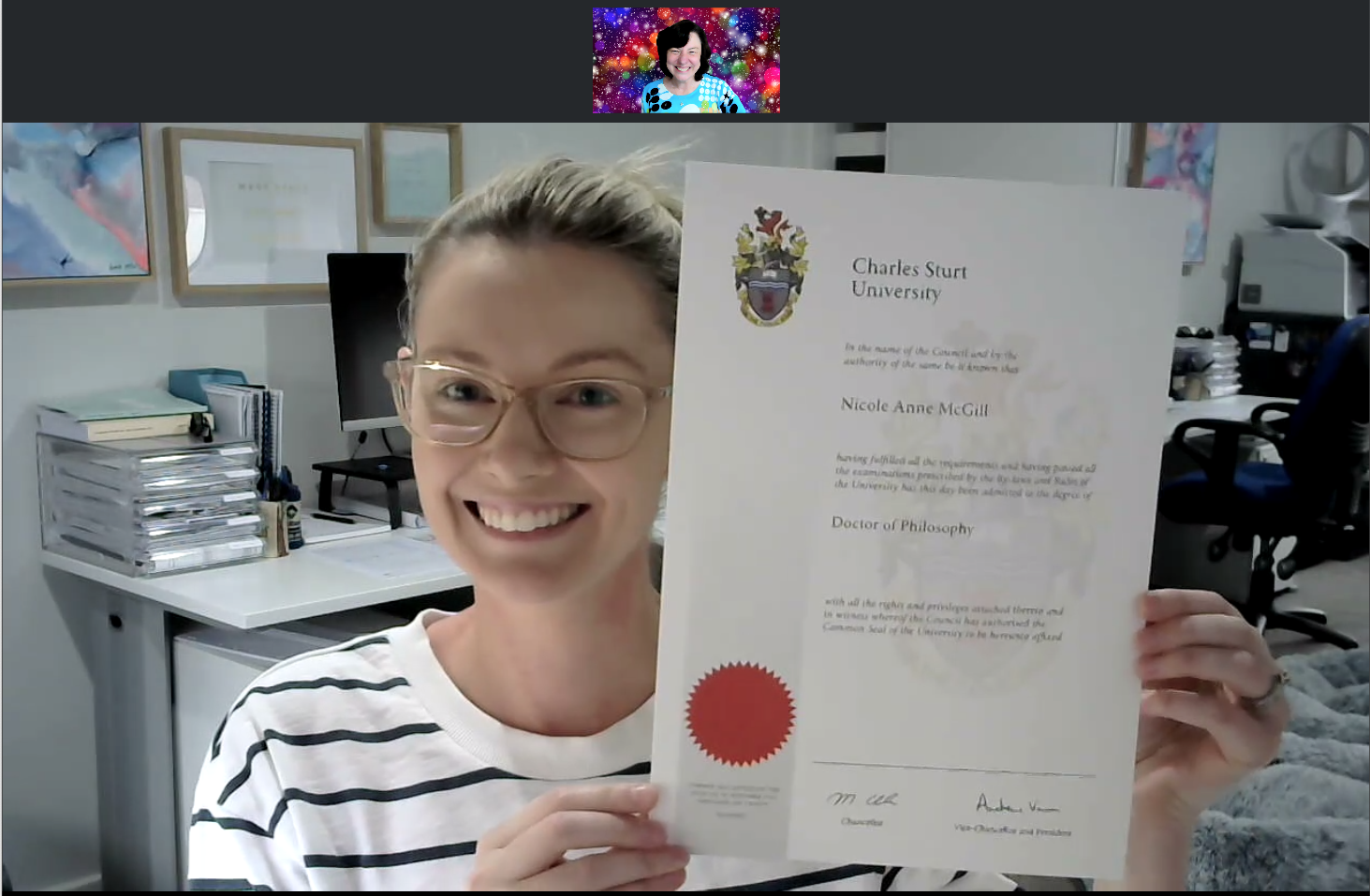 |
| Dr McGill |
The School of Teacher Education Christmas party was virtual this year (of course). It was lovely to see everyone, reflect on the year, farewell Helen Logan and Kay Owens and to play COVID Bingo!


I have been sponsored by Speech Pathology Australia and accepted by the United Nations to attend the 13th session of the Conference of States Parties to the CRPD https://www.un.org/development/desa/disabilities/conference-of-states-parties-to-the-convention-on-the-rights-of-persons-with-disabilities-2/cosp13.html
Last year I attended in person at the United Nations in New York. This year, it is held online: http://webtv.un.org/
I attended the following session: Round Table 3: Promoting inclusive environments for the full implementation of the CRPD (Virtual - 3 December 2020 – 10.00 am to 12.00 pm (EST, 2am Sydney time).
Here is the background reading: http://undocs.org/CRPD/CSP/2020/4
There were 6 panellists and Santiago Velasquez is representing Australia. The other panellists are from Poland, Ecuador, USA, India and Malawi. Here are the bios of the Co-chairs and panelists https://www.un.org/development/desa/disabilities/wp-content/uploads/sites/15/2020/12/RTB-3-Short-Bios.pdf
COSP13's theme and sub-themes:
Over-arching theme: A decade of action and delivery for inclusive sustainable development: implementing the CRPD and the 2030 Agenda for all persons with disabilities.
Sub-themes for the three round tables
Cross-cutting theme: Strengthening capacity-building to fully implement the CRPD and the SDGs for persons with disabilities, in particular women and girls with disabilities. (Addressing the Beijing+ 25th and other relevant commemorations of the historical benchmarks in the global agenda this year).
- Disability and business: realizing the right to work in open, inclusive and accessible environments for persons with disabilities.
- Addressing the rights and needs of older persons with disabilities: ageing and demographic trends (co-chair by Liberia and CSO)
- Promoting inclusive environments for the full implementation of the CRPD (co-chair by Finland and CSO)

 |
| Santiago Velasquez represented Australia at COSP13 |
Enjoy and share this video "The Lifelong Effects Of Speaking Multiple Languages" created by Charles Sturt University profiling our Speech-Language-Multilingualism team's research (@DrKateCrowe @SV_SLP @VanTranTH @KateMargetson @helenlblake )
Multilingualism is a superpower!
https://www.youtube.com/watch?v=wBrXmRW7lwg
https://www.facebook.com/28431613915/posts/10160630198933916/
February 2021 update from our colleague from Western Sydney University: https://theconversation.com/dont-be-afraid-to-pass-your-first-language-and-accent-to-your-kids-it-could-be-their-superpower-143093
