Showing posts with label ARC Discovery. Show all posts

February 16, 2024

CONGRATULATIONS KATE M - PhD submission today

Congratulations to Kate Margetson who submitted her PhD today. 

Her PhD is titled: "Moving Beyond Monolingual Practices with Multilingual Children: Learning from Vietnamese-English–Speaking Children, Families, and Professionals"

Congratulations Kate!

A/Prof Sarah Verdon and I have been very honoured to be Kate's supervisors for her PhD. Kate started working with us when she joined our VietSpeech (ARC Discovery Grant https://www.csu.edu.au/research/vietspeech/overview) research team as our Project Office. Once the grant finished, Kate re-analysed some of the very rich VietSpeech data to answer new questions for her PhD. 

Kate's family and our Speech-Language-Multilingualism team joined to support Kate from across Australia and Ben joined from Viet Nam!


Here is Kate's PhD abstract:

Multilingual children’s speech assessment and differential diagnosis of speech sound disorders can be challenging for speech-language pathologists (SLPs), especially if they do not speak the same language as the children they are working with. While best practice recommendations include assessing children in all the languages that they speak, in many English-dominant contexts SLPs often rely on English assessments for diagnostic decision-making. There are few guidelines for how SLPs can assess, transcribe, and analyse speech in children’s home languages. This doctoral research aimed to explore assessment, transcription, speech analysis, and diagnosis of speech sound disorders in multilingual children involving direct speech assessment of children’s home languages. Vietnamese-English–speaking children and their families were the focus of this research.

The thesis contained four parts, which included five publications. Part One, Monolingual Speech-Language Pathologists in Multilingual Contexts (Chapter 1), included an orientation to the thesis, situated the researcher, presented a literature review, and outlined methodology. Linguistic multicompetence (Cook, 2016) and the emergence approach (Davis & Bedore, 2013) were presented as the theoretical frameworks underpinning the research.

Part Two, Vietnamese-English–speaking Children’s Speech described similarities and differences between Vietnamese and English phonology, Vietnamese-English–speaking children’s speech acquisition, and current resources available to SLPs for assessment and intervention with Vietnamese-English–speaking children (Chapter 2). The interaction between Vietnamese and English phonology was explored in a cross-sectional study (n = 149) of Vietnamese-English–speaking children’s and adult family members’ speech in Vietnamese and English (Chapter 3) and found that direction of cross-linguistic transfer in children’s speech was significantly associated with children’s age and language proficiency. 

Part Three, Diagnosis of Speech Sound Disorders in Vietnamese-English–speaking Children presented in-depth case studies of Vietnamese-English–speaking children’s speech. Case studies of four children considered the impact of assessing both languages on differential diagnosis (Chapter 4). All four children appeared to have speech sound disorder based on English assessment only, but analysis of children’s speech in both languages revealed that only two children had a speech sound disorder. A longitudinal case study explored four influences on a Vietnamese-English–speaking child’s speech over time (Chapter 5) and found that most speech mismatches could be explained by development, dialect, cross-linguistic transfer, and ambient phonology, and that cross-linguistic transfer reduced over time.

Part Four, Moving Beyond Monolingual Speech-Language Pathology Practices with Multilingual Children presented an evidence-based research protocol, the VietSpeech Multilingual Transcription Protocol, for assessing and transcribing multilingual children’s and adults’ speech, that ensured consistent and reliable transcription (Chapter 6). A clinical protocol, the Speech Assessment of Children’s Home Languages, was proposed, for SLPs to assess, transcribe, and analyse multilingual children’s speech, to account for the idiolects of children, their families, and their SLPs (Chapter 7). The Speech Assessment of Children’s Home Languages will enable SLPs to collaborate with family members and interpreters to assess speech in children’s home languages, providing opportunities to consider children’s entire phonological repertoires during diagnostic decision-making. Finally, conclusions, contributions of the doctoral research, limitations, and future directions were presented (Chapter 8).

This doctoral research sought to bridge a gap between research and practice in multilingual children’s speech assessment by demonstrating the importance of speech assessment of home languages, describing ways of analysing multilingual children’s speech to identify four potential mismatches (development, dialect, cross-linguistic transfer, ambient phonology), and outlining how SLPs move beyond monolingual practices in the way they assess, transcribe, and analyse multilingual children’s speech using the VietSpeech Multilingual Transcription Protocol and the Speech Assessment of Children’s Home Languages.


Congratulations Kate on your important work - and the huge impact that it is already having on professional practice. We are excited that you will continue working with us to translate this work for rural speech pathology practice during your postdoc.

Here are Kate's PhD publications to date (more to come):

  1. Margetson, K., McLeod, S., Verdon, S., Tran, V. H., & Phạm, B. (in press). English + Vietnamese speech development. In S. McLeod (Ed.), The Oxford handbook of speech development in languages of the world. Oxford University Press. 
  2. Margetson, K., McLeod, S., Verdon, S. (in press). Diagnosing speech sound disorder in bilingual Vietnamese-English–speaking children: Are English-only assessments sufficient? In E. Babatsouli (Ed.), Multilingual acquisition and learning: An ecosystemic view to diversity. John Benjamins Publishing Company.
  3. Margetson, K., McLeod, S., & Verdon, S. (2023). Cross-linguistic transfer and ambient phonology: Impact on diagnosis of speech sound disorders in a longitudinal bilingual case study. Journal of Monolingual and Bilingual Speech, 4(3), 311-339. https://doi.org/10.1558/jmbs.23672 
  4.  Margetson, K., McLeod, S., Verdon, S. & Tran, V. H. (2023). Transcribing multilingual children’s and adults’ speech. Clinical Linguistics and Phonetics, 37 (4-6), 415-435. https://doi.org/10.1080/02699206.2022.2051073


December 12, 2022

Kate Margetson's PhD endorsement

Today, School of Education PhD student Kate Margetson presented her PhD research proposal at an Endorsement of Candidature session. 

Kate’s thesis title is: Supporting English-Speaking Professionals to Work with Bilingual Vietnamese-English-Speaking Children. Her study is supervised by Professor Sharynne McLeod and Associate Professor Sarah Verdon 

Proposal Abstract: Culturally responsive practice that values multilingualism is needed for education and health professionals to provide equitable service to multilingual children and their families. Extensive studies have identified that professionals lack knowledge and skills for assessing multilingual children’s speech, especially when they do not speak the same languages. While assessing children in all the languages that they speak is recommended, often professionals rely on English assessments. There are no guidelines for how professionals can transcribe multilingual children’s speech, which likely contributes to speech sound disorders being under- or over-diagnosed in multilingual children. The proposed research aims to investigate how English-speaking professionals can assess and diagnose speech sound disorders in bilingual Vietnamese-English-speaking children, using a mixed methods research design. A research protocol for multilingual speech transcription will be designed and tested with Vietnamese-English-speaking children and adults. Speech profiles of bilingual Vietnamese-English-speaking children will be used to explore the interaction between Vietnamese and English, the impact of ambient phonology on acquisition, characteristics of typical acquisition versus speech sound disorder, and the subsequent importance of assessing both Vietnamese and English. An implementation science approach will be adopted to develop and test an online tool for professionals to learn how to assess and transcribe children’s speech in Vietnamese. This body of work seeks to bridge the gap between research and practice by equipping professionals with practical guidelines and transcription skills so that they can provide a culturally responsive, equitable service when assessing multilingual children’s speech.

Congratulations Kate!


October 17, 2022

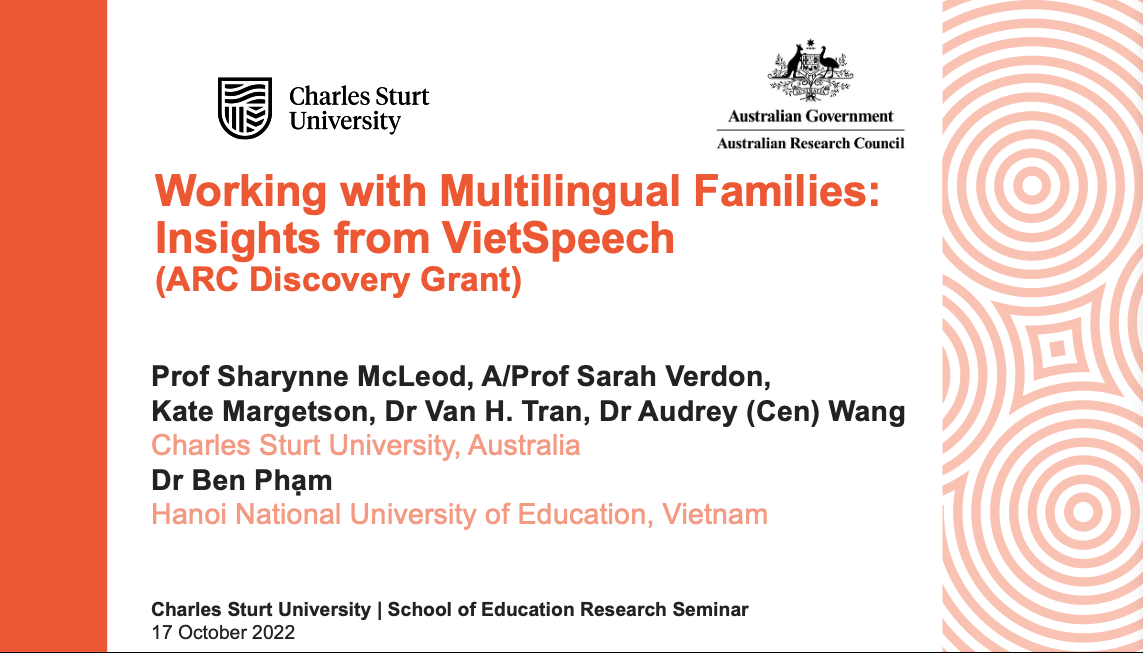
CSU School of Education Research Seminar: Working with Multilingual Families

Today our VietSpeech team presented the CSU School of Education Research Seminar. Our title was: “Working with Multilingual Families: Insights from VietSpeech (ARC Discovery Grant)” Presenters: Professor Sharynne McLeod, A/Prof Sarah Verdon, Kate Margetson, Dr Van Tran and supported by Dr Audrey Wang and Dr Ben Pham.

Here is the recording of our presentation:https://charlessturt.zoom.us/rec/share/e5QhLac3mruLQjUz26YXWt1UmXcQOqwhhnOlG2-udO0BWzaqUBOg9geiplnMlRMj.iBwuo8tqd2Pu3MnN  

More information about the project can be found here: https://www.csu.edu.au/research/vietspeech/overview

Thanks Dr Kate Smithers and Dr Andi Salamon for organising this session.

April 6, 2022

International Symposium on Monolingual and Bilingual Speech 2022

The International Symposium on Monolingual and Bilingual Speech (ISMBS) (6-9 April 2022) is a hybrid conference with both on site and online presentations and events at the Department of Communicative Disorders at the University of Louisiana at Lafayette (Université des Acadiens et Créoles). https://speechandlanguage.louisiana.edu/international-symposium-monolingual-and-bilingual-speech-ismbs-2022 

Kate Margetson and I are chairing a session each (starting ~6:30am our time!) and over three days are virtually presenting three papers from our VietSpeech research:

  1. VietSpeech: Vietnamese-Australian children’s speech and language competence (Sharynne McLeod, Sarah Verdon, Kate Margetson, Van H. Tran, Cen Wang, Ben Pham) 
  2. The VietSpeech Multilingual Transcription Protocol: A 4-step process for transcribing Vietnamese-Australian children’s speech (Kate Margetson, Sharynne McLeod, Sarah Verdon, Van H. Tran) 
  3. Cross-linguistic transfer during multilingual speech acquisition: A longitudinal Vietnamese-English case study (Kate Margetson, Sharynne McLeod, Sarah Verdon, Van H. Tran) 

Additionally, I am on the ISMBS International Scientific Committee https://speechandlanguage.louisiana.edu/international-symposium-monolingual-and-bilingual-speech-ismbs/ismbs-international-scientific

It has been an inspiring conference with fascinating papers from across the world.

January 3, 2022

SBS radio interview: How does communication affect a child's development?

My interview on SBS radio has just been broadcast: Năng lực giao tiếp có ảnh hưởng đến sự phát triển của trẻ như thế nào? [How does communication affect a child's development?] https://www.sbs.com.au/language/vietnamese/audio/nang-luc-giao-tiep-co-anh-huong-den-su-phat-trien-cua-tre-nhu-the-nao 

Với trẻ gốc Việt sinh sống ở nước ngoài, khả năng giao tiếp của các em chịu ảnh hưởng của nhiều yếu tố, trong đó có việc duy trì tiếng mẹ đẻ. Năng lực giao tiếp của trẻ nói hai hay nhiều thứ tiếng cần được quan tâm và nuôi dưỡng thế nào cho đúng? [For children of Vietnamese origin living abroad, their communication ability is influenced by many factors, including maintaining their mother tongue. How should the communication ability of children who speak two or more languages be properly cared for and nurtured?] 

Here is the English translation of the Vietnamese transcript: 

Communication is one of the basic human rights. Everyone has the right to say what they want in their own language, especially in their mother tongue (Article 5, Universal Declaration on Cultural Diversity, UNESCO, 2001). Likewise with children, they have the right to communicate, talk, express their feelings and it is our duty as adults to create the best conditions and opportunities for them to be able to promote these rights. maximally. How does communication affect children's intellectual, emotional, and spiritual development? You and Hong Van are invited to chat with Professor Sharynne McLeod from Charles Sturt University to learn more about this topic. Professor McLeod was voted by The Australian newspaper as the world's leading professor in the field of speech therapy (Discipline Leader in Speech and Language Pathology) for three consecutive years 2018, 2019, 2020 according to the quality and number of criteria. volume and influence. In 2021, she is the first foreigner to receive the American Speech and Hearing Association (ASHA) Honor Award since its inception in 1944. Hi Professor McLeod, thank you for accepting the invitation to interview SBS Vietnamese together. 

Prof. McLeod: Happy New Year. Hello friends! I am very pleased to speak on the topic of children's communicative competence. 

With your experience and achievements in research on children's speech and language in more than 60 languages around the world, can you tell us what the ability to communicate means to a child's development? 

Prof. McLeod: Thank you SBS for giving me the opportunity to talk about this topic today. Many people consider learning to speak as one of the most miraculous human development. The ability to communicate affects many aspects such as self, relationships, education, work, social participation, health and spiritual life. So I'm looking forward to talking to you about the effects of communication on the lives of children, especially children in Australia. 

Can you explain a little bit about the concept of “communication”? In your opinion, what are the components of communication?

Prof. McLeod: Communication is a two-way interactive process. When it comes to communication, people talk about three main components: Language, speech, and hearing. Language is concerned with the ability to understand and express spoken, written, and sign language. Speech, the second component, the area that I am particularly interested in researching, is related to pronunciation, the ability to say sounds so that others understand me. For bilingual children like Vietnamese children in Australia, we see an interesting phenomenon that they often pronounce Vietnamese sounds influenced by English sounds or vice versa. Speech is also associated with problems with speech, such as hoarseness and stuttering. The third component of communication is Hearing, which is the ability to hear and receive sounds. 

Can you tell why some children have language and communication problems? 

Prof. McLeod: It's a difficult question because in most cases (70%-80%) children come to speech therapy clinics, we don't know the underlying cause why children have developmental disorders. Speech Sound Disorder, it is not known why children have Developmental Language Disorder (DLD). We only know the cause of a small number of children with language and communication problems. These are cases where children have hearing problems or have congenital intellectual disabilities or brain diseases. However, we know how to help children overcome communication difficulties, improve pronunciation and language ability. So if you are concerned about your child's pronunciation and language, contact your local health center for a referral to free speech therapy services (if available with Medicare) and to other health care providers. private service. In some states, the service is also available in kindergartens and schools. 

Professor and colleagues did a very famous study on the relationship between communication ability and the academic performance and mental life of children in Australia. Could you tell me about some of the main results of this study? 

Prof. McLeod: This is a long-term study from 2003, also called Growing up in Australia. We took data from 10,000 children, including 5,000 1-3 year olds and 5,000 4-5 year olds. We have tracked children in nine data sets from 2003 to the present and have found many important results. One of those results is the relationship between children's communication ability and their learning capacity as well as their emotional and spiritual life. When children are 4-5 years old, 25% of parents and 22% of teachers have concerns about their child's pronunciation and language, I want to emphasize that this is the main language children use in the family, not 2nd or 3rd language. Thus, many people worry about the language ability of children aged 4-5 years old. We monitored and compared the reports of parents and teachers, the results of the NAPLAN national exam of children in the group of 25% worried parents with children in the group of 75% of parents who were not worried and found that when the children At 8-9 years old, parents of children in the 25% group will worry more about their children's literacy than parents in the 75% group. When they were 12-13 years old and 14-15 years old, they continued to have more learning problems than children in the 75% group. As they got older, they made more progress, but at a slower rate than the children in the other group. Their results on the NAPLAN test in all subjects of reading, writing, grammar, and arithmetic were lower than those in the other group. 

Thus, when children are at school age, if parents have concerns about their child's language or pronunciation, it is more likely that the child will have learning problems when going to school, easily falling behind in school. throughout the high school years, compared with children whose parents had no concerns. During the period from 4-5 years old to 14-15 years old, were the children whose parents worried about their ability to communicate, received any support or intervention? 

Prof. McLeod: That's a very good question. A large part of these children do not receive early intervention or support. It is not easy for teachers to find out that the children have problems with language and pronunciation skills because most of the children in this group are quiet and if the family and school don't pay attention, no one will do anything. , and they keep growing up with those difficulties, which leads to them not doing well in school. 

Thus, there is a relationship between children's communication ability and learning ability. What about their spiritual and emotional lives? How does limited communication capacity affect the children's spiritual life? 

Prof. McLeod: That's a very good question. In the group of children aged 8-9, we asked about their school experiences and found that for the group of children where 25% of their parents were worried when they were 4-5 years old, when they were 8-9 years old, they said know that children are bullied more, have fewer friends, and don't like going to school as much as children in the group of non-anxious parents. In short, if you have concerns about your preschooler's ability to communicate, you should seek help as soon as possible. If you haven't done it yet, it's never too late. Well-trained and professionally trained speech and speech therapists in Australia will help figure out what your child's problem is and the right treatment will have a positive impact on academics, social interactions and learning. socialization, interest in school, and ability to socialize with other children. 

For children who speak two or more languages like Vietnamese children abroad, how should their communication ability be properly assessed?  

Prof. McLeod: This is the most important question in today's talk. Some studies have mentioned the concept of "double disability", i.e. if a child has language and pronunciation problems but still speaks another language at home, it is considered a problem. its language disability becomes more severe and so many people recommend giving up the mother tongue. This is a mistake because our studies with thousands of children have shown that the ability to speak two or more languages is a superpower. There were no differences in reading, writing, math skills, and social communication between monolingual and multilingual children. We compared the NAPLAN test results of children who speak a language and children who speak a language other than English at home, and found that by grade 3, children in these two groups have equal achievements in all categories. reading, writing, arithmetic, and grammar items. 

So how to distinguish children with general language problems from children with one language delay due to exposure to two or more languages? 

Prof. Mcleod: If you're worried because your child doesn't speak English well while being very good at Vietnamese, it's not a problem with speech or language, and don't go to a speech therapist. Only see a speech therapist if you find that your child does not speak Vietnamese well even though it is your family's home language, or both Vietnamese and English are not good. That is, if you stutter, speak no one understands, pronounce consonants that are not found in both Vietnamese and English, you speak but family members like grandparents, aunts and uncles who often listen to you also If you don't understand, then it's time to intervene. 

Thank you to Professor Sharynne McLeod for this wonderfully informative and very helpful talk, especially for families with children of a language development age.

... Wishing Vietnamese families in Australia as well as in other countries around the world always keep their bilingual ability, speak both English and Vietnamese, what Professor McLeod calls superpower, superpower. Wishing you a healthy and peaceful new year 2022.

December 22, 2021

Our VietSpeech ARC Discovery Grant (DP180102848) is officially finished

Today Sarah Verdon and I met for the last time to work on our Final Report to the Australian Research Council describing all we have achieved over the past 4 years during our VietSpeech ARC Discovery Grant (DP180102848). Wow! We have been so productive and our research has impacted so many people in Australia and across the world. We are really proud of our team. 

The CSU Director of Research stated that we had written "a good report at the end of an excellent project".

In 2022, there are a few more papers to finalise, and Kate Margetson (PhD) and Sarah Faulks (Honours) will be continuing analysing some of the data, but from the perspective of CSU and the Australian Research Council we are officially finished.

December 18, 2021

SuperSpeech: Multilingual speech and language maintenance intervention for Vietnamese-Australian children and families via telepractice

The following manuscript from our ARC Discovery Grant has just been accepted for publication 

McLeod, S., Verdon, S., Tran, V. H., Margetson, K., & Wang, C. (2021, in press). SuperSpeech: Multilingual speech and language maintenance intervention for Vietnamese-Australian children and families via telepractice. Language, Speech, and Hearing Services in Schools

Here is the abstract 

Purpose. To evaluate the effectiveness of the group VietSpeech SuperSpeech program targeting speech skills and home language maintenance via telepractice. 

Method. In Stage 1 of this pilot feasibility study using a case-controlled design, 30 Vietnamese-English-speaking children were assessed in English and Vietnamese and parents completed questionnaires about speech and language competency and practices. During Stage 2, children were allocated to Intervention (n=14) or Control (n=16) conditions. COVID-19 restrictions resulted in changes including non-random allocation. Online group intervention was delivered 1-hour/week for 8 weeks encouraging multilingualism as a superpower. For Stage 3, assessments were undertaken approximately 10 weeks after the pre-intervention assessment. 

Results. Parents in the Intervention group significantly increased encouragement of their children to speak Vietnamese. The Intervention group significantly increased intelligibility in English. Growth of Vietnamese vocabulary was faster for the Control group. There was a moderate effect of intervention for children’s perception of being happy talking in Vietnamese and English. There was no significant mean change from pre- to post-intervention compared with the Control group for measures of speech sound accuracy in Vietnamese or English, Vietnamese intelligibility, English vocabulary, or hours of Vietnamese spoken each week. 

Conclusions. This study presents preliminary evidence that this 8-hour online group program targeting speech skills and home language maintenance had some impact on Vietnamese-Australian children’s speech and home language maintenance. Further research involving a randomized trial is warranted.


December 14, 2021

Launch of VietSpeech: Multilingual Children/Trẻ em Đa ngữ

Yesterday we launched the web page and book titled "VietSpeech: Multilingual Children/Trẻ em Đa ngữ" https://www.csu.edu.au/research/vietspeech/info This book aims to support Vietnamese-Australian children and families to maintain their home language and enhance speech skills in Vietnamese and English. Cuốn sách này nhằm hỗ trợ trẻ em và các gia đình Việt nam ở Úc duy trì tiếng Việt và cải thiện kỹ năng phát âm tiếng Việt và tiếng Anh. Download the entire 52 page book for VietSpeech Multilingual Children/Trẻ em Đa ngữ [PDF]

November 30, 2021

Vietnamese–Australian children’s language proficiency and use

Congratulations Van on the publication of this important paper from your PhD:

Tran, V. H., Wang, C., McLeod, S., & Verdon, S. (2021). Vietnamese–Australian children’s language proficiency and use. International Journal of Bilingualism, 25(6), 1735-1763. https://doi.org/10.1177/13670069211034587

The data from this paper were collected as part of our Australian Research Council Discovery Grant (VietSpeech). 


November 2, 2021

VietSpeech Writing Retreat

This week our VietSpeech team are on a writing retreat to write and finalise papers for our ARC Discovery Grant that finishes at the end of this year. It is going to be a productive week.

We had planned to be together at a beach - but with the inconsistency of COVID rules and regulations - we have ended up working at home with beach Zoom backgrounds! Travel restrictions did end up lifting on 1 November (our first day of writing) so we actually could have been together.

Dr Audrey Wang, Prof Sharynne McLeod, Kate Margetson, Dr Van Tran, Dr Sarah Verdon

October 14, 2021

CSU Faculty of Arts and Education - Altitude Series - Invited Presentation

Today was the first presentation in the CSU Faculty of Arts and Education - Altitude Series to inspire high quality research reaching into the stratosphere.

Our VietSpeech team were invited to talk about "ARC Grant Success Stories" and described the journey of from our first work in Vietnam in 2011 through to gaining the ARC grant in 2018 and what we have achieved over the past almost 4 years. It was wonderful to remember where the work began and to celebrate our achievements and impact.

September 7, 2021

VietSpeech Team Meeting

Today we had a fantastic 3-hour VietSpeech team meeting. We went through the requirements for our final report for our ARC Discovery Grant. We are wonderfully on track - and our research has answered all of the objectives we set out to achieve when we wrote the grant. We will spend the remainder of the year analysing and writing up the rest of our research, finalising our workbooks for dissemination, and continuing our impact via media and presentations.

Dr Van Tran, Sharynne, Kate Margetson and Oscar, Dr Audrey Wang, Dr Sarah Verdon

September 1, 2021

Sound Effects Study and Sound Start Study teams

Our ARC Discovery Sound Effects Study and Sound Start Study teams met today to consider re-contacting the participants to learn from them about their lives and experiences. It was such a pleasure to see Kate Crowe, Sarah Masso and Jane McCormack together on the same zoom session again after so many years.

Kate Crowe, Sharynne, Sarah Masso, Jane McCormack