Showing posts with label OUP. Show all posts

August 12, 2026

Celebration - The Oxford Handbook of Speech Development in Languages of the World

Today we had two celebrations of The Oxford Handbook of Speech Development in Languages of the World with 61 of our our chapter authors. We had one celebration at 8am and one at 6pm AEST in order to accommodate the world's timezones. THANK YOU TO OUR WONDERFUL MULTILINGUAL MINDS.

OUP chapter authors - Celebration 1
 
OUP chapter authors - Celebration 2 (photo 1)

OUP chapter authors - Celebration 2 (photo 2)

OUP chapter authors attending celebration 1 (yellow) and 2 (blue)

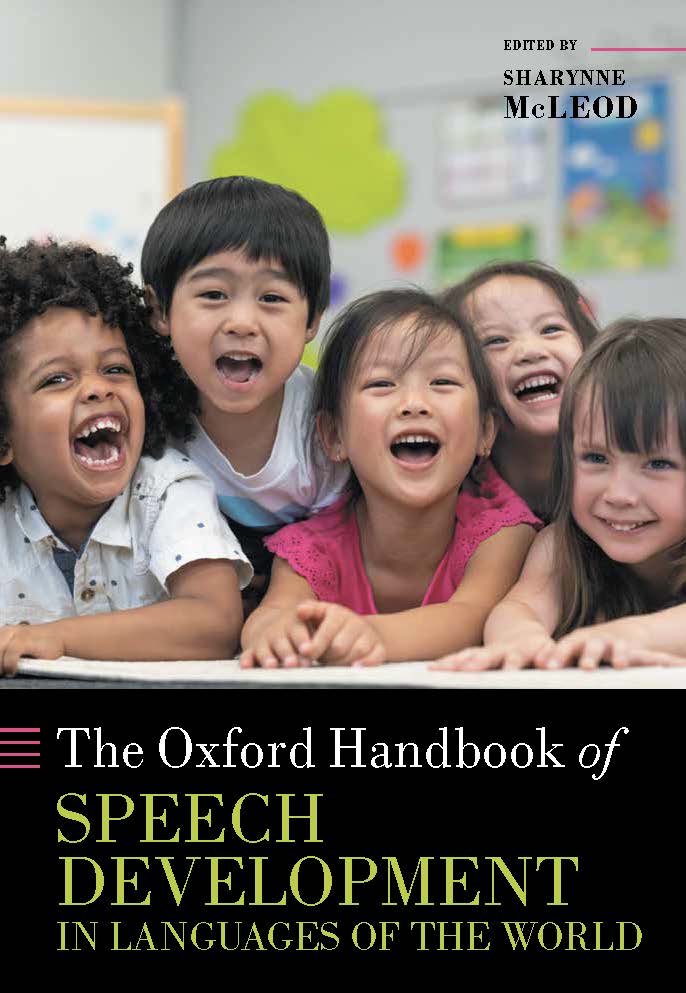
The Oxford Handbook of Speech Development in Languages of the World (McLeod, 2026)

  • 80 chapters: 5 intro chapters, 49 language chapters, 27 dialect chapters
  • 173 authors 
  • 1503 pages
  • Publication 2026
  • Companion child/adult recordings

Oxford University Press websites: 

Google books sample: 

Charles Sturt University associated sites: 


CELEBRATION 1 – 21 ATTENDEES
Wed 12 August 2026 – 8am AEST

  1. Alexis Black
  2. Barbara M Bernhardt
  3. Benjamas Prathanee
  4. Brenda Louw
  5. Chelsea Sommer
  6. Daniel Bérubé
  7. Francoise Brosseau-Lapre
  8. Hatun Zengin-Bolatkale
  9. Helen Blake
  10. Ida Stockman
  11. Joe Stemberger
  12. Kate Margetson
  13. Kelly Farquharson
  14. Krisztina Zajdó
  15. Lynn Williams
  16. Márcia Keske-Soares
  17. Peter Flipsen
  18. Sharynne McLeod
  19. Simon McDonald
  20. Susan Rvachew
  21. Tanya Flores

CELEBRATION 2 – 39 ATTENDEES
Wed 12 August 2026 – 6pm AEST
 

22.    Anna-Leena Martikainen
23.    Annette Fox-Boyer
24.    Spyros Armostis (Σπύρος Αρμοστής)
25.    Anniek van Doornik
26.    Avivit Ben-David
27.    Ben Phạm
28.    Ciara O'Toole
29.    Dana Buntová
30.    Diana Ignatova
31.    Elaine Ballard
32.    Ewa Czaplewska
33.    Ghada Khattab
34.    Hadeel Ayyad
35.    Hanne Gram Simonsen
36.    Helen Blake
37.    Helen Grech
38.    Jennifer Boer
39.    Katri Saaristo-Helin
40.    Lakshmi Venkatesh
41.    Leah Gedalyovich
42.    Marit Carolin Clausen
43.    Martina Ozbič
44.    Melanie Basinger
45.    Olebeng Mahura
46.    Paula Fikkert
47.    Paulina Zydorowicz
48.    Salome Geertsema
49.    Tamer Abou-Elsaad
50.    Rowena Garcia
51.    Saira Ambreen
52.    Sara Lavaggi
53.    Sari Kunnari
54.    Savitha Vadakkanthara Hariharan
55.    Sharynne McLeod
56.    Silke Fricke
57.    Sofia Strömbergsson
58.    Spyros Armostis
59.    Taelo Qhala
60.    Thora Masdottir
61.    Yvonne Wren

Apologies

  1. Kathryn Crowe, Iceland
  2. Sarah Verdon, Australia 
  3. Wiebke Freese, Germany
  4. Shahla Fatemi, Iran 
  5. Mia Roux, South Africa


June 6, 2025

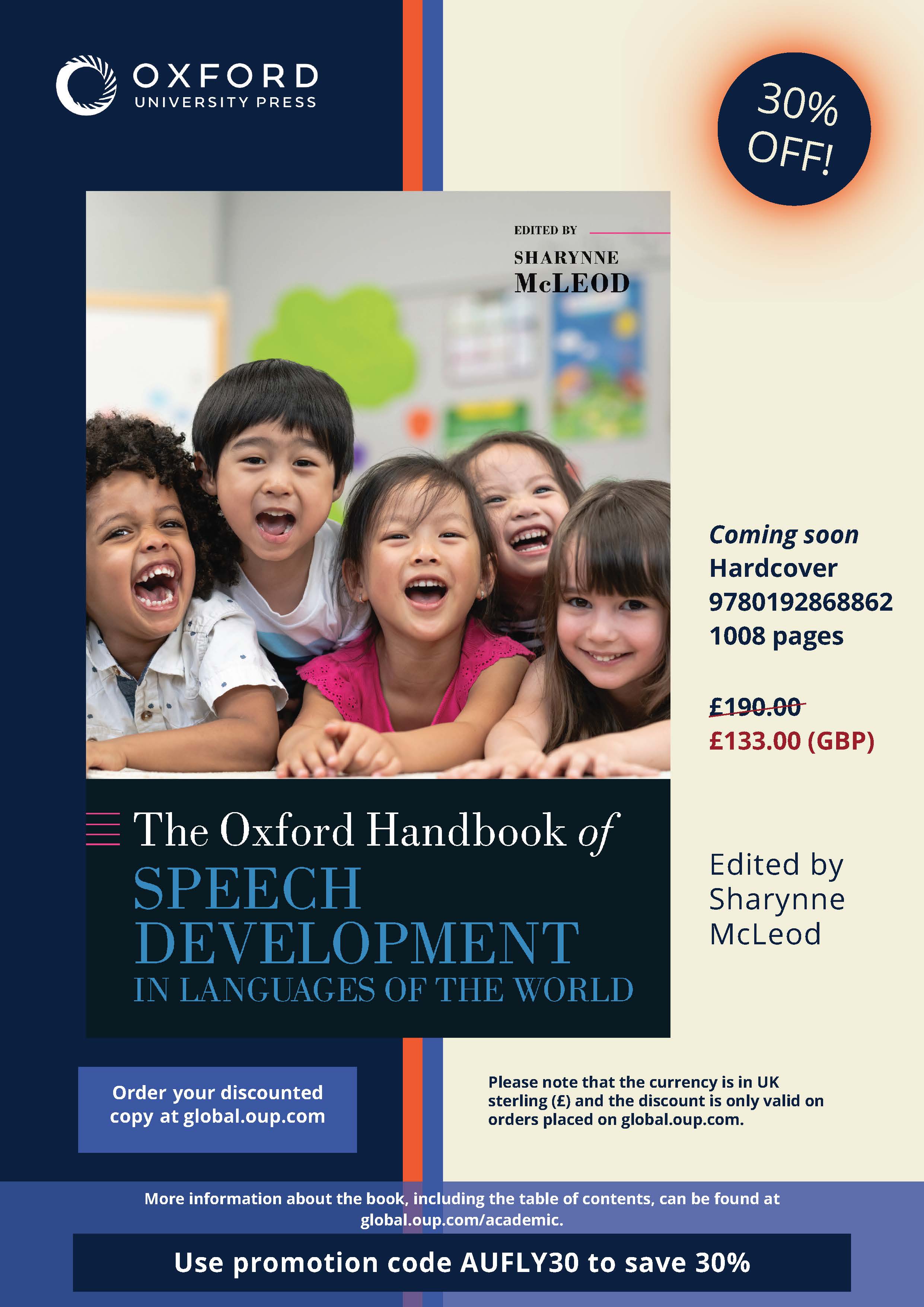
The Oxford Handbook of Speech Development in Languages of the World now has a webpage

The Oxford Handbook of Speech Development in Languages of the World now has a webpage and a flyer - just in time for the ISMBS and ICPLA conferences! Hooray https://global.oup.com/academic/product/the-oxford-handbook-of-speech-development-in-languages-of-the-world-9780192868862


November 28, 2024

Conversations with Oxford University Press

Julia Steer, Linguistics Editor for Oxford University Press invited Dr Helen Blake and myself to discuss ideas for increasing OUP's coverage of speech-language pathology/speech and language therapy titles as a new mission and business proposition. We had lots of ideas.


October 25, 2024

The Oxford Handbook of Speech Development in Languages of the World

Oxford University Press have just sent the description that they will use to promote my new book "The Oxford Handbook of Speech Development in Languages of the World" to be published in 2025

This volume presents a paradigm shift in the world’s knowledge about children’s speech development, with 80 chapters covering 75 languages and language varieties or dialects from across the globe. Each of the chapters follows the same structure, facilitating comparison across languages and dialects. Researchers and students can identify relationships between common and unique elements of children’s speech to develop new theories and enhance understanding. Crucially, the curated data in the chapters can be used by communication specialists to collaborate with families and communities, in order to support children’s home language maintenance and speech development, including in languages not spoken by the specialists.

The Oxford Handbook of Speech Development in Languages of the World presents a transformative approach by which the discipline can overcome traditional English- and Western-centric biases by respecting and acknowledging longstanding traditions of research, theories, and knowledge from a wide range of countries and cultures – including knowledge not previously translated into English. Languages spoken by First Nations people and traditionally marginalized groups are given equivalent status to majority languages, and the language maps, resources, and pronunciation guides have been created using a rights-based, social justice approach, acknowledging the impact of colonization.

  • Features data from 75 languages and dialects, including Indigenous languages and those spoken by traditionally marginalized groups
  • Enables effective comparison between languages, with each chapter following the same structure
  • Includes audio files of child and adult speakers, as well as bespoke maps, pronunciation guides, and links to further information and resources

August 29, 2024

Writing Children's Speech (2nd edition)

Elise Baker and I are working on the second edition of Children's Speech. A lot has happened in this field since it was published in 2017. Our second edition will be published by Oxford University Press.

Elise and Sharynne


July 31, 2024

SUBMITTED - The Oxford Handbook of Speech Development in Languages of the World

Today I submitted The Oxford Handbook of Speech Development in Languages of the World. HOORAY!

Thanks to the 172 chapter authors - my  CSU support team including DVC-R Prof Mark Evans, Dr Helen Blake, Dr Carolyn Gregoric, Mark Filmer, Craig Poynter, and my family.

Here is an overview of the book.

The Oxford Handbook of Speech Development in Languages of the World provides a thorough and updated overview of children’s speech development in 49 languages and 26 dialects. The 80 chapters are written by 172 of the world’s leading scholars. Each chapter follows the same structure to enable comparisons between languages: 

  • Overview: location, maps, varieties, writing 
  • Components: consonants, clusters, vowels, tones, phonotactics, prosody, anatomy) 
  • Typical acquisition: consonants, clusters, vowels, tones, percentage correct, intelligibility, phonological patterns, inventory, mismatches, word structure, prosody, perception, phonological awareness 
  • Supporting children’s speech: children with speech sound disorders (SSD), assessments, interventions 
  • Resources: terminiology, books, journals, websites, professional associations, universities. 

The Handbook upholds communication as a fundamental human right and presents a transformative social-justice approach to understanding languages cultures and communication.

 Here is the Table of Contents and more details:

https://speakingmylanguages.blogspot.com/2024/07/oxford-handbook-of-speech-development.html

Now it is over to Oxford University Press who will take 12 months for production.

Dr Helen Blake, Prof Sharynne McLeod and Vicki Sunter
from OUP celebrating submission of the Handbook

June 26, 2024

Author meetings for The Oxford Handbook of Speech Development in Languages of the World

This week I have held two meetings (to accommodate the world's timezones) for the chapter authors of the The Oxford Handbook of Speech Development in Languages of the World. It has been wonderful to see everyone together on the screen and to celebrate that the book will be submitted soon and published in 2025.

Chapter authors attending meeting 1 - Wednesday at 8am Sydney time
 
Chapter authors attending meeting 2 - Thursday at 7pm Sydney time

Here is the final table of contents:

The Oxford Handbook of Speech Development in Languages of the World
Editor: Sharynne McLeod
1.    Children’s speech development around the world: An introduction
2.    Cultural considerations regarding children’s speech development
3.    Researching children’s speech development
4.    Articulatory and phonological foundations of children’s speech development
5.    Speech assessment of children’s home languages (SACHL): A clinical protocol
6.    Afrikaans speech development
7.    Akan speech development
8.    Arabic (Egyptian) speech development
9.    Arabic (Kuwaiti) speech development
10.    Arabic (Lebanese) speech development
11.    Azerbaijani/Azeri Turkish speech development
12.    Bulgarian speech development
13.    Cantonese speech development
14.    Danish speech development
15.    Dutch speech development
16.    English (African American) speech development
17.    English (Appalachian) speech development
18.    English (Australian) speech development
19.    English (Cajun) speech development
20.    English (Canadian) speech development
21.    English (English) speech development
22.    English (Fiji) speech development
23.    English (General American) speech development
24.    English (Irish) speech development
25.    English (New Zealand) speech development
26.    English (Scottish) speech development
27.    English (South African) speech development
28.    English + Cantonese speech development
29.    English + French speech development
30.    English + Greek speech development
31.    English + Spanish speech development  
32.    English + Vietnamese speech development
33.    Finnish speech development
34.    Flemish speech development
35.    French (Canadian) speech development
36.    French (France) speech development
37.    French (Swiss) speech development  
38.    German speech development
39.    Greek (Cypriot) speech development
40.    Greek (Standard) speech development
41.    Hebrew (Israeli) speech development  
42.    Hungarian speech development
43.    Icelandic speech development
44.    Irish speech development  
45.    Italian speech development  
46.    Jamaican Creole speech development  
47.    Japanese speech development  
48.    Kurdish speech development
49.    Laki speech development
50.    Maltese speech development  
51.    Mandarin/Putonghua speech development  
52.    Māori speech development
53.    Norwegian speech development  
54.    Persian/Farsi speech development
55.    Polish speech development  
56.    Portuguese (Brazilian) speech development  
57.    Portuguese (European) speech development  
58.    Samoan speech development  
59.    Sesotho speech development
60.    Setswana speech development
61.    Slovak speech development  
62.    Slovenian speech development  
63.    Spanish (Andalusian) speech development  
64.    Spanish (Castilian) speech development  
65.    Spanish (Chilean) speech development  
66.    Spanish (Mexican) speech development  
67.    Spanish (Peruvian) speech development  
68.    Swedish speech development
69.    Tagalog speech development
70.    Tamil speech development
71.    Thai speech development
72.    Tok Pisin speech development
73.    Turkish speech development  
74.    Urdu speech development
75.    Vietnamese speech development  
76.    Walpiri speech development
77.    Welsh speech development  
78.    Xhosa/isiXhosa speech development
79.    Zapotec speech development  
80.    Zulu/isiZulu speech development


June 14, 2024

The Oxford Handbook of Speech Development in Languages of the World - retreat and meeting with OUP

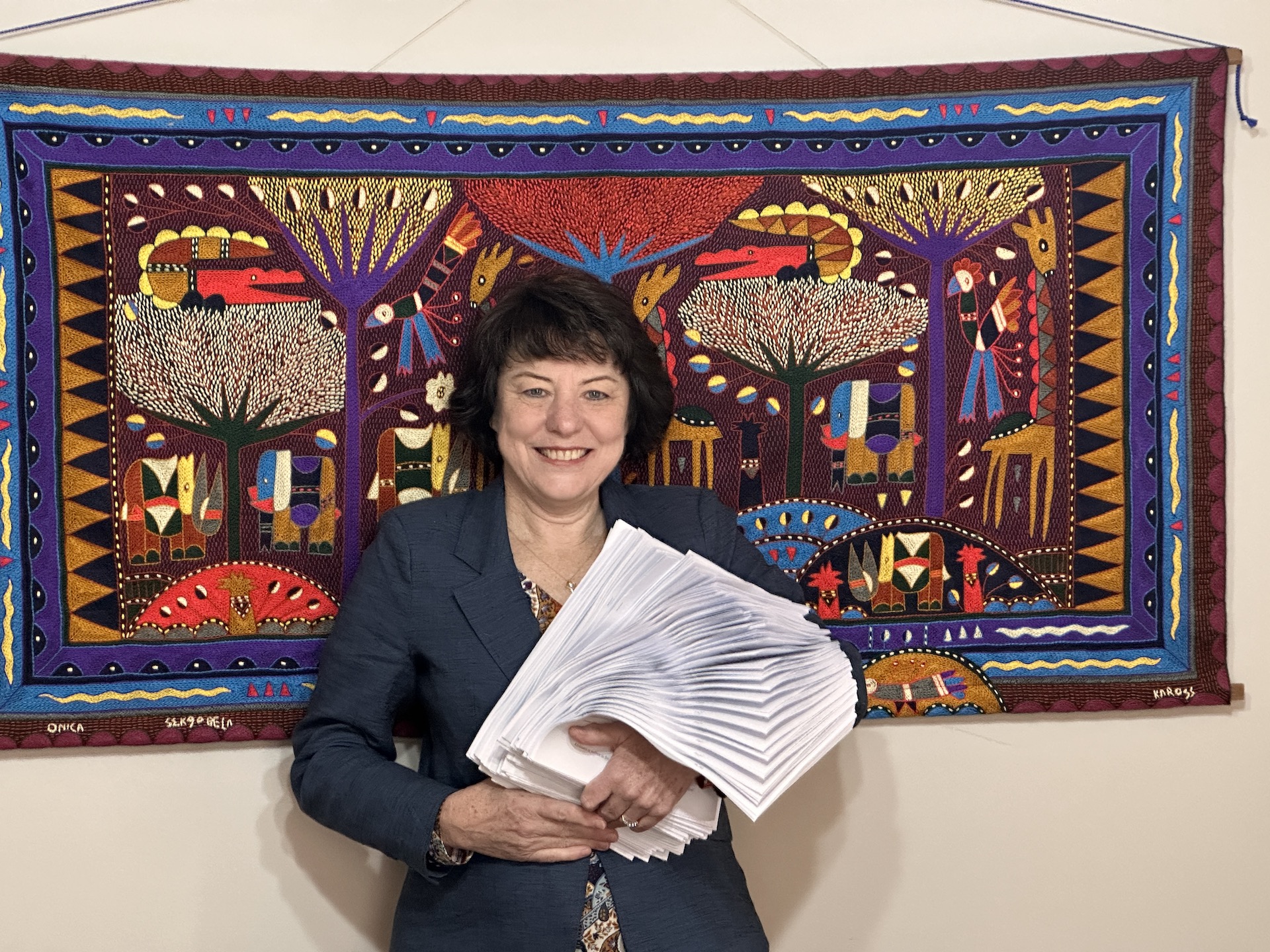
Over the past two days Helen Blake and I have had a book retreat to get The Oxford Handbook of Speech Development in Languages of the World closer to submission. This is the first time I have printed the book - and it is quite an impressive thickness (double sided). We have had a lot of fun finalizing this amazing book.

Tonight (Friday) we met online with Vicki Sunter, linguistics production editor with Oxford University Press to plan for submission - production - and publication. What an exciting conversation working through the next steps. We are very pleased that the book is in good shape and close to submission.

Helen Blake, Vicki Sunter (OUP) and Sharynne

Helen and Sharynne working hard


June 6, 2024

A productive week back in Bathurst

This was my first week back in Bathurst after my 7-week trip to Lisbon (Portugal), Bristol, Cambridge, London, Worcester, and Oxford (England), Cardiff, Bangor(virtual) (Wales), and Perth (Australia). It has been wonderful to share what I have learned and done while overseas - and also to learn about all of the great work that has been done to advance our many projects while I have been away. Thanks everyone.

Dr Helen Blake and Sharynne

Sarah Bartlett, Emily-Jane Woodhead, and Sharynne

Dr Carolyn Gregoric and Sharynne

November 16, 2023

American Speech-Language-Hearing Association Convention, Boston, MA, USA

It is exciting to be in Boston for the American Speech-Language-Hearing Association Convention. Our team is presenting a number of papers and seminars, including:

1. McLeod, S., Blake, H. L., Crowe, K., Louw, B., Farquharson, K., Bérubé, D., Goldstein, B., Babatsouli, E., Kakia Petinou, Zajdó, K., Washington, K. N., Auza, A, Buntová, D., Oravkinová, Z., & Masdottir, T. (2023, November). Children’s speech development in 70+ languages and dialects. [1-hour oral presentation]. American Speech-Language-Hearing Association Convention, Boston, MA, USA. 

2. Ireland, M., Verdon, S., & McLeod, S. (2023, November). Team decision making for SLPs in schools: Tensions and the impact of rules. [Oral presentation]. American Speech-Language-Hearing Association Convention, Boston, MA, USA. 

3. McLeod, S. & Marshall, J. E. (2023, November). Speech-language pathologists and the United Nations’ Sustainable Development Goals. [Oral presentation]. American Speech-Language-Hearing Association Convention, Boston, MA USA. 

4. Washington, K., Crowe, K., McLeod, S., Margetson, K., Kokotek, L., van der Straten Waillet, P., Masdottir, T., Volhardt, M. (2023, November). Methods for accurate differential diagnosis of speech sound disorder in multilingual children. [1-hour oral presentation]. American Speech-Language-Hearing Association Convention, Boston, MA USA.  

 The final attendance numbers are: 15,904 (1,458 – Virtual Only 14,446 – In Person)


July 31, 2022

Submitted chapters for The Oxford Handbook of Speech Development in Languages of the World

I am enjoying editing the 30+ (of 77) chapters that have been submitted to The Oxford Handbook of Speech Development in Languages of the World and look forward to receiving the rest: 

  1. Afrikaans 
  2. Arabic (Egyptian) 
  3. Azerbaijani 
  4. Dutch 
  5. English (Appalacian) 
  6. English (Cajun) 
  7. English (Fijian) 
  8. English (Irish) 
  9. English+Spanish 
  10. Finnish 
  11. Flemish 
  12. French(Swiss) 
  13. Icelandic 
  14. Irish 
  15. isiXhosa 
  16. Jamaican 
  17. Kurdish 
  18. Maltese 
  19. Mandarin-Putonghua 
  20. Maori 
  21. Norwegian 
  22. Persian-Farsi 
  23. Polish 
  24. Portuguese (European) 
  25. Sesotho 
  26. Slovak 
  27. Slovenian 
  28. Spanish (Andalusian) 
  29. Spanish (Mexican) 
  30. Swedish 

Additional chapters submitted this week

  1. English (South African)
  2. Hebrew (Israeli)
  3. Setswana 
  4. Japanese 
  5. English (Canadian)
  6. Samoan
  7. Arabic(Kuwaiti)
  8. Spanish(Chilean)
  9. English(English)


May 19, 2022

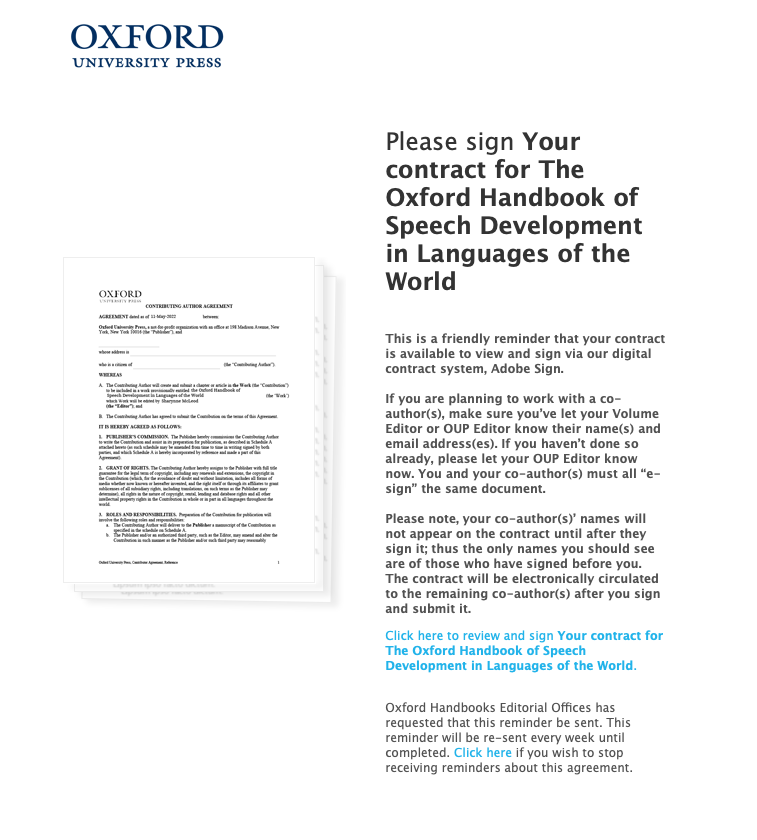
Oxford University Press contracts are ready

Oxford University Press is currently sending contracts to the chapter authors for The Oxford Handbook on Speech Development in Languages of the World. How exciting!

I have already received chapters titled Sesotho Speech Development and Flemish Speech Development. This is going to be a fantastic book.


March 10, 2022

First meetings of The [Oxford] Handbook of Speech Development in Languages of the World

I have held three meetings across different timezones for chapter authors within The [Oxford] Handbook of Speech Development in Languages of the World. It has been wonderful to see familiar faces as well as to meet new colleagues who are embarking on this exciting journey with me.

Chapter authors - Meeting 1

Chapter authors - Meeting 2
Chapter authors - Meeting 3
(with New Zealand authors writing Samoan and Māori chapters)


Chapter author - Meeting 4
(with Olebeng Mahura who is co-authoring Setswana, isiXhosa, and South African English chapters)


Here is the current Table of Contents

1.     Speech development of monolingual and multilingual children

2.     Articulatory and phonological foundations of children’s speech development 

3.     Cultural considerations regarding children’s speech development

4.     Research into children’s speech development

5.     Afrikaans speech development

6.     Akan speech development

7.     Arabic (Egyptian) speech development

8.     Arabic (Kuwaiti) speech development

9.     Arabic (Lebanese) speech development

10.  Azerbaijani speech development

11.  Bulgarian speech development

12.  Cantonese speech development

13.  Croatian speech development

14.  Danish speech development

15.  Dutch speech development

16.  English (African American) speech development

17.  English (Appalachian) speech development

18.  English (General American) speech development

19.  English (Australian) speech development

20.  English (British) speech development

21.  English (Canadian) speech development

22.  English (Cajun) speech development

23.  English (Fijian) speech development

24.  English (Irish) speech development

25.  English (New Zealand) speech developmen

26.  English (Scottish) speech development

27.  English (South African) speech development

28.  English + Cantonese speech development

29.  English + French speech development

30.  English + Greek speech development

31.  English + Korean speech development

33.  English + Spanish speech development 

34.  English + Vietnamese speech development

35.  Farsi speech development 

36.  Filipino speech development

37.  Finnish speech development

38.  Flemish speech development

39.  French (Canadian) speech development

40.  French (French) speech development

41.  French (Swiss) speech development 

42.  German speech development

43.  Greek (Cypriot) speech development

44.  Greek (Standard) speech development

45.  Hebrew (Israeli) speech development 

46.  Hungarian speech development

47.  Icelandic speech development

48.  Irish speech development 

49.  Italian speech development 

50.  Jamaican Creole speech development 

51.  Japanese speech development 

52.  Korean speech development 

53.  Kurdish speech development

54.  Malay speech development 

55.  Maltese speech development 

56.  Māori speech development

57.  Mandarin/Putonghua speech development 

58.  Norwegian speech development 

59.  Persian speech development

60.  Polish speech development 

61.  Portuguese (Brazilian) speech development 

62.  Portuguese (European) speech development 

63.  Samoan speech development 

64.  Sesotho speech development

65.  Setswana speech development

66.  Slovak speech development 

67.  Slovenian speech development 

68.  Spanish (Andalusian) speech development 

69.  Spanish (Castilian) speech development 

70.  Spanish (Chilean) speech development 

71.  Spanish (Mexican) speech development 

72.  Swedish speech development

73.  Thai speech development

74.  Turkish speech development 

75.  Vietnamese speech development 

76.  Welsh speech development 

77.  isiXhosa speech development

78.  Zapotec speech development 

79.  isiZulu speech development (TBC)