Showing posts with label Intelligibility enhancement. Show all posts

December 19, 2021

A viewpoint on accent services: Framing and terminology matter

This is an interesting new article: Grover, V., Namasivayam, A., & Mahendra, N. (2021). A viewpoint on accent services: Framing and terminology matter. American Journal of Speech-Language Pathology. https://doi.org/10.1044/2021_AJSLP-20-00376 

It includes a discussion of intelligibility enhancement, a term coined by Helen Blake and used within her PhD research:

“A key issue is whether terms like accent modification, accent reduction, or accent elimination are misnomers, as researchers have questioned whether accents can be completely changed or eliminated in adulthood (Celce-Murcia et al., 1996; Flege et al., 1995). We consider the term intelligibility enhancement (Blake, 2020) as a more accurate descriptor of services because of its emphasis on a shared responsibility for intelligibility, successful speaker–listener interactions, and on functional communication in context. On critical analysis, however, even this descriptor “intelligibility enhancement” is inadequate and misrepresentative because it fails to convey that an accented speaker is fully intelligible in their L1 (if not English) and also intelligible in their accented English or World English to speakers who share their linguistic or cultural background or who have been previously exposed to their accent...”

March 3, 2021

Multilingual university students’ perceived English proficiency, intelligibility and participation

The following manuscript has been accepted for publication:

Blake, H. L., Verdon, S. & McLeod, S. (2021, in press March). Multilingual university students’ perceived English proficiency, intelligibility and participation. Journal of Monolingual and Bilingual Speech

Here is the abstract:

This paper reports on 137 multilingual students enrolled at 14 English-speaking Australian universities who completed a 27-item online survey investigating the relationship between perceived English proficiency, intelligibility, and their academic, social, and vocational participation. Open-ended responses described strategies used to enhance spoken English. Participants came from 44 countries and spoke 49 home languages. Self-ratings of English communication skills were significantly affected by age, English experience, number of languages spoken, and home language. Participants reported spoken English proficiency impacted participation; however, results highlighted lack of awareness of intelligibility as an essential component of spoken language proficiency. Although environmental factors (e.g., more time using English in conversations) were associated with higher self-ratings of proficiency, participants preferred using individual strategies (e.g., listening/repeating) to support English intelligibility rather than social interactions with native speakers. The results demonstrate the importance of conversation practice in language learning to increase proficiency and confidence, as well as participation.

https://journal.equinoxpub.com/JMBS/issue/view/1810

February 11, 2020

First articles of the decade in two journals

I am very pleased to announce that my PhD students' papers have been published as the first papers of the decade (first pages in issue 1) in two different journals:
  • Blake, H. L., McLeod, S., & Verdon, S. (2020). Intelligibility Enhancement Assessment and Intervention: A single-case experimental design with two multilingual university students. Clinical Linguistics and Phonetics, 34(1-2), 1-20. https://doi.org/10.1080/02699206.2019.1608470 
  • McGill, N., & McLeod, S. (2020). Waiting list management in speech-language pathology: Translating research to practice. Speech, Language and Hearing, 23(1), 2-8. https://doi.org/10.1080/2050571X.2020.1716471
I have had another paper published in 2020 as well:

January 28, 2020

First publication for the new decade

Blake, H. L., McLeod, S., & Verdon, S. (2020). Intelligibility Enhancement Assessment and Intervention: A single-case experimental design with two multilingual university students. Clinical Linguistics and Phonetics, 34(1-2), 1-20. https://doi.org/10.1080/02699206.2019.1608470

Intelligibility Enhancement Assessment and Intervention protocols are available as supplemental materials here: https://www.tandfonline.com/doi/suppl/10.1080/02699206.2019.1608470/suppl_file/iclp_a_1608470_sm6855.pdf
Abstract: Speech-language pathologists (SLPs) may be approached by multilingual speakers wishing to improve their intelligibility in English. Intelligibility is an essential element of spoken language proficiency and is particularly important for multilingual international students given their need to express complex ideas in an additional language. Intelligibility Enhancement aims to improve the intelligibility and acceptability of consonants, vowels and prosody with multilingual speakers who are learning to speak English. This study aimed to describe the Intelligibility Enhancement Assessment and Intervention Protocols and determine whether the intervention changed multilingual university students’ English intelligibility. A multiple-baseline single-case experimental design was applied with direct inter-subject replication across two female participants whose home languages were Vietnamese and Putonghua (Mandarin). English intelligibility was assessed at multiple intervals pre, post and during intervention. The intervention protocol consisted of 11 weekly 1-h sessions with an SLP targeting English consonants, vowels and prosody. Following intervention, both participants displayed increased performance across most measures. For example, the Vietnamese participant’s percentage of consonants correct (PCC) increased from 62.5% to 85.0% in probe keywords. Effect sizes, when comparing baseline and withdrawal phases, were 5.5 for PCC, 4.6 for final consonants, 2.3 for consonant clusters and 1.6 for syllables indicating improvements in all variables measured. Her speech rate reduced, word stress increased in accuracy and she perceived less difficulty communicating in English. These promising results suggest further testing of the Intelligibility Enhancement Protocols is warranted to determine effectiveness as an intervention for multilingual speakers.

December 12, 2019

Congratulations Dr Blake!

Today Helen Blake graduated with her PhD.
Charles Sturt University published a media release about her success: An interesting career led to PhD for significant multilingual speech research

Dr Sarah Verdon and I are her proud supervisors.

More information about Dr Blake’s PhD research is here:

Dr Helen Blake with her proud supervisors Dr Sarah Verdon and Prof Sharynne McLeod
Dr Helen Blake
Faculty of Arts and Education PhD graduates
Dr Helen Blake and her father are related to ex-CSU Vice Chancellor CD Blake
 

November 21, 2019

American Speech-Language-Hearing Association Convention, Orlando, FL


This week, members of the SLM team are attending the American Speech-Language-Hearing Association Convention, in Orlando, FL. There were almost 3,000 papers and posters presented over the 3 days and 15,000+ attendees.
Here are the seminars/papers we are presenting:
  • McLeod, S. & Crowe, K. - Children’s consonant acquisition across languages. Invited 1-hour seminar. 
  • Baker, E., Williams, A. L., McCauley, R. J. & McLeod, S. - A taxonomy of phonological intervention to guide and teach clinical decision-making and fidelity of implementation. 1-hour seminar. 
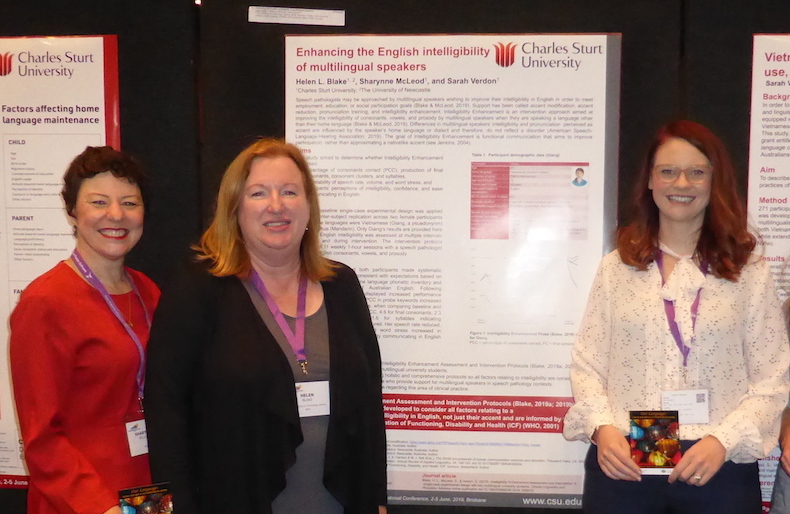
  • Blake, H. L., McLeod, S. & Verdon, S. - Intelligibility Enhancement assessment and intervention for multilingual university students. Technical paper. 
  • Brown, M. I., Wang, C., & McLeod, S. - Parent-child book reading impacts academic achievement in Grade 3. Technical paper. 
Alyssa Boucher (Boston University), Sharynne McLeod (CSU), Kate Crowe (CSU/Iceland University), Michelle Brown (CSU), Sheila Deogtardi (Macquarie Uni) at ASHA
Sharynne, Karla Washington, Kate Crowe, Thora Masdottir, Helen Blake and Michelle Brown at the Researcher Academic Town Meeting (Wednesday night)
Sharynne, Rebecca McCauley and Lynn Williams about to present their 1-hour seminar
(Elise Baker presented via voice-over)
Speech Sound Disorders Researchers: Sharynne, Rebecca McCauley, Shelley Velleman, Greg Lof, Kelly Farquharson, Francois Brosseau Lapre, SLP, Brian Goldstein, Katy Cabbage, Jill Hoover, Sarah Masso
Sharynne and Kate Crowe presented an invited 1-hour seminar (and gave out free handouts)
Helen Blake about to present her paper
Dr Michelle Brown about to present her second paper
Michelle Brown, Sheila Degotadi, Sharynne, Lynn Williams (2021 ASHA President), Kate Crowe
John Bernthal and Sharynne catch up every year at the ASHA convention.
Sharynne is currently updating a book chapter in the 9th edition of John's book
Sharynne, Shelley Velleman, Amy Glaspey, Brian Goldstein
Sharynne, Michelle, Kate and Helen sampling Harry Potter's butter beer (100% sugar!)
Helen, Sharynne, Lynn, Michelle, Kate and Marie Ireland at the Harry Potter World ASHA closing party

November 6, 2019

Congratulations Helen on your PhD

Congratulations to Helen Blake on being approved to graduate with her PhD. Helen's thesis "English proficiency, intelligibility, and participation of multilingual speakers in Australia" included 7 articles + 1 encyclopaedia entry. Dr Sarah Verdon and I are proud supervisors.
Here is the blog post at the time she submitted her thesis: https://speakingmylanguages.blogspot.com/2019/03/congratulations-helen-phd-submission.html

Her PhD thesis is available here: https://researchoutput.csu.edu.au/en/publications/english-proficiency-intelligibility-and-participation-of-multilin

Helen met her PhD examiners at the American Speech-Language-Hearing Association convention in Orlando, Florida who congratulated her on her success.
Prof Travis Threats with Helen
Helen with Prof Amber Franklin
Helen with Prof Lilly Cheng and Emeritus Prof Dolores Battle

October 22, 2019

Congratulations Helen!

Helen Blake has just received a letter from Chair of the Faculty PhD Examinations' Committee to say "Congratulations to you and your supervisory team for a successful PhD completion." What wonderful news. Congratulations Helen.

April 11, 2019

The SAGE encyclopedia of human communication sciences and disorders

The SAGE encyclopedia of human communication sciences and disorders has just been published. The 4-volume encyclopedia was edited by Jack Damico and Martin Ball. The website states "The editors have recruited top researchers and clinicians across multiple fields to contribute to approximately 640 signed entries across four volumes"  Members of our SLM team have written seven of these entries:
  1. Blake, H. L. & McLeod, S. Intelligibility enhancement
  2. Cronin, A. & McLeod, S. Cleft lip and palate: Speech effects
  3. Cronin, A. & McLeod, S. Craniofacial anomalies.
  4. McLeod, S. International Classification of Functioning, Disability and Health. 
  5. McLeod, S. Prevalence of communication disorders.
  6. McLeod, S. & Verdon, S. Multilingualism and speech sound disorders
  7. Phạm, B. & McLeod, S.  Tone languages and communication disorders.
Anna Cronin with volume 1 (of 4) of the encyclopedia

February 19, 2019

Exploring multilingual speakers’ perspectives on their intelligibility in English

The following manuscript has been accepted for publication. It forms part of Helen Blake's PhD research:
Blake, H. L., Verdon, S. & McLeod, S. (2019, in press February). Exploring multilingual speakers’ perspectives on their intelligibility in English. Speech, Language and Hearing.
50 free copies are available from this link: https://www.tandfonline.com/eprint/eJF8jisEZg7UkRtFFBIM/full?target=10.1080/2050571X.2019.1585681
Here is the abstract:
Multilingual speakers’ ability to communicate effectively and intelligibly in the language of their country of residence is crucial to their participation. This study explored multilingual speakers’ motivations for improving their intelligibility in English and their perceptions of potential barriers and facilitators to enhancing intelligibility. Participants were multilingual students and staff at 14 Australian universities. Extended response data from 137 survey responses were combined with seven semi-structured interviews, thematically analysed using the World Health Organization’s International Classification of Functioning, Disability and Health as a conceptual framework, and coded using NVivo software. Three overarching themes were: motivations, barriers, and facilitators. Themes that emerged under motivations were meeting their own and others’ expectations and career aspirations. Themes that emerged under barriers to intelligibility were lack of self-awareness of reduced English intelligibility, use of ineffective strategies (e.g., fast speech rate to disguise pronunciation difficulties), language differences, lack of opportunity to practise English, participants’ perceptions of others’ negative attitudes to their English skills, and challenging conversational partners. Facilitators to intelligibility were emotional support from others, beneficial strategies (e.g., confirming listener understanding), and opportunities to practice. The results highlight the importance of supporting multilingual speakers’ efforts to improve their English intelligibility. An environment with barriers such as lack of opportunity to practise English may restrict an individuals’ performance and participation, while facilitators such as support from others may increase participation. This study will inform the understanding of speech-language pathologists engaged in Intelligibility Enhancement, as well as SLPs working with multilingual speakers in any context.

January 30, 2018

Intelligibility Enhancement in English for multilingual speakers

Helen Blake is presenting an online seminar titled "Intelligibility Enhancement in English for multilingual speakers" on 24 April 2018. The seminar is sponsored by Speech Pathology Australia and more details are here.
(UPDATE new title and new date "Updating accent modification practice: Intelligibility Enhancement for multilingual speakers"- https://www.cpdlive.com/speechpath/seminars4/7633/preview.html)

The abstract is here:
This event aims to support speech-language pathologists working with multilingual adults to enhance their intelligibility in English. Clinicians working in Intelligibility Enhancement, as in any area of clinical practice, need information not only to make appropriate clinical decisions, but also to better understand the needs of clients in order to advocate for and empower them. This webinar will review the literature and terminology relating to Intelligibility Enhancement and multilingual speakers in Australia. Presentation of principles for assessment and intervention will be supplemented with specific examples from different languages.

April 29, 2017

Speech Intelligibility Clinic at The University of Newcastle

This week I visited Helen Blake who leads the Speech Intelligibility Clinic at the University of Newcastle. Helen is my PhD student and some of her PhD is based around her work in the clinic. She also works in the clinic one day per week supervising speech pathology students providing intelligibility enhancement to staff and students. They also support the students at ELICOS (English Language Intensive Courses for Overseas Students).

Helen brings a wide range of specialist skills to her role and studies. As well as being a speech pathologist, she has been an air traffic control standarization officer, and has learned  nine languages (Latin, French, German, Spanish, Japanese, Russian, Polish, Mandarin, Hebrew). As part of her PhD Helen has already published two journal articles and has written an encyclopedia entry:
  • Blake, H. L. & McLeod, S. (2017, accepted for publication). Intelligibility enhancement. In M. J. Ball & J. S. Damico (Eds.), The SAGE encyclopedia of human communication sciences and disorders. Thousand Oaks, CA: Sage. 
  • Blake, H. L., Bennetts Kneebone, L. & McLeod, S. (2017, in press). The effect of oral English proficiency on humanitarian migrants’ experiences of settling in Australia. International Journal of Bilingual Education and Bilingualism. doi: 10.1080/13670050.2017.1294557 
  • Blake, H. L., McLeod, S., Verdon, S. & Fuller, G. (2016, in press). The relationship between spoken English proficiency and participation in higher education, employment, and income from two Australian censuses. International Journal of Speech-Language Pathology. doi: 10.1080/17549507.2016.1229031
While I was visiting the University of Newcastle, I also gave a lecture to staff and students who were on campus and via video conference to clinical sites around Newcastle (and beyond). The attendees were enthusiastic about the free resources available on the Multilingual Children's Speech website.
Helen (at the far end of the table) with speech pathology students at the Speech Intelligibility Clinic
Some of the audience who attended my presentation at the University of Newcastle