Showing posts with label UDHR. Show all posts

November 13, 2025

Visiting the United Nations

Today I had the opportunity to visit the United Nations. Originating alongside the League of Nations that was formed after World War I, the United Nations has had a fundamental role to play in shaping the modern world. While the United Nations Head Office is in New York, the Geneva Office holds many important meetings and roles.

The Universal Declaration of Human Rights (UDHR), Convention on the Rights of the Child (CRC), Convention on the Rights of Persons with Disabilities (CRPD), and Declaration on the Rights of Indigenous Peoples (UNDRIP) are some of the important documents from the United Nations that inform my work every day.


The view from the UN

June 2, 2025

ACU interview for SPHY406 Module 1: Human Dignity and Human Rights

This morning I was interviewed by A/Prof Jane McCormack for her subject SPHY406 Module 1: Human Dignity and Human Rights. It was a privilege to discuss this important topic.

Here are some of the questions she asked:

  • Tell us a little about yourself - what motivated you to become a speech pathologist? What keeps you in the profession?
  • What work are you most proud of doing? Why?
  • What are "human rights"?  
  • What does it mean to say that "Communication is a basic human right"?
  • Why are human rights important to our work as speech pathologists?
  • Tell us about your experience researching and working in the area of human rights.
  • Can you provide an example of when your work has advocated for a client's human rights and a time when you have advocated for the community (eg through legislation or policy)?
  • What do speech pathologists need to know/do to be advocates of human rights and human dignity?
  • How can graduates be change-makers in this space?

August 15, 2023

The Universal Declaration of Human Rights turns 75 next year

The Universal Declaration of Human Rights turns 75 next year. The Office of the High Commissioner for Human Rights (OHCHR) has put out a Call for input: Views of youth-led and youth-focused organizations and institutions on the future of human rights for the development of the Human Rights 75 Youth Declaration https://www.ohchr.org/en/calls-for-input/2023/call-input-views-youth-led-and-youth-focused-organizations-and-institutions

Our team has done a lot of work on Article 19 of the UDHR.

Article 19. Everyone has the right to freedom of opinion and expression; this right includes freedom to hold opinions without interference and to seek, receive and impart information and ideas through any media and regardless of frontiers 

As part of our recent Early Childhood Voices conference we asked children across the world to draw themselves talking to someone. We listened to 200 hundred children (2-12 years) from 20+ countries (Armenia, Australia, Bangladesh, Canada, China, Croatia, Fiji, Ghana, Greece, Hong Kong SAR China, Hungary, Indonesia, Iran, Latvia, Malaysia, Netherlands, New Zealand, Poland, Slovakia, Spain, United Kingdom, United States, Vietnam). Their drawings are displayed in four Children Draw Talking Global Online Galleries. The majority of children (79%) felt happy about talking, 8% felt unsure, 1.5% felt sad, and some did not respond or said another feeling. The children drew themselves talking to a friend (22%), their mother (16%), father (14%), animals (9%), siblings (9%), other family members (5%), and teacher/speech pathologist (4%) (some unable to be classified). Parents of 28.5% of children had concerns about how their child talked or made speech sounds (similar to the Longitudinal Study of Australian Children, McLeod & Harrison, 2009). 

The Early Childhood Interdisciplinary Research Sturt Scheme at Charles Sturt University have put together a submission to the United Nations where children have provided “recommendations to decision and policymakers, including … the United Nations, and others, to advance human rights in the future”. 

A few years ago we documented communication as a human right in the special issue of IJSLP (free online). The lead article summarizing the special issue is here: 

McLeod, S. (2018). Communication rights: Fundamental human rights for all. International Journal of Speech-Language Pathology, 20(1), 3–11. https://doi.org/10.1080/17549507.2018.1428687 

We took this special issue to the United Nations in 2019.

Recently, we have published a special issue demonstrating how communication is central to the Sustainable Development Goals (free online). The lead article summarizing the special issue is here: 

McLeod, S., & Marshall, J. (2023). Communication for all and the Sustainable Development Goals. International Journal of Speech-Language Pathology, 25(1), 1-8. https://doi.org/10.1080/17549507.2022.2160494 

I have been encouraging my colleagues fro across the world to engage with the 75th anniversary of the Universal Declaration of Human Rights.  

Also, see Dr Suzanne Hopf reading Article 19 from Fiji - https://youtu.be/XlfonR_aQaQ. Her video is included in the Universal Declaration of Human Rights Multilingual Video Collection https://www.un.org/en/udhr-video/curated.shtml.

References 

Mahony, L., McLeod, S., Salamon, A., Dwyer, J. (Eds.) (in press). Early childhood voices: Children, families, professionals. Springer Nature. 

McCormack, J., McLeod, S., Harrison, L. J., & Holliday, E. L. (2022). Drawing talking: Listening to children with speech sound disorders. Language, Speech, and Hearing Services in Schools, 53(3), 713-731. https://doi.org/10.1044/2021_LSHSS-21-00140 

McLeod, S. (2018). Communication rights: Fundamental human rights for all. International Journal of Speech-Language Pathology, 20(1), 3–11. https://doi.org/10.1080/17549507.2018.1428687

McLeod, S., & Marshall, J. (2023). Communication for all and the Sustainable Development Goals. International Journal of Speech-Language Pathology, 25(1), 1-8. https://doi.org/10.1080/17549507.2022.2160494

July 23, 2021

Communication and human rights within speech pathology

In 2019, lawyer Bill Mitchell presented a lecture at James Cook University titled "Communication and human rights within speech pathology" (see my blog post: https://speakingmylanguages.blogspot.com/2019/10/communication-and-human-rights-in.html)

During his lecture, he cited our work on communication rights https://tandfonline.com/doi/full/10.1080/17549507.2018.1428687 

His new open-access paper has just been published:

Mitchell, B. (2021). Communication and human rights within speech pathology. Griffith Law Review. https://www.tandfonline.com/doi/full/10.1080/10383441.2021.1932646

July 1, 2020

External mentor for "Good to Great" scheme

Dr Julie Marshall is one of 20 people from Manchester Metropolitan University (UK) to be selected for the "Good to Great" scheme aimed to develop leadership skills, research collaborations, new skills and knowledge. I have been appointed as Julie's external mentor as part of the scheme. We had our first official meeting today, where we discussed Julie's alignment with the United Nations including her important work with UNHDR in Rwanda. Here is a paper that Julie and colleagues wrote in 2018 that I presented as part of my speech at COSP12 at the United Nations in 2019:

Marshall, J., & Barrett, H. (2018). Human rights of refugee-survivors of sexual and gender-based violence with communication disability. International Journal of Speech-Language Pathology, 20(1), 44-49. doi:10.1080/17549507.2017.1392608

October 10, 2019

Communication and human rights in speech pathology


"Communication and human rights in speech pathology" was the title of the James Cook University Speech Pathology Student Society's Inaugural Lecture. Congratulations to the JCU Speech Pathology Student Society, Gareth Lloyd, and Bill Mitchell (Townsville Community Legal Service) for addressing this important topic tonight. Thank you for inviting me to introduce the evening outlining some of the work we have been able to undertake to speak up for communication rights.
Speech-language pathologists are human rights defenders and cross-cutting enablers. We also need to "speak up" to be human rights advocates.
Speech-language pathologists are "canaries in the coal mine". We are first identifiers - unlocking communication to enable positive health, educational and social outcomes ~ Bill Mitchell

September 6, 2019

Communication rights special issue of IJSLP

I just calculated that the Communication rights special issue of International Journal of Speech-Language Pathology (IJSLP) has been viewed 89,794 times and has an Altmetric score of 1,164 since it was published in 2018!
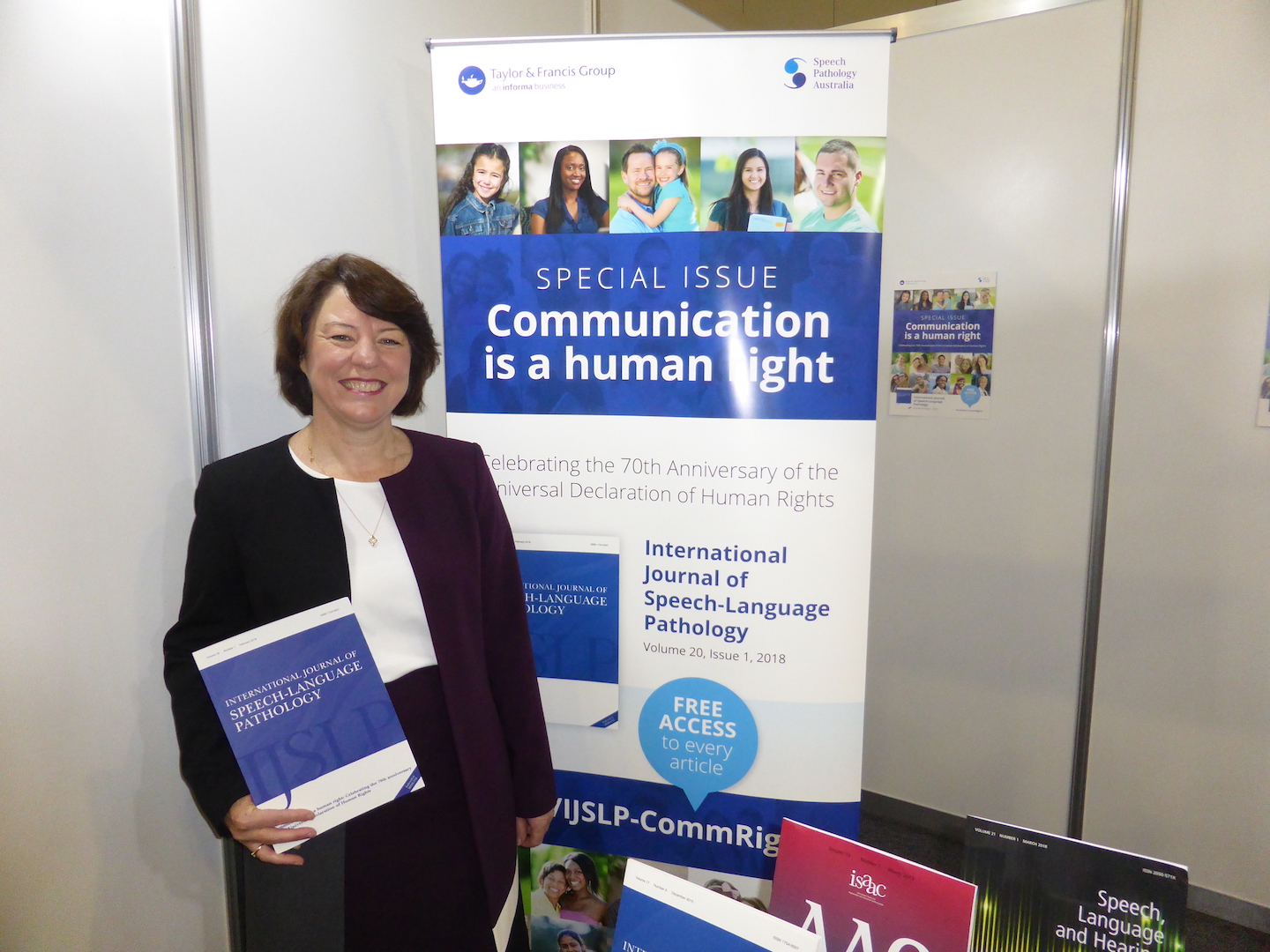
My introductory article "Communication rights: Fundamental human rights for all" has been viewed 8,261 times to date.
I have enjoyed seeing the impact of this work rippling around the world. For example, yesterday I learned that the James Cook University Speech Pathology Student Society have planned their inaugural lecture to be titled "Communication and human rights" in October.

UN statement about the 70th anniversary of the Universal Declaration of Human Rights

December 10, 2018

70th anniversary of the Universal Declaration of Human Rights

Today (10th December, 2018) is the 70th anniversary of the Universal Declaration of Human Rights. Over the past year, we have promoted this day, and particularly Article 19, celebrating communication rights in many ways. Here are some of the highlights:

November 15, 2018

American Speech-Language-Hearing Association Convention in Boston, MA

My PhD students, Helen Blake and Nicole McGill, at the ASHA convention in Boston
 The American Speech-Language-Hearing Association Convention in Boston, MA was held from 15-17 November. Over 19,000 people registered to attend.

Our team had eight presentations: 
3-hour short course
  • Farquharson, K., Storkel., H., & McLeod, S. (2018). Evolution of speech sound norms: Revolutionizing assessment (invited) 
1-hour seminars
  • Baker, E., Williams, A. L., McLeod, S., & McCauley, R. J. (2018). The Phonological Intervention Taxonomy: How do phonological interventions differ from one another? 
  • McLeod, S., Mulcair, G., Pietranton, A., Williams, C., Wofford, M., Tibi, S., Hemsley, B., Lyons, R., Carroll, C. & Hersh, D. (2018). The right to communicate: Celebrating the 70th anniversary of the Universal Declaration of Human Rights (invited) 
Technical research papers
  • Blake, H., Verdon, S., & McLeod, S. (2018). Intelligibility in English: Multilingual speakers' perspectives
  • Crowe, K., Marschark, M., & McLeod, S. (2018). Intelligibility in American Sign Language
  • McGill, N. & McLeod, S. (2018). Designing a website to support children and families who are waiting for speech-language pathology services
Posters
  • Blake, H., Verdon, S., & McLeod, S. (2018). English proficiency, intelligibility and participation of multilingual university students
  • Deutenberg, C., Loebick, K. Wright, R., Washington, K. N., McLeod, S. (2018). Using drawings to understand Jamaican children's talking
UDHR Seminar: Bronwyn Hemsley, Claire Wofford, Deb Hersh, Rena Lyons, Arlene Pietranton


Also at the convention our Sound Start Study team received the Journal of Speech, Language, and Hearing Research Editor's Award.

Additionally, Corrine Deutenberg was selected to receive a Student Research Travel Award to attend the ASHA Convention. She was selected for this award because she was the first author on our poster titled Using Drawings to Understand Jamaican Children’s Talking, which was the "highest-rated, student-authored paper in its Convention topic area”.  Congratulations Corrine!
Corrine Deutenberg, Dr Karla Washington, and co-authors on the award winning poster

Unfortunately I couldn't attend the convention, but had prepared videos for two of the sessions and am grateful to my students and colleagues for presenting the others.
Gina Olwoch (2nd from right) and the ASHA team (Ellen Shortill, Erinn Gorey, and Deena Thompson) who organize the entire convention
Australians at ASHA: Cori Williams, Kate Crowe, Helen Blake, Nicole McGill

November 7, 2018

Communication Rights presentation

I have created a 13 minute video presentation titled "Communication rights: Celebrating the 70th anniversary of the Universal Declaration of Human Rights". This presentation was created to celebrate the 70th anniversary of the Universal Declaration of Human Rights in 2018.
It can be downloaded here: https://cloudstor.aarnet.edu.au/plus/s/mylsgcvZqzj2Htf (note - 52MB file)
The presentation profiles papers from the special issue of the International Journal of Speech-Language Pathology that can be downloaded from bit.ly/IJSLP-CommRights
A summary of the special issue is presented in the following paper: https://www.tandfonline.com/doi/full/10.1080/17549507.2018.1428687
The presentation was played at the International Clinical Phonetics and Linguistics Association conference in Malta and will be played at the American Speech-Language-Hearing Association convention in Boston next week.

October 23, 2018

International Clinical Phonetics and Linguistics Association (ICPLA) Conference in Malta

The 17th International Clinical Phonetics and Linguistics Association (ICPLA) Conference was held in Malta (23-25 October) https://www.um.edu.mt/events/icpla2018

 Our team presented the following papers:
  • Blake, H. L. & McLeod, S. - Intelligibility Enhancement in English in a multilingual university student 
  • Crowe, K., Marshark, M. & McLeod, S. - More than a matter of skill: Exploring the concept of intelligibility in sign language 
  • Hegarty, N., Titterington, J., McLeod, S. & Taggart, L. - The research-practice gap when working with children with phonological impairment 
  • McLeod, S. & Crowe, K. - A cross-linguistic review of children’s consonant acquisition in 27 languages 
  • Van Doornik, A., Gerritts, E., McLeod, S., & Terband, H. - Self-evaluation of the communicative attitude of children with speech sound disorders 
Dr Kate Crowe
Natalie Hegarty
Additionally, I organised a special seminar titled: "The right to communicate: Celebrating the 70th anniversary of the Universal Declaration of Human Rights" that included the following presentations:
  • Communication as a fundamental human right for all – Sharynne McLeod, Australia (via video)
  • Citizenship, politics, coffeeshops, restaurants, and the role of the speech-language pathologist in supporting human rights – Rena Lyons and Clare Carroll, Ireland
  • Human rights and aphasia – Deborah Hersh, Australia
  • Creating human rights-driven guidelines for South African speech-language pathologists – Michelle Pascoe, Mikateko Ndhambi, Daleen Klop, and Thandeka Mdlalo, South Africa
  • Listening to people with a history of childhood communication disorder regarding their human right to communicate – Kathryn Crowe, Jane McCormack and Elise Baker, Australia/USA/Denmark
  • Bilingualism: Lessons from California about communication as a human right – Gabriela Simon-Cereijido, USA
  • Human rights in a communicative exchange: Discussing the stakeholder model of voice research – Catherine Madill, Australia 
Panel presenters: Michelle Pascoe, Mikateko Ndhambi, Gabriella Simon-Cereijido, Kate Crowe, Sharynne McLeod (video), Antonia Chacon (for Cate Madill), Rena Lyons, Deborah Hersh

Members of our team attending ICPLA in Malta (with friends)

September 10, 2018

UTS seminar on communication rights

On 10 September, the University of Technology Sydney hosted a seminar to celebrate communication rights. Professor Bronwyn Hemsley organised the day, and it was attended by Alastair McEwan, the Disability Discrimination Officer from the Australian Human Rights Commission as well as speakers who had papers published in our special issue of IJSLP on communication rights. I was unable to attend, so my speech was presented via video. It was a very successful day.
Bronwyn Hemsley, Cate Madill, Gaenor Dixon, Alastair McEwan, Megan, Gail Mulcair, Jane McCormack
Sharynne presenting via video
There was a lot of Twitter activity during the event


August 30, 2018

Profiling communication rights in Australia and the US

Over the past few days our work on communication rights has been profiled by Speech Pathology Australia (SPA) during Speech Pathology week in social media and by promoting the Speak Up for Communication Rights website: http://www.speechpathologyaustralia.org.au/SpeakUp
The website now includes a video from my SPA presentation in May: https://www.youtube.com/watch?v=NXG8kaQrrNc&feature=youtu.be

The American Speech-Language-Hearing Association also has profiled our work in the ASHA Leader Blog: https://blog.asha.org/2018/08/27/speak-up-for-communication-rights-speakup4commrights/

June 28, 2018

Communication rights presentation to CSU Centre for Law and Justice

Today I gave an invited seminar at the CSU Centre for Law and Justice titled:'Communication rights: Celebrating the 70th anniversary of the Universal Declaration of Human Rights'. The presentation was attended by people in Bathurst as well as online across the country. I profiled the special issue of the International Journal of Speech-Language Pathology on communication rights, including the paper by Emily Howie titled "Protecting the human right to freedom of expression in international law".
Attendees at the CSU Centre for Law and Justice presentation
(the people who joined virtually are not pictured)

June 25, 2018

United Nations NGO Accreditation Status for Speech Pathology Australia

Following on from our work to celebrate communication rights and the 70th anniversary of the Universal Declaration of Human Rights, Speech Pathology Australia has just been granted NGO Accreditation Status by the United Nations.

Here is the announcement on Facebook by Speech Pathology Australia:
Speech Pathology Australia has just been granted NGO (Non-Government Organisation) Accreditation Status by the United Nations! The Association’s application for new NGO accreditation to the Conference of States Parties to the CRPD (Convention on the Rights of Persons with Disability) was recently approved by consensus at the first meeting at the CoSP 11th session on 12 June in New York.
What this means is that Speech Pathology Australia can send delegations to the CRPD Conference of State Parties and participate in UN meetings and the Civil Society forum concerning the implementation of the Convention. The Association can now also host a side event at future CRPD Conferences of States Parties. Such a proposition has been under active consideration by the International Communication Project, as well as the Australian Department of Foreign Affairs and Trade and the Australian Human Rights Commission.
It is pleasing that the RCSLT has also just been granted accreditation status, providing further support for possible future ICP activities to promote communication as a human right. Additionally, the Association is aiming to apply for Consultative Status with United Nations Department of Economic and Social Affairs, which will provide further opportunities for consultation at this global level.
Gail Mulcair Chief Executive Officer

June 13, 2018

United Nations Multilingual Video Collection

Dr Suzanne Hopf, is in Fiji and has added her voice to the United Nations Multilingual Video Collection reading Article 19 of the Universal Declaration of Human Rights: https://youtu.be/XlfonR_aQaQ #SpeakUp4CommRights #StandUp4HumanRights
Add your voice here: https://www.un.org/en/udhr-video/

June 11, 2018

Speech Pathology Australia's support for communication as a human right

Gaenor Dixon (President, SPA), Gail Mulcair (CEO, SPA), Prof Kirrie Ballard (Editor, IJSLP), Prof Sharynne McLeod (Guest Editor, IJSLP). Photo credit: Louise Hutchinson
At the Speech Pathology Australia (SPA) National Conference we celebrated the 70th anniversary of the Universal Declaration of Human Rights, focusing on communication as a human right. The photograph of the audience showing their support for communication rights is below. I was the editor of the special issue of the International Journal of Speech-Language Pathology (volume 20, issue 1) that contains 31 open access papers discussing communication as a human right is available here. The foreword is written by Alastair McEwan (Australian Disability Discrimination Commissioner) and Ed Santow (Australian Human Rights Commissioner) and is titled "The importance of the human right to communication".
Speech Pathology Australia delegates celebrating 70th anniversary of the Universal Declaration of Human Rights and communication as a human right (Article 19). Photo credit: Louise Hutchinson

Authors and editors of the special issue of IJSLP celebrating communication as a human right L-R: A/Prof Jane McCormack, Prof Sharynne McLeod (Guest Editor, IJSLP), Gail Mulcair (CEO, SPA), Hayley Tancredi, Prof Kirrie Ballard (Editor, IJSLP), Prof Bronwyn Hemsley, Prof Lindy McAllister, A/Prof Deborah Hersh, Dr Bea Staley. Photo credit: Louise Hutchinson
Natalie Davall (Taylor & Francis), A/Prof Anne Whitworth (Editor, IJSLP), Prof Kirrie Ballard (Editor, IJSLP), Prof Sharynne McLeod (Guest Editor, IJSLP), A/Prof Deborah Hersh (author), Hayley Tancredi (author). Photo credit: Louise Hutchinson

May 29, 2018

Celebrating the 70th anniversary of the Universal Declaration of Human Rights at the Speech Pathology Australia National Conference

Today at the Speech Pathology Australia National Conference I presented a short plenary talk titled "Communication rights: Celebrating the 70th anniversary of the Universal Declaration of Human Rights". At the conclusion of the talk, we took a photograph of the audience showing their support for communication rights by holding up postcards with #SpeakUp4CommRights and details of the special issue of the International Journal of Speech-Language Pathology (volume 20, issue 1) that contains 31 open access papers discussing communication as a human right.

One of the papers in the special issue is by Dr Jane McCormack, Dr Elise Baker and Dr Kate Crowe who are presenting a paper at the SPA conference about their work and have written a blog post published by the Australian Association of Research in Education (AARE): http://www.aare.edu.au/blog/?p=2907
A/Prof Anne Whitworth, Prof Kirrie Ballard (Editors of IJSLP), Dr Elise Baker, Dr Jane McCormack, Prof Sharynne McLeod

April 14, 2018

Media attention regarding our teacher-child relationships paper

The following journal article has been profiled by Charles Sturt University's media department this week:

Wang, C., Harrison, L. J., McLeod, S., Walker, S., & Spilt, J. L. (2018). Can teacher–child relationships support human rights to freedom of opinion and expression, education and participation? International Journal of Speech-Language Pathology, 20(1), 133-141. doi:10.1080/17549507.2018.1408855

It is freely available (open access) here:
https://www.tandfonline.com/doi/full/10.1080/17549507.2018.1408855

The CSU media release is here: http://news.csu.edu.au/latest-news/education/teacher-education/early-teacher-child-relationships-vital-to-a-childs-ability-to-effectively-communicate-in-life

Cen (Audrey) has been interviewed about the journal article here:
The article and media release also has received attention on social media too:

Here is Audrey's summary of our findings that she presented on the radio (and available at Kudos https://goo.gl/uAZzMD):
Communication is a fundamental human right. We believe it is important for children, especially children with speech and language difficulties to have the ability to express themselves and debate in the public domain. Therefore, we wanted to study what factors are helpful for children with speech and language difficulties to overcome these challenges. In this particular research, we studied teacher-child relationships. We all remember or know teachers who made us feel valued, loved, warm and safe. We are more likely to share our feelings/experience with them and have a warm affectionate relationship. This positive relationship provides children a wonderful language context to freely express themselves and develop language skills. This can be especially important for children with speech language difficulties.

We analysed the data from a government collected dataset called Growing Up in Australia: The Longitudinal Study of Australian Children. It is a study that spanned a number of years. In this study, we were able to examine teacher-child relationships when children were 4-5 years, then  6-7 years, then again 8-9 years and finally 10-11 years. The total number of participants is over 4000.

We found a few interesting findings:
  1. First of all, we have good news.  For both children with speech language difficulties and children without speech language difficulties, the majority had consistently higher levels of closeness and consistently lower levels of conflict with their teachers over time.
  2. However, children with speech and language difficulties tend to have slightly higher levels of conflict and lower levels of closeness with their teachers over time, compared to children without speech language difficulties.
  3. An important and interesting finding is that children with speech and language difficulties who had positive relationships with teachers did better on all the outcomes compared to children who had NO speech language difficulties but had negative relationships with their teachers. This suggests that teacher-child relationship quality matters and a positive relationship is an important buffer against the negative effects associated with speech and language difficulties. The outcomes we examined in this study include children’s literacy and language skills, their sense of school belongingness, their peer relationship quality and their school engagement.
There are a few suggestions for teachers, parents and schools:
  1. Forming positive relationships need to start early. This is because early close relationships with teachers can put children at a low conflict trajectory with their teachers; equally importantly, it helps children who started school with moderate/high initial levels of conflict to be on a trajectory of decreasing conflict.
  2. One aspect to note is that children with speech language difficulties may have difficulties expressing themselves, understanding concepts and social cues. They have also been shown to have reduced capacity to understand their emotional experiences, express their needs effectively, and regulate their behaviours. Therefore, some of these children may appear more disruptive and show behavioural issues in the school environment. It is important to look beyond the behaviour issues and investigate whether the underlying cause could be speech and language difficulties. There are certain tools out there for teachers and family to make this identification.  My colleagues Prof. Sharynne McLeod and Prof. Linda Harrison have developed a very short, easy to use checklist, called Intelligibility in Context scale to help with early identification. This scale can be found at CSU’s website: http://www.csu.edu.au/research/multilingual-speech/ics
  3. There are free speech pathology services provided at local hospitals and community health centres that families can access. Families and schools can also go to the Speech Pathology Australia website to type in their postcode to locate local speech pathology service.

April 10, 2018

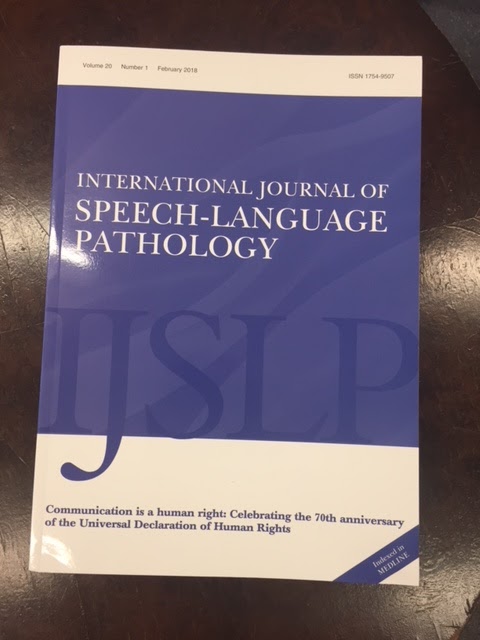
Special issue of IJSLP has been published in hard copy

Today I received my copy of the special issue of the International Journal of Speech-Language Pathology (volume 20, issue 1) on the topic of Communication Rights. I was the guest editor for the special issue, and it was published to celebrate the 70th anniversary of the Universal Declaration of Human Rights. The 31 articles are published across 190 pages, and are also available as open access articles online here: https://www.tandfonline.com/toc/iasl20/20/1