Showing posts with label Iceland. Show all posts

July 27, 2023

Visiting Kate at The University of Iceland

Aðjúnkt Kathryn Crowe and A/Prof Þóra Másdóttir teach and research in the Talmeinafræði program at the University of Iceland
https://ugla.hi.is/kennsluskra/index.php?tab=nam&chapter=namsleid&id=820072_20176&kennsluar=2023 

I enjoyed visiting to see exactly where they worked - and Icelandic research into speech development and their home language maintenance research with their multilingual children.

Working on a book chapter and a Memorandum of Understanding between our universities
McLeod and Crowe (2018) posters in Iceland
Icelandic speech development poster featuring Lubbi and based on Masdottir & McLeod (2021)
Kate with her CSU award
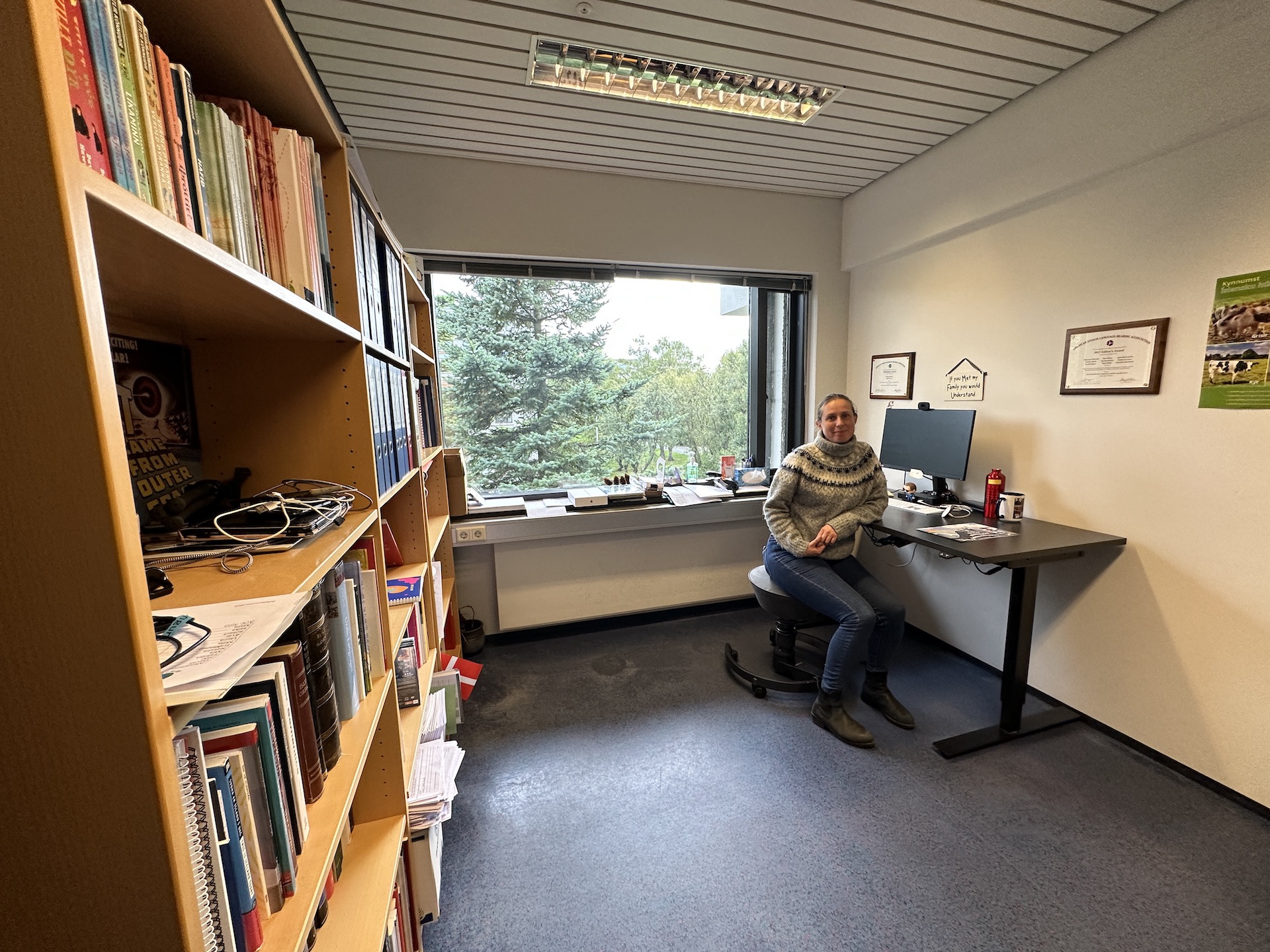
Kate's office
Kate and Thora are currently undertaking a large-scale randomised controlled trial in preschools across Iceland to support multilingual children's speech and language development.

The Nordic House - University of Iceland

 The Nordic House is located at The University of Iceland. https://nordichouse.is/en/

It is a library of books and artwork from Nordic and Baltic countries. It has a vibrant children's section, hosts concerts and events, and was a wonderful place to visit to learn more about language and literature from: 

  • Icelandic 
  • Faroese 
  • Sami 
  • Greenlandic 
  • Norwegian 
  • Swedish 
  • and  other languages

Kate showed me how many resources were found in multiple languages and I had lots of ideas to bring back to the International Children's Communication Centre at CSU.


Iceland - the land of the midnight sun

Iceland is spectacular and because it is summer, the days have been long. In the north of Iceland the sun has set after 11pm and risen just after 3am.

Icelandic sky at 12:15am


Icelandic learning, collaborating and planning the future

Over the past few days A/Prof Thora Masdottir, A/Prof Kate Crowe, Marie Ireland and I have travelled around Iceland learning about the country, customs, children, education, speech pathology and so much more. Many conversations compared similarities and differences between Iceland (and other Nordic countries), the United States and Australia. It has been a wonderful time of collegiality and planning future endeavours.

Sharynne, Marie and Kate at Gullfoss

Learning about fishing and the role of women


Sharynne, Kate, Marie and Thora at Godfoss

Icelandic children's readers

Learning about elves

Kate and Thora explained Icelandic folklore.
This is Grýla the troll who eats naughty children.


Kate at Dettifoss


July 26, 2023

Íslensk málnefnd [Icelandic Academy of Novel Words]

Íslensk málnefnd [Icelandic Academy of Novel Words] https://islenskan.is/islensk-malnefnd/ considers words that come into the international lexicon (e.g., computer, GPS, social media) and makes recommendations to the Icelandic government about equivalent new Icelandic words. Ultimately, it is the Icelandic people who choose which word they will use as language is a living thing - but it is interesting to learn about this method of language preservation.

July 23, 2023

Congratulations Marie on your PhD submission

Congratulations to Marie Ireland who submitted her PhD in Iceland today. She undertook her PhD by Prior Publication.

Congratulations Marie!

The moment of submitting Marie's PhD
 
A/Prof Sarah Verdon (in Australia) and Adjunct A/Prof Kate Crowe,
Marie Ireland and Prof Sharynne McLeod in Iceland

Lava cake!

Marie's thesis title was "Evaluation and Eligibility of Students with Communication Disorders in Public Schools in the United States" and consisted of 13 chapters (10 publications + 3 exegesis chapters).

Here is the abstract 

Communication is an essential human right that, beginning early in a child’s life, provides the foundation for interaction with others. Communication is the underpinning for success in school and untreated communication disorders may impact children’s futures. In the United States, students with disabilities in public schools receive free speech and language evaluations and, if needed, services from speech-language pathologists (SLPs). In U.S. public schools this process is regulated by the Individuals with Disabilities Education Act (IDEA) and services are only available to students who meet specific eligibility criteria. An educational disability must result in an educational impact and is decided by a team that includes SLPs. Private speech-language pathology services are also available using a fee for service model decided by individual service providers. As parents and some educators may desire free services for students under IDEA, there is pressure to identify students as disabled who do not meet eligibility criteria. Misidentification due to cultural or linguistic differences also occurs. There are potential negative consequences to inappropriate disability identification such as: segregation from typically developing peers, violating the child’s rights with decreased expectations or limited educational opportunities, increased caseloads for SLPs resulting in recruitment and retention issues, and violation of state and federal regulations. While service options exist outside of IDEA, inconsistency in evaluation practices and eligibility decision-making has been documented and creates tensions for families, educators, and SLPs.
This thesis presents work for a PhD by Prior Publication to explore and describe evaluation and eligibility of students with communication disorders in U.S. public schools using quantitative and qualitative research and publications (presented as chapters) over the span of a career drawn together through an exegesis. Part 1 includes 7 chapters and provides an introduction and literature review that examines the SLPs’ practice patterns and documents the unique requirements for public-school practice in the United States. Chapter 2 reviews public policy and Chapter 3 discusses educational requirements and provides the context of public policy in the United States. A review of evaluation and eligibility requirements under IDEA and research on evaluation practices focusing on students from diverse backgrounds, test accuracy, and state differences are included in Chapter 4. Clarification regarding regulations, guidance and information to support understanding of guidelines and severity rating tools used by states as they implement IDEA is presented in Chapter 5. Options for services to support students with language differences, not disorders, outside of IDEA are detailed in Chapter 6. Chapter 7 integrates research and policy in the United States and addresses the implementation of research on children with speech sound disorders in the context of IDEA.
Part 2 includes six chapters and addresses the complex activity system involving team decision-making regarding evaluation and eligibility for speech-language pathology services in U.S. schools. Chapter 8 presents the theoretical framework that was used as the unifying approach to this thesis and for the study reported in Chapter 9. The chosen theoretical framework, Cultural-Historical Activity Theory (CHAT) by Engström (1987, 2015), was used to explain the complex activity system of speech-language pathology services in U.S. schools. Chapter 9 investigates the team decision-making activity system for determining student eligibility for speech or language services in U.S. schools and documents nine major tensions related to the team decision-making activity system. Chapters 10, 11, and 12 document SLPs’ use of evidence-based practices and language sample analysis techniques. Variations in evaluation and eligibility decision-making often are attributed to the SLP, rather than the team decision-making system. The impact of differences in state and local regulations and policy, input from other members of the team, and variations in requirements for use of specific tools for evaluation were identified. Knowledge of the individual elements within the team decision-making activity system and the interactions and tensions that arise between elements may assist in understanding practice patterns of SLPs in U.S. schools. There are common tensions experienced by school SLPs regarding evaluation and eligibility of students. Using the CHAT framework enables acknowledgment of the interplay of elements within the broader activity system (beyond the SLP) and promotes the importance of teamwork and advocacy by SLPs at the local, state and national level. Inconsistency and tensions in school team decision-making are well documented in the research literature. Once identified, information on inconsistency and tensions can be used to develop of strategies to improve practice. The findings identify needs and solutions to strengthen school teams’ and SLPs’ knowledge of the regulations, research, and advocacy to address challenges in the school setting. Use of evidence-based practices for evaluation and compliance with IDEA regulations for data collection and decision making will reduce mis- and overidentification and protect students’ civil rights. Improving consistency by school decision-making teams will enable all students to receive quality evaluations and appropriate decision-making regardless of where they live or attend school. Consistency in evaluation and eligibility processes is essential to advance SLPs’ professional practice and build or maintain trust between families, students, and public-school professionals across the United States.

We had a fun day preparing for submission - see here.

Visiting the University of Iceland

Dr Kate Crowe is both an Adjunct Associate Professor at Charles Sturt University and Adjunct at The University of Iceland. It was good to see where she spends a lot of time each day.


We are working on creating a Memorandum of Understanding between Charles Sturt University and the University of Iceland https://english.hi.is/university/partner_universities

July 22, 2023

Speech Therapy Association of Iceland

I was very welcomed by the Félag talmeinafræðinga á Íslandi https://www.talmein.is/ [Speech Therapy Association of Iceland]. I really enjoyed meeting speech therapists and students. Marie Ireland also joined us from the Unitted States. One new graduate (Ösp) even brought her book for me to sign!


Meeting with the Speech Therapy Association of Iceland

Meeting with members of the Speech Therapy Association of Iceland

I enjoyed chatting with Ösp about her work and research


July 6, 2023

ICPLA19 - Poster presentations

Australians have presented three posters at the International Clinical Phonetics and Linguistics Association (ICPLA) symposium:

  • Poster #17 Caitlin Hurley, Sharynne McLeod and Robert Anthonappa: Children’s speech and premature loss of primary maxillary incisors
  • Poster # 27 Sharynne McLeod and Julie Marshall: Accomplishment of the Sustainable Development Goals requires communication
  • Poster #36 Kate Crowe, Harpa Stefánsdóttir, Egill Magnússon, Mark Guiberson, Thora Másdóttir, Ösp Vilberg Baldursdóttir and Inga Ágústsdóttir: How is speech intelligibility measured for children who are d/Deaf or hard of hearing
Caitlin Hurley and Sharynne
Kate Crowe
Kate Crowe and Sharynne

July 17, 2022

A special week with Kate and Marc from Iceland

What a special week to have Dr Kate Crowe and her colleague Marc Volhardt (https://english.hi.is/staff/mds) visiting Bathurst from Iceland. While they were here, Kate and Marc presented a lecture on the Bathurst campus: https://speakingmylanguages.blogspot.com/2022/07/there-and-back-again-linguists-tale.html

Kate has not been to Australia since the beginning of the COVID-19 pandemic, so the last time I saw her was at the ASHA convention in Florida in 2019. We have a number of projects we are working on together, a student we are co-supervising, and two book chapters that are due soon. We had time for work and play - and lots of catching up.

I was very happy to receive gifts of children's books in a range of languages, including Icelandic and Polish, to add to my bookshelf of children's books from around the world.

It was great to spend time together. Thanks for visiting.
Kate and Marc presented a lecture on the Bathurst campus

We enjoyed the Bathurst Winter Festival


COVID-19 rapid antigen tests are now part of visiting!

Catching up with our colleague Dr Audrey Wang


July 14, 2022

There and Back Again: A Linguist’s Tale Living and Learning Under the Northern Lights

We are so excited that Dr Kate Crowe is back in Australia. Kate is an Adjunct at CSU but also works and studies at the University of Iceland. She is visiting with Mark Volhardt from the University of Iceland (https://english.hi.is/staff/mds) During their visit they presented at Charles Sturt University Thursday, 14 July 2022 at 12:30 pm – 1:45 pm - via ZOOM and in Bathurst
Visiting from Iceland, Marc Volhardt and Kate Crowe will talk about all things Nordic in this presentation. Both Marc and Kate live in Reykjavík and work at the University of Iceland. Marc teaches courses in Icelandic as Second Language, Linguistics, Danish, and Nordic Studies. Kate is a researcher in the Speech-Language Pathology focusing on supporting multilingual education. This presentation will touch on many aspects of life in Iceland and the Nordic countries and particularly on the languages spoken. Come along and learn some new words, and ponder the possibilities for future Nordic collaborations in your work.


April 27, 2021

Icelandic children’s acquisition of consonants and consonant clusters

The following article has just been published as an early online article. 

Másdóttir, T., McLeod, S., & Crowe, K. (2021). Icelandic children's acquisition of consonants and consonant clusters. Journal of Speech, Language, and Hearing Research, Advance online publication. https://doi.org/10.1044/2021_JSLHR-20-00463

Here is the abstract: 

Purpose. This study investigated Icelandic-speaking children’s acquisition of singleton consonants and consonant clusters.
Method
. Participants were 437 typically-developing children aged 2;6 to 7;11 acquiring Icelandic as their first language. Single-word speech samples of the 47 single consonants and 45 consonant clusters were collected using Málhljóðapróf ÞM [ÞM's Test of Speech Sound Disorders].
Results
. Percentage of consonants correct for children aged 2;6-2;11 was 73.12 (SD = 13.33) and increased to 98.55 (SD = 3.24) for children aged 7;0-7;11. Overall, singleton consonants were more likely to be accurate than consonant clusters. The earliest consonants to be acquired were /m, n, p, t, j, h/ in word-initial position and /f, l/ within words. The last consonants to be acquired were /x, r, r̥, s, θ, n̥/, and consonant clusters in word-initial /sv-, stl-, str-, skr-, θr-/, within-word /-ðr-, -tl-/, and word-final /-kl̥, -xt/ contexts. Within-word phonemes were more often accurate than those in word-initial position, with word-final position the least accurate. Accuracy of production was significantly related to increasing age, but not sex.
Conclusion
. This is the first comprehensive study of consonants and consonant cluster acquisition by typically developing Icelandic-speaking children. The findings align with trends for other Germanic languages; however, there are notable language-specific differences of clinical importance. 

This research has been the result of a long-term collaboration with Thora Másdóttir (Þóra Másdóttir) and Kate Crowe that began with my visit to Iceland in 2014 https://speakingmylanguages.blogspot.com/2014/06/icelandic-association-of-speech-and.html

February 25, 2021

Iceland: Earthquakes and northern lights

I love sharing the world with my colleagues. Today Kate Crowe, who is living in Iceland, gave a presentation to people in Belgium in the midst of earthquakes, the library was closed because of the earthquakes, then saw the northern lights - all in one day!

https://www.icelandreview.com/nature-travel/reykjanes-earthquake-swarm-magma-accumulation-suspected-eruption-a-possibility/