Showing posts with label University of Ulster. Show all posts

September 8, 2020

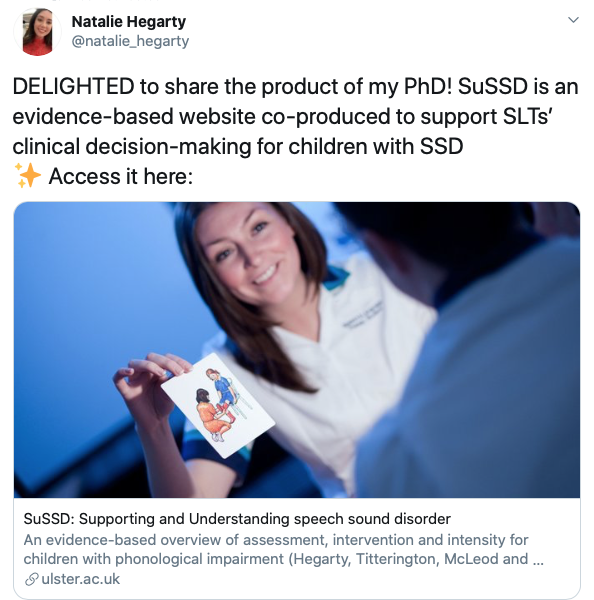
Supporting and Understanding Speech Sound Disorder (SuSSD) has been launched

Supporting and Understanding Speech Sound Disorder (SuSSD) has been launched this week: https://www.ulster.ac.uk/research/topic/nursing-and-health/intellectual-and-developmental-disabilities/projects/ssd/about-this-website.

It was a pleasure to be Natalie Hegarty's co-supervisor for her PhD and to work with Dr Jill Titterington and Dr Laurence Taggart at Ulster University (Northern Ireland, UK) on the research that lead to the creation of the SuSSD.

"This resource was developed to support SLTs [speech and language therapists] to use research in practice when working with children with phonological impairment. This resource was produced through Natalie Hegarty's PhD Studentship in Ulster University, Northern Ireland, funded by the Department for Employment and Learning (DEL). This resource was informed by the evidence-base and was co-produced with speech and language therapists from each of the Health and Social Care Trust’s in Northern Ireland. The research team were: Natalie Hegarty, Jill Titterington (Ulster University), Sharynne McLeod (Charles Sturt University) and Laurence Taggart (Ulster University)."

July 9, 2019

Dr Natalie Hegarty's PhD graduation

Congratulations Dr Natalie Hegarty on your PhD graduation at Ulster University this week. It was an honour to be on your supervisory team, along with Dr Jill Titterington and Dr Laurence Taggart.
Here are the blogposts from 2015 documenting some of Natalie's PhD journey: https://speakingmylanguages.blogspot.com/search?q=Natalie+Hegarty&max-results=20&by-date=true

March 14, 2019

Congratulations Dr Natalie Hegarty

This week Natalie Hegarty completed her PhD viva and passed with minor changes. She undertook her PhD at the University of Ulster in Northern Ireland. I have thoroughly enjoyed working with Natalie and the other members of her PhD supervisory team (Dr Jill Titterington and Dr Laurence Taggart) over the past few years. We had a virtual celebration via Skype this week. Here are the blogposts I have written during her PhD journey: https://speakingmylanguages.blogspot.com/search?q=Natalie+Hegarty
Congratulations Dr Hegarty!

January 15, 2019

Congratulations Natalie on your PhD submission

Today Natalie Hegarty submitted her PhD at Ulster University in Northern Ireland. Her thesis was titled: "Supporting speech and language therapists' application of evidence-based practice in the management of phonological speech sound disorders". Congratulations Natalie!
I have been fortunate to be on Natalie's supervisory team with Dr Jill Titterington and Laurence Taggart from Ulster University. Her viva will be held in March.
Natalie Hegarty (image from Twitter @UlsterUniPhD)

Here is the abstract:
Background: Speech and language therapists (SLTs) often use two elements of evidence-based practice in their management of children with phonological impairment (i.e., internal clinical data and child/parent preferences integrated through SLTs’ experiences), but do not regularly use the third element: research evidence. Indeed, SLTs often use long-standing approaches with developmental target selection criteria (e.g. conventional minimal pairs) despite some research suggesting that interventions with more complex target selection criteria (e.g. the complexity approaches or multiple oppositions) may provide greater system-wide change. Moreover, recent research has found that SLTs’ intervention intensity provision is lower than provision in the literature. Narrowing this research-practice gap is necessary to achieve evidence-based practice.
Aim
: To support SLTs’ use of evidence-based practice in the clinical management of children with phonological impairment.
Methods
: This thesis used an explanatory sequential mixed methods design. There were five stages: (1) systematic review; (2) online survey; (3) focus groups and interviews; (4) resource co-production workshops and; (5) face validity exploration. This thesis was guided by the Medical Research Council, the Knowledge to Action framework and the Intervention Mapping framework, including the use of logic modelling and the socio-ecological model.
Findings
: Using information gathered throughout this thesis and through co-production with SLTs, this work resulted in the development of an online, evidence-based resource that aims to support SLTs’ use of research in practice in the clinical management of children with phonological impairment. The resource is called SuSSD (Supporting and understanding Speech Sound Disorder) and was found to have high face validity.
Conclusion
: Integrating SuSSD into SLTs’ decision-making should support their use of research in practice and improve outcomes for children with phonological impairment. Further research is necessary to determine if SuSSD can effectively increase SLTs’ use of research in practice and improve speech outcomes for children with phonological impairment.

June 30, 2018

Intervention for children with phonological impairment: Knowledge, practices and intervention intensity in the UK

The following manuscript has just been accepted for publication.
Hegarty, N., Titterington, J., McLeod, S., Taggart, L. (2018, in press June). Intervention for children with phonological impairment: Knowledge, practices and intervention intensity in the UK. International Journal of Language and Communication Disorders.

It forms part of Natalie Hegarty's PhD (She is studying at the Ulster University and I am co-supervisor). Congratulations Natalie

Here is the abstract
Background Across the world, research has shown that intervention for children with phonological impairment can be both effective and efficient. However, research has also raised concerns about the translation of this evidence to practice, highlighting questions around clinician knowledge and understanding of approaches, and the intensity of intervention provided within real-life clinical contexts.
Aim To investigate the clinical management of phonological impairment by speech and language therapists (SLTs) in the United Kingdom (UK).
Methods & Procedures An anonymous, UK-wide, online survey was developed using Qualtrics. The target audience were UK-based SLTs who worked with children with phonological impairment. The following topics were explored: (1) SLTs’ understanding of intervention approaches, (2) SLTs’ use of intervention approaches to treat phonological impairment, (3) SLTs’ provision of intervention intensity for children with phonological impairment.
Outcomes & Results A total of 166 responses were analysed. To remediate phonological impairment, SLTs most commonly used speech discrimination (79.5%), conventional minimal pairs (77.3%), phonological awareness therapy (75.6%) and traditional articulation therapy (48.4%). Participants least frequently used the complexity approaches targeting the empty set (82.9%) and 2/3-element clusters (75%) as well as the cycles approach (75.6%). Results also showed that some SLTs were uncertain of what the empty set and 2/3-element clusters approaches entailed. In terms of intervention intensity, participants predominantly provided intervention once per week (69%) for a total of 9-12 sessions (ranging from 5-30 sessions, 71.5%) and elicited targets 10-30 times in single words per session (59.4%) in sessions lasting 21-30 minutes (41.4%).
Conclusions & Implications The most commonly used intervention approaches identified in the current survey (i.e., speech discrimination, conventional minimal pairs and phonological awareness therapy) may be used eclectically by SLTs, which could impact upon the effectiveness and efficiency of treatment for phonological impairment. The current study also highlighted that almost half of participants always/often used traditional articulation therapy to remediate phonological impairment, even though this approach has been found to be less effective for this difficulty. Additionally, it appears that the currently provided intervention intensity for phonological impairment in the UK is significantly lower than what is indicated in the literature. Therefore, a research-practice gap exists for SLTs in the UK working with children with phonological impairment.

February 9, 2018

Summer snow

I am co-supervising Natalie Hegarty's PhD with Dr Jill Titterington. Natalie is studying in Northern Ireland at Ulster University and we meet via email then meet via Skype every few months. We met on Friday night (my time) to discuss her latest work. It was very warm in Australia, yet I was watching snow falling outside of Natalie's window. Natalie is working hard - and is planning to submit her PhD in September.
Dr Jill Titterington and Natalie Hegarty


November 27, 2016

Management of phonological speech sound disorders: A survey of current UK speech and language therapy practice

Last week, Natalie Hegarty  presented a poster titled: "The Management of Phonological Speech Sound Disorders: A Survey of Current UK Speech and Language Therapy Practice" at the Royal College of Speech and Language Therapists Northern Ireland Hub Conference in Templepatrick, Northern Ireland. The poster included data based on a survey of 165 speech and language therapists conducted as part of her PhD. Natalie is supervised by Jill Titterington and Laurence Taggart from Ulster University, and myself. Here are some of her conclusions:
  • SLTs commonly employ speech discrimination, phonological awareness and the minimal pairs approach to remediate phonological SSD. They rarely use complexity approaches.
  • SLTs typically employ once weekly, 1:1 sessions lasting 21-30mins for 9-12 weeks. Most SLTs (70.8%) feel that this dose is sufficient to remediate moderate-severe consistent phonological SSD.