Showing posts with label RCT. Show all posts

June 13, 2023

Waiting for Speech Pathology - Summary of publications and websites

Frequently Nicole McGill and I are asked for copies of the work we have undertaken about waiting for speech pathology. Here is a summary Nicole sent recently: 

  1. • McGill, N., Crowe, K., & McLeod, S. (2020). “Many wasted months”: Stakeholders’ perspectives about waiting for speech-language pathology services. International Journal of Speech-Language Pathology, 22(3), 313-326. https://doi.org/10.1080/17549507.2020.1747541 
  2. • McGill, N., & McLeod, S. (2019). Aspirations for a website to support families’ active waiting for speech-language pathology. International Journal of Speech-Language Pathology, 21(3), 263-274. https://doi.org/10.1080/17549507.2019.1604802 
  3. • McGill, N., & McLeod, S. (2020). Waiting list management in speech-language pathology: Translating research to practice. Speech, Language and Hearing, 23(1). https://doi.org/10.1080/2050571X.2020.1716471
  4. • McGill, N., McLeod, S., Crowe, K., Wang, C., & Hopf, S. C. (2021). Waiting lists and prioritization of children for services: Speech-language pathologists’ perspectives. Journal of Communication Disorders, 91, 106099. https://doi.org/10.1016/j.jcomdis.2021.106099 
  5. • McGill, N., McLeod, S., & Hopf, S. C. (2021). Waiting list management: Professionals’ perspectives and innovations. Advances in Communication and Swallowing, 24(1), 5-19. https://doi.org/10.3233/ACS-210026 
  6. o There is also a recorded online lecture relating to this paper, available here: https://www.youtube.com/watch?v=m8FO1t1Rrfs 
  7. • McGill, N., McLeod, S., Ivory, N., Davis, E., & Rohr, K. (2021). Randomised controlled trial evaluating active versus passive waiting for speech-language pathology. Folia Phoniatrica et Logopaedica, 73(4), 335-354.https://doi.org/10.1159/000508830 
  8. • McLeod, S., Davis, E., Rohr, K., McGill, N., Miller, K., Roberts, A., Thornton, S., Ahio, N., & Ivory, N. (2020). Waiting for speech-language pathology services: A randomised controlled trial comparing therapy, advice, and device. International Journal of Speech-Language Pathology, 22(3), 372-386.https://doi.org/10.1080/17549507.2020.1731600 
  9. The Waiting for Speech Pathology website referred to in the articles can be accessed here: https://www.nsw.gov.au/health/wnswlhd/services/speech-pathology 
  10. A waiting list management self-paced learning program that is available on the Speech Pathology Australia Learning Hub: https://learninghub.speechpathologyaustralia.org.au/speechpathologyaust/1706-waiting-list-management-in-speech-pathology 

October 10, 2020

Supporting children with speech sound disorders during COVID-19 restrictions: Technological solutions

Our manuscript has been published online:

McLeod, S., Ballard, K. J., Ahmed, B., McGill, N., & Brown, M. I. (2020). Supporting children with speech sound disorders during COVID-19 restrictions: Technological solutions. Perspectives of the ASHA Special Interest Groups, Advance online publication. https://doi.org/doi:10.1044/2020_PERSP-20-00128

Here is the abstract:

“Children are the hidden victims of the COVID-19 pandemic” (United Nations Children's Fund, 2020). Timely and effective speech intervention is important to reduce the impact on children's school achievement, ability to make friends, mental health, future life opportunities, and government resources. Prior to the coronavirus disease (COVID-19) pandemic, many Australian children did not receive sufficient speech-language pathology (SLP) services due to long waiting lists in the public health system. COVID-19 restrictions exacerbated this issue, as even children who were at the top of lengthy SLP waiting lists often received limited services, particularly in rural areas. To facilitate children receiving speech intervention remotely during the COVID-19 pandemic, evidence from randomized controlled trials regarding three technological solutions are examined: (a) Phoneme Factory Sound Sorter (Sound Start Study), (b) Waiting for Speech Pathology website, and (c) Apraxia World. 

Conclusions For the first two technological solutions, there were similar gains in speech production between the intervention and control groups, whereas, for the third solution, the average magnitude of treatment effect was comparable to face-to-face SLP therapy. Automated therapy management systems may be able to accelerate speech development and support communication resilience to counteract the effects of the COVID-19 restrictions on children with speech sound disorders. Technology-based strategies may also provide a potential solution to the chronic shortage of SLP services in rural areas into the future.

May 19, 2020

Randomised controlled trial evaluating active versus passive waiting for speech-language pathology

The following manuscript has been accepted for publication today:

McGill, N., McLeod, S., Ivory, N., Davis, E., & Rohr, K. (2020, in press May). Randomised controlled trial evaluating active versus passive waiting for speech-language pathology. Folia Phonatrica et Logopedia.

 It is part of Nicole McGill's PhD (congratulations Nicole) and is the companion to the following paper that was undertaken as part of the NSW Health Translational Research Grant Scheme (TRGS):

McLeod, S., Davis, E., Rohr, K., McGill, N., Miller, K., Roberts, A., Thornton, S., Ahio, N., & Ivory, N. (2020, in press February). Waiting for speech-language pathology services: A randomised controlled trial comparing device, advice, and therapy. International Journal of Speech-Language Pathology. Advance online publication https://doi.org/10.1080/17549507.2020.1731600

Here is the abstract:
Introduction: High demand for speech-language pathology means children sometimes wait over 12 months for services, missing out on timely support. Waiting can be a time of stress, concern, and powerlessness for caregivers. Provision of information via a website may support families and encourage active waiting.
Objective: To compare children’s speech, intelligibility, language, and literacy outcomes, and caregivers’ satisfaction and empowerment in active versus passive waiting conditions. Methods: Ninety-seven preschool-aged children referred to a community health speech-language pathology service, Australia, were screened for eligibility. Eligible children (n = 42) with speech/language difficulties were randomly allocated to (a) active waiting (provision of a purpose-built website; n = 20), or (b) passive waiting (control group; n = 22). Pre- and post-assessments (after 6 months on a waiting list) were completed with children and caregivers by a speech-language pathologist blinded to group allocations.
Results: Intention to treat (n = 36) and per protocol analyses (n = 30) were conducted to measure group differences in child and caregiver outcomes at post-assessment using one-way ANCOVA, controlling for baseline scores. There were no statistically significant differences between groups for children’s speech, intelligibility, language, and literacy, or caregivers’ empowerment and satisfaction. Children in both groups made minimal gains over 6 months.
Conclusions: Provision of an active waiting website did not lead to statistically significant change in child or caregiver outcomes, and children in both groups made little progress over a 6-month period. Early speech-language pathology intervention delivered with appropriate dosage is needed to optimise children’s outcomes. Until timely and effective speech-language pathology intervention can be provided for all who need it, provision of early assessments may be beneficial. There remains a need for effective ways to support children and families on waiting lists.

March 6, 2019

NSW Health Translational Research Grant team meeting

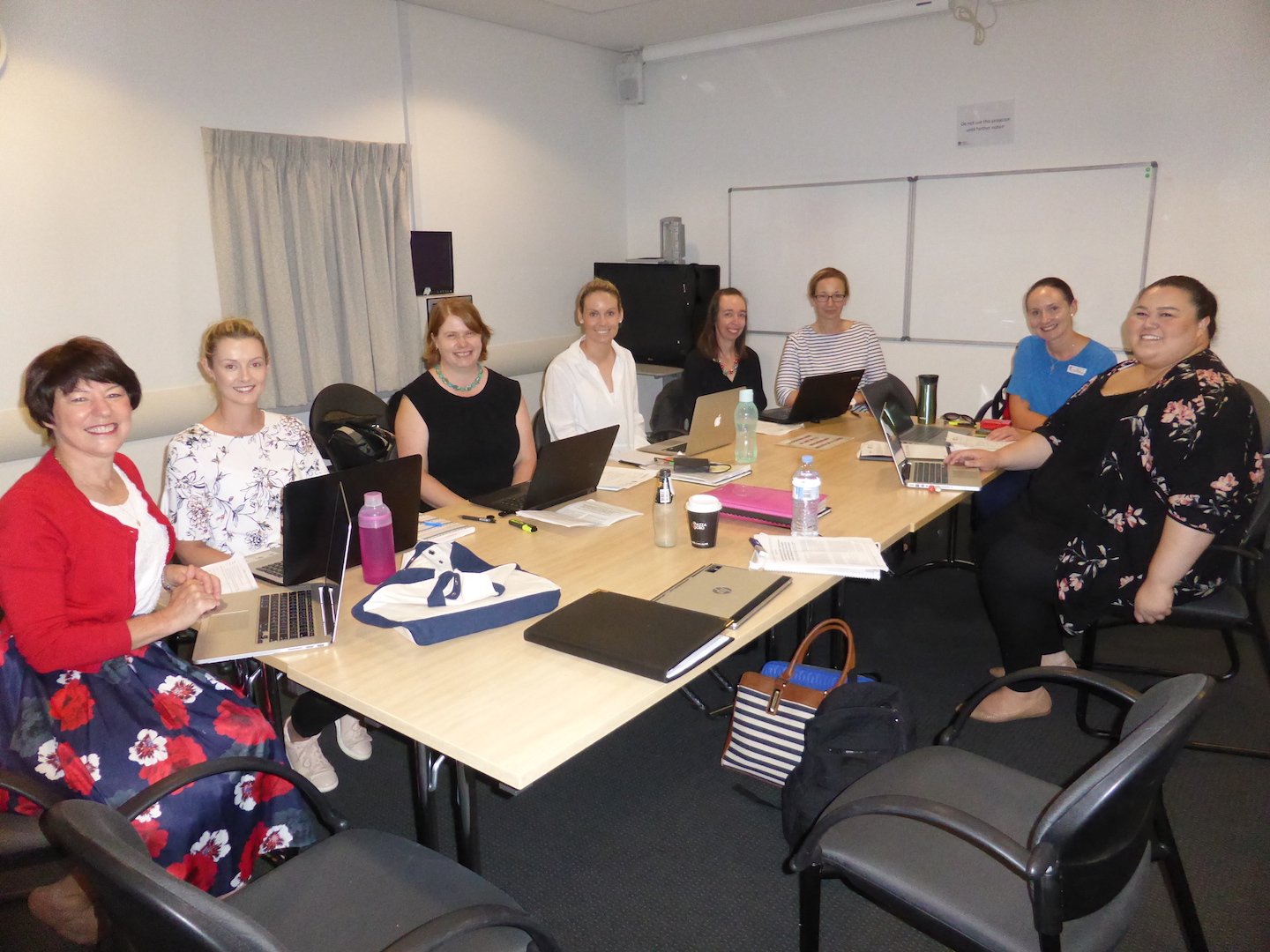
Today our NSW Health Translational Research Grant team met in Orange to begin writing our conference poster and journal article. We are almost finished collecting the data for our randomised controlled trial comparing advice, device, and therapy for children on speech pathology waiting lists. We spent a lot of time using the CONSORT statement to describe our sample, and prepare for writing. It was a very productive day.

Sharynne McLeod, Angela Roberts, Emily Davis, Sally Thornton, Nina Ahio, Kate Miller, Katrina Rohr, Nicole McGill
Sharynne, Nicole, Emily, Kate, Angela, Sally, Katrina, and Nina hard at work

November 15, 2018

Presentation of the 2017 Journal of Speech, Language, and Hearing Research Editor's Award

Today the Sound Start Study team was presented the 2017 Journal of Speech, Language, and Hearing Research Editor's Award (Speech) at the American Speech-Language-Hearing Association (ASHA) convention in Boston, MA. Dr Kate Crowe accepted the award during the Researcher-Academic Town Meeting (RATM) and it will be mentioned during the main awards ceremony at Convention.
"An Editor’s Award is truly a high honor, with selection limited to the most impactful works that meet the highest quality standards in research design and presentation." 
Kate receiving the award with Sharynne, Sue, Sarah and Yvonne online (Elise was online earlier)
At the ASHA Award ceremony in Boston: Bronwyn Hemsley, Helen Blake, Thora Masdottir, Karla Washington, Kate Crowe, Nicole McGill
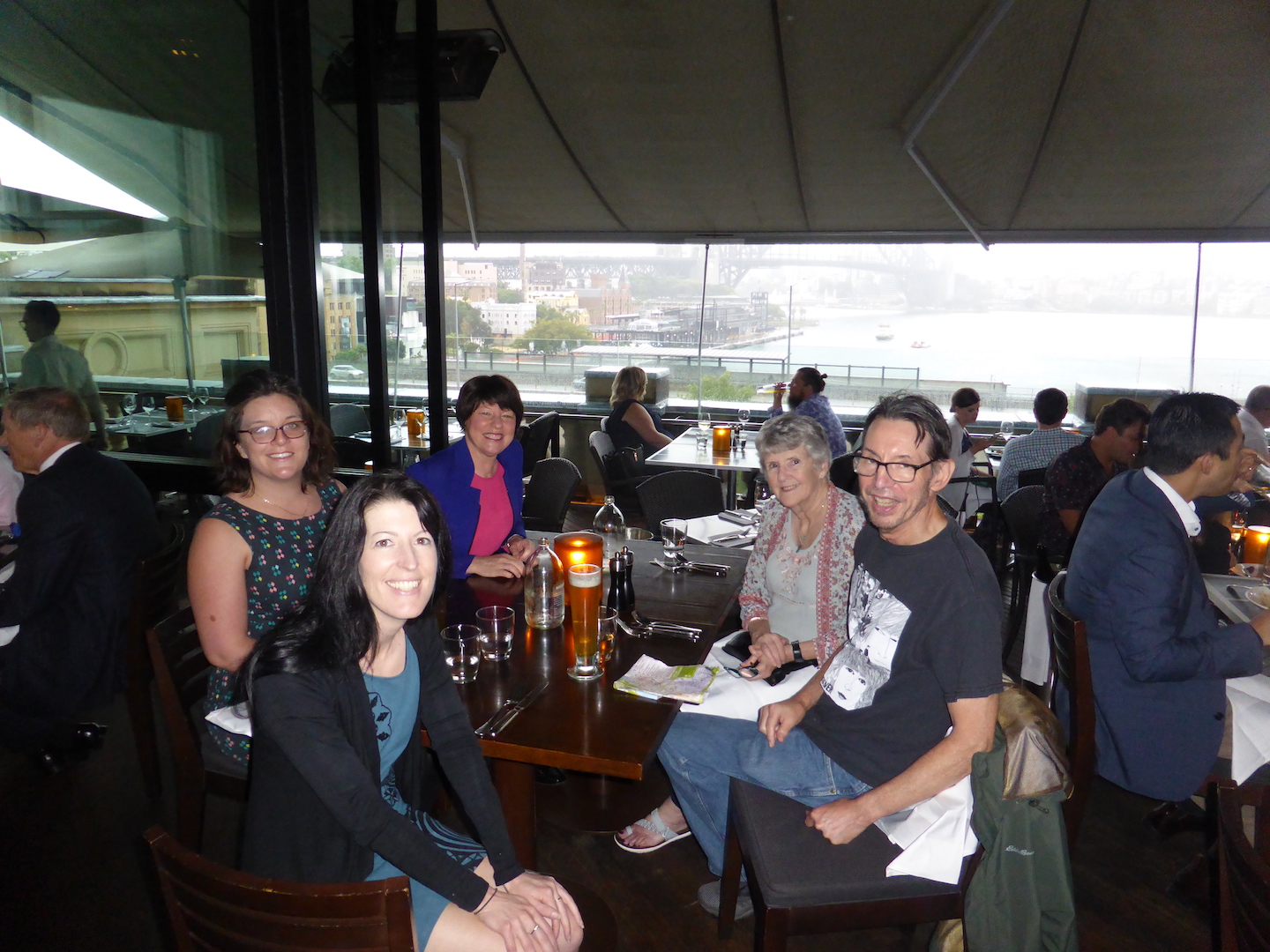
We are able to celebrate the award in Sydney, Australia with Marc Fey, who received the 2017 Journal of Speech, Language, and Hearing Research Editor's Award (Language)
Jane McCormack, Sarah Masso, Sharynne, Sandy and Marc Fey
 Here are the details of our article:
Cluster-Randomized Controlled Trial Evaluating the Effectiveness of Computer-Assisted Intervention Delivered by Educators for Children With Speech Sound Disorders
Sharynne McLeod, Elise Baker, Jane McCormack, Yvonne Wren, Sue Roulstone, Kathryn Crowe, Sarah Masso, Paul White, and Charlotte Howland
Free download: https://jslhr.pubs.asha.org/article.aspx?articleid=2643351

The CSU media release is here: http://news.csu.edu.au/latest-news/education/teacher-education/international-award-for-best-paper-in-top-speech-pathology-journal 

All of the award winners are listed here: https://academy.pubs.asha.org/2018/09/2018-asha-journals-awards/

Here are the other journal award winners (we know and collaborate with a number of these authors)
American Journal of Speech-Language Pathology (Editor-in-Chief: Julie Barkmeier-Kraemer)
Investigating the Adequacy of Intervention Descriptions in Recent Speech-Language Pathology Literature: Is Evidence From Randomized Trials Useable?
Arabella Ludemann, Emma Power, and Tammy C. Hoffmann
Journal of Speech, Language, and Hearing Research–Speech Section (Editor-in-Chief: Julie Liss)
Cluster-Randomized Controlled Trial Evaluating the Effectiveness of Computer-Assisted Intervention Delivered by Educators for Children With Speech Sound Disorders
Sharynne McLeod, Elise Baker, Jane McCormack, Yvonne Wren, Sue Roulstone, Kathryn Crowe, Sarah Masso, Paul White, and Charlotte Howland
Journal of Speech, Language, and Hearing Research–Language Section (Editor-in-Chief: Sean Redmond)
Do the Hard Things First: A Randomized Controlled Trial Testing the Effects of Exemplar Selection on Generalization Following Therapy for Grammatical Morphology
Amanda Jean Owen Van Horne, Marc Fey, and Maura Curran
Journal of Speech, Language, and Hearing Research–Hearing Section (Editor-in-Chief: Frederick Gallun)
Speech Recognition in Adults With Cochlear Implants: The Effects of Working Memory, Phonological Sensitivity, and Aging
Aaron C. Moberly, Michael S. Harris, Lauren Boyce, and Susan Nittrouer
Language, Speech, and Hearing Services in Schools (Editor-in-Chief: Shelley Gray)
Interactive Book Reading to Accelerate Word Learning by Kindergarten Children With Specific Language Impairment: Identifying an Adequate Intensity and Variation in Treatment Response
Holly L. Storkel, Krista Voelmle, Veronica Fierro, Kelsey Flake, Kandace K. Fleming, and Rebecca Swinburne Romine
American Journal of Audiology (Editor-in-Chief: Sumit Dhar)
The Effects of Service-Delivery Model and Purchase Price on Hearing-Aid Outcomes in Older Adults: A Randomized Double-Blind Placebo-Controlled Clinical Trial
Larry E. Humes, Sara E. Rogers, Tera M. Quigley, Anna K. Main, Dana L. Kinney, and Christine Herring

July 4, 2017

Cluster randomized controlled trial evaluating the effectiveness of computer-assisted intervention

The latest Sound Start Study article has just been published:

McLeod, S., Baker, E., McCormack, J., Wren, Y., Roulstone, S. Crowe, K., Masso, S., White, P., & Howland, C. (2017). Cluster randomized controlled trial evaluating the effectiveness of computer-assisted intervention delivered by educators for children with speech sound disorders. Journal of Speech, Language, and Hearing Research. Advance online publication doi:10.1044/2017_JSLHR-S-16-0385 http://jslhr.pubs.asha.org/article.aspx?articleid=2643351
Members of the Sound Start Study Team (+Yvonne Wren and Paul White)
Here are the details of our other Sound Start Study publications: 
Crowe, K., Cumming, T., McCormack, J., Baker, E., McLeod, S., Wren, Y., Roulstone, S., & Masso, S. (2017, in press). Educators’ perspectives on facilitating computer-assisted speech intervention in early childhood settings. Child Language Teaching and Therapy. doi:10.1177/0265659017717437
Masso, S., Baker, E., McLeod, S., & Wang, C. (2017). Polysyllable speech accuracy and predictors of later literacy development in preschool children with speech sound disorders. Journal of Speech, Language, and Hearing Research. Advance online publication doi:10.1044/2017_JSLHR-S-16-0171 http://jslhr.pubs.asha.org/article.aspx?articleid=2639744
Masso, S., McLeod, S., Baker, E., & McCormack, J. (2016). Polysyllable productions in preschool children with speech sound disorders: Error categories and the Framework of Polysyllable Maturity. International Journal of Speech-Language Pathology, 18(3), 272-287. doi:10.3109/17549507.2016.1168483 http://www.tandfonline.com/doi/abs/10.3109/17549507.2016.1168483?journalCode=iasl20
Masso, S., McLeod, S., Wang, A. & Baker, E., & McCormack, J. (2017). Longitudinal changes in polysyllable maturity of preschool children with speech sound disorders. Clinical Linguistics and Phonetics, 31(6), 424-439. doi:10.1080/02699206.2017.1305450
http://www.tandfonline.com/eprint/hnFtnIR6iTvXn4IQNAV5/full
McCormack, J., Baker, E., Crowe, K., Masso, S., McLeod, S., Wren, Y., & Roulstone, S. (2017). Implementation fidelity of a computer-assisted intervention for children with speech sound disorders. International Journal of Speech-Language Pathology, 19(3), 265-276. doi:10.1080/17549507.2017.1293160
http://www.tandfonline.com/eprint/JjWu9TGPwWahCX53IuMM/full
McLeod, S., Crowe, K., & Shahaeian, A. (2015). Intelligibility in Context Scale: Normative and validation data for English-speaking preschoolers. Language, Speech, and Hearing Services in Schools, 46(3), 266-276. doi:10.1044/2015_LSHSS-14-0120 http://lshss.pubs.asha.org/article.aspx?articleid=2290674
McLeod, S., Crowe, K., Masso, S., Baker, E., McCormack, J., Wren, Y., Roulstone, S., & Howland, C. (2017). Profile of Australian preschoolers with speech sound disorders at risk for literacy difficulties. Australian Journal of Learning Difficulties. Advance online publication doi:10.1080/19404158.2017.1287105 http://www.tandfonline.com/doi/abs/10.1080/19404158.2017.1287105?journalCode=rald20
McLeod, S., Crowe, K., McCormack, J., White, P., Wren, Y., Baker, E., Masso, S., Roulstone, S. (2017). Preschool children’s communication, motor and social development: What concerns parents and educators? International Journal of Speech-Language Pathology. Advance online publication doi:10.1080/17549507.2017.1309065 http://www.tandfonline.com/doi/abs/10.1080/17549507.2017.1309065?journalCode=iasl20
Wren, Y., McCormack, J., Masso, S., McLeod, S., Baker, E. & Crowe, K. (2016, in press). Digital tools to support children’s speech and language skill. In S. Danby, M. Fleer, C. Davidson & M. Hatzigianni (Eds). Digital childhoods: Technologies in children’s everyday lives. Dordrecht, Germany: Springer.