Today Dr Carolyn Gregoric and I met with Prof Julian Grant and Wahid from the Rural Health Research Institute (RHRI) to discuss collaborations, membership and affiliate structures across the Children's Voices Centre (CVC) and RHRI. We have a long history of working together so it was a productive meeting.
January 30, 2026
September 11, 2025
Nation-building in the Global South
This week we have attended and presented at the Oceania and Indigenous Trans-national Methods and Practices Symposium focusing on Nation-building in the Global South.
Nation-building in the Global South
An initiative of the Oceania and Global Indigenous Research Hub (Charles Sturt University)
September 11-12th, 2025
Orange, CSU Campus & Hybrid
The symposium brings together expert speakers on First Nations nation-building in the Global South. The program focuses on the important arms of nation-building in the areas of: Language; Inter-cultural and trans-national exchange; Education Governance; Energy and Water sovereignty; Human Rights; and Health and Wellbeing. Each of these arms requires innovative methodologies and data collection to support the diversity of sovereignties in the Global South.
The purpose of the symposium is to highlight existing activities of nation-building as well as new approaches with an emphasis on trans-national and inter-cultural methodologies and data collection.
The 2-day symposium began with a Welcome to Country and Smoking Ceremony by Uncle Dale Carr.
![]() |
| Lynn Williams, Camilla Porsanger, Sharynne McLeod and Uncle Dale Carr |
During the first morning of the symposium were invited to present the following paper
Building the present and the future: Indigenous children’s speech, language and literacy
Sharynne McLeod, Jamie Newman, Christine Sweeney, Sarah Bartlett, Emily-Jane Woodhead, Carolyn Gregoric.
Christine Sweeney from Orange Aboriginal Medical Services, Orange and I presented the paper.
September 6, 2025
Multilingual Speech Assessment: Using an Implementation Science Framework to Explore Acceptability of the Speech Assessment of Children’s Home Language(s) (SACHL)
Congratulations Kate Margetson who has just had the following manuscript accepted for publication that was written during her postdoc It is the next step in the research about the Speech Assessment of Children’s Home Language(s) (SACHL)
Margetson, K. & McLeod, S. (2025). Multilingual speech assessment: Using an implementation science framework to explore acceptability of the Speech Assessment of Children’s Home Language(s) (SACHL). American Journal of Speech-Language Pathology. Advance online publication.
Here is the abstract
Purpose: The Speech Assessment of Children’s Home Language(s) (SACHL) offers a new, evidence-based clinical protocol for speech-language pathologists (SLPs) to assess speech in unfamiliar languages. This study used implementation science to investigate SLPs’ current multilingual speech assessment practices, determine the prospective acceptability of the SACHL, and compare current confidence to prospective confidence with the SACHL.
Method: The Consolidated Framework for Implementation Research (CFIR) and Theoretical Framework of Acceptability (TFA) were used to explore innovation deliverers’ (SLPs’ and student SLPs) prospective acceptability of the innovation (SACHL). Attendees at in-person and online SACHL presentations were invited to participate. 360 participants commenced an online questionnaire exploring current practices, transcription skills, confidence and acceptability of the SACHL. Statistical tests compared attendees at different presentations, SLPs and students SLPs, and monolingual and multilingual participants.
Results: The majority of participants indicated low current confidence in assessing multilingual children. Most SLPs assessed, transcribed, and analyzed multilingual children’s speech in English; but rarely or never applied these practices in children’s home language(s). The majority of participants rated the SACHL as being culturally responsive, well-designed, easy to understand, and that it would increase diagnostic accuracy. There were concerns around the time burden in using the SACHL. Most (87.45%) indicated they would like to use the SACHL in clinical practice, and there was a statistically significant improvement between current confidence and prospective confidence.
Conclusions: The SACHL was evaluated by SLPs and student SLPs to be an acceptable clinical protocol to assess children’s speech in unfamiliar languages.
July 3, 2025
Finalising our project with OAMS
After 18 months our research project with OAMS has ended. This week we said farewell to Emily-Jane Woodhead as our amazing research assistant (0.4FTE) and wrapped up our research.
Throughout the project we purchased books and toys to use with the children during the research. Now we are able to donate them to OAMS for future children and families to use them. The books were donated to four Little Libraries as well as to some of the elders and families who participated.
The toys were donated to the Allied Health Assistant (Katrina) and the Early Years Program team. The maps were donated to sit above each of the Little Libraries as well as to one of the elders whose idea it was to add them to the Little Library display.
June 17, 2025
RHRI Symposium
The RHRI Symposium was held 17-18 June in Orange to celebrate the research funded by a grant to the Charles Sturt University Rural Health Research Institute from the Commonwealth of Australia, represented by the Department of Health (Grant Activity 4-DGEJZ1O/4-CW7UT14).
We presented (virtually) two papers based on the successful outcomes of Project 8: – Improving access to speech pathology services for rural children with speech, language and communication needs
- Improving access to speech pathology services for rural Indigenous children (Sharynne McLeod, Emily-Jane Woodhead, Sarah Bartlett, Christie Cain, Jamie Newman, & Carolyn Gregoric)
- Assessing multilingual children in languages not spoken by the clinician: Using an implementation science approach to enhance rural speech pathology services (Kate Margetson & Sharynne McLeod)
Our research was so productive - in terms of the impact on our learning, communities' support for children's speech, language and communication, and academic outcomes.
June 15, 2025
Speech Pathology Australia National Conference
The Speech Pathology Australia National Conference (https://www.speechpathologyaustralia.org.au/Public/Public/CPD-events/SPA-conference/2025/Home.aspx) is in Adelaide 13-15 June 2025. I am unable to attend as I am going to Greece. Sarah Bartlett and Suzanne Hopf are attending. Here are our papers:
- What is the evidence-base for Hanen® programs? A narrative review - Sarah Bartlett and Sharynne McLeod (Rapid impact)
- Rural Australians’ ratings of Indigenous children’s books to support communication and literacy -Sharynne McLeod, Emily-Jane Woodhead, Jamie Newman, Ebony Hay, Sarah Bartlett, Carolyn Gregoric (Research insights)
- Child-focused participatory action research: Seeking children's voices in speech-language pathology research - Holly McAlister, Sharynne McLeod, Suzanne C. Hopf (Research insights)
- Knowledge, practices and aspirations of speech-language pathologists’ provision of culturally responsive practice for Pacific Islander families - Holly McAlister, Suzanne C. Hopf, Sharynne McLeod (Research insights)
![]() |
| Jamie Newman and Sarah Bartlett presenting our paper at SPA 2025 |
June 12, 2025
Thanks Emily-Jane
Emily-Jane Woodhead has been a fantastic research assistant on our Rural Health Research Institute project over the past 18 months. Today was my last official day working with her in Bathurst. Although she still has a few weeks' work before the end of the project, I head to Greece tomorrow.
Thank you so much Emily-Jane for your unwavering commitment to the project and your gentle insightful way of working with all of the stakeholders. We have had a lot of fun, worked through a lot of challenges and have made an impact on children's lives. Thank you!
June 10, 2025
Kate Margetson's postdoc is coming to an end
Dr Kate Margetson has been working with me as a postdoc for 2-days per week for the past 1.5 years. It has been an amazing time of developing the SACHL using the implementation science processes. We will end her postdoc in Greece at the ICPLA conference. Congratulations Kate on all you have achieved so far - I know that your work will continue to inspire SLPs' practice and change multilingual children's communication capacity.
Grant: Australian Commonwealth Grant Activity 4-DGEJZ1O/4-CW7UT14 - Project 8: Improving access to speech pathology services for rural children with speech, language and communication needs
Aim: To equip rural speech-language pathologists (SLPs) to work cross-culturally and cross-linguistically, especially in languages they do not speak
Outcomes against objectives:
- Developed workshop on a clinical protocol for assessing speech in other languages: the Speech Assessment of Children’s Home Language(s) (SACHL)
- Provided 7 workshops in person and online to speech pathologists and speech pathology students training them in the SACHL
- 459 speech pathologists and speech pathology students responded to a questionnaire about the SACHL to provide feedback on the acceptability of the SACHL, recommendations for change and barriers and facilitators to using the SACHL in clinical practice
- Collaborated with 15 multilingual speech pathologists and speech pathology students to gather more SACHL feedback via focus groups and develop language-specific resources for the SACHL
Outputs (Grants, Publications, etc.):
Journal articles
- Margetson, K., & McLeod, S. (2025). Multilingual speech assessment: Using implementation science to explore acceptability of the Speech Assessment of Children’s Home Language(s) (SACHL). [Manuscript submitted for publication].
- Margetson, K., McLeod, S., & Verdon, S. (2025). Collaborative design of the Speech Assessment of Children’s Home Language(s) (SACHL) through implementation science. [Manuscript in preparation]
- McLeod, S. & Margetson, K. (2025, Feb 7). Help! How can I support multilingual children? Speech assessment of children’s home language(s) (SACHL) [Invited workshop]. Central West Speech Pathologists’ Professional Development/Networking Day. Orange, NSW.
- McLeod, S. & Margetson, K. (2024, Oct 19-20). Multilingual speech development, assessment, analysis and intervention [Invited workshop]. Hong Kong, SAR China.
- McLeod, S., Blake, H. L. & Margetson, K. (2024, June 27-29). Multilingual speech development and disorders: A contemporary perspective of children’s speech development in languages of the world [Invited presentation]. 100th Anniversary Celebration of the International Association of Communication Sciences and Disorders (IALP), Vienna, Austria (online). https://ialp-org.com/event/9853/
- McLeod, S. & Margetson, K. (2024, April 18). Assessing children’s speech in unfamiliar languages: Insights from Vietnamese-English children [Invited keynote]. XI LLDI Universidade de Lisboa, Lisbon, Portugal.
Presentations
- Margetson, K. & McLeod, S. (2025, June). Developing a clinical protocol for assessing speech in languages that you do not speak: The Speech Assessment of Children’s Home Language(s) (SACHL). Paper presented at the International Clinical Phonetics and Linguistics Association Conference, Patras, Greece.
- McLeod, S., Blake, H., & Margetson, K. (2024, December). Culturally Appropriate Assessment in International Contexts: Assessing Children’s Speech in their Home Language(s). Paper presented at the American Speech-Language Hearing Association Convention, Seattle, WA, USA.
- Margetson, K. & McLeod, S. (2024, November). Using an implementation science framework to co-design and test the Speech Assessment of Children’s Home Language(s) (SACHL). Paper presented at the Early Childhood Voices Conference, Charles Sturt University, Australia.
- Margetson, K. & McLeod, S. (2024, May). How can I assess children’s speech in a language I do not speak? Insights from VietSpeech research. Paper presented at the Speech Pathology Australia National Conference, Perth, Australia.
CONGRATULATIONS KATE! What an amazing legacy!
June 6, 2025
OAMS Little Library at Early Years
This morning Emily-Jane Woodhead and Sarah Bartlett sent me these photos of our OAMS Little Library at in the Early Years building - it's wonderful to see it set up and ready to be enjoyed. They have also added our Treehouse poster about acquisition of speech sounds (based on McLeod & Crowe, 2017)
June 4, 2025
Cross-linguistic transfer in Vietnamese-English speech
Congratulations to Dr Kate Margetson who has just had this paper accepted for publication
Margetson, K., McLeod, S., & Verdon, S. (2025). Cross-linguistic transfer in Vietnamese-English speech. Language, Speech, and Hearing Services in Schools.
Here is the abstract
Purpose
Typically developing multilingual children’s speech may include mismatches and phonological patterns that are atypical in monolingual peers. One possible reason for mismatches is cross-linguistic transfer, when structures unique to one language are used while speaking another language. This study explored cross-linguistic transfer in Vietnamese-English–speaking children’s and adults’ speech at phoneme and syllable levels.
Method
Children (n = 66) aged between 2;0 and 8;10 and adult family members (n = 83) completed single word speech assessments in Vietnamese and English. Cross-linguistic transfer of non-shared consonants was analyzed in terms of frequency, patterns and direction of transfer. Syllable structure patterns in English consonant clusters (cluster reduction, cluster simplification, epenthesis) were identified, as consonant clusters do not occur in Vietnamese.
Results
Cross-linguistic transfer of non-shared consonants occurred in most children’s speech at least twice (75.76%; n = 66), tended to happen when the target was non-shared and occurred at a low frequency. During Vietnamese speech assessment, 21.82% of children’s and 26.30% of adults’ mismatches were due to cross-linguistic transfer of English consonants. During English speech assessment, 2.84% of children’s and 24.33% of adults’ mismatches were due to cross-linguistic transfer of Vietnamese consonants. Direction of cross-linguistic transfer was significantly associated with children’s age and language proficiency. Bi-directional cross-linguistic transfer only occurred in the youngest children (2;6 - 4;5 years). English consonant clusters were impacted by syllable structure patterns for both children (35.76%) and adults (22.95%), indicating these mismatches in Vietnamese-English-speaking children’s speech may be due to development, cross-linguistic transfer of Vietnamese syllable structure to English and/or ambient phonology.
Conclusions
Cross-linguistic transfer occurred in Vietnamese-English–speaking children’s and adults’ speech. These findings highlight the importance of assessing multilingual children’s speech in each language, considering interaction between languages, and identifying reasons for mismatches to ensure accurate diagnosis.
May 30, 2025
Summing up our 18 months' research learnings and progress
Today it was such an honour to present our research learning and progress with the 100+ staff at the Orange Aboriginal Medical Service (OAMS) Continuous Quality Improvement (CQI) day. We were given 45 minutes to discuss our 5-phase project that concludes at the end of June.
It has been such an honour and privilege to work alongside the amazing team to support children's speech, language, communication, and literacy. We hope that the books, resources and learnings we have planted grow roots and blossom in the future. We'd love to continue collaborations if there was a pathway forward.
| Sharynne presenting at the OAMS CQI day on 30th May 2025 |
| Sharynne and Sarah Bartlett spent the day with the OAMS team |
May 21, 2025
Elders morning tea
This morning I was invited to the OAMS Elders' morning tea. It was organised as part of Australia's Biggest Morning Tea to raise money for the Cancer Council.
While I was there, I was able to share our learning and successes with the CEO Jamie Newman - and to have an update about the new hydrotherapy pool and other new initiatives. Jamie will be co-presenting our research at the upcoming Speech Pathology Australia National Conference in Adelaide next month.
![]() |
| OAMS CEO Jamie Newman and Sharynne (shared with permission) |
I also learned about children's communication and books from the elders.
![]() |
| Learning from the elders (photo shared with permission) |
April 19, 2025
OAMS Little Libraries launch
On Thursday we launched the OAMS Little Libraries. What a special day of celebrating the launch of four Little Libraries of children's books written by Indigenous authors and selected by the OAMS community:
- OAMS Medical
- OAMS Dental
- OAMS Early Years
- OAMS Marang Gunya
It has been an exciting research collaboration - and we were thrilled to have members of the OAMS community cutting the ribbon - being joined by local speech pathologists and colleagues from the CSU Rural Health Research Institute. Book passports have been designed for the children to record their reading. A special thanks to Christine Sweeney (OAMS) and Emily-Jane Woodhead (CSU) for all of the behind the scenes work.
![]() |
| CSU team: Emily-Jane Woodhead, Prof Sharynne McLeod, Sarah Bartlett |
![]() |
| RHRI team: Sarah Bartlett, Dr Hazel Dalton, Prof Anna Walduck, Dr Liz Pressick, Emily-Jane Woodhead, Prof Sharynne McLeod |
| The launch |
![]() |
| An OAMS child's first entry in her book passport after reading Kick with My Left Foot with Sharynne |
| OAMS team cutting the ribbon: Adam Gollan, Jess Lees (Early Years), Tegan Wood (OAMS Medical), Christine Sweeney, Melinda Paine-Lambden (Close the Gap) |
April 7, 2025
Breakfast Club and books!
We received this email from our research partners
"We posted the following text on our socials with the attached photos."
Breakfast Club and books!
Our young mob were given the opportunity to read, choose and take books home to read for keeps as a thank you from our CSU Research Project team (who visited Breakfast Club and exchanged opinions on books late last year). Marang Gunya will soon have it's own Little Library for the kids to access every week.

April 3, 2025
Speech pathology screening clinic at OAMS
Today, as part of our RHRI research, Sarah Bartlett, Emily-Jane Woodhead and I (3 speech pathologists) worked alongside Katrina and Tegan from OAMS to run a speech pathology screening clinic for Indigenous families to drop in and yarn about their children's speech, language and communication. We learned a lot and enjoyed yarning with the families and children.
February 7, 2025
Help! How can I support multilingual children? Speech assessment of children’s home language(s) (SACHL)
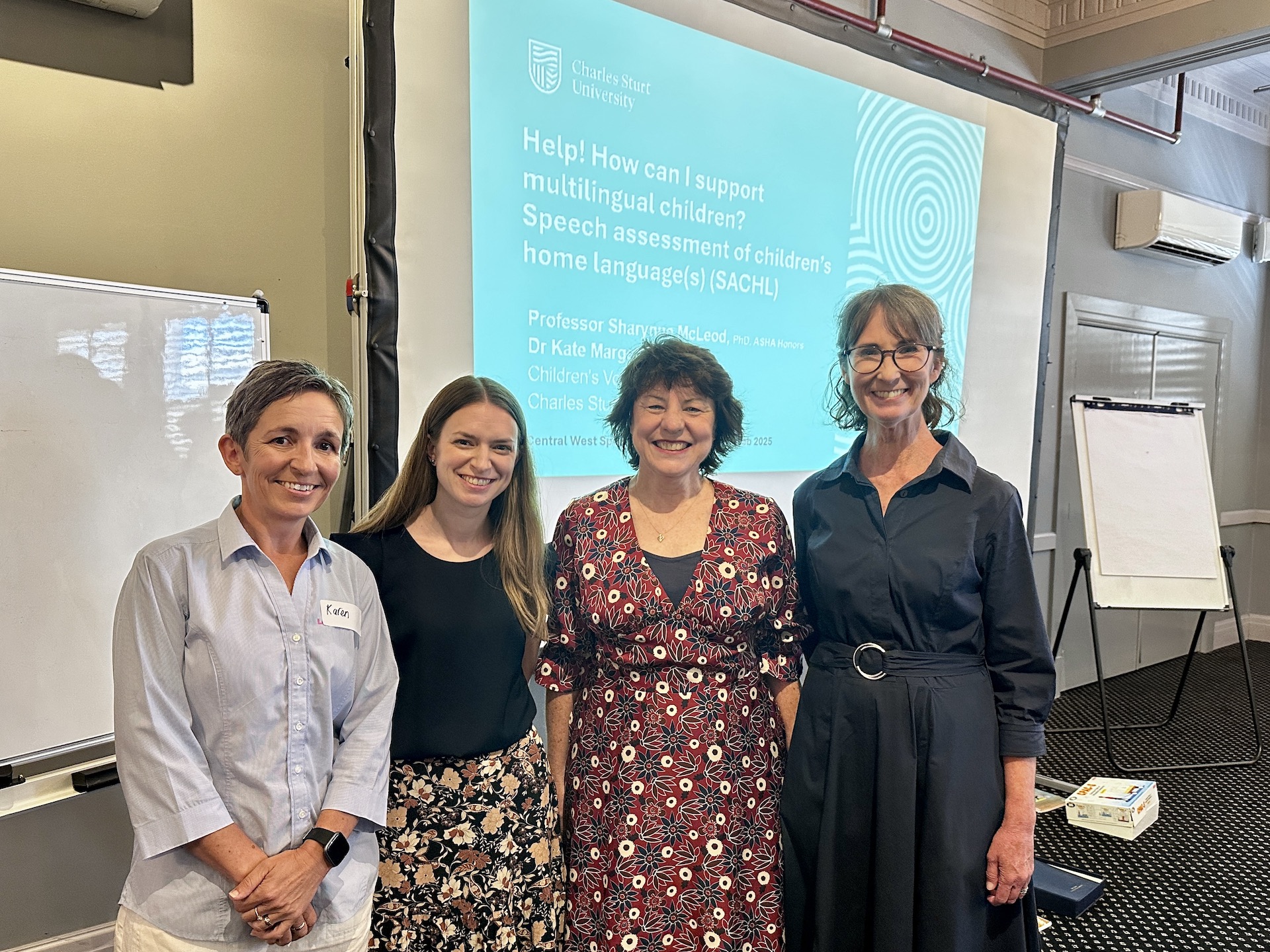
Today Dr Kate Margetson and I presented a 2-hour invited seminar titled "Help! How can I support multilingual children? Speech assessment of children’s home language(s) (SACHL)" at the Central West Speechies' PD Day in Orange.
![]() |
| Karen Trengove (Learn2Communicate), Dr Kate Margetson (CSU), Prof Sharynne McLeod (CSU), Dr Rebecca Sutherland (The University of Sydney) |
![]() |
| Dr Kate Margetson describing data from our research |
![]() |
| Dr Kate Margetson describing the SACHL |
This presentation was a really important day for Kate's postdoctoral research. We have had a 18month grant from the Rural Health Research Institute (RHRI) to consider how speech pathologists can support multilingual children, particularly in rural areas. Kate presented our work on the SACHL:
https://www.csu.edu.au/research/multilingual-speech/speech-assessments/sachl
The attendees both provided a wonderful audience for research translation, but also for providing advice about how to make the SACHL better for all.
November 27, 2024
ECV2024 presentations by our team
Here are the presentations from our team at ECV2024 this week
- Children draw talking: Interdisciplinary insights into drawings from 200 children from 24 countries - Sharynne McLeod, Carolyn Gregoric, Jessamy Davies, Lysa Dealtry, Laura Delli-Pizzi, Belinda Downey, Sheena Elwick, Suzanne C. Hopf, Nicola Ivory, Holly McAlister, Elizabeth Murray, Azizur Rahman, Shukla Sikder, Van H. Tran, Cherie Zischke
- Building The Treehouse: A physical and virtual children’s research environment co-designed with children, colleagues, community - Sharynne McLeod
- Indigenous children’s speech, language and communication: Identifying and co-creating resources and services - Sharynne McLeod, Emily-Jane Woodhead, Sarah Bartlett, Ebony Hay, Carolyn Gregoric
- Using an implementation science framework to co-design and test the Speech Assessment of Children’s Home Language(s) (SACHL) - Kate Margetson and. Sharynne McLeod
- Voices and visions: Engaging children with childhood apraxia of speech in intervention research- Marie Ireland, Anna Cronin, Jane McCormack, Sharynne McLeod, Cen Wang, Caroline Tiong
- Adaptation of the Early Childhood Voices Drawing Protocol for collecting children’s experiences of play - Carolyn Gregoric, Shukla Sikder, Suzanne C. Hopf, and Sharynne McLeod
- “Absolutely cuddled out” – Building personal resources to build retention - Belinda Downey, Will Letts, Leanne Gibbs, and Sharynne McLeod
- Caregiver implemented intervention for early communication development: A review of evidence for Hanen® programs - Sarah Bartlett and Sharynne McLeod
- Children on Australian university campuses: A rapid review of internal policies, guidelines, and procedures - Carolyn Gregoric, Sharynne McLeod, Suzanne C. Hopf, and Claudio Dionigi
- Multilingual children’s speech development - Sharynne McLeod and Helen L. Blake
- Children’s speech development: English (Australian) - Sharynne McLeod and Helen L. Blake
- Children’s speech development: English (Fiji) - Holly McAlister, Suzanne C. Hopf, Paul A. Geraghty, Sharynne McLeod
- Children’s speech development: English + Vietnamese - Kate Margetson, Sharynne McLeod, Van H. Tran, Sarah Verdon, Ben Phạm
- Children's speech development: Cantonese - Carol Kit Sum To, Pamela Cheung, Sharynne McLeod
- Children’s speech development: Vietnamese - Ben Phạm, Kate Margetson, Sharynne McLeod, Van H. Tran, Sarah Verdon - https://multilingual-childrens-speech-development.csu.domains/ecv2024-570/
November 19, 2024
SACHL - Phase 2 information session 2
Today we hosted another information session about Phase 2 of the Speech Assessment of Children’s Home Languages (SACHL, Margetson & McLeod, 2025).
https://www.csu.edu.au/research/multilingual-speech/speech-assessments/sachl
We met with another group of very enthusiastic participants who are keen to collaborate with us to develop resources for multilingual children and families across the world.
We also showed the attendees the Multilingual Children’s Speech website - 1000+ free resources in 100+ languages - https://www.csu.edu.au/research/multilingual-speech/home
One of the attendees said "Languages are a very big part of my identity"
November 18, 2024
SACHL - Phase 2 information session 1
The first SACHL information session for people who want to participate with us in Phase 2 was held tonight.
It was great to see how many people came along for a session that was held at 8-9pm on a Monday evening!
We provided the first look at the data from Phase 1 - the need for this tool is compelling
We also showed the attendees the Multilingual Children’s Speech website - 1000+ free resources in 100+ languages - https://www.csu.edu.au/research/multilingual-speech/home
November 7, 2024
Sarah Bartlett's PhD endorsement
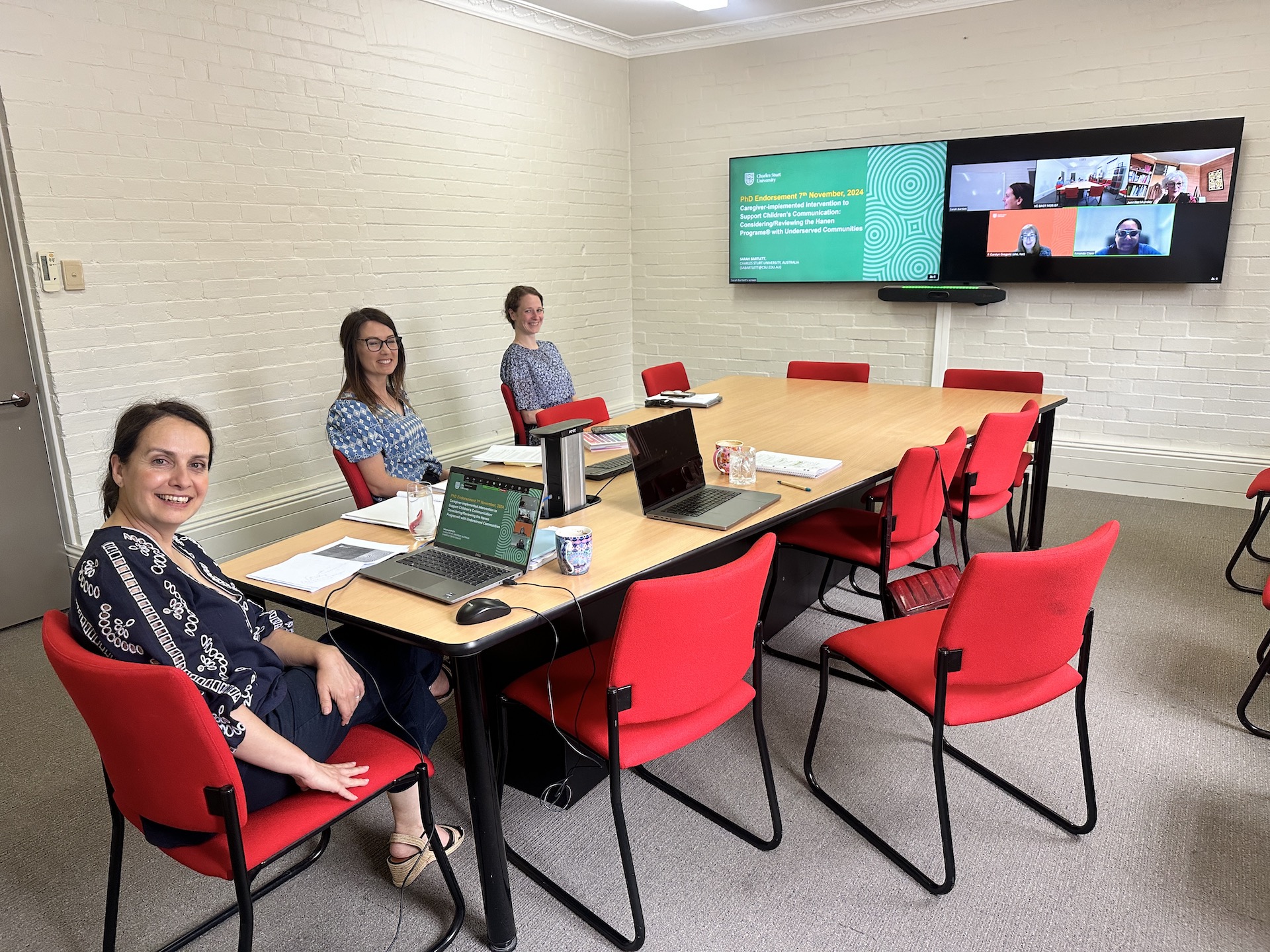
Congratulations to my PhD student Sarah Bartlett who traveled to Bathurst to present her PhD proposal. Her topic is: Caregiver-implemented Intervention to Support Children’s Communication: Considering the Hanen Programs® with Underserved Communities
| Sarah presenting her endorsement in Bathurst and online |
| Prof Sharynne McLeod, Sarah Bartlett, A/Prof Will Letts (Head, School of Education) |
Background. Children’s ability to communicate is supported by family and caregivers during children’s development. Some children have difficulty communicating and have speech, language and communication needs (SLCN). Caregiver-implemented interventions are family centred and focus on empowering caregivers to support children’s communication development. Hanen® programs are a common exemplar of an evidence-based caregiver-implemented intervention with 57 studies from 15 countries demonstrating the programs’ efficacy, effectiveness and perceived effectiveness. Hanen® programs were developed in Canada and evidence supporting their use largely reflects perspectives of Western, educated, industrialised, rich and democratic (WEIRD) researchers and participants. Hanen® programs have potential for supporting underserved communities in Australia including families who multilingual, humanitarian migrants, or Indigenous; however, the applicability has not been examined.
Aim. This study aims to understand if caregiver-implemented interventions are suitable or can be modified to be responsive to the communication needs of children and families in underserved communities in Australia.
Method. This PhD program will comprise three parts. A scoping/narrative review will be undertaken to document current evidence for Hanen® programs and the demography of researchers and participants. The PhD candidate received invitations to work with three underserved communities to undertake research regarding the applicability of the Hanen programs: families who are asylum seekers, migrant families from low SES communities, and a rural Indigenous community. Conversations have been undertaken with the communities to consider the acceptability and feasibility of the Hanen® program. If appropriate, the communities will co-develop and adapt elements of Hanen® programs to support caregivers of children who have SLCN. Quantitative and qualitative tools will be identified to measure outcomes of the adapted Hanen® programs during trials in the communities. In response to consultation with the Indigenous community, a Hanen® program will not be implemented. Instead, an international scoping review of services and resources for supporting children with SLCN from Indigenous communities will be undertaken to inform their future community-driven support.
Conclusions. Professionals routinely support families from a range of different cultures. Much of the evidence for interventions typically reflects the values and beliefs of WEIRD communities. It is essential for professionals to provide culturally safe and responsive practices for all families. This PhD program will contribute to co-designing and understanding the acceptability and feasibility of a caregiver-implemented intervention (adapted Hanen® program) to support children’s communication across three underserved communities.
| Sharynne and Sarah on the Bathurst campus |