Showing posts with label International Speech Screen. Show all posts

April 23, 2026

CeTasSSD Speech Census wrap up

This week our CeTasSSD Speech Census team met to celebrate meeting so many wonderful 4- to 5-year-olds during our research. We also reflected on what went well and what can be changed in the future.

Here are our statistics so far:  

  • 1207 Kinder students in the state
  • 981 consent forms returned (226 not returned)
  • 945 consent forms provided consent (36 did not provide consent)
  • 874 assessments attempted (45+ more not yet entered into the spreadsheet)
  • 14 children did not give assent and 8 could not be assessed (e.g., due to disability)
  • 859 (+45) children have completed the International Speech Screener (ISS)

Thanks so much to the children and schools (especially the SSCs and TAs). Thanks to our wonderful CeTasSSD research team. Hooray team!

Helen Blake, Sharynne McLeod, Felicity Laurence, Emma Scanlon, Ally Barrett met for 2 hours to debrief, summarise, and plan
Team members not pictured: Sarah Verdon, Kate Crowe, Lisa Johnson 

March 30, 2026

Week 3 of the Tasmanian Kinder Speech Census begins

 At the beginning of week 3 of our Tasmanian Kinder Speech Census we have:

  • 32 schools
  • 1,203 Kinder students
  • 889 parent consent forms returned 
  • LOTS of children who have assented to participating in our research and who have told us how they feel about their speech 
  • LOTS of children assessed using the International Speech Screener (ISS). I personally have assessed 208 children so far :)
  • 63 control children assessed with the Diagnostic Evaluation of Articulation and Phonology (DEAP)


Another day face-to-face with Kinder students in CET schools

The rest of the week I have been assessing the students and undertaking data analysis via Zoom because I am no longer in Tasmania. 

March 5, 2026

International Speech Screener recording session and testing with young friends

This morning Dom Ingersole from CSU Communications recorded my speech at the CSU radio station to be imported into the updated International Speech Screener to be used in our CeTasSSD research project. Thanks Dom!


I had a delightful weekend practicing using the ISS with some of my young friends. One 4;5 year old said that she liked it, her favourite part of the test was the smiley face and there was nothing she wanted me to change. Her Mum said to remind children to keep their hands away from their mouths - and put the device close to the child. Thanks for your helpful feedback.

February 6, 2025

Tasmanian research planning

It is such a pleasure to collaborate with the team from Catholic Education Tasmania. They are rigorous, responsive, and care for the children in Tasmania. We are planning for our research this year - and are getting closer to finalising the procedures and protocols.

November 3, 2018

Screening children's speech: The impact of imitated elicitation and word position

The following article has just been published:
McLeod, S., & Masso, S. (2018). Screening children's speech: The impact of imitated elicitation and word position. Language, Speech, and Hearing Services in Schools, Advance online publication doi:10.1044/2018_LSHSS-17-0141
Here is the link: http://LSHSS.pubs.asha.org/article.aspx?doi=10.1044/2018_LSHSS-17-0141
 Here is the abstract:
Purpose: Diagnostic decision making is influenced by the attributes of assessments. In order to propose time-efficient protocols for screening children's speech, this study aimed to determine whether eliciting imitated responses and analyzing productions in different word positions resulted in different levels of consonant accuracy.
Method: Participants were 267 English-speaking preschool-age children in the Sound Start Study whose parents were concerned about their speech. They were assessed using the International Speech Screener: Research Version (ISS; McLeod, 2013) using either imitated or spontaneous elicitation. Productions were compared with an established diagnostic assessment of speech accuracy (Diagnostic Evaluation of Articulation and Phonology; Dodd, Hua, Crosbie, Holm, & Ozanne, 2002).
Results: Participants' performance on the ISS was significantly correlated with performance on the Diagnostic Evaluation of Articulation and Phonology. Eliciting imitated productions on the ISS (M = 2:18 min, SD = 0:59 min) took significantly less time than spontaneous productions (M = 6:32 min, SD = 2:34 min). There was no significant difference in accuracy of imitated versus spontaneous productions in word-initial position; however, consonants were significantly less accurate in spontaneous than imitated productions in other word positions. Overall, participants had significantly lower consonant accuracy in word-initial position than within-word or word-final positions. Examination of the influence of word position on test discrimination, using receiver operating characteristic analyses, revealed acceptable test discrimination for percentage of consonants correct across word positions.
Conclusion: This research supports using imitated elicitation and analysis of percentage of consonants correct in word-initial position as a time-efficient procedure when screening the speech of English-speaking preschool children.

July 14, 2018

Screening children’s speech: The impact of imitated elicitation and word position

This morning the following paper was accepted for publication:
McLeod, S. & Masso, S. (2018, in press July). Screening children’s speech: The impact of imitated elicitation and word position. Language, Speech, and Hearing Services in Schools.
Here is the abstract
Purpose: Diagnostic decision-making is influenced by the attributes of assessments. In order to propose time-efficient protocols for screening children’s speech this study aimed to determine whether eliciting imitated responses and analyzing productions in different word positions resulted in different levels of consonant accuracy.
Method: Participants were 267 English-speaking preschool-aged children in the Sound Start Study whose parents were concerned about their speech. They were assessed using the International Speech Screener (ISS, McLeod, 2013) using either imitated or spontaneous elicitation. Productions were compared with an established diagnostic assessment of speech accuracy (Diagnostic Evaluation of Articulation and Phonology, DEAP-Phonology, Dodd et al., 2002).
Results: Participants’ performance on the ISS was significantly correlated with performance on the DEAP-Phonology. Eliciting imitated productions on the ISS (M = 2:18 mins, SD = 0:59) took significantly less time than spontaneous productions (M = 6:32 mins, SD = 2:34). There was no significant difference in accuracy of imitated versus spontaneous productions in word-initial position; however, consonants were significantly less accurate in spontaneous than imitated productions in other word positions. Overall, participants had significantly lower consonant accuracy in word-initial position than within word or word-final positions. Examination of the influence of word position on test discrimination, using receiver operating characteristic (ROC) analyses, revealed acceptable test discrimination for percentage of consonants correct across word positions.
Conclusions: This research supports using imitated elicitation and analysis of percentage of consonants correct in word-initial position as a time-efficient procedure when screening the speech of English-speaking preschool children.

August 15, 2013

New speech research with Turkish children

Today I discussed a collaborative research project with Professor Seyhun Topbaş and Özge Sultan Teker to study Turkish children's speech. We proposed two inter-related projects. One to consider Turkish children's perspectives of their speech by asking them to draw themselves talking s well as using other child-friendly techniques. The second to validate the use of two tools to screen Turkish children's speech. I look forward to working together on these projects.
Sharynne, Özge, and Seyhun


August 14, 2013

Speech and language in Turkey

This week I am visiting Professor Seyhun Topbaş and colleagues at Dilkom, Anadolu University, Eskişehir,  Turkey. Seyhun founded the speech-language pathology program in Turkey, and it is wonderful to finally visit her department. I have known Seyhun for many years and have continually been impressed by her research and ability to develop assessments and interventions for Turkish children.

On Wednesday I gave an invited presentation titled "Children's speech acquisition around the world" then worked with a group of speech-language pathologists to review the Turkish version of the International Speech Screen.
Staff and students who attended the presentation titled
"Children's speech acquisition around the world"

Sharynne with Professor Seyhun Topbaş at Dilkom
Dr Esra Ertan and Prof Seyhun Topbaş in the Student Union Building
View across Eskişehir from Anadolu University
Group therapy room in the Dilkom clinic
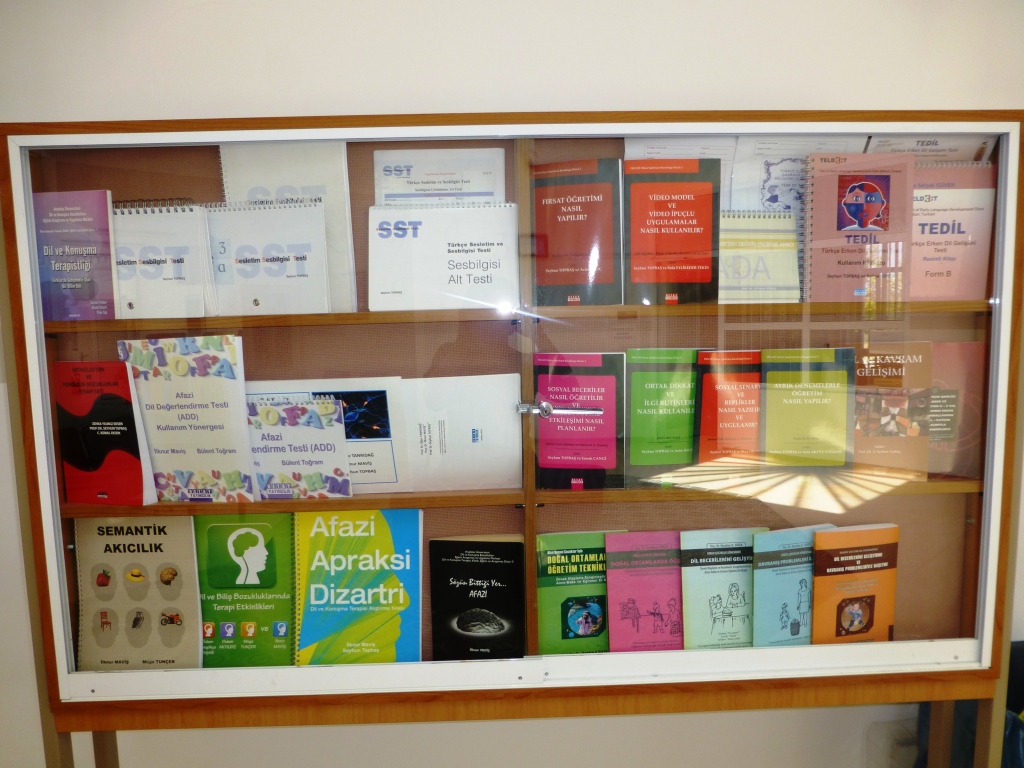
Turkish speech and language assessments created at Dilkom

June 12, 2013

Typical Vietnamese preschoolers

Yesterday the speech therapy students from Phạm Ngọc Thạch University visited a preschool. We spent time looking at the preschool, participating in songs and games, and playing with the children. Next, six children visited us and we worked in small groups to practice assessing the children's speech. The children taught us all a lot. We had a lot of practice transcribing online and keeping children's attention. We also had a chance to test the stimulus items in our newly developed speech tests to see if we needed to make changes (and we did!)
The next day members of the class gave me extremely valuable feedback on the pilot version of the International Speech Screen for Vietnamese.