- Rena Lyons: Exploring identity in children with speech and/or language impairments
- Ros Merrick: Picture Me: Using illustrations in conversation with children
- Graham Daniel and Sharynne McLeod: Listening to children with speech and language impairment: Implications for teachers of young children (presented by Graham via video conference from Australia!)
- Mary Wickenden: See me, not just the chair: Aspects of identity for disabled teenagers who use Augmentative and Alternative Communication
- Helen Hambly: One voice among many – contrasting children’s experiences of their primary language impairment (PLI) with the experiences of their parents, peers and the professionals who support them
- Sue Roulstone: Children’s perspectives from the Better Communication Research Programme
-
Linda Lascelles: Chief Executive, Afasic: Tuning
in to children and young people with speech and language difficulties.
Sharynne presenting the keynote address
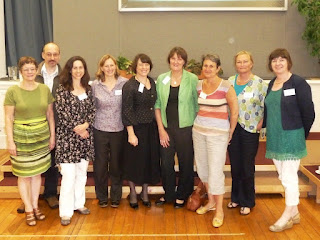
Rachael and Jim, Ros Merrick, Helen Hambly, Sharynne, Sue Roulstone, Linda Lascelles, Mary Wickenden, Rena Lyons
Year 3 students from Cardiff University with their copies of the Listening book
Graham Daniel presenting his paper from Australia
Rosemary Hayhow, and Anna Blackwell
Jim and Rachael from J&R Press
June 21, 2012
Listening Conference in Bristol
On
20th June the University of the West of England hosted a 1 day
conference titled: Listening to Children and Young People with Speech, Language
and Communication Needs. The conference was attended by over 50 speech and
language therapists, teachers, psychologists, parents and students. During the
conference our Children Draw Talking art exhibition was displayed. I was
invited to present the keynote address titled: The importance and challenges of
listening to children and young people with speech, language and communication
needs
The
other presenters were:
June 16, 2012
Launch of the FOCUS: Focus on Outcomes of Children Under Six
| The FOCUS team: Nancy Thomas-Stonell (seated), L-R Bruce Oddson, Bernadette Robertson, Karla Washington, Peter Rosenbaum, Joan Walker |
This week a new outcome measure of communicative
participation was launched in Toronto, Canada. The FOCUS: Focus on
Outcomes of Children Under Six is a parent and clinician-report measure that is
framed around the World Health Organization's International Classification of
Functioning, Disability and Health (ICF). The FOCUS has taken 12 years to
develop and has established reliability and validity measures.
I was invited to
open the 2-day conference with a presentation titled: "Children’s speech, language
& communication: Learning from the WHO’s focus on functioning &
participation".
Other presentations included:
- Using the Communication Function Classification System (CFCS) Mary Jo Cooley Hidecker
- Development and Validation of the FOCUS© Nancy Thomas-Stonell, Bernadette Robertson & Bruce Oddson
- Outcomes and Predictors of Outcomes for preschoolers with S/LI: A Post-doctoral Research Study Using the FOCUS© Karla Washington
- Measures & Measurement: Do we really need another lecture on this? Peter Rosenbaum
- Knowledge Translation: A great idea but how do we overcome people’s conservatism? Dr. Peter Rosenbaum & Dr. Virginia Wright
- What do we know about effective knowledge translation strategies? Dr. Diane Russell
- Opportunities & Challenges with using the FOCUS© Claire Maclean, Judy Meintzer, and Kate Wishart
Labels:
assessment,
Canada,
Invited presentations,
travel
Planning future research projects
Over the past week I have been working with Dr Karla Washington to plan our upcoming research project in Jamaica in January. We have been working on grants, ethics protocols and papers.
June 6, 2012
Parents' choices about language mode and use
Kate Crowe is one of my PhD students who is working on a fascinating and important topic. She is examining parental choices about the language mode (speech / signing) and language (English / Arabic / Greek / etc) for children with hearing loss. She has asked over 100 parents using a survey that included both open-ended questions and closed questions. She has been analysing the quantitative data with A/Prof David McKinnon, and the qualitative data with Dr Loraine Fordham. This picture shows the first stage of analysis of the qualitative data - using the old-fashioned technique of reading and sorting meaning statements to create themes. She is now entering the data into NVivo to undertake further analyses of the important insights these parents have given about the factors that influence their choices.
UPDATE February 2013:
Here is the link to the published paper from this research
http://speakingmylanguages.blogspot.com.au/2013/02/part-of-our-world-influences-on.html
| Dr Libbey Murray and Kate Crowe discussing emerging themes from Kate's data (in Brisbane) |
Here is the link to the published paper from this research
http://speakingmylanguages.blogspot.com.au/2013/02/part-of-our-world-influences-on.html
Labels:
CSU,
hearing loss,
research,
Students
Disentangling the impact of speech and language impairment from speaking a language other than English
While in Brisbane I have been able to discuss and progress the analysis of data regarding children in the Longitudinal Study of Australian Children (LSAC) who speak languages other than English. My colleagues, Dr Sue Walker (Queensland University of Technology), Chrystal Whiteford (QUT), Linda Harrison (CSU) and I have been disentangling the impact of speaking a language other than English from having a speech and language delay in any/all languages.
Here is a summary of our findings to date:
Within Australia educational provisions are made to support children who speak languages other than English (LOTE) as their primary language. For children who speak a LOTE and have speech and language difficulties in each language, additional support services are required. This study aimed to determine the impact of primarily speaking a language other than English at home when 4- to 5-years-old on teacher-rated literacy, numeracy, and social-emotional outcomes at 8- to 9-years-old for children identified with and without overall speech and language concern. Participants were from the Kindergarten cohort of The Longitudinal Study of Australian Children (LSAC) (n = 4983). A matched-case control design (controlled for sex, socio-economic position (SEP), and age) enabled comparison between four groups of children: a) English + typical speech and language (n=109), b) LOTE + typical speech and language (n=109), c) English + speech and language concern (n=109), d) LOTE + speech and language concern (n=109). Next, multiple regression analyses were undertaken for the entire LSAC sample (n=4983) constructed in a hierarchical framework, with variables entered in four steps: child factors (including LOTE), family factors, competencies when 4- to 5-years-old, then competencies when 6- to 7-years-old. Three teacher-rated outcome measures at age 8- to 9-years were considered. The results indicated at 4- to 5-years there were significant differences between groups a) and b) on the Peabody Picture Vocabulary Test (PPVT), a direct assessment measure, and the parent-rated Strengths and Difficulties Questionnaire (SDQ). Further, there were significant differences between groups c) and d) on the PPVT. Children speaking LOTE performed more poorly than English speaking children on both these measures. There were no significant differences between groups on the Who am I? (WAI). However, by 8-to 9-years speaking a LOTE did not predict school-age academic and social-emotional difficulties. Significant predictors for Language and Literacy included SEP, parent and teacher reported use of speech pathology services, expressive language concerns, PPVT at 4- to 5-years and children’s competencies at 6- to 7-years. Significant predictors for Mathematical Thinking included child sex, SEP, LOTE, parent and teacher reported use of speech therapy, 4/5 PPVT and children’s competencies at 6- to 7-years. For the SDQ significant predictors included child sex, SEP, receptive language concerns and children’s approaches to learning at 6-7 years. These results indicate that presence of speech and language concern at 4- to 5-years was a greater predictor of school-age academic and social-emotional difficulties than speaking a LOTE.
Here is a summary of our findings to date:
Within Australia educational provisions are made to support children who speak languages other than English (LOTE) as their primary language. For children who speak a LOTE and have speech and language difficulties in each language, additional support services are required. This study aimed to determine the impact of primarily speaking a language other than English at home when 4- to 5-years-old on teacher-rated literacy, numeracy, and social-emotional outcomes at 8- to 9-years-old for children identified with and without overall speech and language concern. Participants were from the Kindergarten cohort of The Longitudinal Study of Australian Children (LSAC) (n = 4983). A matched-case control design (controlled for sex, socio-economic position (SEP), and age) enabled comparison between four groups of children: a) English + typical speech and language (n=109), b) LOTE + typical speech and language (n=109), c) English + speech and language concern (n=109), d) LOTE + speech and language concern (n=109). Next, multiple regression analyses were undertaken for the entire LSAC sample (n=4983) constructed in a hierarchical framework, with variables entered in four steps: child factors (including LOTE), family factors, competencies when 4- to 5-years-old, then competencies when 6- to 7-years-old. Three teacher-rated outcome measures at age 8- to 9-years were considered. The results indicated at 4- to 5-years there were significant differences between groups a) and b) on the Peabody Picture Vocabulary Test (PPVT), a direct assessment measure, and the parent-rated Strengths and Difficulties Questionnaire (SDQ). Further, there were significant differences between groups c) and d) on the PPVT. Children speaking LOTE performed more poorly than English speaking children on both these measures. There were no significant differences between groups on the Who am I? (WAI). However, by 8-to 9-years speaking a LOTE did not predict school-age academic and social-emotional difficulties. Significant predictors for Language and Literacy included SEP, parent and teacher reported use of speech pathology services, expressive language concerns, PPVT at 4- to 5-years and children’s competencies at 6- to 7-years. Significant predictors for Mathematical Thinking included child sex, SEP, LOTE, parent and teacher reported use of speech therapy, 4/5 PPVT and children’s competencies at 6- to 7-years. For the SDQ significant predictors included child sex, SEP, receptive language concerns and children’s approaches to learning at 6-7 years. These results indicate that presence of speech and language concern at 4- to 5-years was a greater predictor of school-age academic and social-emotional difficulties than speaking a LOTE.
| Sue Walker, Chrystal Whiteford, Linda Harrison & Sharynne |
Labels:
multilingual,
research,
travel
Brisbane: Early Years Education Collaborative Research Network
This week almost 70 people within the Early Years Education Collaborative Research Network met in Brisbane. The CRN includes researchers from Charles Sturt University, Monash University, and Queensland University of Technology. What an inspiring week by the Brisbane River!
| Over the week we have gone under, over and around many research ideas and questions |
| Love the spelling! Actually we are mostly "sisters" not "bro"s |
June 2, 2012
A systematic review of the influence of bilingualism on speech production
The following paper has been accepted for publication this week:
Hambly, H., Wren, Y., McLeod, S., & Roulstone, S. (2012, in press May). The influence of bilingualism on speech production: A systematic review. International Journal of Language and Communication Disorders.
ABSTRACT
Background: Children who are bilingual and have speech sound disorder are likely to be under-referred, possibly due to confusion about typical speech acquisition in bilingual children.
Aims: The aim of this review was to investigate what is known about the impact of bilingualism on children’s acquisition of speech in English to facilitate identification and treatment of bilingual children with speech sound disorder.
Methods: A systematic review of studies from the last 50 years was conducted. Studies investigating speech acquisition in bilingual infants and children (where one language was English) were identified through searching 7 electronic databases, bibliographies of relevant articles and emailing authors. Sixty six studies investigating bilingual speech production met inclusion criteria, with 53 describing typically developing children and 13 describing children with speech sound disorder. The 66 studies were analysed thematically and summarised in terms of methods, key findings and underlying theories.
Main Contribution:
There was limited evidence to suggest that bilingual children develop speech at a slower rate than their monolingual peers; however, there was evidence for qualitative differences and increased variation in speech production. Nearly all studies provide evidence for transfer between the two phonological and language structures, although the amount of transfer varied between studies. There was evidence of positive and negative transfer of features from the dominant language (L1) to the second language (L2) as well as from L2 to L1. Positive transfer became more evident with increased age and length of exposure to a second language. More recently researchers have moved away from investigating whether there are one or two phonological systems and accept that there are two systems that interact. Interest has shifted to examining how phonological systems interact and to identifying factors that influence interactions. The review revealed a number of inconsistencies in the findings of studies due to differences in methodology, languages investigated, and degree of language exposure. Overall, measurement issues were addressed well but most studies provided limited sample information about language experience, schooling and socio-economic status.
Conclusions: There are differences in speech sound acquisition between monolingual and bilingual children in terms of rate and patterns of error, with both positive and negative transfer occurring in bilingual children.
Hambly, H., Wren, Y., McLeod, S., & Roulstone, S. (2012, in press May). The influence of bilingualism on speech production: A systematic review. International Journal of Language and Communication Disorders.
ABSTRACT
Background: Children who are bilingual and have speech sound disorder are likely to be under-referred, possibly due to confusion about typical speech acquisition in bilingual children.
Aims: The aim of this review was to investigate what is known about the impact of bilingualism on children’s acquisition of speech in English to facilitate identification and treatment of bilingual children with speech sound disorder.
Methods: A systematic review of studies from the last 50 years was conducted. Studies investigating speech acquisition in bilingual infants and children (where one language was English) were identified through searching 7 electronic databases, bibliographies of relevant articles and emailing authors. Sixty six studies investigating bilingual speech production met inclusion criteria, with 53 describing typically developing children and 13 describing children with speech sound disorder. The 66 studies were analysed thematically and summarised in terms of methods, key findings and underlying theories.
Main Contribution:
There was limited evidence to suggest that bilingual children develop speech at a slower rate than their monolingual peers; however, there was evidence for qualitative differences and increased variation in speech production. Nearly all studies provide evidence for transfer between the two phonological and language structures, although the amount of transfer varied between studies. There was evidence of positive and negative transfer of features from the dominant language (L1) to the second language (L2) as well as from L2 to L1. Positive transfer became more evident with increased age and length of exposure to a second language. More recently researchers have moved away from investigating whether there are one or two phonological systems and accept that there are two systems that interact. Interest has shifted to examining how phonological systems interact and to identifying factors that influence interactions. The review revealed a number of inconsistencies in the findings of studies due to differences in methodology, languages investigated, and degree of language exposure. Overall, measurement issues were addressed well but most studies provided limited sample information about language experience, schooling and socio-economic status.
Conclusions: There are differences in speech sound acquisition between monolingual and bilingual children in terms of rate and patterns of error, with both positive and negative transfer occurring in bilingual children.
June 1, 2012
Book review: Listening to children and young people
The following book review has just been published in the RCSLT Bulletin referring to Listening to Children and Young People with Speech, Language, and Communication Needs. Here are some excerpts
"I am a self-confessed train/bedtime reader, so I found this book fantastic for its dip-in-able, engaging and readable style.
The first few pages are a series of short passages...These are heart-warming, sensitively written and very powerful examples of the impact of our work...their voices radiate through the pages.
The rest of the book ... is packed with different ideas and techniques that I have been truly inspired by...
I would normally recommend taking a thriller to bed but I will put my neck on the line and say that your clinical practice will be enhanced after ‘sleeping on this book’."
Reviewer Kirsty Bui, SLT, Director, SLT Journal Club
Overall rating: 4 out of 5
"I am a self-confessed train/bedtime reader, so I found this book fantastic for its dip-in-able, engaging and readable style.
The first few pages are a series of short passages...These are heart-warming, sensitively written and very powerful examples of the impact of our work...their voices radiate through the pages.
The rest of the book ... is packed with different ideas and techniques that I have been truly inspired by...
I would normally recommend taking a thriller to bed but I will put my neck on the line and say that your clinical practice will be enhanced after ‘sleeping on this book’."
Reviewer Kirsty Bui, SLT, Director, SLT Journal Club
Overall rating: 4 out of 5
Labels:
Books
May 30, 2012
Walkie Talkies
| Kate and Hannah with their pedometres |
As a result, my students and I have decided to conduct a 10 week challenge to walk at least 10,000 steps per day. We live in different cities from one another, so if we find ourselves in the same place, we try to walk (and talk) together. Consequently we have called ourselves the Walkie Talkies and are plotting our steps using Excel spreadsheets.
There are prizes not only for the most steps walked, but also for the largest standard deviation, and the most improved since baseline. We may even use more of the statistical capabilities to explore our results as an exercise in quantitative stats! I will keep you posted on how we are doing.
May 25, 2012
March-May 2012 summary
AUSTRALIAN RESEARCH COUNCIL FUTURE FELLOWSHIP UPDATE
‘Speaking my language: International speech acquisition in Australia’
Written by Kim Woodland, Research Institute for Professional Practice, Learning and Education for the May 2012 RIPPLE Update
‘Speaking my language: International speech acquisition in Australia’
Written by Kim Woodland, Research Institute for Professional Practice, Learning and Education for the May 2012 RIPPLE Update
| Sharynne and Dr Yvonne Wren in Bathurst |
Sharynne began March by speaking to over 400 parents and teachers from 30 rural and remote schools throughout New South Wales. Her presentation—Supporting children’s speech and language development—was part of RDE RELATE, a community education initiative from the Department of Education and Communities’ Country Areas Program which aims to support rural and remote communities by using videoconferencing to broadcast important speakers and issues. Work has also continued on the Early Years Education Collaborative Research Network (EYE CRN), including a two-day meeting in Albury where Sharynne worked with colleagues from three universities to analyse data from the Longitudinal Study of Australian Children (LSAC). She used the wealth of information from her Fellowship experience to focus on children speaking languages other than English. Dr Yvonne Wren from The University of the West of England visited in April, and they worked on a journal article, conference presentation and a grant submission. An international speech assessment project Sharynne has been supervising with Dr Martin Barrett, which involved Masters’ students from East Tennessee State University creating a prototype computer program for the International Speech Assessment, was wrapped up in early May with a final presentation. Sharynne has also continued publishing, with three co-authored journal articles on children's speech and language recently being released.
The RIPPLE Effect is published here: http://www.csu.edu.au/__data/assets/pdf_file/0004/255163/The-RIPPLE-Effect-Issue-1-2012.pdf
Labels:
Summary
May 15, 2012
Systematic review of speech assessments
Sarah Verdon and I have been spending each Friday undertaking a systematic review of speech (articulation and phonology) assessments for speakers of languages other than English. The review encompasses the conceptual and operational aspects of the assessments. We have had a lot of fun working out what the manuals are saying by using Google Translate, then asking our colleagues from around the world who speak the languages (and we also try to ask the people who have written the test). There are some very impressive assessments that are available, and I can't wait until it is completed and we are ready to tell the English-speaking world about them.
| Sarah with German, Spanish, Turkish, Greek, Cantonese and Norwegian tests |
Labels:
assessment,
Languages
May 11, 2012
Analysing Vietnamese children's speech with students in Ho Chi Minh City
This afternoon I spent an hour discussing speech analysis with two
groups of students from Ho Chi Minh City (via Skype) facilitated by
Janella Christie and a Vietnamese interpreter. It is exciting to
see how they have been applying my lectures from May 2011 to real
children in Vietnam. They have been developing assessments and analyses
that are relevant to the different pronunciations from different parts
of Vietnam. They have also been finding phonological patterns that are typical for English-speaking children, and not listed in Tang and Barlow (2006). It is a
privilege to be a part of developing the profession of speech pathology
in VietNam.
Labels:
assessment,
speech-language pathology,
Students,
Vietnamese
May 9, 2012
Help! My computer is full
We often take our computers for granted.
This week I was copying data (video and audio files as well as images from the children's drawings) from our Talking about Talking research onto my computer -- and received the message that my computer was full! Researching about children's speech does take a lot of computer storage, and is another factor and cost in undertaking research in this field.
May 4, 2012
International Speech Assessment: Finalization of the ETSU capstone project
Today was the final presentation of the capstone project undertaken by the masters' students from East Tennessee State University. Over the past 18 months they have been working with Dr. Martin Barrett and myself to create a prototype for the International Speech Assessment. During their presentation, the students said that they had completed 2897.5 hours of work on the project! It has been a very an interesting process to learn what is important for creating a working computer program.
An earlier blog posting about the project (May 2011) is here
ISA Capstone Team: L-R Howard Morris, Jim
Johnson, Dr. Martin Barrett, Nathanial McConnell, Heather Haley, Chandan Biswas, Eric Barclay, Kris
Cunigan, Aaron Stokes
|
Labels:
assessment,
Students,
Universities,
USA
May 3, 2012
Speech-language pathologists at war?
Two journal articles have been published recently that talk about battles:
- McCormack, J., McAllister, L. McLeod, S. & Harrison, L. J., (2012). Knowing, having, doing: The battles of childhood speech impairment. Child Language Teaching and Therapy, 28, 141-157.
- Kenny, B. & Lincoln, M. (2012). Sport, scales or war?Metaphors speech-language pathologists use to describe caseload management. International Journal of Speech-Language Pathology, 14(3), 247-259.
Labels:
research,
speech-language pathology
April 21, 2012
Student graduation
Rebekah
Lockart graduated on 20th April with a Master of Speech and Language Pathology
from the Faculty of Human Sciences, Department of Linguistics, Macquarie University
in Sydney. Congratulations Rebekah! Her thesis was titled: “Factors that
enhance Australian speech-language pathologists’ assessment of the speech of Cantonese-speaking
children” and it was a privilege to supervise her work (we had an official arrangement between the two universities).
During June Rebekah will
be presenting aspects of her thesis at the Speech Pathology Australia National
Conference in Hobart, Australia and I will be presenting a different paper based on this work at
the International Clinical Phonetics and Linguistics Conference in Cork,
Ireland. We have also just received positive reviews from an international
journal about a paper based on her thesis – so soon the world will also know
about the important work that Rebekah has undertaken.
![]() |
| Rebekah and David Lockart |
Labels:
Cantonese,
graduation,
speech-language pathology,
student,
Students
April 11, 2012
Supervision of distance and part-time higher degree research students
Today I coordinated a supervisory workshop for the CSU Research Office titled "Supervision of distance, remote and part-time higher degree research students" The workshop was attended by academics from four universities (Australian National University, University of Canberra, Charles Sturt University, and University of New South Wales).
The other presenters were
Rob Doubleday, Manager, Research Policy and Coordinator | CSU Research Office
The other presenters were
Rob Doubleday, Manager, Research Policy and Coordinator | CSU Research Office
Dr Rod Pope, Head, Research
Professional Development Programs | CSU Research Office
Kate Crowe, PhD student, Faculty
of Education, CSU.
As part of my presentation I discussed practices of effective supervisors (based on James and Baldwin, 1999) that required special consideration when working with part-time distance students (see asterisked points):
"FOUNDATIONS
1.Ensure
partnership is right for project
2.*Get to know
students and carefully assess their needs
3.*Establish
reasonable, agreed expectations
4.Work with students
to establish a strong conceptual structure and research plan
MOMENTUM
5. Encourage students
to write early and often
6. *Initiate regular contact and
provide high quality feedback
7. *Get students into
the life of the department
8. Inspire and motivate
9. *Help if academic
and personal crises crop up
FINAL STAGES
10. Take an active interest in
students’ future careers
11. Carefully monitor the final
production and presentation of the research"
James, R., & Baldwin, G. (1999).
Eleven practices of effective
postgraduate supervisors. Parkville VIC: University of Melbourne.
Labels:
CSU,
Invited presentations,
presentations,
student,
Students
April 9, 2012
Children's books in languages other than English
As part of my Future Fellowship research I have collected many children's books written in languages other than English. I have been considering the vocabulary, illustrations, and conventions used by authors, illustrators and publishers in different cultures. This weekend I found a wonderful bookshop in Sydney that specializes in Japanese and Chinese books (including extensive children's book sections). It is called Kinokuniya, and think I will be visiting it again.
Japanese books are traditionally opened from right to left and written from top to bottom. However, many contemporary Japanese children's books are opened from left to right, and are written horizontally to mirror English conventions.
April 7, 2012
Dr Yvonne Wren's visit
Over Easter Dr Yvonne Wren and her family visited Bathurst. I have worked with Yvonne in Bristol on a number of occasions, and we have worked in many other cities in the world on days before or after conferences. So, it was wonderful to have her visit my home this time. Yvonne and I have been working on a paper based on analysis of the ALSPAC longitudinal data set. We also discussed her development, computerisation and testing of Phoneme Factory Phonology Screener.
| Sharynne and Yvonne exploring Bathurst |
| A kangaroo near the entrance of Charles Sturt University |
April 6, 2012
Just published: Intelligibility in Context Scale
The following manuscript has just been published
McLeod, S., Harrison, L. J. &
McCormack, J. (2012). Intelligibility in Context Scale: Validity and reliability of a subjective rating measure. Journal of Speech, Language, and Hearing
Research, 55, 648-656.
Purpose:
To describe a new measure of functional intelligibility, the Intelligibility in
Context Scale (ICS), and evaluates its validity, reliability, and sensitivity
using clinical measures of severity of speech sound disorder: percentage of
phonemes correct (PPC), percentage of consonants correct (PCC), and percentage
of vowels correct (PVC).
Method: Speech skills of 120 preschool children (109
with parent-/teacher-identified concern about how they talked and made speech
sounds, and 11 with no identified concern) were assessed via the Diagnostic
Evaluation of Articulation and Phonology. Parents completed the 7-item ICS
questionnaire which rates the degree to which children’s speech is understood
by different communication partners (parents, immediate family, extended
family, friends, acquaintances, teachers, and strangers) on a 5-point scale.
Results: Parents’ ratings showed that most children were “always” (5) or “usually” (4) understood by
parents, immediate family and teachers, but only “sometimes” (3) by strangers. Factor analysis confirmed the internal consistency of the
ICS items; therefore, ratings were averaged to form an overall intelligibility
score. The ICS had high internal reliability (α=0.93), sensitivity, and
construct validity. Criterion validity was established through significant
correlations between the ICS and PPC (r=.54),
PCC (r=.54), and PVC (r =.36).
Conclusion:
The ICS is a promising new measure of functional intelligibility. These
data provide initial support for the ICS as an easily administered, valid
and reliable estimate of preschool children’s intelligibility when speaking
with people of varying levels of familiarity and authority.
Labels:
ICF,
Publications,
research
Subscribe to:
Posts (Atom)


