July 22, 2010

African educational theories and practices

African educational theories and practices: A generative teacher education handbook
(Editors: Bame Nsamenang and Therese M.S.T. Tchombe, Cameroon).

This book was described at the ISSBD conference. It contains 39 chapters written by 44 different authors from 15 countries. It is the first of its kind. The book acknowledges the three influences on education in Africa: African, Eastern (Islamic/Arabic) and Western.

In supporting the underpinning rationales for the book, the editors quoted the goals of the African Union (2006) “an integrated peaceful, prosperous Africa driven by its own people” as well as the United National Convention on the Rights of the Child enshrining the right to a cultural identity. Some of the African educational philosophies that have been included are: using oral African traditions (proverbs, tongue twisters, rhymes and folk tales), using peer group cooperation (child-to-child learning), and siblings in the learning process.
Rose Ndonka (project administrator, HDRC), Sharynne and
Gladys Ngoran (Director of , Human Development Resource CentreCameroon)


International Society for the Study of Behavioural Development (ISSBD), Lusaka, Zambia

Conference: International Society for the Study of Behavioural Development (ISSBD), Lusaka, Zambia 18-22 July, 2010.


I have been attending the ISSBD conference in Lusaka, Zambia. Some of the presentations I have enjoyed attending include:
• African educational theories and practices (Chairs: Bame Nsamenang and Therese M.S.T. Tchombe, Cameroon)
• Cultural differences in cognitive styles (Pierre Daser)
• Socially distributed caretaking (Chair: Thomas S. Weisner)
• Beyond diathesis-stress: Differential susceptibility to environmental influences (Jay Belsky)
• Language influences in literacy acquisition in the African context (Chair: R. Malatesha Joshi) including a presentation on the effects of orthographic opacity on reading development in Zambia by Bestern Kaani from the University of Zambia
• Growing up in a multilingual society: Developmental stages and strategies in multilingual socialization (Ajit Mohanty)
• Reading acquisition in Africa: Typical and atypical pathways (Chair: Heikki Lyytinen)
• Using longitudinal research to improve child and youth well-being through inter-disciplinary and inter-sectoral collaboration (Ann Sanson)
I presented “Speech impairment in 4- to 5-year-old Australian children: Prevalence, severity and service provision” on behalf of the Sound Effects Team: Linda J. Harrison, Lindy McAllister, and Jane McCormack.

Languages in Zambia

Zambia is a country in southern Africa. There are approximately 10 million people living in Zambia and 45% are between 0-14 years old.
There are seven main/official/special languages and 73 different dialects/cultural groups. The seven main languages are: Bemba, Nyanja, Tonga, Lozi, Lunda, Kaonde, and Luvie. According to researchers at the University of Zambia the following provinces use these major language(s):
• Copperbelt: Bemba
• Eastern: Nyanja/Chewa
• Luapula: Bemba
• Lusaka: Nyanja/Bemba
• Southern: Tonga
• Western: Lozi

 
In 1977 the Ministry of Education standardized the writing systems of the 7 major languages. Prior to this, the languages were written in different ways based on inventions by different missionaries. In standardizing the languages there is a one-to-one correspondence between the sounds and letters of each of the languages. Zambian children learn to read one of the 7 Zambian languages in grade 1, and then switch to learning to read English in grade 2.
I have been listening to the languages of Zambia and have been learning how to say “how are you?” and “thankyou”
  • Nyanja: muli bwanji? (how are you?), zikomo (thankyou)
  • Bemba: muli shani? (how are you?), natotela (thankyou)
  • Lozi: muchwani (how are you?), lwitomezi (thankyou)
  • Tonga: mwapona buti? (how are you?), twalumba (thank you)
I have also been sampling Zambian food - Zambian style! So far I have enjoyed eating chikanda (root loaf) and stewed village chicken with nshima (maize) using my fingers.

Madiba Nelson Mandela’s impact throughout the world

Nelson Mandela’s cross cultural influence has been obvious throughout this trip. While in Oslo, Norway, Nelson Mandela’s photograph, sayings, and memorabilia were available throughout the city acknowledging and celebrating his Nobel Peace Prize. The movie Invictus was shown on a number or planes I have travelled on. When I flew from UK to Zambia via Johannesburg I arrived in South Africa on Nelson Mandela Day (18th July), a day that celebrates his birthday and the significant impact he has had in Africa. Even the customs officer was excited, and happily told us of the importance of the day. Everyone he told broke into a smile, certainly changing the mood of the customs hall. In the airport at Johannesburg there was a large statue of Nelson Mandela created over 8 months from tiny glass beads. In the plane to Zambia, even the headrest covers celebrated Nelson Mandela Day! He certainly continues to have an impact throughout Africa as evidenced by presentations at the conference in Zambia. At the ISSBD conference a new book was described, with one chapter titled: “Managing Africa’s multiculturalism: Bringing the Madiba magic into the African school curriculum” describing the influence of Nelson Mandela’s genre of humanistic psychology on African education.

Listening to the perspectives of children and young people with speech, language and communication needs

Listening to the perspectives of children and young people with speech, language and communication needs

University of the West of England (UWE), Bristol, UK
Wednesday 14th July, 2010
This day drew people from across the UK presenting many different perspectives on listening to children and young people with speech, language and communication needs (SLCN). Participants included young people and parents of children with SLCN, social workers, policy makers, speech and language therapists, psychologists, nurses, teachers, academics, PhD students and publishers.
Invited speakers
• Sharynne McLeod (CSU) presented “The whys and hows of listening to children"
Abigail Beverly spoke about her life as a young person with a speech and language difficulty and her current work running the girls’ group at the Afasic youth group and as an artist
• Sue Roulstone (SLTRU/UWE) spoke about The Bristol Project: A film about five teenage boys to explore the research question “What is it like to be a teenager with speech and language difficulties”. The resulting film focussed on their interests, enthusiasm, and positive contributions.
• Jane Coad (UWE) spoke presented “Using an arts based approach to elicit the views of children and young people with speech, language and communication needs
• Barry Percy-Smith (UWE) presented “Children and voice: The struggle for recognition of children’s perspectives”

Additionally, the other 19 participants provided a summary of their work and the ways that they had listened to children and young people with speech, language, and communication needs. As an outcome of the day we are writing an edited book about this important topic and aim to have it available in 2011, the UK year of the child with speech, language, and communication needs.

Developing a national inter-centre protocol for use by SLTs working with children with speech sound disorders

Developing a national inter-centre protocol for use by SLTs working with children with speech sound disorders

University of the West of England, Bristol, UK
Thursday 15th July, 2010
The aim of this day was to explore the possibility of developing a national inter-centre protocol for use by speech and language therapists (SLTs) in the UK working with children with speech sound disorders. It was lead by Yvonne Wren (SLTRU/University of West of England, UWE), Anne Hesketh (University of Manchester), Joy Stackhouse (University of Sheffield), and Sue Roulstone (SLTRU/UWE). There were 10 other invited people from across the UK. Debbie Sell from Great Ormond Street Hospital London described the assessment protocol in use in the cleft palate community in the UK and Europe. I was invited to talk about holistic assessment of children with speech impairment, and the inclusion of consideration of activities and participation. Jan Broomfield spoke about how this endeavour can be assisted by/part of the Royal College of Speech and Language Therapists (RCSLT). A network was established and future meetings and grants are planned.

July 11, 2010

Speech and Language Therapy Research Unit, Bristol, UK

I was invited to work at the Speech and Language Therapy Research Unit, located at Frenchay Hospital, Bristol, UK during July. The unit is affiliated with the University of the West of England (UWE) and the team is directed by Professor Sue Roulstone.

During my visit the following seminars are taking place
  • Monday 12th July - Children with speech sound disorders - 1 day presentation for UK speech and language therapists
  • Wednesday 14th July - 1 day with specialists and academics on the topic of listening to the perspectives of children and young people with speech, language and communication needs
  • Thursday 15th July - 1 day workshop to commence development of a national inter-centre protocol for use by SLTs working with children with speech sound disorders
Some of the people from the SLTRU that I have worked with are:
  • Professor Sue Roulstone
  • Dr Yvonne Wren
  • Dr Brian Petherham
  • Dr Rosemary Hayhow
  • Helen Hambly (PhD student)
  • Lydia Morgan (PhD student)

Welsh

Welsh (Cymraeg in Welsh) is a Celtic language and is spoken in Wales and Patagonia (Argentina). The Welsh alphabet is: a, b, c, ch, d, dd, e, f, ff, g, ng, h, i, l, ll, m, n, o, p, ph, r, rh, s, t, th, u, w, y, with a close correspondence between the letters and spoken sounds, particularly in the north of Wales. Welsh contains a lateral fricative as a component of typical speech, that in English would be classified as a lateral lisp, or an error sound requiring speech intervention.

**An update from Martin Ball: "Welsh is not the only language to have lateral fricatives as phonemes. For example Zulu and Xhosa have both voiced and voiceless, they occur in many native American languages (e.g., Navajo), with some 30+ languages listed for the voiceless one alone on Wikipedia. There's also lateral fricatives at other places of articulation (retroflex, palatal)."

Invitation to the House of Commons, London

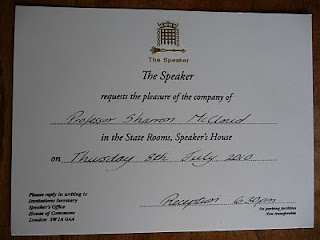
On Thursday 8th July at 6.30pm I was invited to a reception at Speakers House, Houses of Parliament, London hosted by the Speaker of the House of Commons, John Bercow (of the Bercow Report fame). The reception was in honour of Afasic, the national organisation that support families of children with speech, language and communication needs (SCLN). The speaker's rooms along the bank of the Thames were filled with celebrities (including Bob Hoskins), academics, government officials, speech and language therapists, parents, and young adults, all of whom were passionate advocates for children with speech, language and communication needs. I was very impressed with the strong support these children receieved from across the community, a situation that is quite different from Australia.

In 2011/12 the UK will celebrate the National Year of Speech, Language and Communication focussing on children with speech, language and communication needs!

More information about the reception
More information about Afasic
More information about the Bercow Report


John Bercowe (photo from Afasic)
Bob Hoskins (photo from Afasic)

Multilingual Europe

While in Europe it has been reinforced to me that throughout the world bilingualism is defined differently depending on where you live. In Europe, many people define "bilingualism" as only relating to  "simultaneous bilingualism"; that is being bilingual from birth. They define "monolingualism" as only learning one language at birth, since subsequent languages are learned at school.
People in The Netherlands typically speak Dutch from birth and English from school-age, yet call themselves monolingual despite being extremely fluent in English. Similarly, people in Norway typically speak Norwegian from birth and English from school-age. People in Germany typically speak German from birth and English from school-age. People in Belgium typically learn Dutch (Flemish), or French (Wallonian), German, and English.

In English-speaking countries such as Australia, USA and UK "bilingualism" refers both to "simultaneous bilingualism" and "sequential bilingualism"; that is learning one language after another. "Monolinguals" are people who can only speak one language, and who cannot speak another language at all (a state that is almost impossible within much of Europe).

July 2, 2010

Listening to children in Germany

While in Germany I have listened to children who have moved from an English-speaking country to live in Germany. They told me how they learned to speak German, as well as some Spanish, Korean, and Italian because of their school friends from across the world.

2010 Charles Sturt University Vice-Chancellor's Award Recipient

Message from the CSU Vice Chancellor:
"It is with great pleasure that I announce the recipients of the 2010 Vice-Chancellor’s Awards for Excellence. These awards acknowledge the commitment, dedication and contribution of both academic and general staff as they continue to excel in areas such as client service, teaching and learning, leadership, research, sustainability and innovation."

Research Excellence:

• Team Award: Associate Professor Linda Harrison, Professor Sharynne McLeod, Professor Jennifer Sumsion and Ms Frances Press

Research Supervision Excellence:

• Professor Sharynne McLeod

Thank you to those who nominated me! It is a great honour to have received these awards.

June 29, 2010

Oslo: Logopedia for children

I was fortunate to visit the Bredtvet Resource Centre in Oslo that provides specialist assessment and intervention services for children and adults with communication needs across Norway. In addition, they aim to contribute to develop knowledge via research. In 2009 there were 33 speech therapists, 6 psychologists, 8 pedagogues, 1 physiotherapist, 2 ENT doctors, 1 dentist and 2 linguists working at the Resource Centre.  

I watched an intervention session in Norwegian with a 6-year-old boy who was an excellent skateboard rider and had difficulties producing consonants as a result of his cleft lip and palate. Marianne Moe and Jorunn Lemvik conducted the session.

Anne Berit Andreassen, the head of the department focussing on cleft lip and palate, voice, aphasia and dysarthria, provided a lot of information about how logopedia (speech pathology) in Norway developed as a part of special education, and how assessment and intervention is predominately free for all people who need it. We compared the problems for accessing rural services in Norway vs. Australia.

I also met Kristin Billaud Feragen and Ase-Marie Bergfall, who have just published an excellent book titled "Albin og Luna: Det Mystiske Speilet" a story book about two children with cleft lip and palate. It also contains information about cleft lip and palate, professionals who work with children and what to say to others if you have a cleft lip and palate.

June 28, 2010

Listening to children in Norway

Norway and the other Scandanavian countries have a strong tradition of pedagogy and listening to children. This was very apparent in so many places throughout Oslo. The Oslo City Hall has paintings of children on many of its walls, including the fresco of children in the annual Oslo day parade.
Many of the statues in the famous Vigeland Sculpture Park are of children (left).

Many street signs include children. However, my favourite place was the International Museum of Children's Art: a gallery completely dedicated to showing children's art from around the world in a setting that is vibrant with a child-friendly atmosphere. Most of the art has been collected around themes including "Fathers", and "Disasters". They were interested to hear of our "Children draw talking" art exhibition.

International Clinical Phonetics and Linguistics Conference, Oslo Norway

The 13th International Clinical Phonetics and Linguistics Conference, was held in Oslo Norway. It was an extremely stimulating conference with attendees from 26 different countries speaking even more languages. Speech acquisition around the world was a topic that was discussed frequently both within formal sessions and during the breaks.
I co-presented the following papers/posters:
  • McLeod, S., Harrison, L. J., Holliday, E. L., McCormack, J., McAllister, L. (2010, June). Children draw talking: Art exhibition. International Clinical Phonetics and Linguistics Association, Oslo, Norway.
  • McLeod, S., McCormack, J., McAllister, L., & Harrison, L. J. (2010, June). Severity and nature of speech impairment in a community sample of 4- to 5-year-old children. International Clinical Phonetics and Linguistics Association, Oslo, Norway.
  • Aldum, I. & McLeod, S. (2010, June). Afrikaans: Phonology, acquisition and assessment. International Clinical Phonetics and Linguistics Association, Oslo, Norway.
A number of my research students were in attendance and I enjoyed having time to talk about their research face-to-face (since most of my students are distance education students).
Sharynne with students and colleagues Inge Aldum (Perth, Australia),
Karla Washington (Canada), and Sandra Neumann (Germany)
ICPLA President: Sara Howard, ICPLA Vice President: Sharynne McLeod,
ICPLA Ex-president and editor of Clincial Linguistics and Phonetics: Martin Ball
I also worked on a number of books with colleagues, including Electropalatography for speech assessment and intervention, the second edition of the International guide to speech acquisition,  and  Multilingual speech sound disorders.
The City of Oslo hosted a welcome reception for us at the Oslo City Hall where the Nobel Peace Prize is awarded each year.
The conference was held at a magnificent venue, the Holemkollen Park Hotel. We were there for the summer solstice, so experienced the very long summer days, and very short nights. Here is a view of the hotel taken at midnight, just as the sun had set, and just after the conference dinner/boat cruise on the Oslo fjord.


Oslo: Children's speech acquisition workshop

Norwegian Academy of Science
I was an invited speaker at a phonological acquisition workshop held at the Norwegian Academy of Science organsed by the Department of Linguistics and Scandinavian Studies, the University of Oslo. My presentation was titled "Consonant cluster acquisition in Australian English-speaking children" and included a genealogy of Australian research about typical and atypical acquisition of consonant clusters. There have been 47 Australian papers published on this topic.

Listening to children in USA


I was invited to visit the Child Study Centre at ETSU to find out about the program and talk with the children. The children told me how they had been looking at maps and learning about the world, so were very excited to find out that I was from another country. I got permission to upload this photo of the children who showed me their maps, postcards, artefacts, and pretend school complete with a wombat student! After I left I posted the children an Australian postcard of a wombat. Later, I visited a toystore in another city and found this huge jigsaw globe. I am sure that the children would have loved it.

June 9, 2010

East Tennessee State University

From June 6-19 I visited the Centre for Excellence in Early Childhood Learning and Development at East Tennessee State University and worked with Professor Lynn Williams.
I presented two seminars as outlined on the ETSU website:
    Prof. Sharynne McLeod, Prof. Marty Barrett,
    Prof. Lynn Williams, and Prof. Stephen Camarata
  • Speech sound disorders in children: Typical acquisition, prevalence, risk, and impact (ASHA CEUs event)
  • Listening to Children through the Sound Effects Study (incorporating Children Draw Talking: Art Exhibition)
I have enjoyed working with many people while at ETSU.
Prof. Stephen Camarata drove from Vanderbuilt University to visit us and to discuss research and grants.
I enjoyed talking with
Prof. Becky Isbell about her research into children's art and listening to children
Prof. Nancy Shearer about her international work with children with cleft lip and palate
Prof. Brenda Louw about her work in Africa and her research into Afrikaans and Zulu speech acquisition
Prof. Wally Dixon about his research on children's temperament and language acquisition
Prof. Marty Barrett about computer programming assessments
Prof. Kerry Proctor-Williams, Dr. Sandy Countermine, Dr. Julia Herwig, and so many others. I was made to feel so welcome and learned a lot about people of the Appalachian Mountains and Tennessee.

ETSU professors

Children draw talking: Art exhibition on tour

Children Draw Talking is an art exhibition of illustrations produced by 157 4- to 5-year-old children in the Sound Effects Study. 143 children who had difficulty talking and making speech sounds were invited to draw themselves talking to someone. The resulting drawings have been identified with six focal points, including enlarged ears on the listeners and smaller mouths on the speakers.
The art exhibition has already been shown at the opening session of the 2009 Speech Pathology Australia Conference in Adelaide and the 2009 Asia Pacific Speech Language Hearing Association Conference in Hawai'i.
In 2010 it has been shown in the following venues:

June 7 to 11, 2010: Johnson City, TN, USA
East Tennessee State University (ETSU) at the Slocumb Art Gallery
Receptions: June 10, Thursday, 5 p.m. and June 11, Friday, 11 a.m.

Lecture: June 10, 5:30 to 8 p.m. and June 11, 11:30 a.m. to 1 p.m., Ball Hall Auditorium
Hosted by ETSU Center of Excellence in Early Childhood
http://www.etsu.edu/cas/art/slocumb/exhibitions/students.aspx

Slocumb Gallery, East Tennessee State University, Johnson City, TN, USA

June 23, 2010: Oslo, Norway
International Clinical Phonetics and Linguistics Assocation Conference
Approximately 200 people attended the opening session of the ICPLA conference and listened to a half hour presentation about our research with children and the background to the Children Draw Talking art exhibition. The exhibition was displayed throughout the conference.
ICPLA conference Holmenkollen Park Hotel, Oslo, Norway


July: Bristol, United Kingdom
University of the West of England

May 24, 2010

Hong Kong University

As part of my Future Fellowship I am travelling to a number of countries over the next 2 months.
The first place I visited was Hong Kong University. During my visit I presented two seminars for speech therapists across Hong Kong:
I learned about Cantonese, and worked with Dr Carol To and Pamela Cheung on children's speech acquisition. I also discussed research with Tara Whitehill, Anita Wong, Estella Ma, Brad McPherson, Brendan Weekes, Edwin Yiu, Manwa Ng, Lydia So, Diana Ho, Lorinda Kwan, and others from the department. I was also taken to many fantastic resturants, incluing the one pictured below where the whole deparment took me out to lunch! One delicacy that I was given was ducks' tongues (I am not sure if this was specially reserved for visiting speech therapists)!

Sharynne, Jessica and Tara Whitehill
visiting Lamma Island
Carol To, Sharynne, and Pamela Cheung at HKU
</></></></>
Lunch with the staff from HKU