May 23, 2015

Creating the Vietnamese Speech Assessment

This week Thị Thanh Xuân (Xuân) is visiting Charles Sturt University in Bathurst. One of the major aims of her visit is to work on developing the Vietnamese Speech Assessment with my PhD student, Phạm Thị Bền (Bền) and myself. We started the visit with imagining what the best assessment could look like by viewing my collection of speech assessments from around the world and considering the following article:
McLeod, S., & Verdon, S. (2014). A review of 30 speech assessments in 19 languages other than English. American Journal of Speech-Language Pathology, 23(4), 708-723.
The collaboration between Ben and Xuan has been exceptional and I know that a great resource will be created.
Ben and Xuan considering the merits of speech assessments from around the world
Xuan and Ben discussing words that work across Vietnamese dialects and contexts
Sharynne, Xuan, and Ben at CSU

Visiting Bathurst in Autumn

This week Xuan Le is visiting Bathurst and Ben Pham and I have enjoyed showing her the beauty of Bathurst in autumn (fall). It is a lovely city to visit - especially at this time of year.
Xuan amongst the autumn leaves in Machattie Park
The curious local possum (in the tree) welcoming Xuan
Visiting a local farm with views of Bathurst in the background
Sharynne and Xuan at the Court House

May 20, 2015

Speech Pathology Australia National Conference in Canberra

This year's Speech Pathology Australian National Conference was held in Canberra. There were over 600 delegates, with keynote addresses from Nicola Nelson, Jay Rosenbek, and Pam Snow. Many of my students and colleagues attended and presented papers. In addition to the Sound Start Study symposium, we presented the following posters and papers:

  • Hopf, S. C. & McLeod, S. (2015, May). Agents of intervention for people with communication disability in Fiji.
  • Pham, B. T. & McLeod, S. & McCormack, J. (2015, May). Comparison of consonants, vowels, and tones across three dialects of Vietnamese. 
  • Verdon, S., McLeod, S., & Wong, S. (2015, May). Universal principles, individual approaches: The provision of culturally and linguistically appropriate speech pathology services to diverse populations.
Suzanne Hopf and Ben Pham with their posters

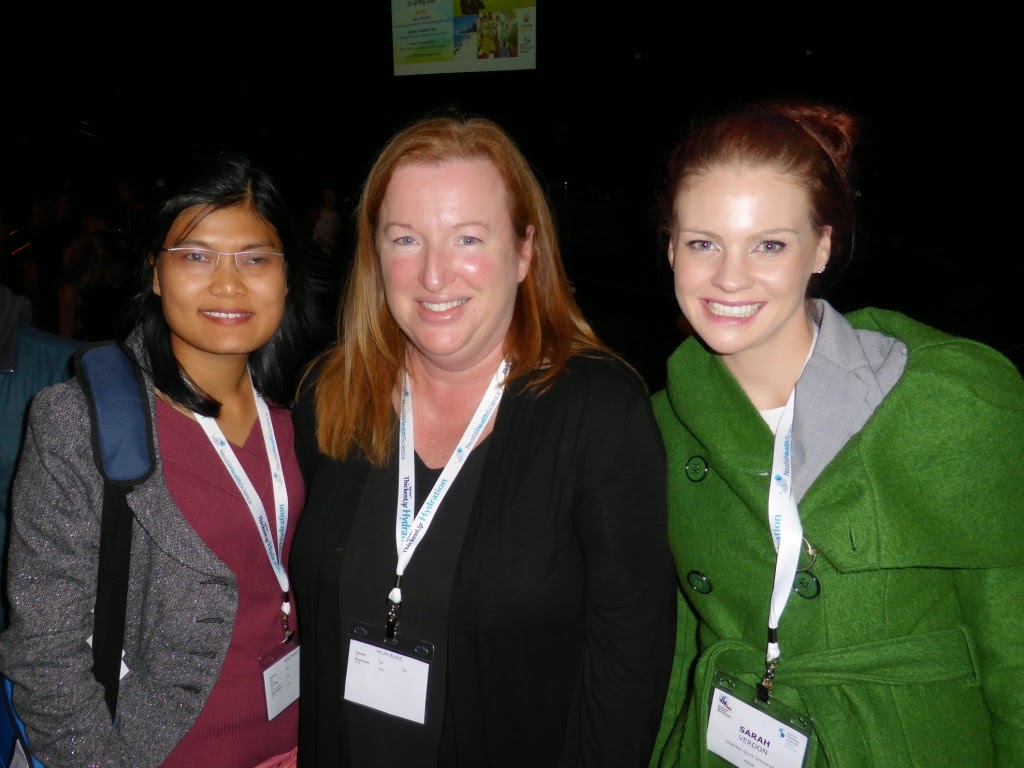
Current and past PhD students: Ben Pham, Helen Blake and Sarah Verdon
Xuan Le (visiting from Vietnam) and Ben Pham

Sound Start Study at Speech Pathology Australia National Conference

The Sound Start Study team presented a symposium at the Speech Pathology Australia National Conference this week in Canberra. It was well attended and we received great feedback from the delegates. Here are the presentation titles:

Baker, E., McLeod, S., Masso, S., Crowe, K., McCormack, J., Wren, Y., & Roulstone, S. (2015, May). Sound Start Study: The home literacy environment and print knowledge of preschool children with speech sound disorders.
Baker, E., McLeod, S., Masso, S., & Wren, Y. (2015, May). Sound Start Study: Dummies, bottles and thumb sucking in preschool children with speech sound disorders.
Crowe, K., Cumming, T., McCormack, J., McLeod, S. Wren, Y., &  Roulstone, S. (2015, May). Sound Start Study: Educators’ perceptions of supporting speech pathology intervention in preschools.
Masso, S., Baker, E., McLeod, S., McCormack, J., & Crowe, K. (2015, May). Polysyllable production in preschool-aged children with speech sound disorders.
McCormack, J., Baker, E., McLeod, S., Crowe, K., Masso, S., Wren, Y., & Roulstone, S. (2015, May). Sound Start Study: How do children with speech sound disorders feel about their talking?
McLeod, S., Baker, E., McCormack, J., Wren, Y., Roulstone, S., Crowe, K., & Masso, S. (2015, May). Sound Start Study: A community-based randomized controlled trial for preschoolers with speech sound disorders. 
McLeod, S., Crowe, K., White, P., Masso, S., Baker, E., McCormack, J., Wren, Y., & Roulstone, S. (2015, May). Sound Start Study: Preschool children’s speech and language is of concern for more parents and teachers than other aspects of development
Sharynne McLeod, Elise Baker, Kate Crowe, Jane McCormack
Sarah's poster presentation: Jane, Elise, Debbie James, Kate and Sharynne

May 18, 2015

Journal of Clinical Practice in Speech-Language Pathology (JCPSLP) Editor's Prize for 2014

At the Speech Pathology Australia National Conference, the article written by Kate Crowe and myself titled Communication choices: Translating research to practice for professionals working with children with hearing loss won the  Journal of Clinical Practice in Speech-Language Pathology (JCPSLP) Editor's Prize for 2014. The award was presented at the Speech Pathology Australia AGM on 18th May. This article translated Kate’s PhD research to a professional audience – so the award is not only for her article, but also for her outstanding PhD research.

Life Member of Speech Pathology Australia

I have been nominated to be transferred to Life Member of Speech Pathology Australia. Here is the letter I received:

It is with great pleasure that I am emailing to inform you of a successful nomination to transfer you to Life Membership of the Speech Pathology Association of Australia.
The Board of Speech Pathology Australia recognise the outstanding leadership and committed service to the Association and the profession that you have provided over many years. Therefore we would like to award you with the highest honour that we can provide; Life Membership of the Association.
Congratulations and thank you for your ongoing service to the Association and the profession in Australia and across the world.
Gaenor Dixon, Vice President, Communications, Speech Pathology Australia
The award was conferred at the Speech Pathology Australia Annual General Meeting in Canberra on 18th May. I hold the association and profession in such high esteem, and have been privileged to work with so many inspiring speech pathologists, teachers, children and families over the years.It is a great honour to receive this award.
The SPA Life Members are listed here.
My acceptance speech is reproduced here.
Lindy McAllister, Sharynne and David McLeod
Celebrating with my colleagues: Elise Baker, Jane McCormack, Sharynne McLeod,
Kate Crowe, Xuan Le, Sarah Verdon, Ben Pham, Lindy McAllister

May 9, 2015

European CPLOL conference in Florence, Italy

The European CPLOL conference was held in Florence, Italy on 8-9 May. There were 600 attendees from 4 continents representing more than 32 countries and 25 different languages. The keynote speakers included:
  • Dorothy Bishop (United Kingdom) Why do some children find language so hard to learn?
  • Virginia Volterra (Italy) From action to language: Recent theoretical perspectives and empirical evidence
  • Jois Stansfield (United Kingdom) Education, effective practice and ethics in speech and language therapy
I presented the following paper: McLeod, S. (2015, May). Intelligibility in Context Scale: A screening tool for multilingual children in 60 languages.
I enjoyed talking with colleagues from around the globe (including the Speech Fairy (Barbara May Bernhardt) and my Turkish friends Ilknur Mavis, Pinar Ege, Sharynne, Seyhun Topbas) and walking around this beautiful city.
CPLOL opening session
Sharynne with the Duomo in the Tuscan sunshine
Speech Fairy (May Bernhardt) and Sharynne at CPLOL
Turkish friends: Ilknur Mavis, Pinar Ege, Sharynne, Seyhun Topbas
CPLOL conference dinner at the Palazzo Borghese

Intelligibility in Context Scale at CPLOL in Florence, Italy

Research and translations of the Intelligibility in Context Scale continue to grow. While at the CPLOL conference in Florence, Italy I gave a presentation about the ICS. The presentation following mine was by Annick van Doornik-van der Zee from The Netherlands who has shown that if the ICS score is added to the PCC score it will explain between 61-74% of the variance of scores by preschool-aged children. The session was chaired by Thora Masdottir, the person who translated the ICS into Icelandic, and after the session colleagues from Portugal offered to translate the ICS into European Portuguese. 
Annick van Dorrnik-van der Zee (Netherlands), Thora Masdottir (Iceland),
Marisa Louasda, Ana Margarida Ramalho (Portugal), and Sharynne

May 5, 2015

Pursuit Award finalist

Sarah Verdon flew to Toronto, Canada to compete in the Pursuit Award for the best PhD in childhood disability. She came third, which was a fantastic achievement. Her PhD findings are summarized in this CSU news release titled early intervention must embrace diversity: http://news.csu.edu.au/latest-news/education/ripple/early-intervention-must-embrace-diversity,-research-shows

Important historical language icons

While in London I visited two important historical icons relating to written language:
  • Rosetta Stone at the British Museum
  • Shakespeare's Globe Theatre
The Rosetta Stone
Romeo and Juliet at the Globe

Board Meeting of the International Association of Logopedics and Phoniatrics, London, UK

The Board of the International Association of Logopedics and Phoniatrics (IALP) met for a 2-day meeting in London to discuss the issues of IALP and continue to plan for the IALP conference in Dublin in 2016. It was a collaborative meeting with colleagues from around the globe.We met at the Royal College of Speech and Language Therapists' head office at London Bridge, and were able to meet the CEO, chair and other key people within RCSLT over dinner.
IALP Board meeting in London (with Yvette Hyter via Skype)
Dinner with IALP and RCSLT
Sharynne at the RCSLT headquarters at London Bridge

April 24, 2015

Intelligibility in Context Scale: Normative and validation data for English-speaking preschoolers

The following article has been accepted for publication today:
McLeod, S. & Crowe, K. & Shahaeian, A. (2015, in press April). Intelligibility in Context Scale: Normative and validation data for English-speaking preschoolers. Language, Speech, and Hearing Services in Schools. 
Updated publication details: 
McLeod, S. & Crowe, K. & Shahaeian, A. (2015). Intelligibility inContext Scale: Normative and validation data for English-speaking preschoolers. Language, Speech, and Hearing Services in Schools, 46(3), 266-276. doi: 10.1044/2015_LSHSS-14-0120 
Here is the abstract:

Purpose: To describe normative and validation data on the Intelligibility in Context Scale (ICS, McLeod, Harrison, & McCormack, 2012a) for English-speaking children.
Method: The ICS is a seven item parent report measure of children’s speech intelligibility with a range of communicative partners. Data were collected from the parents of 803 Australian English-speaking children aged 4;0 to 5;5 (37.0% were multilingual).
Results: The mean ICS score was 4.4 (SD = 0.7) of a possible total score of 5. Children’s speech was reported to be most intelligible to their parent, followed by their immediate family, friends, and teachers, and least intelligible to strangers. The ICS had high internal consistency (α = .94). Significant differences in scores were identified based on sex and age, but not socioeconomic status (SES) or the number of languages spoken. There were significant differences in scores between children whose parents had concerns about their child’s speech (M = 3.9) and those who did not (M = 4.6). Sensitivity of .82 and specificity of .58 was established as the optimal cut-off. Test-retest reliability and criterion validity was established for 184 children with speech sound disorder. There was a significant low correlation between the ICS mean score and percentage of phonemes correct (PPC, r =.30), percentage of consonants correct (PCC, r =.24), and percentage of vowels correct (PVC, r =.30) on the Diagnostic Evaluation of Articulation and Phonology (Dodd et al., 2002). Thirty-one parents completed the ICS about English and another language spoken by their child with speech sound disorder. The significant correlations between the scores suggest that the ICS may be robust between languages.
Conclusion: This paper provides normative ICS data for English-speaking children and additional validation of the psychometric properties of the ICS. The robustness of the ICS was suggested since mean ICS scores were not affected by SES, number of languages spoken, or whether the ICS was completed about English or another language. The ICS is recommended as a screening measure of children’s speech intelligibility.