 |
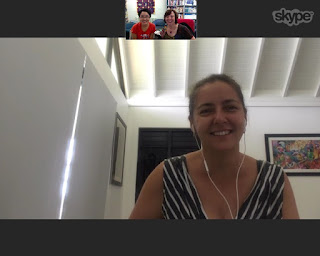
| Some of the Charles Sturt University SPH201 students with Dr Sarah Verdon and Professor Sharynne McLeod (Photo credit: Allan) |
March 9, 2017
Teaching the SPH201 students in Albury about children with speech sound disorders
Today I begged Dr Sarah Verdon to let me teach her SPH201: Speech sound disorders class at Charles Sturt University in Albury. The class is using our Children's Speech textbook, so this was the first time I was able to actually use the material from the textbook with an undergraduate class. The students were enthusiastic and I am looking forward to hearing from Sarah about their learning throughout the semester and their application of the material to children with speech sound disorders in their professional practice. The students also promised to send feedback on the book* (something that Elise and I are very happy to receive from anyone!).
*We did find one error in the Powerpoint slides that
accompany the book (a risk/protective factor is "having an older
sibling" not "being an older sibiling"

March 8, 2017
Academic Senate in Albury
I attended Charles Sturt University's Academic Senate today. I am an elected representative of the Professorial Forum. Today also was international women's day, and the contribution of women at CSU was acknowledged. In fact, CSU
is leading the sector in terms of the number of women in management roles. CSU
has 64% of female governors (9/14) (p. 26 of WomenCount: Australian Universities 2016).
March 7, 2017
Cluster randomized controlled trial evaluating the effectiveness of computer-assisted intervention delivered by educators for children with speech sound disorders
The following manuscript has been accepted for publication. It is the main outcomes paper from the Sound Start Study.
McLeod, S., Baker, E., McCormack, J., Wren, Y., Roulstone, S. Crowe, K., Masso, S., White, P., & Howland, C. (2017, in press). Cluster randomized controlled trial evaluating the effectiveness of computer-assisted intervention delivered by educators for children with speech sound disorders. Journal of Speech, Language, and Hearing Research.
We received extremely positive feedback from the editors and reviewers. For example, the associate editor wrote “The reviewers and I enthusiastically await the publication of this important article on delivering services to children with speech sound disorders.”
Here is the abstract:
McLeod, S., Baker, E., McCormack, J., Wren, Y., Roulstone, S. Crowe, K., Masso, S., White, P., & Howland, C. (2017, in press). Cluster randomized controlled trial evaluating the effectiveness of computer-assisted intervention delivered by educators for children with speech sound disorders. Journal of Speech, Language, and Hearing Research.
We received extremely positive feedback from the editors and reviewers. For example, the associate editor wrote “The reviewers and I enthusiastically await the publication of this important article on delivering services to children with speech sound disorders.”
Here is the abstract:
Purpose: To evaluate the effectiveness of computer-assisted input-based intervention for children with speech sound disorders (SSD).
Method: The Sound Start Study was a cluster randomized controlled trial. Seventy-nine early childhood centers were invited to participate, 45 were recruited, and 1,205 4- to 5-year-old children’s parents/educators returned questionnaires. Children whose parents/educators had concerns about speech were assessed (n=275); 132 children who were identified with phonological impairment of unknown origin underwent additional assessment. Children with SSD and no receptive language or hearing difficulties, typical non-verbal intelligence, and English as their primary language were eligible; 123 were randomized (Intervention n=65; Control n=58); 3 withdrew. Intervention involved Phoneme Factory Sound Sorter software administered by educators over 9 weeks; Control involved typical classroom practices. Participants were re-assessed twice by a speech-language pathologist (SLP) blinded to the initial assessment and intervention conditions.
Results: For the primary outcome variable (percentage of consonants correct), the significant mean change from pre- to post-intervention for the Intervention group (mean change+6.15, p<.001) was comparable in magnitude to the significant change for the Control group (mean change+5.43, p<.001) with a small between groups effect size for change (Cohen’s d=0.08). Similar results occurred for measures of emergent literacy, phonological processing, participation, and wellbeing.
Conclusion: Computer-assisted input-based intervention administered by educators did not result in greater improvement than typical classroom practices.
Polysyllable speech accuracy and predictors of later literacy development in preschool children with speech sound disorders
The following journal article
has been accepted for publication. It forms part of Sarah Masso’s PhD and uses
data from the Sound Start Study.
Masso, S., Baker, E., McLeod, S., & Wang, C. (2017, in press). Polysyllable speech accuracy and predictors of later literacy development in preschool children with speech sound disorders. Journal of Speech, Language, and Hearing Research.
Here is the abstract:
Masso, S., Baker, E., McLeod, S., & Wang, C. (2017, in press). Polysyllable speech accuracy and predictors of later literacy development in preschool children with speech sound disorders. Journal of Speech, Language, and Hearing Research.
Here is the abstract:
Purpose: The aim of this study was to determine if polysyllable accuracy in preschoolers with speech sound disorders (SSD) was related to known predictors of later literacy development; phonological processing, receptive vocabulary, and print knowledge. Polysyllables--words of three or more syllables--are important to consider as unlike monosyllables, polysyllables have been associated with phonological processing and literacy difficulties in school-age children. They therefore have the potential to help identify preschoolers most at risk of future literacy difficulties. Method: Participants were 93 preschool children with SSD from the Sound Start Study. Participants completed the Polysyllable Preschool Test (Baker, 2013) as well as phonological processing, receptive vocabulary, and print knowledge tasks. Results: Cluster analysis was completed and two clusters were identified: low polysyllable accuracy and moderate polysyllable accuracy. The clusters were significantly different based on two measures of phonological awareness and measures of receptive vocabulary, rapid naming, and digit span. The clusters were not significantly different on sound matching accuracy, letter/sound or print concept knowledge. Conclusions: The participants’ poor performance on print knowledge tasks suggested that as a group, they were at risk of literacy difficulties but that there was a cluster of participants at greater risk—those with both low polysyllable accuracy and poor phonological processing.
Analysing data from the Longitudinal Study of Indigenous Children in Canberra
This week Linda Harrison, Audrey Wang and I have been in Canberra visiting the Department of Social Services (DSS). We have been working with Fiona Skelton and Ana Sartbayeva who have been assisting us with the analysis of the Footprints in Time: Longitudinal Study of Indigenous Children database. Speech Pathology Australia have commissioned this research. We really appreciated the insights from Fiona and Ana to ensure our analysis and interpretation of the data is the best it can be in order to respect the children and families who have contributed these data.
 |
| Sharynne, Fiona, Ana, Linda and Audrey at DSS, Canberra |
March 6, 2017
Understanding children’s communication and educational needs using Australia’s longitudinal datasets
Today Linda Harrison, Audrey Wang and I presented an invited seminar at the Department of Social Services (DSS) in Canberra. The presentation was titled "Understanding children’s communication and educational needs using Australia’s longitudinal datasets". The audience included people from the National Centre for Longitudinal Data (DSS) and the Department of Prime Minister and Cabinet. The audience asked many questions and some asked for additional information following the presentation. It is great to see that our work is of relevance to members of the government who are responsible for developing policy.
Here is the abstract:
Here is the abstract:
The Australian Government has funded research to create longitudinal datasets that provide valuable insights into children’s communication and educational needs:
Researchers from Charles Sturt University have analysed these datasets, learning many valuable insights that have informed policy and practice. Insights to be profiled during the seminar, include:
- Growing up in Australia: Longitudinal Study of Australian Children (LSAC)
- Footprints in Time: Longitudinal Study of Australian Children (LSIC)
The profiled research has been funded by Australian Research Council Discovery and Future Fellowship grants and Speech Pathology Australia. Insights from Australian Government’s longitudinal datasets have been profiled in the national media, published in high profile international academic journals, and used to inform government submissions including:
- Indigenous Australian children spoke between one and eight languages including: English, Indigenous languages, creoles, foreign languages, and sign languages. Children who spoke an Indigenous language were more likely to live in moderate to extreme isolation.
- Multilingualism did not contribute to poorer educational and social-emotional outcomes at school.
- The main predictor of academic difficulties at school was concern about 4- to 5-year-old children’s speech and language (regardless of monolingual or multilingual status).
- Children with speech and language problems in early childhood achieved significantly lower scores on every NAPLAN test (reading, writing, spelling, grammar and numeracy) at years 3, 5 and 7 compared to students without these problems.
- Most children with speech and language problems had not seen a speech pathologist.
- Productivity Commission Inquiry into the Education Evidence Base (2016)
- Senate Education and Employment References Committee into Inquiry into the current levels of access and attainment of students with disabilities (2015)
- Senate Community Affairs References Committee into Prevalence of different types of speech, language and communication disorders and speech pathology in Australia (2014)
Implementation fidelity of a computer-assisted intervention for children with speech sound disorders
The following manuscript has been accepted for publication and is based on work from our Sound Start Study.
McCormack, J., Baker, E., Crowe, K., Masso, S., McLeod, S., Wren, Y., & Roulstone, S. (2017, in press). Implementation fidelity of a computer-assisted intervention for children with speech sound disorders. International Journal of Speech-Language Pathology. doi 10.1080/17549507.2017.1293160
Here is the abstract:
McCormack, J., Baker, E., Crowe, K., Masso, S., McLeod, S., Wren, Y., & Roulstone, S. (2017, in press). Implementation fidelity of a computer-assisted intervention for children with speech sound disorders. International Journal of Speech-Language Pathology. doi 10.1080/17549507.2017.1293160
Here is the abstract:
Early childhood educators are frequently called on to support preschool-aged children with speech sound disorders and to engage these children in activities that target their speech production. This study explored factors that acted as facilitators and/or barriers to the provision of computer-based support for children with SSD in early childhood centres. Participants were 23 early childhood educators at 13 centres who participated in the Sound Start Study, a randomised controlled trial that examined the effectiveness of the Phoneme Factory Sound Sorter (PFSS) computer program (Wren & Roulstone, 2013). Following the trial, participants completed a telephone interview discussing their experiences implementing the program. Transcripts from the interviews were analysed and three categories emerged as factors that influenced the provision of support: (a) Personal factors that related to the children (engagement with PFSS, inclusion/exclusion experience), peers, and educators (service provision, educator engagement, and support of child PFSS use); (b) Environmental factors that related to policies and philosophies (child-centred practice, technology), the physical environment (inclusion/exclusion), and logistics (time, technology); and (c) Program factors that related specifically to PFSS (program format, specific games, game duration). In order to best meet the needs of children, parents, educators, and clinicians, these factors need to be taken into consideration in the provision of speech and language therapy services in early childhood centres.
March 4, 2017
Children with speech sound disorders at school: Challenges for children, parents and teachers
The following journal article has been accepted for publication:
Daniel, G. R. & McLeod, S. (2017, in press). Children with speech sound disorders at school: Challenges for children, parents and teachers. Australian Journal of Teacher Education.
It is available here: http://ro.ecu.edu.au/ajte/vol42/iss2/6
Here is the abstract:
Daniel, G. R. & McLeod, S. (2017, in press). Children with speech sound disorders at school: Challenges for children, parents and teachers. Australian Journal of Teacher Education.
It is available here: http://ro.ecu.edu.au/ajte/vol42/iss2/6
Here is the abstract:
Teachers play a major role in supporting children’s educational, social, and emotional development although may be unprepared for supporting children with speech sound disorders. Interviews with 34 participants including six focus children, their parents, siblings, friends, teachers and other significant adults in their lives highlighted challenges for these children in school, and challenges for their parents and teachers in meeting these children’s developmental and educational needs. These challenges were centred on the need for specific expertise in the school setting, and access to additional classroom and professional services to support these students’ engagement in the learning and social environments of school. This research identifies frustrations that impact these families and teachers as they attempt to navigate the bureaucracies to which they are beholden.
March 3, 2017
2017 PhD students and post docs
In 2017 I am working with an amazing team:
CSU PhD students:

CSU PhD students:
- Suzanne Hopf
- Ben Pham
- Helen Blake
- Anna Cronin
- Nicole McGill (nee Limbrick)
- Natalie Hegarty (Ulster University, Northern Ireland)
- Anniek van Doornik-van der Zee (University of Utrecht, The Netherlands)
March 2, 2017
The effect of oral English proficiency on humanitarian migrants’ experiences of settling in Australia
The
following manuscript has been accepted for publication.
Blake, H. L., Bennetts Kneebone, L. & McLeod, S. (2017, in press). The effect of oral English proficiency on humanitarian migrants’ experiences of settling in Australia. International Journal of Bilingual Education and Bilingualism. doi: 10.1080/13670050.2017.1294557
It can be downloaded for free from here: http://www.tandfonline.com/eprint/SCMzCTEsAucbwEzRtjDi/full
Here is the abstract:
Blake, H. L., Bennetts Kneebone, L. & McLeod, S. (2017, in press). The effect of oral English proficiency on humanitarian migrants’ experiences of settling in Australia. International Journal of Bilingual Education and Bilingualism. doi: 10.1080/13670050.2017.1294557
It can be downloaded for free from here: http://www.tandfonline.com/eprint/SCMzCTEsAucbwEzRtjDi/full
Here is the abstract:
Key drivers for migrants’ social integration are education, employment, and skills in the dominant language of the settlement country. Data from Building a New Life in Australia: The Longitudinal Study of Humanitarian Migrants were used to examine migrants’ English proficiency and how oral English proficiency facilitated or hindered participation in activities that may help them become self-sufficient and settle. Participants were 2399 humanitarian migrants interviewed in the first wave of data collection (during 2013/14). Before arrival in Australia, 80.1% reported they spoke English not well or not at all. After arrival, oral English proficiency was a statistically significant predictor of self-sufficiency (knowing how to look for a job, get help in an emergency, etc.) explaining 21% of the variance while controlling for confounding variables such as age and education. After English proficiency, age (neither too young nor too old), gender (male), education (more than 12 years), and time since arrival (more than one year) were significant predictors of self-sufficiency. Identification of factors that predict self-sufficiency informs the understanding of people who provide support for humanitarian migrants. These findings indicate poor oral English skills may profoundly hinder humanitarian migrants’ ability to settle and highlight the importance of supporting migrants’ English learning.
March 1, 2017
Cowra Speech, Language and Literacy Summit
 Last night Sarah McDonagh and I presented at the Cowra Speech, Language and Literacy Summit. Our presentations were titled "The road to children's speech, language and reading success". It was very well attended by educators, parents and health professionals from across the region (including Cowra, Dubbo, Grenfell and Canowindra).
A holiday in Spain
During February I had the most wonderful time exploring Spain with my family. What a diverse, colourful, creative, innovative, and friendly country. I look forward to visiting again as soon as possible.


February 1, 2017
Digital tools to support children’s speech and language skill
The following book chapter has been accepted for publication. It is based on work from the Sound Start Study.
Wren, Y., McCormack, J., Masso, S., McLeod, S., Baker, E. & Crowe, K. (in press). Digital tools to support children’s speech and language skill. In S. Danby, M. Fleer, C. Davidson & M. Hatzigianni (Eds). Digital childhoods: Technologies in children’s everyday lives. Dordrecht, Germany: Springer.
Here is the abstract
Wren, Y., McCormack, J., Masso, S., McLeod, S., Baker, E. & Crowe, K. (in press). Digital tools to support children’s speech and language skill. In S. Danby, M. Fleer, C. Davidson & M. Hatzigianni (Eds). Digital childhoods: Technologies in children’s everyday lives. Dordrecht, Germany: Springer.
Here is the abstract
Most children develop speech and language with ease and quickly become sophisticated communicators. For some children however, these skills are acquired with difficulty and extra support is required. A range of digital tools are available to assist with this: some of these are based on theories of speech and language acquisition while others have been developed in response to market demands. Few empirical studies of digital tools for speech and language development have been carried out though some success has been noted when facilitated by a speech-language pathologist (SLP). Given the interactional capabilities of digital tools, it would be helpful to identify whether they could achieve similar results independent of SLP support. One such tool, Phoneme Factory Sound Sorter®, was tested in a randomised controlled trial with early childhood educators delivering the intervention. Improvement in speech production varied across both groups and significant differences were not observed. However, supplementary investigations found that parents’ and educators’ were positive towards the use of digital tools and findings relating to the implementation of the intervention have been identified, which provide useful information for settings looking to use digital tools to promote speech and language skills in children.
January 31, 2017
Communication disability in Fiji: Community cultural beliefs and attitudes
The following manuscript has just been accepted for publication:
Hopf, S. C., McLeod, S., McDonagh, S., & Rakanace, E. (2017, in press). Communication disability in Fiji: Community cultural beliefs and attitudes. Disability, CBR and Inclusive Development.
Here is the abstract:
Hopf, S. C., McLeod, S., McDonagh, S., & Rakanace, E. (2017, in press). Communication disability in Fiji: Community cultural beliefs and attitudes. Disability, CBR and Inclusive Development.
Here is the abstract:
Aim: Beliefs about communication disability vary according to cultural context and influence people’s attitudes and help-seeking behaviour. Little is known about Fijians with communication disability or the communities in which they live. Fijian specialist services for people with communication disability are yet to be established. Understanding Fijian beliefs about the causes of communication disability and people’s attitudes to people with communication disability may inform future service development.
Methods: An interpretivist qualitative research paradigm and the International Classification of Functioning, Disability and Health (ICF) framework informed this project’s design. Scenarios of adults and children with communication disability were presented to 144 participants, randomly sampled across multiple public spaces in two Fiji cities. Thematic analysis of responses to 15 survey questions revealed participant beliefs about the cause and attitudes towards people with communication disability.
Results: Three clusters describing perceived causes emerged from the analysis: internal, external, and supernatural. Major clusters across child and adult scenarios were similar; however, response categories within the scenarios differed. Community attitudes to people with communication disability were predominantly negative. These community attitudes influenced individual participants’ beliefs about educational and employment opportunities for Fijians with communication disability.
Conclusion: Determination and acknowledgement of individuals’ belief systems informs development of culturally appropriate intervention programs and health promotion activities.
January 30, 2017
Speech sound disorders in preschool children: Correspondence between clinical diagnosis and teacher and parent report
The following manuscript has been accepted for publication
Harrison, L. J., McLeod, S., McAllister, L. & McCormack, J. (2017, in press). Speech sound disorders in preschool children: Correspondence between clinical diagnosis and teacher and parent report. Australian Journal of Learning Difficulties.
It can be downloaded from here: http://www.tandfonline.com/eprint/iPDGd535UzszBgMVkcaT/full
Here is the abstract:
Harrison, L. J., McLeod, S., McAllister, L. & McCormack, J. (2017, in press). Speech sound disorders in preschool children: Correspondence between clinical diagnosis and teacher and parent report. Australian Journal of Learning Difficulties.
It can be downloaded from here: http://www.tandfonline.com/eprint/iPDGd535UzszBgMVkcaT/full
Here is the abstract:
This study sought to assess the level of correspondence between parent and teacher report of concern about young children’s speech and specialist assessment of speech sound disorders (SSD). A sample of 157 children aged 4 to 5 years was recruited in preschools and long day care centres in Victoria and New South Wales (NSW). SSD was assessed independently by: (1) clinical diagnosis by a speech-language pathologist (SLP) using the Diagnostic Evaluation of Articulation and Phonology (DEAP); (2) parent-reported concern using the Parent Evaluation of Developmental Status (PEDS); (3) teacher-reported concern using the PEDS. Agreement between parent identification of SSD and clinical assessment was high (86 to 90%). Agreement between teacher identification and clinical assessment was lower, and varied by state (Victoria 80%; NSW 63%). Differences in the accuracy of early childhood teachers’ identification of SSD are considered in relation to early childhood policies regarding the provision of speech-language pathology services in preschool settings.
January 23, 2017
Profile of Australian preschool children with speech sound disorders at risk for literacy difficulties
The following manuscript from the Sound Start Study has been accepted for publication.
McLeod, S., Crowe, K., Masso, S., Baker, E., McCormack, J., Wren, Y., Roulstone, S., & Howland, C. (2017, in press). Profile of Australian preschoolers with speech sound disorders at risk for literacy difficulties. Australian Journal of Learning Difficulties.
Free downloads are available here: http://www.tandfonline.com/eprint/nG6yIncSNjw93ivSJ6ea/full
Here is the abstract
McLeod, S., Crowe, K., Masso, S., Baker, E., McCormack, J., Wren, Y., Roulstone, S., & Howland, C. (2017, in press). Profile of Australian preschoolers with speech sound disorders at risk for literacy difficulties. Australian Journal of Learning Difficulties.
Free downloads are available here: http://www.tandfonline.com/eprint/nG6yIncSNjw93ivSJ6ea/full
Here is the abstract
Background: Speech sound disorders are a common communication difficulty in preschool children. Teachers indicate difficulty identifying and supporting these children.
Aim: To describe speech and language characteristics of children identified by their parents and/or teachers as having possible communication concerns.
Method: 275 Australian 4- to 5-year-old children from 45 preschools whose parents and teachers were concerned about their talking participated in speech-language pathology assessments to examine speech, language, literacy, non-verbal intelligence, oromotor skills and hearing.
Results: The majority (71.3%) of children demonstrated lower consonant accuracy than expected for their age, 63.9% did not pass the language-screening task, 65.5% had not been assessed and 72.4% had not received intervention from a speech-language pathologist. The 132 children who were identified with speech sound disorder (phonological impairment) were more likely to be male (62.9%) who were unintelligible to unfamiliar listeners, and had poor emergent literacy and phonological processing skills, despite having typical hearing, oral structures, and intelligence.
Conclusion: Children identified by parents and teachers with concerns may have a range of speech, language and communication needs requiring professional support.
January 22, 2017
Intelligibility in Context Scale research
Over the past few years validation and norming research has been undertaken for the Intelligibility in Context Scale. Here is some of the published work (not including the theses):
A paper that discusses intelligibility and include the ICS
- Hopf, S. C., McLeod, S. & McDonagh, S. (2016, in press). Validation of the Intelligibility in Context Scale for school students in Fiji. Clinical Linguistics and Phonetics. http://www.tandfonline.com/eprint/nQPvhBmVCa9MCaZ7nvUj/full
- Kim, J.-H., Ballard, E., & McCann, C. M. (2016). Parent-rated measures of bilingual children's speech accuracy: Implications for a universal speech screen. International Journal of Speech-Language Pathology, 18(2), 202-211. doi: 10.3109/17549507.2015.1081284 http://www.tandfonline.com/doi/full/10.3109/17549507.2015.1081284?src=recsys
- Kogovšek, D., & Ozbič, M. (2013). Lestvica razumljivosti govora v vsakdanjem življenju: slovenščina. Komunikacija, 2(3), 28-34.
- McLeod, S., Crowe, K., & Shahaeian, A. (2015). Intelligibility in Context Scale: Normative and validation data for English-speaking preschoolers. Language, Speech, and Hearing Services in Schools, 46(3), 266-276. doi: 10.1044/2015_LSHSS-14-0120
- McLeod, S. (2015). Intelligibility in Context Scale: A parent-report screening tool translated into 60 languages. Journal of Clinical Practice in Speech-Language Pathology, 17(1), 7-12.
- McLeod, S., Harrison, L. J., & McCormack, J. (2012). Intelligibility in Context Scale: Validity and reliability of a subjective rating measure. Journal of Speech, Language, and Hearing Research, 55(2), 648-656. doi: 10.1044/1092-4388(2011/10-0130)
- Neumann, S., Rietz, C., & Stenneken, P. (2016, in press). The German Intelligibility in Context Scale (ICS-G): Reliability and validity evidence. International Journal of Language and Communication Disorders. http://onlinelibrary.wiley.com/wol1/doi/10.1111/1460-6984.12303/abstract
- Ng, K., To, C. K. S. McLeod, S., (2014). Validation of the Intelligibility in Context Scale as a screening tool for preschoolers in Hong Kong. Clinical Linguistics and Phonetics, 28(5), 316-328. http://www.tandfonline.com/doi/full/10.3109/02699206.2013.865789
- Pascoe, M. & McLeod, S. (2016). Cross-cultural adaptation of the Intelligibility in Context Scale for South Africa. Child Language Teaching and Therapy, 32(3), 327-343. doi:10.1177/0265659016638395
- Phạm, B, McLeod, S. & Harrison, L. J. (2016). Validation and norming of the Intelligibility in Context Scale in Northern Viet Nam. Manuscript in submission.
- Tomić, D. & Mildner, V. (2014, June). Validation of Croatian Intelligibility in Context Scale. Poster presented at International Clinical Phonetics and Linguistics Association Symposium, Stockholm, Sweden.
- Washington, K. N., McDonald, M. M., McLeod, S., Crowe, K., Devonish, H. (2016, in press). Validation of the Intelligibility in Context Scale for Jamaican Creole-speaking preschoolers. American Journal of Speech-Language Pathology.
A paper that discusses intelligibility and include the ICS
- Miller, N. (2013). Measuring up to speech intelligibility. International Journal of Language and Communication Disorders, 48(6), 601-612. doi: 10.1111/1460-6984.12061
January 21, 2017
Busy January
It is summertime in Australia, so my students and I have been on holidays. Even though we have only been back on deck for a short while we have submitted revisions to journal articles, invited encyclopedia entries, abstracts for conferences, and are working on a grant submission. Ben has been teaching in the speech pathology program at Pham Ngoc Thach University in Ho Chi Minh City. Kate has been working hard in the US on her Fulbright fellowship in the snow. We are a busy and productive group. I am looking forward to taking a little more leave in February before getting back to work in March.
 | |
| Summer in Australia |
 |
| Winter in the US - where Kate Crowe is on her Fulbright fellowship |
January 9, 2017
Suzanne Churcher's Churchill Trust Report has been published
In August 2016, Suzanne Churcher visited my colleagues and I at Charles Sturt University as part of her Winston Churchill Memorial Trust Fellowship. Her project was titled "Early intervention for speech disorder not just desirable but essential". Details of her visit are here.
Her report from the visit has just been published here: http://www.wcmt.org.uk/users/suzannechurcher2016. Here is a quote from page 9 of the report
Her report from the visit has just been published here: http://www.wcmt.org.uk/users/suzannechurcher2016. Here is a quote from page 9 of the report
Headlines
Recommendations
- There was ubiquitous agreement that the age of the child was not a primary factor in the clinical decision making process, with regard to exclusion of target of intervention.
- Like the UK, Australia sometimes has to respond to resource demands and pressures but this is not due to evidence of ineffectiveness in this age group.
- There is evidence that both Australia and the UK respond to need using approaches that may have similar theoretical underpinning. This needs further investigation and research.
- Australia is using a wider range of evidence based interventions with children of all ages than both my experience and the current research would suggest.
- SLPs in Australia reported regular easier access to research. They have three professional publications; SpeakOUT, the Journal of Clinical Practice in Speech-Language Pathology (JCPSLP) and the International Journal of Speech-Language Pathology (IJSLP) and online access to full articles.
- It is vital that we ensure that service development does not exclude children from intervention based on a lack of empirical data.
- Intervention for speech in the preschool population requires continued development of an evidence base.
- We must continue to strengthen our more systematic approach to the assessment and intervention of children with SLCN (speech, language and communication needs).
- The profession as a whole will benefit from international collaboration and the development of EBP (evidence-based practice) across the age ranges and, on occasion, disciplines.
- Increased collaboration between universities and practicing clinicians is highly recommended.
January 5, 2017
First publication for 2017
Congratulations to Suzanne Hopf on our first publication of the year:
Hopf, S. C., McLeod, S., & McDonagh, S. H. (2017). Fiji school children’s multilingual language choices when talking with friends. In M. Theobald (Ed.). Friendship and peer culture in multilingual settings. Sociological studies of children and youth (Vol. 22) (pp. 55-88). Bingley, UK: Emerald.
It can be downloaded here: http://www.emeraldinsight.com/doi/full/10.1108/S1537-466120160000021005
Here is the abstract
Hopf, S. C., McLeod, S., & McDonagh, S. H. (2017). Fiji school children’s multilingual language choices when talking with friends. In M. Theobald (Ed.). Friendship and peer culture in multilingual settings. Sociological studies of children and youth (Vol. 22) (pp. 55-88). Bingley, UK: Emerald.
It can be downloaded here: http://www.emeraldinsight.com/doi/full/10.1108/S1537-466120160000021005
Here is the abstract
Purpose
Fiji is a multicultural and linguistically multi-competent country. Historical ethnic divisions have socialised students into language friendships based around common languages. Recent changes to educational policy, specifically the mandating of students learning all three of the Standard languages of Fiji (Fijian, Hindi, and English), have been introduced in hope that cross-linguistic understanding will encourage a greater sense of national identity amongst all Fijians regardless of ethnicity. This study explores one multilingual school environment considering students’ language use, attitudes and friendships in light of these policies.
Methodology/approach
A convergent mixed-methods research design using surveying, artefact collection, students’ drawing and observation was employed.
Findings
The majority of students reported some proficiency in the language of their inter-ethnic peers; however, students’ inter-ethnic friendships predominantly relied on English language use. It was observed that most friendships amongst these Fijian primary school students were still established according to main language use at home; however, inter-ethnic peer interaction in English was observed to be friendly and respectful. These language use patterns and friendship behaviours were potentially reinforced by individual and societal multilingualism, in addition to the school environment.
Originality/value
The chapter presents the first research linking Fijian primary school students’ language choices and friendship development.
Subscribe to:
Posts (Atom)