CSU's news story is here: https://news.csu.edu.au/latest-news/high-achiever-lines-up-for-prime-ministers-life-science-prize
 |
| Dr Sarah Verdon |
|
| Dr Sarah Verdon |

 |
| Van Tran, Sharynne and Kate Margetson using the VSA and DEAP speech assessments |


 |
| Helen Blake and Sharynne McLeod at UTS |
 |
| Joan Rosenthal and Sharynne |
 |
| Prof Mark Onslow and Sharynne at the Australian Stuttering Research Centre, University of Technology Sydney |
 |
| UTS Speech Pathology Staff Back: Helen Blake, Melissa Brunner, Catherine Gregory, Harmony Turnbull Front: Lucy Bryant, Ben, Sharynne McLeod, Bronwyn Hemsley |


Communication specialists rely on data that document children’s typical speech and language development when diagnosing and treating speech and language disorders in children. In many South Pacific nations there are no recognised communication specialists or recognised tools to assist with this process (e.g., Fiji – see Hopf, 2013; 2017). Thus, suspected diagnoses are mostly based on implicit language knowledge within communities. Tools that can assist with early diagnosis and treatment of communication disability are needed to support communication specialists working with children from language groups other than their own. In alignment with the aims of the 2019 UNESCO International Year of Indigenous Languages (IY2019), this ambitious project will bring together speakers of Pacific Islands indigenous languages, and communication specialists from around the world, to create consensus functional word lists for indigenous languages of the South Pacific nations of Fiji, Tonga, Samoa, and Vanuatu. Significantly, this project will capitalise on a network of communication specialists who will work together beyond the stated languages to continue to document functional word lists in all of the indigenous and immigrant languages of the South Pacific. These word lists will be invaluable for communication specialists working both within and outside the South Pacific with people with communication disability who speak these languages.


 |
| Sharynne and Nicole McGill in the Begonia House, Machattie Park, Bathurst |
 |
| Professor Linda Sheilds and Sharynne |
 |
| Dr Tamara Cumming |
 |
| Nicole and Audrey working on SPSS |
 |
| Nicole, Sharynne, and Audrey discussing variables and outliers in the research data |
 |
| Sharynne McLeod, Angela Roberts, Emily Davis, Sally Thornton, Nina Ahio, Kate Miller, Katrina Rohr, Nicole McGill |
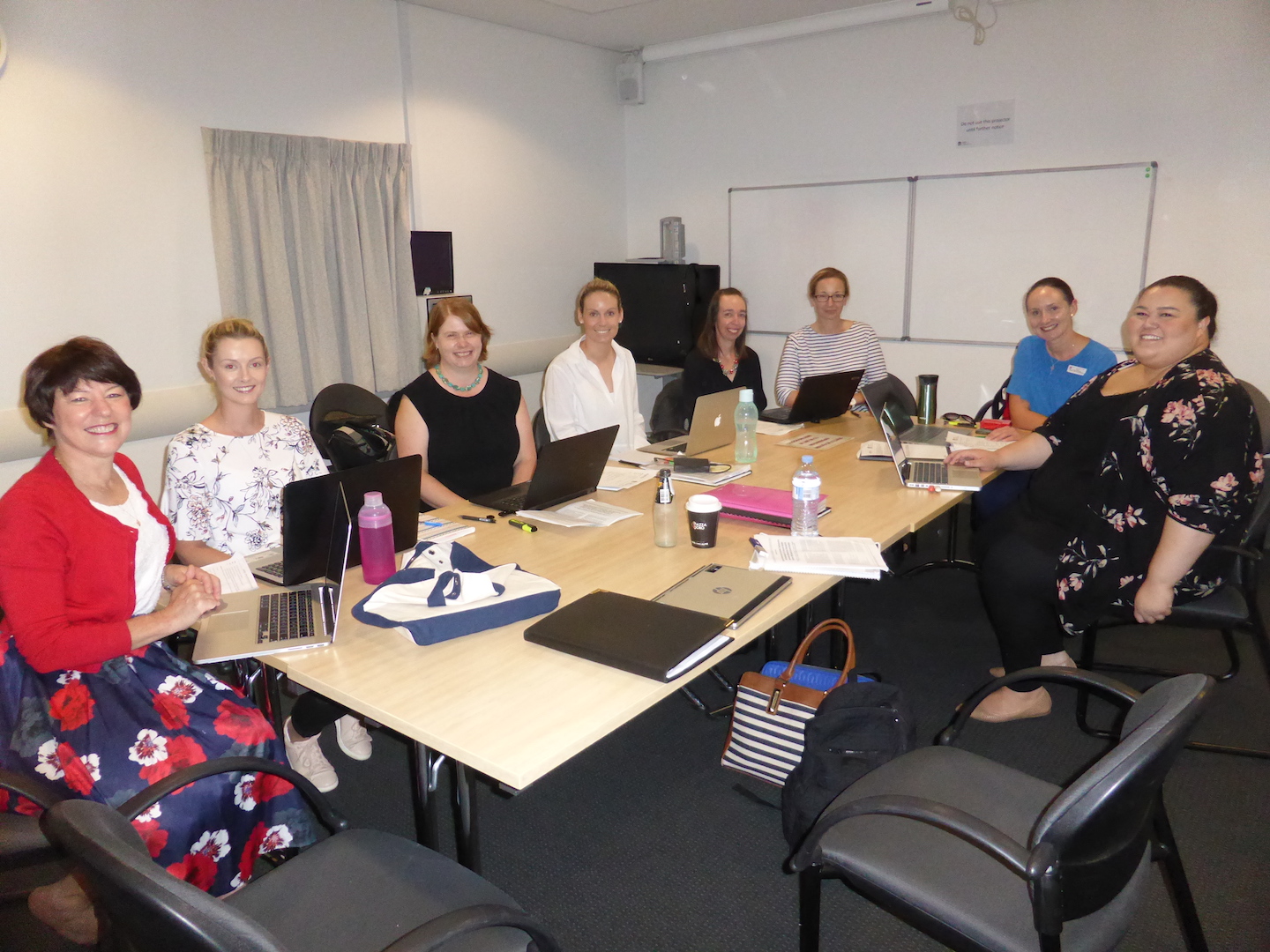 |
| Sharynne, Nicole, Emily, Kate, Angela, Sally, Katrina, and Nina hard at work |

 |
| Dr Van Tran, Prof Sharynne McLeod, Dr Audrey Wang at CSU (it is quiet because it is the week before the students return) |
 |
| Van in the Begonia House in Machattie Park |
Multilingual speakers’ ability to communicate effectively and intelligibly in the language of their country of residence is crucial to their participation. This study explored multilingual speakers’ motivations for improving their intelligibility in English and their perceptions of potential barriers and facilitators to enhancing intelligibility. Participants were multilingual students and staff at 14 Australian universities. Extended response data from 137 survey responses were combined with seven semi-structured interviews, thematically analysed using the World Health Organization’s International Classification of Functioning, Disability and Health as a conceptual framework, and coded using NVivo software. Three overarching themes were: motivations, barriers, and facilitators. Themes that emerged under motivations were meeting their own and others’ expectations and career aspirations. Themes that emerged under barriers to intelligibility were lack of self-awareness of reduced English intelligibility, use of ineffective strategies (e.g., fast speech rate to disguise pronunciation difficulties), language differences, lack of opportunity to practise English, participants’ perceptions of others’ negative attitudes to their English skills, and challenging conversational partners. Facilitators to intelligibility were emotional support from others, beneficial strategies (e.g., confirming listener understanding), and opportunities to practice. The results highlight the importance of supporting multilingual speakers’ efforts to improve their English intelligibility. An environment with barriers such as lack of opportunity to practise English may restrict an individuals’ performance and participation, while facilitators such as support from others may increase participation. This study will inform the understanding of speech-language pathologists engaged in Intelligibility Enhancement, as well as SLPs working with multilingual speakers in any context.
"Altmetric has tracked 12,465,602 research outputs across all sources so far. Compared to these this one has done particularly well and is in the 99th percentile: it's in the top 5% of all research outputs ever tracked by Altmetric."
 |
| Kate Margetson (with Dr Audrey Wang and Prof Sharynne McLeod) |