October 22, 2010

Infants' Lives in Childcare

Over the past 2 days the research team from the Infants' Lives in Childcare Project (funded by an Australian Research Council Linkage Grant 2008-2011) met to discuss the data collected so far, to plan publications and the final stage of the project. It was a productive time and great to work with the team who are located in different sites throughout New South Wales. We are using a mosaic approach to analyse data from a range of sources and perspectives including: babycam, video, photographs from older children, MacArthur-Bates Communicative Development Inventories, time use diaries and temperament questionnaires.

Infants' Lives in Childcare team:
L-R Linda Harrison, Tina Stratigos, Sheena Elwick, Sharynne,
Fran Press, Ben Bradley, Joy Goodfellow


October 7, 2010

Perspectives on Global Issues in Communication Sciences and Related Disorders

I have been invited to be an inaugural editorial board member of Perspectives on Global Issues in Communication Sciences and Related Disorders. The American Speech-Language-Hearing Association have created a new special interest division called Global Issues in Communication Sciences and Related Disorders, and this journal is part of the membership benefits after joining the special interest division.
Sharynne and Prof. Dolores Battle

"It is the mission of the Division on Global Issues in Communication Sciences and Related Disorders to provide international leadership related to audiology and speech-language pathology services by promoting research, networking, collaboration, education, and mentoring for its affiliates, students, and other service providers in the global marketplace."

October 4, 2010

The extent and experience of living with childhood speech impairment

On Friday 1st October, Jane McCormack submitted her PhD titled "The extent and experience of living with childhood speech impairment" Congratulations Jane! It has been a pleasure supervising her PhD along with Lindy McAllister and Linda Harrison. Her PhD comprises 9 journal articles that have been published, or submitted to national and international journals. She was awarded the prestigous Sir Robert Menzies Memorial Research Scholarship in the Allied Health Sciences to complete her studies.

Jane McCormack receiving the Menzies Foundation Allied Health Scholarship

Her abstract is as follows:
"Communication impairment is a high prevalence condition in preschool children, and speech impairment (also called articulation/phonological/speech sound disorder) is one of the most common forms of communication impairment among this age group. Early intervention is recommended for children with speech impairment due to growing awareness of the potential long-term consequences of unresolved speech impairment (e.g., poorer school achievement, unemployment).
Intervention for speech impairment has traditionally focused on correcting children’s production of sounds/words, which may not address the full impact of speech impairment on a child’s life, or the priorities of the child and family. In recent years there has been a shift to consider health (including communication) in a more holistic manner, with the development of the International Classification of Functioning, Disability and Health (ICF; World Health Organization (WHO), 2001) and the ICF-Children and Youth version (ICF-CY; WHO, 2007). There has also been a shift to incorporate the views of clients (children and adults) in health intervention. In particular, the United Nations Convention on the Rights of the Child (UNCROC; UNICEF, 1989) stipulated the rights of children to express their views in all matters affecting them. Both the ICF-CY and the UNCROC have been recommended by speech-language pathology professional associations as important considerations to guide speech-language pathology research and practice.

To date, no studies have investigated the views of individuals with speech impairment regarding their experience of the impairment and the association between the impairment and limitations to life activities. The research undertaken through this doctoral research aimed to develop an understanding of childhood speech impairment as perceived by those who experience speech impairment and their communication partners. Specifically, the research aimed to fulfil two objectives: 1) to investigate the link between childhood speech impairment and limitations to life activities, and 2) to describe the experience of living with childhood speech impairment. In order to fulfil these objectives, a series of reviews and research studies were conducted, the results of which have been published (or submitted for publication) in Australia and internationally.
This doctoral research contains nine papers which present the reviews and research studies. The three review papers provide information about: (1) the prevalence of communication impairment in Australian children, (2) the theoretical framework used to guide the research (the ICF and ICF-CY), and (3) the application of the ICF-CY to children with speech impairment. The six subsequent research papers have unique aims and methodologies; however, all use the ICF and ICF-CY as a theoretical lens to provide an overarching perspective.
The first three research papers investigate the link between speech impairment and limitations to life activities: (1) a systematic review of 57 research studies, (2) analysis of parents’ (n=86) and SLPs’ (n=205) responses to questionnaires about the impact of speech impairment on life activities and participation, and (3) analysis of child, parent and teacher reports gathered (and made available to the researcher) in the nationally representative Longitudinal Study of Australian Children (n=4,329). In these three research studies, activities limited by speech impairment extend beyond communication-based activities, and include interpersonal interactions (e.g., relating to persons in authority, informal relationships with friends/peers, parent-child relationships, sibling relationships), learning activities (reading, writing, attention and thinking, calculating), and handling stress and other psychosocial demands. Furthermore, the difficulties associated with childhood speech impairment extend beyond early childhood into the school years and later.
The experience of living with childhood speech impairment is investigated through three additional research studies: (1) a meaning-making analysis of children’s drawings (n=13), (2) a phenomenological analysis of interviews conducted with preschool children (n=13) and their families (n=21), and (3) a phenomenological analysis of two young adults with a history of childhood speech impairment and their mothers. Again, difficulty with speech is not the only difficulty identified, nor is it always the priority for intervention. Children and their families recognise difficulties with communication relate to the speech skills of the child, but also to the ability of communication partners to understand the child’s message, and frustration resulting from communication breakdowns. Individuals with speech impairment and their mothers reveal the difficulties associated with speech impairment continue throughout the lifespan, affecting social interactions, academic skills, and career progression for individuals and causing distress, isolation or guilt for parents.
This doctoral research expands current understanding of the extent and experience of childhood speech impairment across the lifespan, and reveals the unique and valuable insights about speech impairment that children and their families provide. As a series of papers, this research forms a body of evidence that could be drawn upon by policy-makers, speech-language pathologists, and educators to provide direction for timely and holistic intervention services for individuals with speech impairment and their families."

Research and higher degree students

One of the priviledges of my job is working with my research and higher degree students.
Last week:
  • Jane McCormack submitted her PhD (see next post).
  • 
    Kate working on her PhD
    
  • Kate Crowe worked in Bathurst and developed her PhD research methodology to examine professionals' and parents' decision-making regarding whether children with hearing loss choose to sign, or speak, and if they do speak, do they speak one or more languages.
  • Jacqui Barr worked on her PhD analysing interview data collected from children who are siblings of children with disabilities.
  • Karla Washington finished her postdoctoral fellowship and is writing up her research. Last week we were working on a paper about parents' perspectives of speech and language intervention

September 22, 2010

Victorian Department of Education and Early Childhood Development Speech Pathology Conference

I presented a 2-day workshop at the Victorian Department of Education and Early Childhood Development Speech Pathology Conference held at LaTrobe University, Melbourne on Monday 20th and Tuesday 21st September, 2010. There were 80 participants who worked in schools across Victoria. Here is the abstract:

Speech impairment in childhood is a high prevalence condition and can have a significant impact into adulthood. This 2-day workshop will provide an update about speech production, assessment, intervention, and evidence-based practice. The workshop will include a summary of the world’s research on the prevalence of childhood speech impairment and a comparison of this prevalence with other areas of learning need in childhood. The impact of childhood speech impairment will be examined from the perspectives of children, their siblings, parents, speech pathologists, and teachers. The workshops will also provide an overview of over 250 studies of speech acquisition in 24 languages (including English).
Sharynne with conference organizers
Kim Murrie and Leanne Pollock

September 16, 2010

Conversing with the world

Avril Nicoll, editor of Speech and Language Therapy in Practice has written an article about my Future Fellowship travels during 2010. Speech and Language Therapy in Practice is a UK-based publication for speech and language therapists:
Read the article

She has also written a blog entry about my workshop in Bristol:
Read Avril's blog entry

September 9, 2010

Experiencing language through the eyes of an outsider

One important aspect of my recent travels has been to put myself into the shoes of people who move to Australia who do not speak English. Bill Bryson’s quote below sums up some of my own feelings of bewilderment and joy.

“When I told friends in London that I was going to travel around Europe and write a book about it, they said. “Oh, you must speak a lot of languages.”

“Why no,” I would reply with a certain pride, “only English,” and they would look at me as if I was foolish or crazy. But that’s the glory of foreign travel, as far as I am concerned. I don’t want to know what people are talking about. I can’t think of anything that excites a greater sense of childlike wonder than to be in a country where you are ignorant of almost everything. Suddenly you are five years old again. You can’t read anything, you have only the most rudimentary sense of how things work, you can’t even reliably cross a street without endangering your life. Your whole existence becomes a series of interesting guesses.” (Bryson, 1992, p. 36)

Bryson, B. (1992). Neither here nor there: Travels in Europe. New York: HarperCollins.

Speech assessment and intervention using electropalatography

From 7-10 September I have been in Edinburgh at Queen Margaret University working with Sara Wood and Bill Hardcastle. We have been writing our book titled: Electropalatography for Speech Assessment and Intervention which will be published by Psychology Press, New York. It has been a great honour to work with these knowledgeable people. It has also been wonderful to discuss this and other projects with the other staff at QM.
Sara Wood, Bill Hardcastle, and Sharynne

September 5, 2010

Visiting Stockholm

I visited Stockholm from 4-6 September to learn more about Swedish and to meet with the editorial staff of informahealthcare, who publish the International Journal of Speech-Language Pathology.
Sharynne, and informa staff Jane Webb, Therese Franzén,
Håkan Pårup, and Sofie Wennstrom

Revisiting Speech and Language Therapy Reseach Unit, Bristol

Between 30 August and 3rd September I revisited the Speech and Language Therapy Reseach Unit, Bristol to continue working with colleagues including Professor Sue Roulstone, Dr Yvonne Wren and Helen Hambly on journal articles, a grant and a book. On my last day we had lunch with Professor Jeanine Treffers-Daller and Dr Selma Babayigit from the University of West of England to discuss mulitilingualism and child development. 

August 27, 2010

2010 publications (update)

Earlier this year I listed my 2010 publications: http://speakingmylanguages.blogspot.com/2010/02/publications-in-2010.html

Here are the journal articles that have been accepted/published since February
1. Baker, E. & McLeod (2010a, in press August). Evidence-based practice for children with speech sound disorders: Part 1 narrative review. Language, Speech, and Hearing Services in Schools

2. Baker, E. & McLeod (2010b, in press August). Evidence-based practice for children with speech sound disorders: Part 2 application to clinical practice. Language, Speech, and Hearing Services in Schools

3. McCormack , J., McLeod, S., McAllister, L. & Harrison, L. J. (2010). My speech problem, your listening problem, and my frustration: The experience of living with childhood speech impairment. Language, Speech, and Hearing Services in Schools, 41, 379–392.  DOI 10.1044/0161-1461(2009/08-0129)

4. McCormack, J., McLeod, S., Harrison, L. J., & McAllister, L. (2010). The impact of speech impairment in early childhood: Investigating parents’ and speech-language pathologists’ perspectives using the ICF-CY. Journal of Communication Disorders, 43(5), 378-396. DOI 10.1016/j.jcomdis.2010.04.009.

5. McLeod, S. & McKinnon, D. H. (2010). Required support for primary and secondary students with communication disorders and/or other learning needs. Child Language Teaching and Therapy, 26(2), 123-143.

6. Harrison, L. J. & McLeod, S. (2010). Risk and protective factors associated with speech and language impairment in a nationally representative sample of 4- to 5-year-old children. Journal of Speech, Language, and Hearing Research, 53(2), 508-529.

Gaining wisdom in Athens

Athens is named for Athena, the godess of wisdom. Athena is often accompanied by an owl, so in Athens (as in much of the world), the owl is a symbol of wisdom. I have gained wisdom in Athens through many different ways:
  • meeting with my students and colleagues from around the globe
  • listening to presentations at the IALP conference
  • visiting ancient sites in Athens
  • listening to the Athenian people
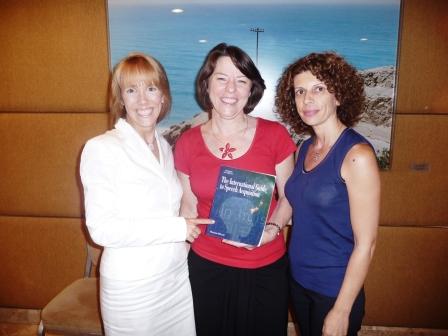
I have also spent time talking with speech-language pathologists and researchers from many different language backgrounds who have given me advice regarding preparation of the second edition of the International Guide to Speech Acquisition.
Isabelle Simard (Montreal, Canda), Sharynne
and Eleni Mitropoulou (Athens, Greece)


August 24, 2010

International Classification of Functioning, Disability, and Health Symposium

At the IALP conference in Athens, Jane McCormack and I organised a syposium on the development of clinical tools for considering communication based around the International Classification of Functioning, Disability, and Health. This symposium was designed to complement the keynote address by Professor Travis Threats. The symposium presenters came from across the globe:

1. Assessing voice activity and participation in dysphonic children (Estella Ma et al., Hong Kong)

2. Using the ICF as a clinical framework: Parents’ and professionals’ perspectives of the impact of speech impairment in early childhood (Jane McCormack et al., Australia)

3. The development of ICF inspired assessments for adults with acute stroke, traumatic brain injury and partners of hearing impaired older people (Linda Worrall  et al., Australia)

4. Considering the ICF as a conceptual framework for understanding quality of life of adults with acquired communication disorders: Strengths and limitations (Madeline Cruice,  UK)

5. The FOCUS (Focus on the Outcomes of Communication Under Six): A measure of communicative participation (Nancy Thomas-Stonell et al., Canada)

6. Considering context in the evaluation of intelligibility (Sharynne McLeod et al., Australia)
Karla Washington, Nancy Thomas-Stonell, Jane McCormack,
Sharynne McLeod, Linda Worrall, Madeline Cruice

August 22, 2010

Greek

Dhimotiki is the official version of Modern Greek spoken in Greece since 1976.

Greek has
• 31 consonants including allophones and affricates (allophones are not included in this list): p, t, k, b, d, g, l, n, m, n, th(+), th(-), f, v, s, z, x, , ts, dz
• 5 vowels: i, e, a, o, u

Most Greek words tend to be more than one syllable in length.
Most Greek words end in a vowel. Consonants in word-final position are restricted to /s/ and /n/, except in loanwords. Consonants in syllable-final word-within position are mainly //, /l/, and /n/.

There are many (approx 65) consonant clusters in word-initial position (e.g., /pt, kt, ps, ks/)
Stress falls on one of the last three syllables in the word.

The Greek alphabet used today was developed around the ninth century B.C. It has 24 letters plus an accent mark to indicate stressed vowels. Typically there is a one-to-one correspondence between sounds and letters; however, in some cases the same sound can be represented by different letters For example, there are five different spellings for the sound [i].

Here are some relevant Greek words:

  •  Sound ήχος
  • Word λέξη
  • Sentence πρόταση
  • Paragraph παράγραφος
Source: Mennen, I. & Okalidou, A. (2007). Greek speech acquisition. In S. McLeod (Ed). The international guide to speech acquisition. Clifton Park, NY: Thomson Delmar Learning.


August 13, 2010

International Association of Logopedics and Phoniatrics Conference - Athens, Greece

Between 22-26th August I have attended the International Association of Logopedics and Phoniatrics  (IALP) in Athens, Greece. This association is auspiced by the World Health Organization, and brings together speech pathologists from around the world. There were over 700 delegates from 52 nations in attendance.

My students, colleagues and I presented the following papers:
  • McCormack, J., McLeod, S., McAllister, L., &Harrison, L. J. (2010, August). Using the ICF as a clinical framework: Parents' and professionals' perspectives of the impact of speech impairment in early childhood. International Association of Logopedics and Phoniatrics, Athens.
  • McCormack, J., McLeod, S., McAllister, L., & Harrison, L. J. (2010, August). The experience and impact of speech impairment in childhood through the eyes of children and their families. International Association of Logopedics and Phoniatrics, Athens.
  • McLeod, S., McCormack, J., & Harrison, L. J. (2010, August). Considering context in the evaluation of intelligibility. International Association of Logopedics and Phoniatrics, Athens.
  • Washington, K., N., Thomas-Stonell, N., McLeod, S., Warr-Leeper, G., Oddson, B., & Robertson, B. (2010). Parents' perceptions of speech-language therapy. International Association of Logopedics and Phoniatrics, Athens.
We also had the opportunity to explore Athens, named for Athena, the godess of wisdom:
Jane McCormack and Sharynne visiting the Greek Parliament

I am a member of the IALP Education Committee, and we had our tri-annual face-to-face meeting for the committee to discuss education of speech-langauge pathologists around the globe.
2010 IALP Education Committee with members from Japan, Brazil, Bulgaria, Belgium, Australia, Malta, Taiwan, Finland, and USA

Writing a literature review for PhD students

On Thursday 12th September I was invited to present at seminar for 37 new PhD students studying at Charles Sturt University. The seminar was titled "Writing a  Literature Review" and I based the presentation on the following book chapter:

McLeod, S. (submitted). Disseminating research: Reading, writing, and publishing. In N. Müller & M. J. Ball (Eds). The Blackwell guide to research methods in clinical linguistics and phonetics. Oxford: Blackwells.

August 4, 2010

Silozi: A Zambian language

Silozi is the language spoken by the Lozi people who primarily live in Western Province in Zambia (including in Mwandi).
Silozi consists of:
  • 5 vowels: a, e, i, o, u
  • 20 consonants: p, t, c, k, b, d, j, g, f, s, sh, h, z, w, l, y, m, n, ny, ŋ
  • 40 consonant clusters (mostly in word-initial position): mp, nt, nc, nk, mb, nd, nj, ng, ns, nz, pw, tw, cw, kw, bw, fw, sw, shw, hw, zw, mw, nw, nyw, ŋw, mpw, ntw, ncw, nkw, mbw, ndw, njw, ngw, nsw, nzw, py, by, my, mpy, mby, ly
(The symbols used above are those used in Lozi spelling, apart from ŋ. Lozi has a one-to-one correspondence with the spoken sounds.)

Syllables may consist of a consonant + vowel, consonant cluster + vowel, or a nasal consonant alone (this also occurs in Cantonese). Each syllable is differentiated by the length and tone. There are:
  • 2 tones in short syllables: H, L (H = high, L = low)
  • 3 tones in long syllables: HH, LL, HL
Source: Fortune, G. (2001). An outline of Silozi grammar. Lusaka, Zambia: Bookworld Publishers.


Listening to children at the Mwandi Orphans and Vulnerable Children (OVC) Project, Zambia

I was very honoured to spend a few days visiting the Mwandi Orphans and Vulnerable Children Project in Western Province of Zambia on the Zambezi River. Mwandi is a village of 10,000 people and 1,300 children have been orphaned mostly due to HIV AIDS. The Mwandi OVC project is run by an Australian, Fiona Dixon-Thompson. My family and I helped with the feeding program (feeding 270 children for lunch) and the preschool program (singing, storytelling, and sharpening pencils!). However, most of the time we played and talked with the children. The children particularly loved having their photographs taken, then seeing themselves in the camera display (we have permission to upload their photographs here). OVC has a number of buildings adjacent to the village school. There is a playground, hall (used for the daily feeding program and preschool), kitchen, garden, carpentry centre, sewing centre, administration block (including a counselling area and computer room with 4 computers), and storage. Staff housing is currently being built.


We were shown through the Mwandi village by Gertrude, and visited homes, the market, and the chief’s compound. We were greeted with enthusiasm, particularly after we said "muchwani" (how are you?), and we were thanked on behalf of the Australians who had sponsored the children in their village. The village homes were made of mud, poles and grass, and each family's compound was surrounded by a hedge. We had a chance to pump some water, and to watch as even the young children skilfully carried the water on their heads to their homes. We also got involved in a soccer game. We visited the mission hospital and school and met the Zambian teachers and students at Mwandi Basic School (grades 1-9) and High School (which opened in 2009 and will have children in grades 10-12 in the future). The children were taking their exams in history, maths, chemistry and Silozi, English when we visited.


This sign means friendship:
A gesture that was offered to us frequently during our visit

Children’s home environment and the impact on literacy in Africa

At the ISSBD conference (see earlier post) Damaris Ngorosho, from the University of Dar es Salaam, Tanzania presented an invited paper titled “Phonological awareness and reading and writing ability: The importance of home environment factors in a rural community in Tanzania”.
She assessed the phonological awareness and reading skills (in Kiswahili) of 75 grade 2 children (aged 8-10 years old) in rural Tanzania and collected information on their home learning environment. Here are some of the findings that I found to be very interesting (and representative of what I saw in the villages in Zambia):

  • Books in the home: 64.0% had no books, 30.7% had 1-2 books, 5.3% had 3+ books
  • Pens in the home: 43.5% had no pens, 34.7% had one pen, 20.0% had 2+ pens
  • Homes: most had poles/mud walls, grass/coconut roofs, and sand floors
  • Water: 77% used a neighbourhood tap
  • Lighting: 55% used a locally made lamp, 13% used electricity
  • Fuel: 76% used firewood
  • Furniture: 78% of homes had not enough beds for the number of people living there.
She also found that parental education level was a strong predictor of children’s reading and writing ability.

Listening to children in Mukuni village, Zambia

Mukuni village is a traditional Zambian village close to Victoria Falls. The village represents how the Mukuni people have lived for hundreds of years and is typical of many throughout Zambia. The village earns income through tourism, and invites people to come and meet with the residents, visit their homes, take photographs, and purchase their crafts.
I enjoyed meeting the children and saying mwapona buti? (how are you?), and twalumba (thank you) in Tongan, their first language. The children were surprised that a white person was using their language, and after their first broad smiles and claps quickly transferred to English so we could continue communicating. I was particularly impressed by a young woman who was 15 and in grade 7 (the typical age for Zambian children in grade 7). She was studying for her school exams the next week, and showed me the work she had been doing.