May 27, 2011

Variations in pronunciation: Acceptable or not?

 While travelling in Viet Nam and Hong Kong I have been made very aware of the need to think about 3 categories of pronunciation:
1. "Correct" pronunciation: this includes the official pronunciation of a language
2. Variants in pronunciation: this includes dialectal variants that are produced by adults and children, particularly from a region/cultural group
3. Errors in pronunciation: this includes productions by children with speech sound disorder, who are unable to produce a sound in the appropriate context.

Speech pathologists work with children and adults in the third group. They typically do not work with people in the second group.

For example, in Viet Nam there is an official pronunciation that is closely related to the Ha Noi dialect. This pronunciation is encouraged by the government, and within the schools (see story below from the Viet Nam News). However, within Viet Nam, many people use different pronunciations of consonants, vowels and tones (e.g., n/l, d/nh, d/z, tone 3/tone 4) that are typical variants within their province/region. It is important to differentiate between these variants in pronunciation and errors that are made by children and require speech therapy.

Pronounced improvement (from Viet Nam News, Monday 9th May, 2011)
"The Ha Noi Department of Education and Training said it had helped to improve pronunciation and spelling of Vietnamese in primary schools in the capital with its new teaching programme. Nguyen Tri Dung, deputy head of the Primary Education Department, said the authority had been running a pronunciation training programme since 2009 for both teachers and students in primary schools in thirteen suburban districts with some success. He said teachers and children for example often had trouble distinguishing between the sounds of "l" and "n".
"This is a long-term programme because the habit [of mispronouncing words] began long ago and cannot be easily eliminated in a day or two," Dung said... "Mispronunciation leads to misspelling, and misspelling will negatively affect the students' academic performance and cause problems in communication," Hang said.
'To reduce confusion between letters and promote accurate pronunciation, teachers have been asked to correct students' spelling and diction in non-language classes.
Pronunciation training also forms part of extra-curricular activities. Meanwhile, teachers are encouraged to meet regularly to boost their language skills.
Dung added that the programme was designed to promote standard Vietnamese not just at school but in society as a whole because students would interact with other members of the community.
Vu Thi Du, the principal of Quang Trung School in Phu Xuyen District, said the programme was implemented two years ago and had achieved positive results. Pronunciation and spelling training is now given in all classes... According to a survey conducted in thirteen suburban districts by the Department of Education and Training, the number of primary school teachers with poor diction had fallen markedly and now stood at 9 per cent as opposed to 12 per cent at the end of the 2010-11 school year. Meanwhile, the proportion of students mispronouncing words has fallen from 22 per cent to 18 per cent during the same period. The ministry surveyed about 11,000 teachers and 204,000 students in thirteen suburban districts for the study. — VNS"

Similarly in Hong Kong, there has been a “Proper articulation”正音運動 campaign to correct "lazy" pronunciation. It is possible that these lazy pronunciations are variants in pronunciation (category 2 above). In recent research, Carol To and Pamela Cheung have examined nine sound changes in Hong Kong Cantonese by eliciting single-word samples from 848 children (5;8-11;7) and 112 adults (18-45 years). Five of these sound changes (in syllable-initial and syllabic contexts) were found to be complete or common: (1) /n-/→[l-], (2) /ŋ-/→Ø-, (3) Ø-→[ŋ-], (4) /kwɔ-/→[kɔ-], and (5) syllabic /ŋ/→[m]; and four sound changes (in syllable-final contexts) were emerging: (6) /-ŋ/→[-n], (7) /-n/→[-ŋ], (8) /-k/→[-t], and (9) /-t/→[-k]. They concluded that the five sound changes relating to syllable-initial and syllabic consonants can be treated as acceptable variants in speech sound assessments. Furthermore, they suggested that although the four syllable-final sound changes are not yet used by the majority of the population, they may still be accepted as variants unless additional speech problems are indicated.

May 24, 2011

Cantonese speech and language assessments

A/Prof Kathy Lee demonstrating the soon to be released
Cantonese Tone Identification Test (CanTIT)
I spent time in Hong Kong talking about speech assessments with both Dr Carol To and A/Prof Kathy Lee. They both have great insights into test construction, validation, computerization, and norming. Here are the tests that they have been involved in constructing:
  • Cheung, P. S. P., Ng, A., & To, C. K. S. (2006). Hong Kong Cantonese Articulation Test (HKCAT). Hong Kong: Language Information Sciences Research Centre, City University of Hong Kong.
  • Lee, K. Y. S. (2006). Cantonese Basic Speech Perception Test. Hong Kong: The Chinese University of Hong Kong.
  • Lee, K. Y. S. (2011). Hong Kong Cantonese Tone Identification Test (CanTIT). Hong Kong: Department of Otorhinolaryngology, Head and Neck Surgery, The Chinese University of Hong Kong.
  • Lee, K.Y.S., Lee, L.W.T. & Cheung, P.S.P. (1996). Hong Kong Cantonese Receptive Vocabulary Test (HKCRVT). Hong Kong: The Hong Kong Society for Child Health and Development.
  • T’sou, B., Lee, T. H.-T., Tung, P., Chan, A. W. K., Man, Y. Y. H., & To, C. K. S. (2006). Hong Kong Cantonese Oral Language Assessment Scales (HKCOLAS). Hong Kong: Language Information Sciences Research Centre, City University of Hong Kong.

May 22, 2011

The Hong Kong Association of Speech Therapists

On Sunday 22nd May I presented a workshop to approximately 80 speech therapists for The Hong Kong Association of Speech Therapists. The workshop was titled: Working with children with speech sound disorders: International perspectives of speech acquisition, assessment and intervention  and we covered the following topics, that considered children of Hong Kong in the context of the world
  1. The world’s speech sounds
  2. Speech acquisition
  3. Assessment
  4. Evidence-based intervention
  5. Prevalence, risk, and impact of childhood speech and language impairment
Dr Carol To contributed to the presentation by speaking about sound change in Hong Kong Cantonese. In her presentation she described some of the research we have undertaken (currently under review in different journals):
  1. To, C. K. S., Cheung, P. S. P., & McLeod, S. (2010). Sound change in Hong Kong Cantonese: Implications for speech sound assessment.
  2. To, C. K. -S., Cheung, P. S. -P., & McLeod, S. (2011). Typical speech sound acquisition of Hong Kong Cantonese.
After the workshop I received a number of enthusiastic emails from the participants. Here is one of them: "Thank you very much indeed for your lecture yesterday- I really really enjoyed it. The empirical coverage of your work both within a language and across languages is awesome, and your dedication and enthusiasm to not only "data" but "the well-being of children" is highly respectful!"

Thank you Việt Nam

My 2 weeks in Việt Nam were a special time. I learned so much from the students, interpreters, and staff at Pham Ngoc Thach University. Marie Atherton (course coordinator) and Sarah Verdon also made my visit very special. On my last night in Việt Nam the students took us to dinner in the Vietnamese countryside.
Pham Ngoc Thach speech therapy students at the end of our 2 weeks together
During the two weeks I meet many important advocates for the speech therapy course and profession in Việt Nam, including Professor Nguyen Thi Ngoc Dung (President of the Vietnam Society of Otolaryngology and Director of the Ear Nose and Throat Hospital) and Vice Rector Nguyen The Dung.

I am excited to think about the future of speech therapy in Việt Nam.
Marie Atherton, Vice Rector Dung, and Sharynne


Lunch with Professor Dung, Marie Atherton, and Sarah Verdon

May 19, 2011

Speech therapy for children in Việt Nam

Today I visited Children's Hospital Number 1 (CH1) in Ho Chi Minh City (HCMC). Ms Yen, the head of the rehabilitation department of the hospital, is also a student in the speech therapy course at Pham Ngoc Thach University of Medicine. Dr Ly Kha, the students’ linguistics lecturer also visited the hospital. While we were there, we met a young boy who was 3;11 years. He has been having speech therapy since he was 2 years and has a speech sound disorder. We assessed his speech and found that he had difficulty producing all four Vietnamese nasal consonants in word-initial position (he produced them as stops, ie denasalization). He also had difficulty producing the aspirated /t/, diphthongs/semi vowels and one of the Vietnamese tones (but this difficulty also was typical for adults in HCMC). His parents are very supportive of his speech therapy and wish him to succeed in school when he starts in 2 years’ time. We videoed the session, then discussed it in class with the speech therapy students.

A speech assessment with a young Vietnamese boy, Ms Yen and Dr Ly Kha
The structure of the rehabilitation department at CH1. Note speech therapy in the middle
Ms Yen and Sharynne leaving CH1 via motorbike!

May 17, 2011

Listening to children in Việt Nam

While in Ho Chi Minh City (HCMC), I have been able to observe and meet a number of Vietnamese children. One aspect of many children’s everyday lives is for children to ride on their parents’ motor bikes. This family removed their child's mask to take their photo (right).

Vietnamese children can start school at 3 years. They start elementary school at 6 years, and at this time they start learning to read, as well as learning to speak English.

The People's Committee of HCMC organises youth activities, and children who are involved in their activities wear a red scarf. The HCMC children’s parade and competition was held at the Reunification Palace on Sunday 15th May. Hundreds of elementary and junior high school students participated by singing, dancing, marching, and playing musical instruments. The symbol representing these young people's youth activities is a “young bamboo” because these children are growing very quickly (like bamboo does) into adults.

Speech assessments for Vietnamese children

I have been teaching (and learning) about the assessment of children with speech sound disorders to (and from) students in the Speech Therapy Training Program at Pham Ngoc Thach University of Medicine, in Ho Chi Minh City. In preparation for this course, I have discovered ten different assessments that have been created for Vietnamese children (listed below).

When using these assessments, it is important to determine whether they have been created for children who use northern (e.g., Hanoi), central, or southern (e.g., Ho Chi Minh City) pronunciation. However, there are 58 Vietnamese provinces, and pronunciation of consonants as well as vowels can differ between different provinces, particularly in central Việt Nam.

The results of one classroom discussion about different pronunciations of "a"
I also have shown them examples of assessments in English, particularly to compare different types of presentation, analyses, and how normative data assists in diagnosis and intervention planning.

Speech therapy students at Pham Ngoc Thach University of Medicine
after a class on Vietnamese and English speech assessments
Dr Nguyễn Thị  Ly Kha has developed an extensive speech assessment. It contains 284 words, consisting of 4 words to elicit each vowel, word initial and word final consonant, and tone. The words have been chosen to be in the vocabulary of children throughout Việt Nam. She has collected normative data on this assessment on nearly 300 children. I look forward to seeing this study finalized and published as to my knowledge, it will be one of the only, and definitely the largest normative study of typical Vietnamese acquisition in the world.

Sarah Verdon, Prof Sharynne McLeod, Dr Nguyễn Thị Ly Kha, Ms Ha Hai-Chau

A number of these assessments are available at: http://vnspeechtherapy.com/default.html

Assessment 1: ĐÁNH GIÁ KHẢ NĂNG PHÁT ÂM ÂM TIẾT CỦA TRẺ MẪU GIÁO NÓI TIẾNG VIỆT (Nguyễn, 2011)
Author: TS. Nguyễn Thị Ly Kha, ĐHSP TP.HCM, Viet Nam

Assessment 2: Vietnamese One-Word Articulation Screener (Pham, 2009)
Author: Giang Pham, MA CCC-SLP, USA (2009)

Assessment 3: Southern dialect Vietnamese phonological probe (Tang & Barlow, 2006)
Tang, G., & Barlow, J. (2006). Characteristics of the sound systems of monolingual Vietnamese-speaking children with phonological impairment. Clinical Linguistics and Phonetics, 20(6), 423-445.

Assessment 4: Articulation Test: Vietnamese (Cheng, 1991)
Cheng, L. L. (1991). Assessing Asian Language Performance, (2nd ed.). Oceanside, CA: Academic Communication Associates.

Assessment 5: Vietnamese consonant word list and Vietnamese vowel word list (Hwa-Froelich, Hodson & Edwards, 2002)
Hwa-Froelich, D. A., Hodson, B. H., & Edwards, H. T. (2002). Vietnamese phonology: A tutorial. American Journal of Speech-Language Pathology, 11, 264-273.

Assessment 6: Vietnamese Articulation Test (West, 2000)
Author: Melanie West, Adelaide Central Community Health Service, Adelaide, Australia

Assessment 7: Vietnamese Articulation Test-II (VAT-II) (Cameron & Watt, 2006)
Authors: Tarsh Cameron and Carley Watt, Flinders University, Adelaide, Australia

Assessment 8: Operation Smile Vietnamese Articulation Screening Test (Ducote)
Author: Charlotte A. Ducote, PhD, CCC-SLP, New Orleans, LA 70121, USA (caducote@aol.com)

Assessment/Word lists 9: BẢNG TỪ ÂM TIẾNG VIỆT (Nguyen & Ducote)
Authors: Miss Nguyễn Van Anh in collaboration with Charlotte A. Ducote, PhD, CCC-SLP (caducote@aol.com)

Assessment 10: BỘ TRẮC NGHIỆM ĐÁNH GIÁ KHẢ NĂNG NGÔN NGỮ VÀ KHẢ NĂNG TÍNH TOÁN CỦA TRẺ TỪ 6 ĐẾN 9 TUỔI [EVALUATION TEST OF LANGUAGE ABILITY AND CAPACITY CALCULATION OF CHILD FROM 6 TO 9 YEARS]
Authors: Trần Quốc Duy, Alain Content, Nguyễn Thị Ly Kha, Nguyễn Thị Hồng Phượng, Huỳnh Mai Trang, Hoàng Thị Vân
This assessment and normative data considers: phonological awareness, vocabulary, grammar, memory, and knowledge of numbers and calculation

May 9, 2011

Speech Therapy Training Program, Pham Ngoc Thach University of Medicine, Ho Chi Minh City, Việt Nam

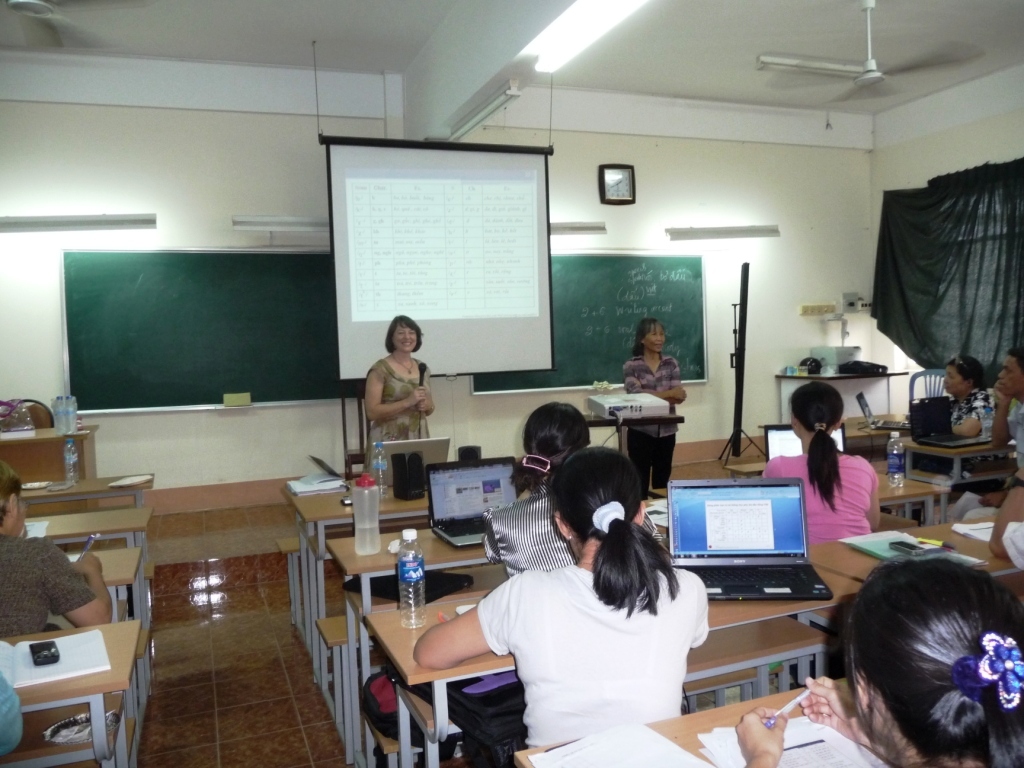
During May I am visiting Việt Nam to teach Assessment and Treatment of Disorders of Speech in Children to students in the Speech Therapy Training Program at Pham Ngoc Thach University of Medicine, in Ho Chi Minh City. Information about the course is here.

I would like to thank the following people:
• Marie Atherton, Lindy McAllister, Alison Winkworth, and Sue Woodward from The Trinh Foundation: http://www.trinhfoundation.org/
• Sarah Verdon, a recent Charles Sturt University speech pathology honours graduate who supported me during my lecturing, and was great company around HCMC
• Charlotte Ducote and Giang Pham (nee Tang) who have allowed me to use their resources: http://vnspeechtherapy.com/
• The wonderful students, who are enthusiastic, supportive, and patient! Mr Dien who is the class captain and ensures I have cold water every day.
• The excellent Vietnamese lecturers and translators: Dr Ly Kha, Ms Hai Chau, Ms Lee

Marie Atherton (Course Director), Sarah Verdon (Tutor),
and Sharynne at briefing session in HCMC prior to teaching
Teaching the students with Ms Hai Chau interpreting
Speech therapy students celebrating Sarah Verdon's birthday
during my first day of teaching

Buddhist teaching

When teaching and presenting seminars in Buddhist countries, I am aware of the perspective of teaching and learning from some of my students:

"A pupil should always rise when his teacher enters, should wait upon him, attend to his instructions, not neglect an offering for him, listen respectfully to his teaching. At the same time, a teacher should act rightly before a pupil, and set him a good example; he should pass on the teaching which he has learned, correctly, he should use good methods and try to prepare the pupil for honors, and he should not forget to protect from evil in every possible way. If a teacher and pupil observe this rule, their association will progress smoothly."
(The Teaching of Buddha, Chapter 2, Practical guide to true living)

I find it difficult being in the position of a revered teacher. Western methods of working with students encourage students to critique information, and research degrees aim for students to develop new knowledge not just to learn previously learned teaching.

I do like this thought though: "To live a single day and hear a good teaching is better than to live a hundred years without knowing such teaching" (The Teaching of Buddha)

May 3, 2011

Vietnamese

 
There is one official language (and pronunciation) in Viet Nam; however, in each of the 58 provinces, pronunciation of consonants and vowels can be different. Most people simplify the conceptualization of pronunciation of Vietnamese to the following three regions:
a) the northern dialect associated with the region surrounding Ha Noi,
b) the central dialect related to Hue, and
c) the southern, Ho Chi Minh City (HCMC) or Saigon dialect.

 
Vietnamese has approximately 24 consonants.
The initial consonants of HCMH include:
• plosives /b, t(dental), t(dental/aspirated), d, t(retroflex), c, k/
• fricatives; /f, v, s, z, voiced and voiceless retroflex fricatives, voiced velar fricative, voiceless uvular fricative, h/
• nasals /m, n, palatal nasal, ng/
• liquid /l/

 
Final consonants are limited to either a voiceless deaspirated stop or a nasal: /p/, /t/, /k/, /m/, /n/, and /ng/
Not all dialects include the same phonemes. For example,
• Central dialect includes: /dZ,z/
• Northern dialect includes: /v, Z/

 
Vietnamese speakers produce 11 different single vowels. Different authors report different vowel inventories varying across the three major dialects. Vowels are influenced by other vowels in the word, and vowels are also influenced by semi-vowels following another vowel.

 
Vietnamese is a syllabic language that allows consonants in the initial or final position with multiple vowel combinations. Other languages have phonotactic constraints for consonant clusters but the Vietnamese linguistic constraint for consonant clusters is that there are none except for combinations with the semi-vowel /w/. There may be other constraints not yet documented that involve consonant-vowel and multiple vowel combinations.

 
Vietnamese consists of 24 consonants and 11 vowels that can be combined in any of the following possible ways:
/V/, /VV/
/CV/, /CVV/, /CVC/, /CVVC/
/VC/, /VVC/
/wV/, /wVV/, /wVC/, /wVVC/
/CwV/, /CwVV/, /CwVC/, /CwVVC/, where /w/ is a semi-vowel

 
Vietnamese does not have consonant clusters

 
Vietnamese is a tonal language. Differences in the reported number of tones for Vietnamese can be explained by dialectal differences. Most often six tones are identified being represented graphically by markings over or under the vowel of a syllable (Hwa-Froelich, 2007)
There are two words for tones in Vietnamese

DaÂuÙ= writing Thanh = oral tone
There are 6 tones, plus 2 derivative tones relating to plosives.

  1. No tone
  2. Thanh huyền
  3. Thanh Ngã
  4. Thanh Hỏi
  5. Thanh Sắc
  6. Thanh Nặng
+ 2 derivative tones with plosives -p, -t, -k
5’. Thanh Sắc
6’. Thanh Nặng


Tone 3 is rarely used in HCMC, and is difficult for children to pronounce. It is replaced by tone 4.

 
Hello is "Xin chào", and thank you is "Cảm ơn".

 
Sources:
  • Dr Ly Kha, Ham Ngoc Thach University, Ho Chi Minh City
  • Hwa-Froelich, D. A. (2007). Vietnamese speech acquisition In S. McLeod (Ed.), The international guide to speech acquisition (pp. 580-591). Clifton Park, NY: Thomson Delmar Learning.
  • Tang, G., & Barlow, J. (2006). Characteristics of the sound systems of monolingual Vietnamese-speaking children with phonological impairment. Clinical Linguistics and Phonetics, 20(6), 423-445.

Computer design students' ISA prototype development

Masters students from East Tennessee State University (ETSU), USA who are studying Computer Science-Information Technology have been working with Dr. Marty Barrett to design a prototype computer program to support the International Speech Assessment (ISA). The ISA is being developed as one of the outputs of my Future Fellowship, with the aim to assess the speech of multilingual children. The computer prototype project was initiated during my visit to ETSU last year.

On Monday evening (their time)/Tuesday morning (my time), Dr Barrett, the students and I met via Skype to discuss their progress, and to move the project to the next stage. We are working on a research version at the moment, that will later be transformed into a clinical version for use by speech-language pathologists around the world.
L-R: (back) Aaron Stokes; Heather Haley; Eric Barclay; Kris Cunigan; Dr. Marty Barrett;
(front) Chandan Biswas; Howard Morris; Jim Johnson

May 2, 2011

Learning from local speech pathologists

L-R: Angela Leake, Anastasia Scott, Meredith Porter (and Mitchell),
Lisa Farley, Natalie Reeves, Christine Porter
Today I had lunch with the local speech pathologists who work in Bathurst. I enjoyed hearing about what they were doing within health, education and disability throughout the Bathurst region. I also gained advice on my research, particularly regarding children's speech assessment. I hope to have more opportunities to link in with my local colleagues in the future.

April 29, 2011

The research student journey

I have been at the Albury campus of Charles Sturt University (CSU) over the past few days.

One reason for my visit was to celebrate with Dr Jane McCormack at her PhD graduation ceremony (see previous post). Jane has been awarded the most outstanding PhD thesis in the Faculty of Education for 2010. This is an amazing achievement. She is now a lecturer in speech pathology at CSU.
ABC Radio recorded an interview on the day of her graduation about her research here:

Dr Jane McCormack, Vice Chancellor Ian Goulter,
A/Prof Linda Harrison, Prof Sharynne McLeod
  While in Albury, Jane and I have also spent time with Nicole Limbrick, our new honours student. Nicole is examining speech pathologists' protocols and decision making during assessment of children with speech sound disorder (speech impairment). She is at the exciting stage of finalizing her question and designing the research methodology.


Jane McCormack, Nicole Limbrick, and Sharynne McLeod
 
It is always a pleasure to walk alongside students as they read, plan, implement, and write up their research -- and are rewarded for their efforts at graduation.

April 20, 2011

Pitjantjatjara and Yankunytjatjara

Pitjantjatjara and Yankunytjatjara are two similar, but distinct dialects of the Western Desert language group spoken by the Anangu people in the centre of Australia near Uluru-Kata Tjuta.
Pitjantjatjara and Yankunytjatjara have been written using 14 letters from the English alphabet, with some consonants being underlined to indicate that the sound is retroflex (made with the tongue tip back). There are  
6 vowels: a, aa, i, ii, u, uu  
2 diphthongs: au, ai
17 consonants:
5 stops: p, t, t, tj, k
5 nasals: m, n, n, ny, ng
7 liquids and glides: l, l, ly, w, r, y
1 trill: r (never in word-intial position)
The first syllable of every word is stressed.
Many words are created with the addition of suffixes. For example, karu = creek, kutu = to, therefore karukutu = to the creek.
In the Pitjantjatjara/Yankunytjatjara picture dictionary there are no words listed for hello, thankyou, or yes. There are four different words for go (go away from, go hunting, go in, go past). Here are some words
    
    Sharynne at Uluru near rock paintings by the Anangu people
    
no = wira
talk = wangkanyi, watjani
tongue = tjalinypa
teeth = katiti
Source: Ekert, P. (2007). Pitjantjatjara/Yankunytjatjara picture dictionary. Alice Springs, NT: IAD Press.


April 16, 2011

Uluru, Kata Tjuta and the Anangu people in central Australia

During April I have taken annual leave with my family. We are visiting Uluru - Kata Tjuta National Park in the centre of Australia. Uluru (named Ayers Rock by white explorers), is one of the largest monoliths in the world with a circumference of 9.4 kilometres. Kata Tjuta means “many heads” (named The Olgas by white explorers). It consists of more than 30 rounded red domes rising from the desert floor. There has been a lot of rain recently, so the landscape is lush with vegetation, and the gorges contain water. This is very unusual for this desert region of Australia.


The Anangu people are the traditional Aboriginal owners and oversee the Uluru-Kata Tjuta National Park. They believe that there are three ancestors to the region: Mala (hare wallaby), Kuniya (woma python) and Liru (poisonous snake). Uluru and Kata Tjuta are sacred to the Anangu people.

The Anangu people mainly speak Pitjantjatjara (pronounced as pit-jan-jah-jarra) and Yankunytjatjara (pronounced as yan-kun-ja-jarra) (see next post) and some Anangu people speak up to six languages.

April 14, 2011

Statistics

I spent today in a workshop run by Alan Taylor from Macquarie University on SPSS(R) Statistics Training. It was useful to brush up my statistical skills and to find additional tricks in the latest version of this powerful statistical program.

April 9, 2011

History of Electropalatography

This week I worked with Bill Hardcastle from Queen Margaret University, Edinburgh on our book titled Electropalatography for Speech Assessment and Intervention. Bill was visiting Sydney from Scotland, so we took the opportunity of being in the same place (and country!) to select figures for inclusion in the book.
This photograph from the 1970s shows Bill demonstrating the Reading EPG2 system.

Reading EPG2 system designed to work with the Commodore computer


March 29, 2011

Cantonese

Cantonese is spoken by over 40 million people in southern China in the Guangdong (including Hong Kong) and Guangxi Provinces, as well as in Britain, Canada, Australia, and USA and many other parts of the world. There are 19 consonants, 11 vowels, 11 diphthongs, and 9 tones in Cantonese.
Cantonese has16 oral consonants
/p, ph, t, th, k, kh, kw, kwh, ts, tsh, f, s, h, w, j, l/

and 3 nasal consonants /m, n, ŋ/.
There are 11 vowels in Cantonese: 7 long vowels /i, y, ɛ, œ, а, ɔ, u/ and 4 short vowels /ɪ, ɵ, ʊ, ɐ/. Of the short vowels, /ɪ, ɵ, ʊ/ are allophones of /i, œ, u/ respectively.

There are 11 diphthongs /аi, ei, ɐi, ui, ɔi, аu, ɐu, iu, ou, ɵy, eu/.

The syllable structure of Cantonese is (C)V(C) and there are six possible syllable structures in Cantonese: V, C, CV, VC, CVV, and CVC. Only two syllables have a single consonant as a syllable: namely /m/ and /ŋ/.

Cantonese uses tones to differentiate lexical meaning. There are six contrastive tones (high level, high rise, mid level, low fall, low rise, and low level) plus three entering tones for syllables that end with /–p/, /–t/ or /–k/.

Cantonese uses syllable-timed rhythm.

Source: So, L. K. H. (2007). Cantonese speech acquisition In S. McLeod (Ed.), The international guide to speech acquisition (pp. 313-326). Clifton Park, NY: Thomson Delmar Learning.
With advice from Dr Carol Kit Sum To.

Visitor from Hong Kong

Dr Carol Kit Sum To has spent the week in Bathurst at Charles Sturt University. Carol and I worked together at the University of Hong Kong last year. Since then we have been working on journal articles, a book chapter, conference presentation, and a grant. This week she spoke with my research students about professional practice in Hong Kong and we submitted a journal article about children's acquisition of Hong Kong Cantonese. While she has been here it has been interesting comparing Bathurst with Hong Kong -- we have very few cars and people and a lot of grass and open space compared with HK.

March 23, 2011

Memorial service for the people of Ōkuma and Japan


Over 140 members of the Bathurst community came together at Bathurst City Uniting Church on Wednesday 23 March for a memorial service for the people of Ōkuma and Japan following the earthquake and tsunami. The service was attended by the Mayor and Bathurst Regional Council members, the Sister City Working Party, clergy and members of the churches of Bathurst, staff and students from Denison College (Bathurst and Kelso High Campuses), Charles Sturt University, MacKillop College, St Stanislaus College, All Saints School, and citizens of Bathurst who have visited and hosted visitors from Ōkuma and Japan. It has been estimated that over the past 20 years around 1000 Bathurst residents have either visited Ōkuma or hosted visitors from Ōkuma. Father Yoshihiro Okawa from Japan also was involved in the service. As a result of the service $1088.90 was donated to the Bathurst-Ōkuma Appeal. School students made hundreds of paper cranes, that will be sent to the residents of Ōkuma.
We also remembered the people of Christchurch in New Zealand, who also are rebuilding their city and their lives after recent earthquakes.

Western Advocate stories (22 March 2011; 24 March 2011)
Insights story (April, 2011)


Mrs. Fudeko Reekie, Father Okawa, Cr. Monica Morse,
Prof. Sharynne McLeod, Rev. 'Oto Faiva