November 16, 2013

Meeting old friends and making new friends at ASHA

The annual American Speech-Language-Hearing Convention is a wonderful time to reconnect with colleagues from around the world, and to meet new colleagues. Much of my time at ASHA is spent discussing research ideas with my colleagues. Here are a few photos of people I was able to meet with while at ASHA this year.
Brian Goldstein and Sharynne
(we are the co-chairs for the 2014 ASHA Cultural and Linguistic Diversity topic)
Li-Rong Lilly Cheng and Sharynne (at Lilly's ASHA Honors party)
Barbara Hodson and Sharynne
Sharynne, Lynn Williams, Marc Fey, Ann Tyler
Stephen Camarata and Sharynne
(Stephen has just written the lead and final articles to the IJSLP scientific forum on autism)
Sharynne and John Bernthal
(happy because we have just finished writing an encyclopedia entry together)

November 15, 2013

Chicago welcomes 15,000 ASHA delegates

The 2013 American Speech-Language-Hearing Association convention is the largest ASHA convention on record. Over 14,000 delegates pre-registered (and over 2,500 of these are students). It is tipped that by the end of the convention 15,000 delegates will be registered. There are 2,387 accepted presentations. ASHA has over 166,000 members. Chicago is happy to have so many visitors - and has welcome signs hanging along the Magnificent Mile.

November 14, 2013

American Speech-Language-Hearing Association Convention in Chicago

Sarah Verdon, Sharynne, Kate Crowe at the entrance to the exhibit hall
This week is the American Speech-Language-Hearing Association Convention in Chicago, IL. I was on the Issues in Culturally and Linguistically Diversity topic committee, so was invited to review many papers earlier in the year. While at ASHA I am co-presenting 6.5 hours of technical reports and seminars including a 3-hour short course:

Crowe, K., McLeod, S., McKinnon, D. H., Fordham, L., & Ching, T. Y. C. (2013, November). Language choice for children with hearing loss: Influences on caregiver decision-making. (30 minute oral presentation). [Winner of the ASHA student prize for best abstract in Cultural and Linguistic Diversity Topic]
Kate Crowe
McLeod, S., Bowen, C., Verdon, S., & Guiberson, M. (2013). Empowering monolingual SLPs to work with multilingual children with speech sound disorders. (3 hour short course)
Mark Guiberson, Sharynne, Caroline Bowen and Sarah Verdon planning our 3 hour short course
McLeod, S. & Verdon, S. (2013, November). A systematic review of tools to assess children’s speech in languages other than English. (30 minute oral presentation)
Sarah Verdon and Sharynne at ASHA 2013
McLeod, S., Verdon, S., Bowen, C. & International Expert Panel on Multilingual Children’s Speech (2013, November).  Aspirations of an international expert panel for working with multilingual children with speech sound disorders. (30 minute oral presentation).
Members of the International Expert Panel on Multilingual Children's Speech after our presentation
McLeod , S., Crowley, C. J., Williams, A. L.,  Louw, B., Westby, C., To , C. K. S., Washington, K. N., & MacLeod, A. A. N. (2013). Beyond Spanish: Competencies for SLPs working with children from diverse cultures. (2 hour seminar). 
Beyond Spanish seminar presenters: Sharynne, Karla Washington, Carol To, Lynn Williams, Andrea MacLeod, Brenda Louw, Carol Westby, Cate Crowely
Washington, K. McLeod, S., Devonish, H., & Samms-Vaughan, M. (2013, November).  Cross-cultural competencies for working with bi-dialectal children from Jamaica. Paper (20 minute oral presentation within a 2-hour seminar).

November 13, 2013

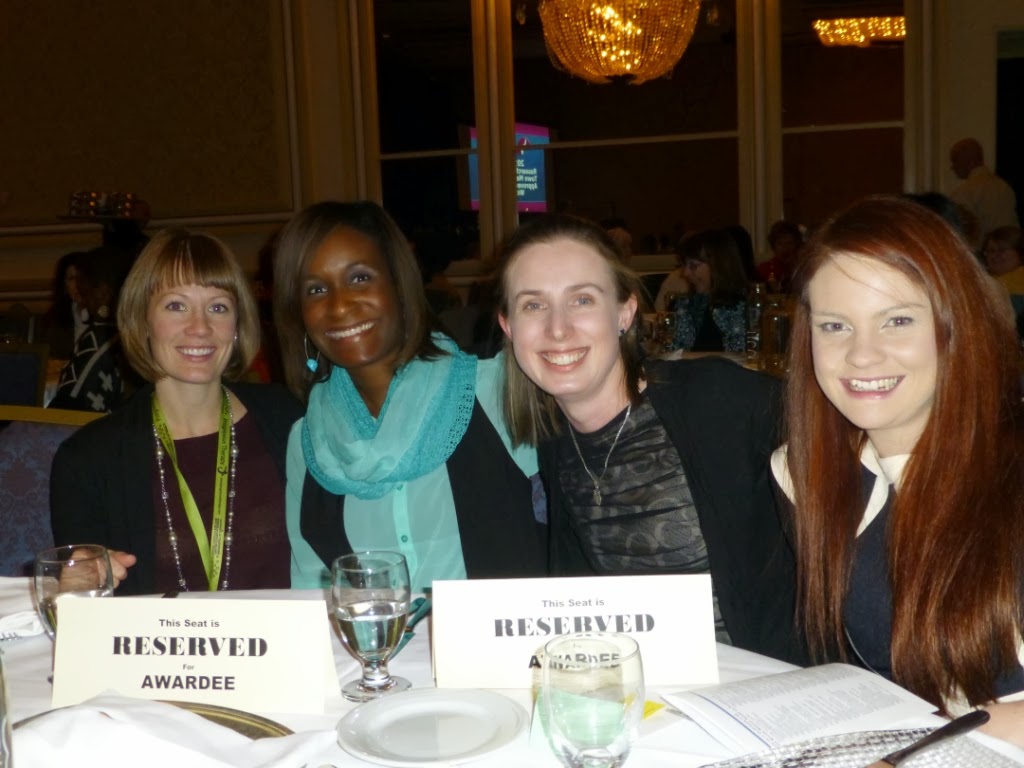
ASHA Awardees

Congratulations to Karla Washington and Kate Crowe who were profiled as awardees at the ASHA
Joint Researcher-Academic Town Meeting this year.

IJSLP handover meeting in Chicago

Kirrie Ballard will be commencing as editor of the International Journal of Speech-Language Pathology in 2014. She is currently working in the US as part of her ARC Future Fellowship, so we met in Chicago to discuss our Future Fellowships and to have a 4 hour face-to-face handover of the journal.

November 12, 2013

Identifying phonological awareness difficulties in preschool children with speech sound disorders

The following manuscript has been accepted for publication.
Masso, S., Baker, E., McLeod, S. & McCormack, J. (in press, November 2013). Identifying phonological awareness difficulties in preschool children with speech sound disorders. Speech, Language, and Hearing.
This is Sarah Masso's first publication and it has been written as part of her PhD, so it is an extra special publication. Here is the abstract:
Phonological awareness is one type of phonological processing ability and is considered to be particularly important for early literacy development. Specific phonological awareness skills include: syllable-level awareness, onset-rime awareness, and phonemic awareness. Children with speech sound disorders are at a high risk of difficulties with phonological awareness and literacy. There is a body of literature reporting both composite scores and task-specific phonological awareness scores from the assessment of children with typically-developing speech and schoolage children with speech sound disorders. In this study we completed a systematic overview of the available literature regarding the assessment of phonological awareness in preschool-age children with speech sound disorders. A systematic search of literature databases yielded 777 articles which were screened. The full text of 30 articles was read and 12 articles met all specified criteria. Ten of the 12 articles reported composite scores for the phonological awareness of participants. The studies rarely reported the profile of specific phonological awareness skills. Of the final 12 articles, eight were case-control studies (Level III) and four were case-series or cross-sectional studies without a control reference (Level IV) (Merlin, Weston & Tooher 2009). There is a need for more research reporting task-specific phonological awareness abilities in preschool-age children with speech sound disorders in order to understand the relationship between specific skills and literacy development in this population.