 |
| Professor Toni Downes, Ben Pham, Sharynne McLeod |
September 4, 2014
Lunch with the Dean of Education
Today Ben Pham and I were invited to lunch with the Dean of the Faculty of Education, Professor Toni Downes. Toni invited us to lunch to welcome Ben and congratulate her on her Australian Awards PhD scholarship. Thank you Toni for a lovely lunch!

HDR Candidate Welcome and Induction
Today Ben Pham and I attended the Charles Sturt University Higher Degree Research (HDR) Candidate Welcome and Induction session. It was conducted using Adobe Connect, and participants "attended" while sitting in front of a computer in different cities in Australia and Asia! The 3-hour session included a welcome to new HDR candidates and discussed: resources, tips, relationships, responsibilities, writing, time management, and professional development. Presenters included the Academic Writing Coordinator and staff from the Research Office, Research Professional Development Office, and the Library. We were impressed at the extent of information shared and the friendly atmosphere created in this virtual environment.

September 3, 2014
Australian Senate Community Affairs Reference Committee's final report
The Senate Community Affairs Reference Committee's final report for the inquiry into
the prevalence of different types of speech, language and communication
disorders and speech pathology services in Australia was released on 2nd September 2014 and can be found here. The tabling of the Senate report is here. Speech Pathology Australia's response is here.
The work of my students and colleagues at CSU has been cited a number of times in the report. It is exciting to see that our work has been useful in advocating for services. The CSU media release is here.
In an email to members of Speech Pathology Australia posted today Gail Mulcair, CEO of Speech Pathology Australia summarized the report as follows:
The work of my students and colleagues at CSU has been cited a number of times in the report. It is exciting to see that our work has been useful in advocating for services. The CSU media release is here.
In an email to members of Speech Pathology Australia posted today Gail Mulcair, CEO of Speech Pathology Australia summarized the report as follows:
The Committee made ten detailed recommendations - which direct the Australian Government Department of Health to progress a program of work that will identify, improve, support and expand speech pathology services in Australia. The time for talking is over - the time for government action is at hand. Recommendations include:
- That governments, when developing policy and programs, consider the costs to individuals and the Australian community of failing to intervene to address speech and language disorders.
- That a gap analysis be undertaken of what data is available to identify the current and future need for speech pathology services and how these information gaps could best be filled.
- Improvements to data on communication disabilities collected through the National Census and other governmental data collection systems.
- An analysis of the current service delivery model of speech pathology services in the aged care sector and how this relates to the federal government's aged care reforms.
- A project that maps language support services across Australia against the Australian Early Development Index information about vulnerable children.
- An immediate audit of the current speech pathology services for children in Australia.
- The development of a position paper on the impact of the NDIS on speech pathology services in Australia.
- A strategy to broaden the opportunities for speech pathology students to undertake clinical placements that satisfy the profession's competency based occupational standards.
- An investigation into the geographical and demographic clustering of speech pathology services in Australia with a focus on new graduate positions.
- A cost benefit study of the current level of funding for public speech pathology positions, various service delivery models and the impact on individuals, the speech pathology profession and the Australian community.
- A position paper (jointly developed by the federal Department of Health in collaboration with state and territory governments) on the most effective models of speech pathology services in:
- Early childhood intervention services
- The educational system
- The justice system
- The health system
- The residential aged care environment.
September 2, 2014
Multilingual Children's Speech website - over 33,000 hits
The Multilingual Children's Speech website has had 33,761 hits since it was launched in November 2012. Here is a summary of the Google analytic reports for the number of visits, and top countries for each month since my last blog post about this in November 2013:
- December, 2013 - 1,444 - Netherlands, US, Philippines, Germany, Australia, Canada
- January, 2014 - 1,190 - US, Netherlands, Philippines, UK, India, Australia
- February, 2014 - 1,686 - Netherlands, Israel, US, Australia, Canada, UK
- March, 2014 - 1,481 - US, Netherlands, Australia, Hong Kong, India, UK
- April, 2014 - 1,846 - (country information unavailable)
- May, 2014 - 1,946 - Australia, UK, US, Egypt, Hong Kong, Ireland, Netherlands
- June, 2014 - 1,291 - US, Australia, Germany, Egypt, Iceland, UK, Ireland, Sweden
- July, 2014 - 1,169 - US, Egypt, Australia, Netherlands, UK, Germany, Switzerland
- August, 2014 - 1,317 - Australia, US, Netherlands, Sweden, UK, Egypt
September 1, 2014
Radio interviews in support of Speech Pathology Australia week
Last week was Speech Pathology Australia week so over the past few days I have given radio interviews on 2BS, ABC Central West (Orange), and ABC Western Plains (Dubbo). The CSU media release is here.
In addition, my colleague Dr Elise Baker from The University of Sydney spoke on ABC Life Matters and the link is here. I think that it is important to inform the public about children's speech, language, communication, multilingualism, and where people can go for advice and support.
In addition, my colleague Dr Elise Baker from The University of Sydney spoke on ABC Life Matters and the link is here. I think that it is important to inform the public about children's speech, language, communication, multilingualism, and where people can go for advice and support.
August 30, 2014
A new speech pathologist begins her career
This morning I met up with Elissa Shand who has just graduated as a speech pathologist from the University of Newcastle. In a few weeks she will begin her first job as a speech pathologist at Therapy ACT working in early intervention. Elissa worked with Hannah Wilkin and I to collect data on our talking about talking project in 2012. Based on her previous work with me I am sure that Elissa will be a wonderful colleague and an excellent therapist as she works with children and families in her new job. Best wishes Elissa.
 |
| Elissa Shand and Sharynne |
August 26, 2014
Faculty of Education Research Summit
This week members of the Charles Sturt University Faculty of Education are engaged in a virtual research summit (via video conference/Adobe Connect). The purpose is to map the future of research for the faculty within the national, international, and local contexts.
Aboriginal Education Consultative Group forum
On Thursday 20th of August PhD student Sarah
Verdon presented at the Aboriginal Education Consultative Group (AECG) forum in
Dubbo. The invited presentation was based upon research undertaken with
professor Sharynne McLeod using the Footprints In Time: Longitudinal Study of
Indigenous Children. The research painted a positive and encouraging picture of
children’s use of languages in the early years. Children in the study were
found to speak between one and eight languages and one quarter were found to be
speaking at lest one Indigenous language. The findings also highlighted the
rich language learning environments that were provided to children in the study
and the many people (including parents, siblings, grandparents, friends, aunts
and uncles) who were involved in supporting children’s language learning and
literacy in the early years.

The findings of the study were well received by attendees at
the forum with many commenting on the positive signs that the data showed for
Indigenous language use and maintenance among Australian Aboriginal and Torres
Strait Islander children. The audience had many questions regarding the study
and also many suggestions for how these data could be used to strengthen
existing language revitalisation programs and to inform the development of
future strategies for the preservation of Australia’s Indigenous language and
cultures.
The forum was used to launch the “Recover, re-voice,
re-practise” foundations framework and implementation plan for Aboriginal
Language and Culture Nests (ALCN) in New South Wales. In addition, the document
“Teaching local NSW Aboriginal Languages and Cultures: A Guide for Schools” was
launched to facilitate culturally appropriate incorporation of Aboriginal
learning in education environments. This project was
headed by Dr Shayne T. Williams and aims to revitalise both Aboriginal
languages and cultures at the community level to preserve sacred knowledge and
ensure the continuation of identity and tradition to future generations.
(Contribution written by Sarah Verdon)
August 21, 2014
The linguistic landscape of our world's cities
Here are some linguistic maps of the languages spoken within different cities across the world
August 19, 2014
Weblinks for CSU Public Lecture
The following weblinks supported my Charles Sturt University Public Lecture - 20th August 2014
The public lecture was held in Bathurst, and broadcast to CSU's campuses in Homebush (Sydney) and Albury. It was also tweeted using #multispeech
The public lecture was held in Bathurst, and broadcast to CSU's campuses in Homebush (Sydney) and Albury. It was also tweeted using #multispeech
- Speaking My Languages blog
- UNESCO Do one thing for diversity
- Early Years Learning Framework
- Celebrating Indigenous Australian children’s speech and language competence
- The cultural and linguistic diversity of 3-year-old children with hearing loss
- Language maintenance and loss in a population study of young Australian children
- Speech, sign, or multilingualism for children with hearing loss
- Influences on caregiver decisions about communication choices for children with hearing loss
-
A systematic review of cross-linguistic and multilingual speech and language outcomes for children with hearing loss
- Influence of bilingualism on speech production: A systematic review
-
Prevalence of speech and language concern for Australian children
- Applying the World Report on Disability to Australian children with communication disability (free access)
-
Multilingual children’s speech: free resources
-
Multilingual children’s speech position paper
-
Speech characteristics of languages
- Speech acquisition: across linguistic review
-
Children's acquisition of Hong Kong Cantonese consonants, vowels, and tones
- Intelligibility in Context Scale
- English validation of Intelligibility in Context Scale
- Non-English speech assessments
- Factors that enhance English transcription of Cantonese consonants
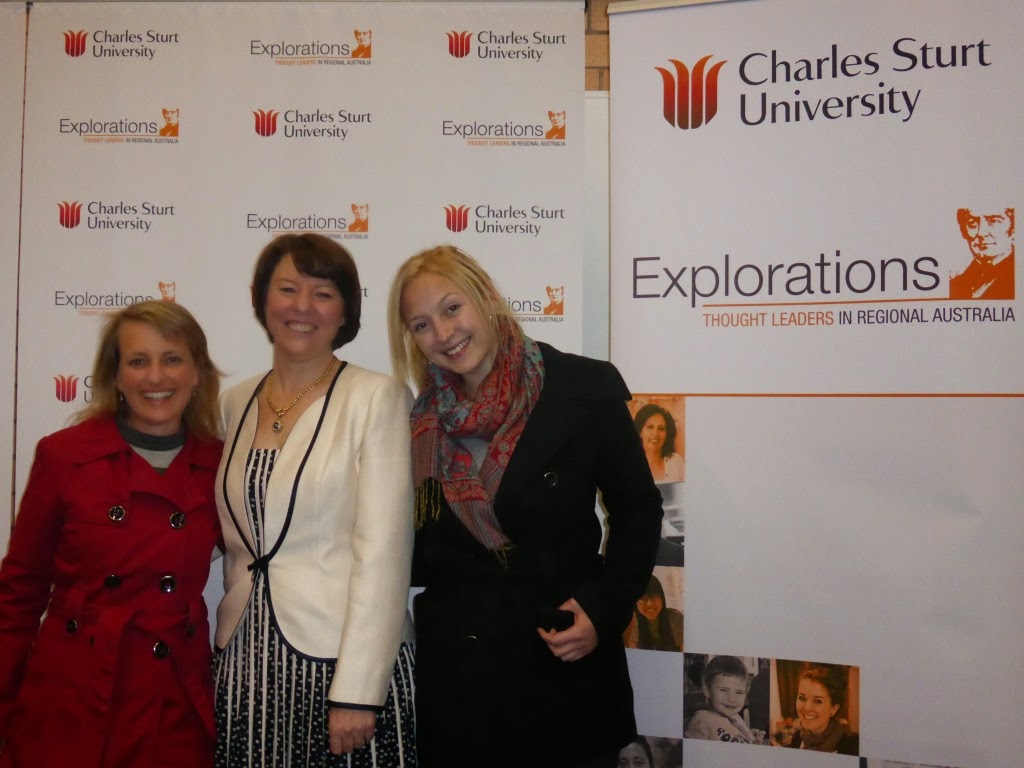 |
| Bathurst speech pathologists at the CSU public lecture: Christine Porter, Sharynne, and Jess Bower |
Vietnamese consonants, vowels, and tones across dialects
The first major task of Ben Pham's PhD is to describe the consonants, semivowels, vowels, and tones for each of the seven dialects of Vietnamese. This is not an easy task. She is reading Vietnamese and English phonetics and phonology literature. Much of the literature describes the orthography of Vietnamese, and only some of it links the orthography to phonetic transcription. This week it has been good to have Ben's supervisory team all together. A/Prof Jane McCormack is visiting from Albury and we have enjoyed discussing Ben's PhD plans.
 |
| A/Prof Jane McCormack and Ben Pham discussing Vietnamese phonetics and phonology literature |
Video case studies
This week A/Prof Jane McCormack and I have been working together on our new book to be published by Oxford University Press: An Introduction to Speech, Language and Literacy. We have been finalising the transcripts from the video case studies. We have excellent videos of children aged 2, 4, 5, and 7 as well as of university students and a retired teacher. These videos will be a resource for each chapter and will be used to illustrate speech (phonetics and phonology), language (semantics, morphology, syntax, discourse), cognition, neurobiology, as well as the links between speech, language, and literacy.

Congratulations Karla

 Dr Karla Washington has been awarded the Excellence in Research Award for the College of Allied
Health Sciences at the University of Cincinnati for her research into children's language and literacy. I have been fortunate to work with Karla in her research program with Jamaican children.
Dr Karla Washington has been awarded the Excellence in Research Award for the College of Allied
Health Sciences at the University of Cincinnati for her research into children's language and literacy. I have been fortunate to work with Karla in her research program with Jamaican children.
August 15, 2014
The importance of our families
 |
| Ben's family in Australia |
 |
| Suzanne's family (and colleagues) in Sweden (at a conference) |
 |
| Sharynne's family in New Zealand (on holiday) |
Subscribe to:
Posts (Atom)