I am very happy to have a month of summer holidays to spend time with the most precious people in my life.

I am very happy to have a month of summer holidays to spend time with the most precious people in my life.

Last night Professor Julie Marshall and I met to consider the 67 submissions to the special issue of the International Journal of Speech-Language Pathology addressing “Sustainable Development Goals (SDGs) and people who experience communication and/or swallowing disability” We had an overwhelming response to our call for EOIs with many more submitted than we had imagined. The scope of work being undertaken across the world to support people who experience communication and/or swallowing disability is outstanding. We spent many hours deliberating about how to meet the page limits of the special issue. In the end we prioritised papers that met the following guidelines from our call for papers:
“Expressions of interest are sought from authors across the world in a variety of disciplines. Commentaries are encouraged from people who live and work in Majority World countries (including low and middle-income countries and small island states) and people who have lived experience of communication and / or swallowing disability. The aim is to cover EVERY SDG – so be creative.”
We are contacting authors regarding their outcomes today and tomorrow.

Today Sarah Verdon and I met for the last time to work on our Final Report to the Australian Research Council describing all we have achieved over the past 4 years during our VietSpeech ARC Discovery Grant (DP180102848). Wow! We have been so productive and our research has impacted so many people in Australia and across the world. We are really proud of our team.
The CSU Director of Research stated that we had written "a good report at the end of an excellent project".
In 2022, there are a few more papers to finalise, and Kate Margetson (PhD) and Sarah Faulks (Honours) will be continuing analysing some of the data, but from the perspective of CSU and the Australian Research Council we are officially finished.

Here is the abstract:
Purpose. Listening to children using age-appropriate techniques supports evidence-based clinical decision-making. In this paper we test the Sound Effects Study Drawing Protocol, an arts-based technique, to support children with speech sound disorder (SSD) to express their views about talking.
Method. Participants were 124 Australian children aged 4- to 5-years in the Sound Effects Study. Their parents and teachers were concerned about their talking and they were assessed as having SSD on the Diagnostic Evaluation of Articulation and Phonology. Drawings and children’s interpretations were elicited then analysed using the: (1) Who Am I? Draw-a-Person Scale and (2) Sound Effects Study Focal Points.
Results. Drawings were developmentally typical for 4- to 5-year-olds. The six Sound Effects Study Focal Points were identified: Body parts and facial expressions, Talking and listening, Relationships and connection, Positivity, Negativity, and No talking. Participants portrayed talking and listening as an action requiring mouths and ears represented by symbols (letters, speech bubbles) or as an activity with a variety of people. Children typically portrayed themselves as happy when talking; however, some portrayed negativity and some chose not to draw talking.
Conclusions. In keeping with Articles 12 and 13 of the Convention on the Rights of the Child (United Nations, 2009), this research demonstrated that 4- to 5-year-old children with SSD can express their views about talking via drawing. Professionals may use drawings as a child-friendly technique to support children to express views to guide holistic, evidence-based, child-centred speech-language pathology practice.
I have received an invitation to receive ASHA Board Certification in Child Language www.ChildLanguageSpecialist.org:
Congratulations from the American Board of Child Language and Language Disorders (ABCLLD) on receiving Honors of the association! As you know, the mission of the ABCLLD is to promote high-quality services by speech-language pathologists to children and adolescents. To meet this charge, the Board encourages exemplary clinicians and administrators to apply for certification of their expertise in child language. Because you are a leader in child language and have been recognized by ASHA for your advanced knowledge, skills, leadership, and experience, you are invited to receive Board Certification in Child Language (BCS-CL).
I am the first International Affiliate to receive ASHA Honors, so Linda Schreibner (Chair, American Board of Child Language and Language Disorders) wrote:
It is because of you -- as the first person in the world to receive ASHA Honors as an International Affiliate and ASHA’s new position on equivalent certifications -- that we were able to revise our requirements. We would be honored if you would consider becoming Board Certified in Child Language.
Thank you!

It is almost Christmas and summer in Australia and the nation is thinking about holidays. Some universities are already closed for the summer holidays. Charles Sturt University closes on Christmas Eve (24 December) and reopens on 4th January. Most academic staff take their four weeks of annual leave from just before Christmas and do not return to work until late January/February.
I work with people all across the world. Many countries do not celebrate Christmas. Many countries celebrate Lunar New Year in February, not the Western calendar New Year in January.
As a result, for many people it is business as usual at the moment, and for some it is their busy time of year as it is cold and wintery - so they are in their offices working hard.
Each year at this time, I find it tricky to navigate my need for a holiday and to celebrate with my community with the work-based needs of my international colleagues. For example, here is a Doodle Poll I received today for an executive board meeting for an international association.

 |
| Proud PhD supervisors: Sarah Verdon, Sharynne, Suzanne Hopf |
This is an interesting new article: Grover, V., Namasivayam, A., & Mahendra, N. (2021). A viewpoint on accent services: Framing and terminology matter. American Journal of Speech-Language Pathology. https://doi.org/10.1044/2021_AJSLP-20-00376
It includes a discussion of intelligibility enhancement, a term coined by Helen Blake and used within her PhD research:
“A key issue is whether terms like accent modification, accent reduction, or accent elimination are misnomers, as researchers have questioned whether accents can be completely changed or eliminated in adulthood (Celce-Murcia et al., 1996; Flege et al., 1995). We consider the term intelligibility enhancement (Blake, 2020) as a more accurate descriptor of services because of its emphasis on a shared responsibility for intelligibility, successful speaker–listener interactions, and on functional communication in context. On critical analysis, however, even this descriptor “intelligibility enhancement” is inadequate and misrepresentative because it fails to convey that an accented speaker is fully intelligible in their L1 (if not English) and also intelligible in their accented English or World English to speakers who share their linguistic or cultural background or who have been previously exposed to their accent...”
Here are Dr Van Tran's SBS Radio Broadcasts to date. Her program was first broadcast in October 2021 and was rated in November as the Highest Performing Language Other than English (LOTE) content (among SBS programs in 68 other languages) with 10 thousand unique Australian visitors.
|
12/12/2021 |
Cùng giữ tiếng Việt: Nói ngọng là tại hướng đình? [Maintaining Vietnamese together: Children’s communication disorders and home language maintenance] https://www.sbs.com.au/language/vietnamese/audio/noi-ngong-la-tai-huong-dinh |
|
5/12/2021 |
Cùng giữ tiếng Việt: Thuận vợ thuận chồng, khác “tông” con vẫn không lạc tiếng [Maintaining Vietnamese together: One parent one language policy - Successful home language maintenance in intermarriage families ] https://www.sbs.com.au/language/vietnamese/audio/thuan-vo-thuan-chong-khac-tong-van-khong-lac-tieng |
|
28/11/2021 |
Cùng giữ tiếng Việt: Như thế nào là tiếng Việt chuẩn? [Maintaining Vietnamese together: What is standard Vietnamese?] https://www.sbs.com.au/language/vietnamese/audio/nhu-the-nao-la-tieng-viet-chuan?fbclid=IwAR2W_O33cHAOJSPL10WRmBJybXQh0PiPu8V0Er94GmHzMBVjOxmz5UuJF3g |
|
21/11/2021 |
Cùng giữ tiếng Việt: Nghe các bạn teen nói [Maintaining Vietnamese together: What do teens say about Vietnamese language maintenance?] https://www.sbs.com.au/language/vietnamese/audio/cung-giu-tieng-viet-nghe-ca-c-ba-n-teen-noi?fbclid=IwAR3rnjX5CperYUJUGdd4bbBqzUuNLu3VpopuN326g-OTgnuQceKsah1FAy4 |
|
14/11/2021 |
Cùng giữ tiếng Việt: Bố mẹ có đơn thương độc mã khi giữ tiếng Việt cho con? [Maintaining Vietnamese together: Are parents the only “gatekeepers” in home language maintenance?] https://www.sbs.com.au/language/vietnamese/audio/cu-ng-giu-tie-ng-vie-t-bo-me-co-don-thuong-doc-ma-khi-giu-tieng-viet-cho-con?fbclid=IwAR26eySa9OrpBJULdZ2T6qHFCgHp8LjpGUQhfd--vENHR3LiaGzICYNN8x4 |
|
7/11/2021 |
Cùng giữ tiếng Việt: Tôi đã giúp con học tiếng Việt như thế nào? [Maintaining Vietnamese together: How did I help my children maintain Vietnamese?] sbs.com.au/language/vietnamese/audio/toi-da-giup-con-giu-tieng-viet-nhu-the-nao?cid=lang%3Asocialshare%3Afacebook&fbclid=IwAR3IVabIA1j9HYVkgE14_lzwgfiS2JhHAsv3FMIuETdKHJmbRb9H1-eM_BY
|
|
31/10/2021 |
Cùng giữ tiếng Việt: Có nên lo lắng về tiếng Anh khi giữ tiếng Việt cho con? [Maintaining Vietnamese together: Should I worry about English when maintaining home language?] sbs.com.au/language/vietnamese/audio/co-nen-lo-lang-ve-tieng-anh-khi-muon-giu-tieng-viet-cho-con
|
|
24/10/2021 |
Cùng giữ tiếng Việt: Em đã học tiếng Việt như thế nào? [Maintaining Vietnamese together: How did I learn Vietnamese?] https://www.sbs.com.au/language/vietnamese/audio/em-da-ho-c-tie-ng-vie-t-nhu-the-na-o?cid=lang%3Asocialshare%3Afacebook&fbclid=IwAR0NsP_RkCmDtwCiuJ3h9ZMyobvgzSW7DGVkVQDWmjWqKroK0Lu25kkwiFk |
|
17/10/2021 |
Cùng giữ tiếng Việt: Tại sao bạn lại muốn giữ tiếng Việt cho con? [Maintaining Vietnamese together: Why do you want your children to maintain Vietnamese?] sbs.com.au/language/vietnamese/audio/cu-ng-giu-tie-ng-vie-t-tai-sao-ba-n-lai-muon-giu-tieng-viet-cho-con?cid=lang%3Asocialshare%3Afacebook&fbclid=IwAR1IrZJcgxba___iGZ_oCSbcrRmmm-SV_s9Y_65g76YSsYbDO1Nsl21Lco8
|
|
5/2/2021 |
VietSpeech SuperSpeech: Supporting Viet families to maintain home language and develop bilingualism https://www.sbs.com.au/language/vietnamese/audio/the-he-thu-hai-day-tieng-viet-va-phat-trien-song-ngu-cho-con-voi-du-an-vietspeech?fbclid=IwAR17CgvIjcVx3fTGYc3tGKT5ro7w2J2cOBivW4R4fwqVD-HMu2hRdSqWiyg |
The following manuscript from our ARC Discovery Grant has just been accepted for publication
McLeod, S., Verdon, S., Tran, V. H., Margetson, K., & Wang, C. (2021, in press). SuperSpeech: Multilingual speech and language maintenance intervention for Vietnamese-Australian children and families via telepractice. Language, Speech, and Hearing Services in Schools.
Here is the abstract
Purpose. To evaluate the effectiveness of the group VietSpeech SuperSpeech program targeting speech skills and home language maintenance via telepractice.
Method. In Stage 1 of this pilot feasibility study using a case-controlled design, 30 Vietnamese-English-speaking children were assessed in English and Vietnamese and parents completed questionnaires about speech and language competency and practices. During Stage 2, children were allocated to Intervention (n=14) or Control (n=16) conditions. COVID-19 restrictions resulted in changes including non-random allocation. Online group intervention was delivered 1-hour/week for 8 weeks encouraging multilingualism as a superpower. For Stage 3, assessments were undertaken approximately 10 weeks after the pre-intervention assessment.
Results. Parents in the Intervention group significantly increased encouragement of their children to speak Vietnamese. The Intervention group significantly increased intelligibility in English. Growth of Vietnamese vocabulary was faster for the Control group. There was a moderate effect of intervention for children’s perception of being happy talking in Vietnamese and English. There was no significant mean change from pre- to post-intervention compared with the Control group for measures of speech sound accuracy in Vietnamese or English, Vietnamese intelligibility, English vocabulary, or hours of Vietnamese spoken each week.
Conclusions. This study presents preliminary evidence that this 8-hour online group program targeting speech skills and home language maintenance had some impact on Vietnamese-Australian children’s speech and home language maintenance. Further research involving a randomized trial is warranted.

Our School of Education Christmas Party was online again...
...and included conversation about the dramatic rise in COVID cases over the past few days (NSW has 2,213 cases in the past 24 hours, 93.3% double vaccinated) and the potential impact on Christmas and holiday celebrations. Charles Sturt University issued an email this morning to all students and staff indicating that to be on campus in 2022 people need to be double vaccinated.

Today I met with Caitlin Hurley and Robert from the University of Western Australia. Caitlin is undertaking a Doctorate in Clinical Dentistry and 30% of the degree involves research. I will be collaborating with Caitlin and her primary supervisor Robert to support her research into the relationship between the primary dentition and children's speech. I look forward to this new collaboration.

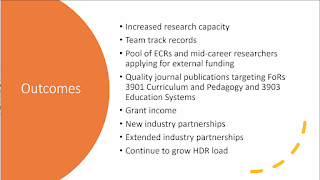
Congratulations to the successful applicants in the Charles Sturt University Early Career Researcher (ECR) Grant Scheme (AUD $25,000). The following people that I mentored have been informed this morning that they were successful:
Look at the list of Associate Editors for Speech, Language and Hearing. Three are my ex-PhD students and two ex-students are on the Editorial Board. I am so proud of them!
Editor in Chief: Dr Anna Miles, New Zealand
Associate Editors
Editorial Board
It has been wonderful to work with Belinda Downey on her PhD during 2021. I have enjoyed working with Belinda and her two supervisors Will Letts and Tamara Cumming. Here is a photo from our meeting today.
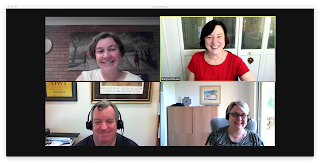 |
| Belinda, Sharynne, Will, Tamara |