June 25, 2013

Resourcing speech pathologists to work with multilingual clients: From Arabic to isiZulu

Today I presented the Elizabeth Usher Memorial Address to the Speech Pathology Australia National Conference on the Gold Coast. The abstract for my presentation is below. During the presentation relevant URLs were tweeted to the audience (see below). Here is the chirpstory containing the tweets from day 2 of the conference and the media release.

 
ABSTRACT
Resourcing speech pathologists to work with multilingual clients: From Arabic to isiZulu
Almost 7000 languages are spoken throughout the world, and many people speak more than one language. Speech pathologists across the world have critical roles to play in supporting children to be competent communicators in the languages of their communities. However, there is a mismatch between the languages spoken by children and families and the languages spoken by speech pathologists. Recent population studies of Australian preschool children show that the most common languages other than English are: Arabic, Vietnamese, Italian, Spanish, and Greek; whereas, Speech Pathology Australia members frequently offer services in: Auslan, French, Italian, Greek, and Cantonese. The need for accessible culturally and linguistically appropriate resources for working with multilingual children has been highlighted in international surveys. For example, Guiberson and Atkins (2012) found that only 51% of speech pathologists were  confident in assessing and providing intervention for multilingual children. Recent international collaborations have resulted in innovative and practical strategies to support speech pathologists during assessment, intervention, and collaboration with families, communities, and other professionals. The International Expert Panel on Multilingual Children’s Speech was assembled to prepare a position paper to address issues faced by clinicians in working with multilingual populations. The new Multilingual Children’s Speech website fulfils one of the aims of the position paper by providing resources and information for speech pathologists in over 30 languages. The recent international collaborations have been framed around the World Health Organization’s International Classification of Functioning, Disability and Health (ICF-CY) and have been established with the goal of supporting  multilingual children to participate in society.
Chris Stone (President of Speech Pathology Australia) presenting the Elizabeth Usher Award
Links
UNESCO Do one thing for diversity
https://www.facebook.com/DoOneThingforDiversityandInclusion   
Early Years Learning Framework
http://foi.deewr.gov.au/system/files/doc/other/belonging_being_and_becoming_the_early_years_learning_framework_for_australia.pdf    
The cultural and linguistic diversity of 3-year-old children with hearing loss
http://jdsde.oxfordjournals.org/content/17/4/421.abstract   
Factors contributing to language use for multilingual children with hearing loss
http://clt.sagepub.com/content/29/1/111.abstract    
Influence of bilingualism on speech production: A systematic review
http://onlinelibrary.wiley.com/doi/10.1111/j.1460-6984.2012.00178.x/abstract   
Prevalence of speech and language concern for Australian children
http://jslhr.asha.org/cgi/content/full/52/5/1213   
Speech-language pathologists’ assessment and intervention practices with multilingual children
http://informahealthcare.com/doi/abs/10.3109/17549507.2011.636071  
Multilingual children’s speech position paper
http://www.csu.edu.au/research/multilingual-speech/position-paper   
Multilingual children’s speech acquisition
http://www.csu.edu.au/research/multilingual-speech/speech-acquisition   
Children's acquisition of Hong Kong Cantonese consonants, vowels, and tones
http://jslhr.asha.org/cgi/content/abstract/56/1/103   
Non-English speech assessments
http://www.csu.edu.au/research/multilingual-speech/speech-assessments   
English validation of Intelligibility in Context Scale
http://jslhr.asha.org/cgi/content/abstract/55/2/648   
Intelligibility in Context Scale
http://www.csu.edu.au/research/multilingual-speech/ics   
Comparison between the speech sounds of English and other languages
http://www.csu.edu.au/research/multilingual-speech/languages  
Multilingual and multicultural considerations in speech-language pathology
http://informahealthcare.com/toc/asl/14/6   
World Report on Disability and people with communication disability
http://informahealthcare.com/toc/asl/15/1   
Working in a Culturally and Linguistically Diverse Society: SPA position paper

http://www.speechpathologyaustralia.org.au/library/Clinical_Guidelines/Working_in_a_CALD_Society.pdf
  
References
Guiberson, M., & Atkins, J. (2012). Speech-language pathologists’ preparation, practices, and perspectives on serving culturally and linguistically diverse children. Communication Disorders Quarterly, 33(3), 169-180.

World Health Organization (2007). International Classification of Functioning, Disability and Health: Children and Youth Version (ICF-CY). Geneva, Switzerland: Author.
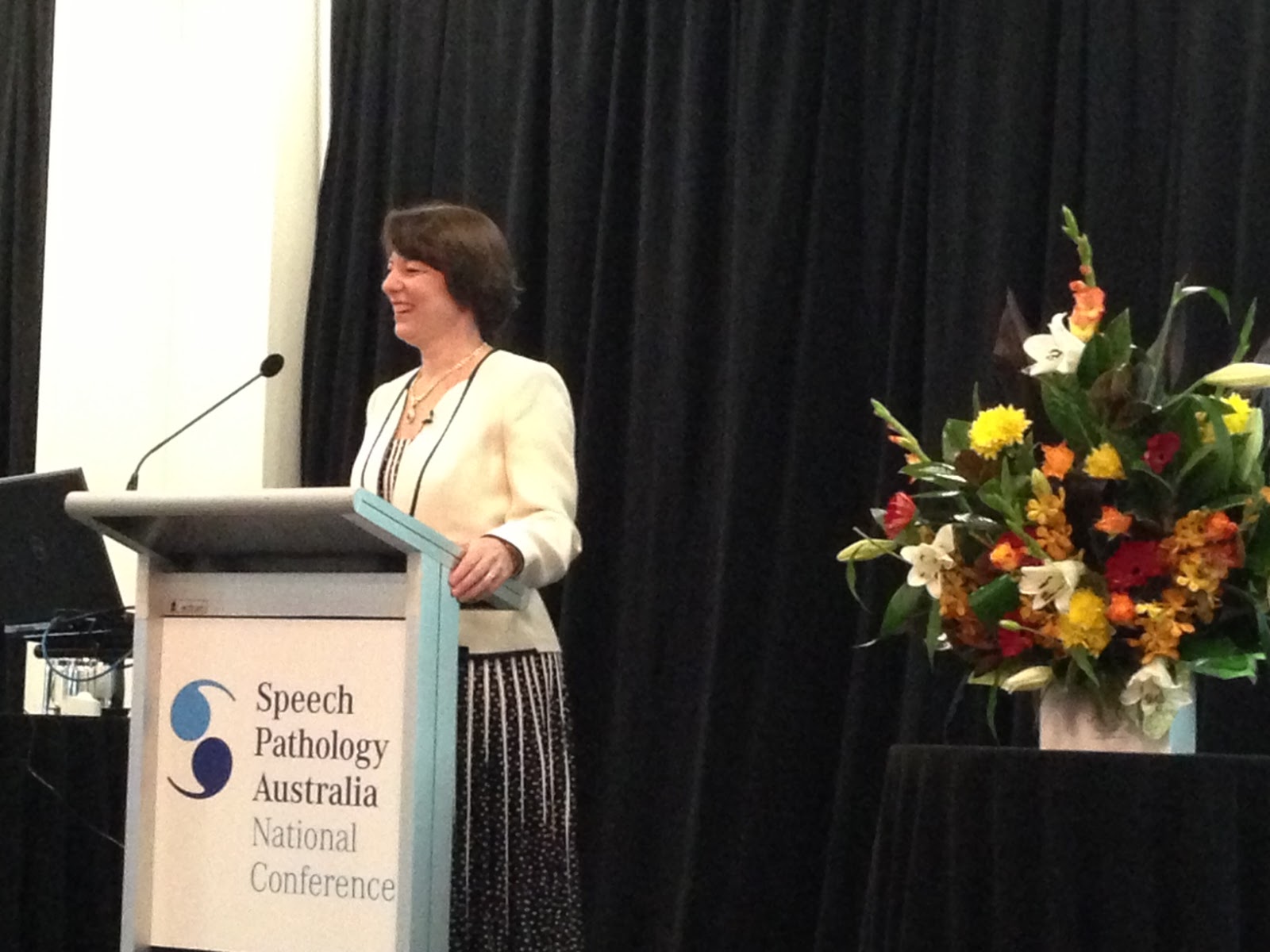

Sharynne presenting the Elizabeth Usher Memorial lecture
 

June 24, 2013

Presentations at the Speech Pathology Australia National Conference

This week I am co-presenting the following papers with my students and colleagues at the Speech Pathology Australia National conference on the Gold Coast in Queensland:
  • McLeod, S. Resourcing speech pathologists to work with multilingual clients: From Arabic to isiZulu. Invited Elizabeth Usher Memorial Address. 
  • Crowe, K. & McLeod, S. Children with hearing loss who use languages other than English: A systematic review of language outcomes.
  • Crowe, K., McLeod, S. & Ching, T. Y. C. 3-year-old Australian children with hearing loss: Cultural and linguistic diversity. 
  • Limbrick, N., McCormack, J., McLeod, S. Speech pathologists' decision-making when creating informal measures for assessing children's speech.
  • Verdon, S. & McLeod, S. A geographical perspective of services to support multilingual Australian children.

The conversations and collaborations that occur as part of the conference are always inspiring and encouraging.
My PhD students are all in one location!
Suzanne Hopf, Kate Crowe, Sharynne, Sarah Masso, Sarah Verdon
Sarah Verdon presenting her paper

June 14, 2013

First set of data for Sound Start study

This week, while I have been in Viet Nam, Kate Crowe and Sarah Masso have collected the first set of screening data for our Sound Start study. Our aim is to collect screening data on 300 children this year - so it is exciting that the screening phase has begun.

Innovations from the speech therapy profession in Viet Nam

On Thursday I was invited to give a 2.5 hour continuing professional development lecture to the graduate and student speech therapists in Viet Nam. I began the lecture outlining some of the innovations I had undertaken since I last saw them in 2011 (e.g., Multilingual Children's Speech website). Then I invited members of the audience to share their innovations. I was so thrilled to see how they had applied what they had learned during their lectures in 2011 to their professional practice. Graduates and students from Children's Hospital Number 1, Children's Hospital Number 2, the Ear Nose and Throat Hospital, and the Orthopedic and Rehabilitation Hospital all showcased their assessment and intervention resources (see photos below). Dr Ly Kha also described her normative research undertaken with teachers. We then outlined a plan to collaborate to develop one speech sampling assessment tool for Viet Nam, and collect  normative data by speech therapists using International Phonetic Alphabet transcription. The Vietnamese speech therapists are so hard working and dedicated, I look forward to seeing this important innovation come to fruition.

Vietnamese Speech Therapy Graduates and Students (Mr Dien on left)
Speech resources for children developed at Children's Hospital Number 1
Speech resources for children developed at Children's Hospital Number2
Speech resources for children developed at Ear Nose and Throat Hospital
Speech resources for children developed at Orthopedic and Rehabilitation Hospital

June 12, 2013

Typical Vietnamese preschoolers

Yesterday the speech therapy students from Phạm Ngọc Thạch University visited a preschool. We spent time looking at the preschool, participating in songs and games, and playing with the children. Next, six children visited us and we worked in small groups to practice assessing the children's speech. The children taught us all a lot. We had a lot of practice transcribing online and keeping children's attention. We also had a chance to test the stimulus items in our newly developed speech tests to see if we needed to make changes (and we did!)
The next day members of the class gave me extremely valuable feedback on the pilot version of the International Speech Screen for Vietnamese.

June 10, 2013

Trinh Foundation

The speech therapy program at Pham Ngoc Thach University in Ho Chi Minh City was established by the Trinh Foundation (http://www.trinhfoundation.org/), a not-for-profit organisation with the following mission:
¨ To improve the quality of life of the many Vietnamese children and adults who suffer from communication and swallowing disorders.
¨ To address this problem by continuing to raise the awareness in Vietnam of Speech-language Therapy as a profession. 
¨ To provide the knowledge, clinical skills and finance to establish formalised educational courses in Speech-language Therapy in Vietnam.  This will allow the Vietnamese people themselves, to successfully manage communication and swallowing disorders such as those arising from head injury, cleft conditions, hearing impairment, autism, developmental delay and head and neck cancer.

Vietnamese minimal pairs

Over the weekend Ms Xuan showed me her compilation of Vietnamese minimal pairs for use in minimal pairs and multiple oppositions intervention for children with speech sound disorders. In tone languages, such as Vietnamese, to create a minimal pair you need to consider the consonants, vowels, and tones. So, if you change a consonant within a word, then you need to match the vowel and the tone. For example,
nho2 – đo2. Ms Xuan is going to make her comprehensive resource into a book, written in Vietnamese and English,  for use by speech pathologists/therapists with children with speech sound disorder. It may also be useful for use with adults with dysarthria and for people learning to speak Vietnamese. The words will be written in Vietnamese, International Phonetic Alphabet transcription, and English. I am looking forward to seeing it published.
Ms Xuan showing words for Vietnamese multiple oppositions intervention

June 8, 2013

Studying typical Vietnamese speech acquisition in over 1000 children

Dr Ly Kha Nguyen is a phonetics and linguistics lecturer at Phạm Ngọc Thạch University and at the HCMC University of Education and Training. She has undertaken a study of typical Vietnamese speech acquisition in over 1000 children in Ho Chi Minh City and surrounding areas. She has invited Ms Xuan and myself to work with her to analyse the data and work towards publishing the data in an English journal. We had many discussions about her research plans in 2011 - so it is extremely exciting to see that the data have now been collected and the first phase of analysis has been undertaken. On Thursday we spent four hours together discussing the data and writing the first draft of the article. With Ms Xuan's excellent interpreting skills it did not seem that Dr Ly Kha and I spoke different languages - and we were so engrossed in our conversation that we missed lunch! (Each day at the university there is a 2 hour lunch break from 11:30-1:30 where the students eat, then lay out their silk cloth on the ground and have a sleep. Typically that is when English-speaking staff have lunch and meetings). We have planned to keep working on the paper together next week. This paper will form a useful first step for working with children with speech sound disorders in Vietnam. These data will provide a preliminary benchmark for decision-making regarding children’s need for speech-language pathology services and for planning appropriate intervention goals.
Ms Xuan, Dr Ly Kha, and Sharynne

June 6, 2013

Learning about Vietnamese every chance I get

While in Việt Nam, I am trying to learn more about Vietnamese. It is a complex language with 6 tones (thanh) and different pronunciations of consonants depending on the region of Vietnam. For example, the letter "d"  is pronounced as /j/ in the south and /z/ in the north.
Some of the people I am learning from include:
  • Dr Ly Kha, the linguistics lecturer from Ho Chi Minh University of Education and Training.
  • Ms Xuan, a new graduate speech therapist who has been my co-teacher and interpreter for the two weeks.
  • Dr Alison Winkworth (from Charles Sturt University) who is a director of the Trinh Foundation, and is in Vietnam for one month. Each day she attends language classes and then tells me about what she has learned that day.
  • Mr Truc, our Vietnamese guide on the Mekong River - who happily chatted about the International Phonetic Alphabet (IPA) that he had learned to enhance his pronunciation of French and English.
Mr Truc - our guide on the Mekong River who uses the IPA

Speech therapy students at Phạm Ngọc Thạch University

Students having fun during a tutorial as they practiced giving speech assessments
(one was the speech therapist, one was the child,
one was the transcriber, one was the teacher/advisor)
Sharynne and Ms Xuan with the speech therapy students at PNTU
The speech therapy students at Pham Ngoc Thach University are very dedicated to learning. They ask many questions, participate wholeheartedly in class discussions, and are committed to co-founding the speech therapy profession in Viet Nam with the first speech therapy graduates. Today we enjoyed discussing how to create and use speech assessments with different children. Ms Xuan (who is interpreting and assisting with teaching) has provided helpful advice and examples from her clinical practice.
Sharynne and Ms Xuan lecturing to the students

June 4, 2013

Teaching and learning at Pham Ngoc Thach University, Việt Nam

Over the next two weeks I am volunteering at Pham Ngoc Thach Medical University, in Hồ Chí Minh City, Việt Nam. I am lecturing in their speech sound disorders class - as I did in 2011. Although I am their teacher, I am learning so much from the students, interpreters, and the new graduate speech therapists. I am very fortunate to have Ms Xuan as my interpreter and tutor for the two weeks. Ms Xuan was in the first cohort of speech therapy graduates in Vietnam - graduating in 2012. She visited me in Bathurst, and over the past two years has helped me to understand alot about the Vietnamese language and Vietnamese children. I am also very thankful to all I have learned from Dr Ly Kha Nguyen (Linguistics lecturer) in 2011 - my lectures are much better this year because of her help. Libby Brownlee (course coordinator), Caitlin Stewart (clinical coordinator) and Ms Thanh (interpreter) also have made me feel welcome and have been really helpful. I am also really pleased that Dr Alison Winkworth from Charles Sturt University, and a director of the Trinh Foundation, is in HCMC this week as well. We have worked together in different universities for over 20 years.
Sharynne at the entrance to PNTU
Sharynne, Ms Thanh, Libby Brownlee, Ms Xuan
Sharynne eating street food (bun) with Caitlin Stewart
Dr Alison Winkworth


June 3, 2013

Images of Việt Nam

Việt Nam is a vibrant and beautiful country. Here are a few contrastive images.
Motorbikes in Hồ Chí Minh City, Việt Nam
Lotus flowers - Viet Nam's national flower
Cai Be floating markets - Mekong River
Rice paddies

May 30, 2013

March - May 2013 Summary

AUSTRALIAN RESEARCH COUNCIL FUTURE FELLOWSHIP UPDATE ‘Speaking my language: International speech acquisition in Australia’ Written by Kim Woodland, Research Institute for Professional Practice, Learning and Education for the May 2013 RIPPLE Update
Sharynne has continued working on her Future Fellowship, participating in CRN-related research, launching the ARC Sound Start study in March, and supervising PhD students.

Back in January, Sharynne travelled to Jamaica with Karla Washington from the University of Cincinnati to study Jamaican children’s speech and language acquisition. Karla and a team from the University of Cincinnati continued the data collection, and 60 children have now had their speech and language skills in Jamaican and English assessed. The researchers are now analysing the data, in readiness for presenting their findings later this year.

In April, Sharynne attended the first meeting of Speech Pathology Australia's Australian Strategic Advisory Group on the International Communication Project. The aim of the intern
ational group is to foreground communication and people with communication disability. To date, five international professional organisations are involved in the discussions, with a focus on hosting events in 2014 and beyond.

Sharynne has also co-authored a manuscript outlining the work of the International Expert Panel on Multilingual Children’s Speech that met in Cork, Ireland in June 2012 and the resulting position paper.

McLeod, S., Verdon, S., Bowen, C., & the International Expert Panel on Multilingual Children’s Speech. (In press). International aspirations for speech-language pathologists’ practice with multilingual children with speech sound disorders: Development of a position paper. Journal of Communication Disorders.

Her journal article publication record for 2013 already looks outstanding: to date she has 6 articles submitted, 6 in press, and 7 published.

For more information, please visit Sharynne’s blog: Speaking my languages.