 |
| Helen Blake and Sharynne McLeod at UTS |
March 14, 2019
Meetings with Helen to support her PhD submission
Helen Blake is very close to submitting her PhD. Helen is an associate lecturer at the University of Technology Sydney. This week I worked with Helen in Sydney finalising her chapters so that her thesis will be ready for submission by the end of the month. Her PhD is titled "English proficiency, intelligibility, and participation of multilingual speakers in Australia" and consists of an exegesis, encyclopedia entry and eight journal articles!

March 13, 2019
Thank you to my early career mentors
This week I had the opportunity to say thank you to two of my early career mentors: Joan Rosenthal and Mark Onslow. Joan and Mark were my lecturers for my undergraduate degree at Cumberland College of Health Sciences (later The University of Sydney). Joan taught me phonetics and clinical education. She was my masters' thesis supervisor where she taught me how to think, write, use APA formatting and play Scrabble. Mark taught me stuttering, clinical processes, and later when I worked at The University of Sydney I worked with him to establish the honours program in speech pathology. They continue to inspire me.
 |
| Joan Rosenthal and Sharynne |
 |
| Prof Mark Onslow and Sharynne at the Australian Stuttering Research Centre, University of Technology Sydney |
March 12, 2019
Adjunct Professor at University of Technology Sydney
I have been appointed as an Adjunct Professor at University of Technology Sydney (UTS) in the Graduate School of Health and the Speech Pathology program. This week I visited UTS and had the opportunity to meet the staff and masters students.
I was invited to teach the speech sound disorders class on Articulatory Foundations of Speech (based on chapter 3 of Children's Speech). What an enthusiastic and keen group of students - it was a joy to meet everyone.
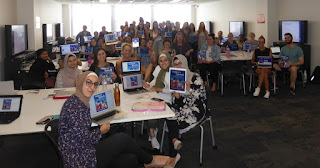


I was invited to teach the speech sound disorders class on Articulatory Foundations of Speech (based on chapter 3 of Children's Speech). What an enthusiastic and keen group of students - it was a joy to meet everyone.
 |
| UTS Speech Pathology Staff Back: Helen Blake, Melissa Brunner, Catherine Gregory, Harmony Turnbull Front: Lucy Bryant, Ben, Sharynne McLeod, Bronwyn Hemsley |


March 11, 2019
Functional Word Lists for Indigenous Languages of the South Pacific: QUOTA Scholarship
Congratulations Dr Suzanne Hopf who has just received a QUOTA South Pacific Area Scholarship for Work in the Fields of Speech and Hearing. Her research grant is titled "Functional Word Lists for Indigenous Languages of the South Pacific"
Here is the abstract:

Here is the abstract:
Communication specialists rely on data that document children’s typical speech and language development when diagnosing and treating speech and language disorders in children. In many South Pacific nations there are no recognised communication specialists or recognised tools to assist with this process (e.g., Fiji – see Hopf, 2013; 2017). Thus, suspected diagnoses are mostly based on implicit language knowledge within communities. Tools that can assist with early diagnosis and treatment of communication disability are needed to support communication specialists working with children from language groups other than their own. In alignment with the aims of the 2019 UNESCO International Year of Indigenous Languages (IY2019), this ambitious project will bring together speakers of Pacific Islands indigenous languages, and communication specialists from around the world, to create consensus functional word lists for indigenous languages of the South Pacific nations of Fiji, Tonga, Samoa, and Vanuatu. Significantly, this project will capitalise on a network of communication specialists who will work together beyond the stated languages to continue to document functional word lists in all of the indigenous and immigrant languages of the South Pacific. These word lists will be invaluable for communication specialists working both within and outside the South Pacific with people with communication disability who speak these languages.

March 9, 2019
Children with speech sound disorders at school: Challenges for children, parents and teachers
The following article has been downloaded 5258 times in the past 2 years!
Daniel, G. R. & McLeod, S. (2017). Children with speech sound disorders at school: Challenges for children, parents and teachers. Australian Journal of Teacher Education, 42(2), 81-101. Retrieved from http://ro.ecu.edu.au/ajte/vol42/iss2/6
The readership distribution is shown here:
https://readership.works.bepress.com/?dashboardToken=5c836580e38586085e879195o3dT3LDOioRvoeVvuRCC0sTfO9CIu6XeBv1C8Zdp

Daniel, G. R. & McLeod, S. (2017). Children with speech sound disorders at school: Challenges for children, parents and teachers. Australian Journal of Teacher Education, 42(2), 81-101. Retrieved from http://ro.ecu.edu.au/ajte/vol42/iss2/6
The readership distribution is shown here:
https://readership.works.bepress.com/?dashboardToken=5c836580e38586085e879195o3dT3LDOioRvoeVvuRCC0sTfO9CIu6XeBv1C8Zdp

March 8, 2019
International women's day
I am fortunate to work with incredible women across the world. On international women's day I spent time celebrating and sharing with some exceptional women in Bathurst from the fields of speech-language pathology, nursing and early childhood education.
Did you know that speech-language pathology professional associations in Australia, US and UK are approximately 97% women?
 |
| Sharynne and Nicole McGill in the Begonia House, Machattie Park, Bathurst |
 |
| Professor Linda Sheilds and Sharynne |
 |
| Dr Tamara Cumming |
March 7, 2019
Nicole's statistical visit
This week Nicole McGill has been in Bathurst to work on statistics associated with her PhD research about waiting for speech pathology services. She had the opportunity to work closely with Dr Audrey Wang using SPSS and to translate this into writing journal articles. Her visit was funded by a Speech Pathology Australia Nadia Verrall Memorial Research Grant.
 |
| Nicole and Audrey working on SPSS |
 |
| Nicole, Sharynne, and Audrey discussing variables and outliers in the research data |
March 6, 2019
NSW Health Translational Research Grant team meeting
Today our NSW Health Translational Research Grant team met in Orange to begin writing our conference poster and journal article. We are almost finished collecting the data for our randomised controlled trial comparing advice, device, and therapy for children on speech pathology waiting lists. We spent a lot of time using the CONSORT statement to describe our sample, and prepare for writing. It was a very productive day.
 |
| Sharynne McLeod, Angela Roberts, Emily Davis, Sally Thornton, Nina Ahio, Kate Miller, Katrina Rohr, Nicole McGill |
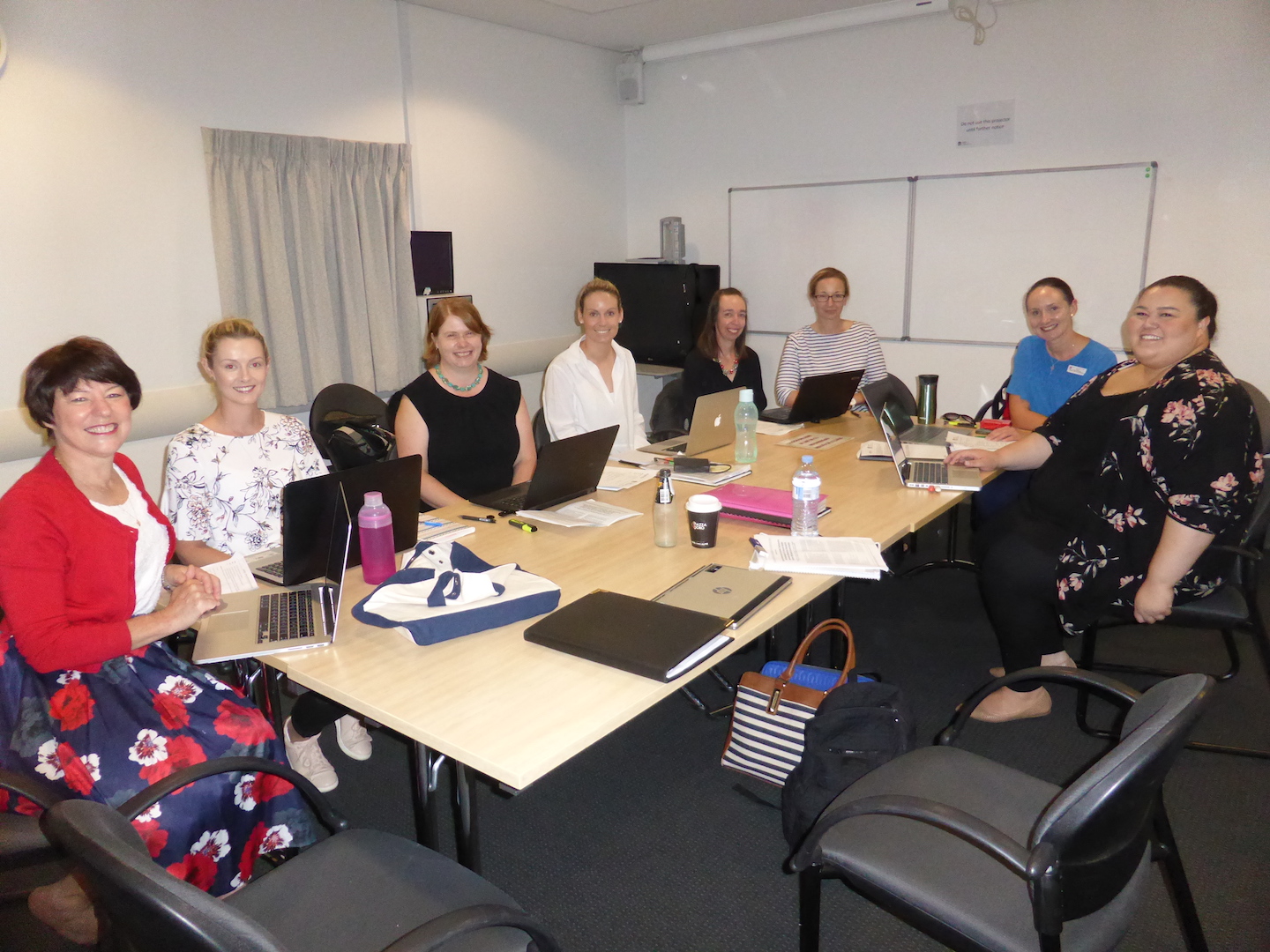 |
| Sharynne, Nicole, Emily, Kate, Angela, Sally, Katrina, and Nina hard at work |
February 27, 2019
Writing for public audiences
Today I attended an online seminar run by Charles Sturt University titled "Writing for Public Audiences". Here is the list of some recommended (mostly) Australian Internet media sites to submit articles:
February 25, 2019
Curriculum vitae workshop
Today I ran a workshop for the early career researchers in the SLM team to support them to compile/write a curriculum vitae. We discussed how it is good to have a master file that you constantly update, then select items when you are required to submit a CV for different purposes.
Each participant also considered example CVs from the SLM team in order to look for gaps/opportunities to add to their own CVs. It was a very productive and collaborative session.

Each participant also considered example CVs from the SLM team in order to look for gaps/opportunities to add to their own CVs. It was a very productive and collaborative session.

February 19, 2019
Van's productive visit to Bathurst
Over the past two days Dr Van Tran visited CSU in Bathurst to work with Dr Cen (Audrey) Wang and myself on her PhD research, which is part of our VietSpeech grant. During her visit we worked on four different journal articles: two for her PhD and two for the VietSpeech study. We submitted the first article based on Study 1 of our VietSpeech ARC Discovery Grant titled "Language proficiency, use, and maintenance among people with Vietnamese heritage living in Australia". We look forward to hearing from the editors and reviewers about whether it is suitable, and any changes we need to make. We also visited a peach orchard, and enjoyed the blooms in the Begonia House in Machattie Park. It was a productive and fun visit.
 |
| Dr Van Tran, Prof Sharynne McLeod, Dr Audrey Wang at CSU (it is quiet because it is the week before the students return) |
 |
| Van in the Begonia House in Machattie Park |
Exploring multilingual speakers’ perspectives on their intelligibility in English
The following manuscript has been accepted for publication. It forms part of Helen Blake's PhD research:
Blake, H. L., Verdon, S. & McLeod, S. (2019, in press February). Exploring multilingual speakers’ perspectives on their intelligibility in English. Speech, Language and Hearing.
50 free copies are available from this link: https://www.tandfonline.com/eprint/eJF8jisEZg7UkRtFFBIM/full?target=10.1080/2050571X.2019.1585681
Here is the abstract:
Blake, H. L., Verdon, S. & McLeod, S. (2019, in press February). Exploring multilingual speakers’ perspectives on their intelligibility in English. Speech, Language and Hearing.
50 free copies are available from this link: https://www.tandfonline.com/eprint/eJF8jisEZg7UkRtFFBIM/full?target=10.1080/2050571X.2019.1585681
Here is the abstract:
Multilingual speakers’ ability to communicate effectively and intelligibly in the language of their country of residence is crucial to their participation. This study explored multilingual speakers’ motivations for improving their intelligibility in English and their perceptions of potential barriers and facilitators to enhancing intelligibility. Participants were multilingual students and staff at 14 Australian universities. Extended response data from 137 survey responses were combined with seven semi-structured interviews, thematically analysed using the World Health Organization’s International Classification of Functioning, Disability and Health as a conceptual framework, and coded using NVivo software. Three overarching themes were: motivations, barriers, and facilitators. Themes that emerged under motivations were meeting their own and others’ expectations and career aspirations. Themes that emerged under barriers to intelligibility were lack of self-awareness of reduced English intelligibility, use of ineffective strategies (e.g., fast speech rate to disguise pronunciation difficulties), language differences, lack of opportunity to practise English, participants’ perceptions of others’ negative attitudes to their English skills, and challenging conversational partners. Facilitators to intelligibility were emotional support from others, beneficial strategies (e.g., confirming listener understanding), and opportunities to practice. The results highlight the importance of supporting multilingual speakers’ efforts to improve their English intelligibility. An environment with barriers such as lack of opportunity to practise English may restrict an individuals’ performance and participation, while facilitators such as support from others may increase participation. This study will inform the understanding of speech-language pathologists engaged in Intelligibility Enhancement, as well as SLPs working with multilingual speakers in any context.
February 14, 2019
ASHA's most shared articles in 2018
The American Speech-Language-Hearing Association has published a blog
today titled: In case you missed it: Our most shared articles of 2018.
https://academy.pubs.asha.org/2019/02/in-case-you-missed-it-our-most-shared-posts-of-2018/
The first article in the blog was ours!
Children’s Consonant Acquisition in 27 Languages: A Cross-Linguistic Review by Sharynne McLeod and Kathryn Crowe
Here is the altmetric score (275): https://asha.altmetric.com/details/47435915#score
It states:
https://academy.pubs.asha.org/2019/02/in-case-you-missed-it-our-most-shared-posts-of-2018/
The first article in the blog was ours!
Children’s Consonant Acquisition in 27 Languages: A Cross-Linguistic Review by Sharynne McLeod and Kathryn Crowe
Here is the altmetric score (275): https://asha.altmetric.com/details/47435915#score
It states:
"Altmetric has tracked 12,465,602 research outputs across all sources so far. Compared to these this one has done particularly well and is in the 99th percentile: it's in the top 5% of all research outputs ever tracked by Altmetric."
February 13, 2019
Maintaining Vietnamese
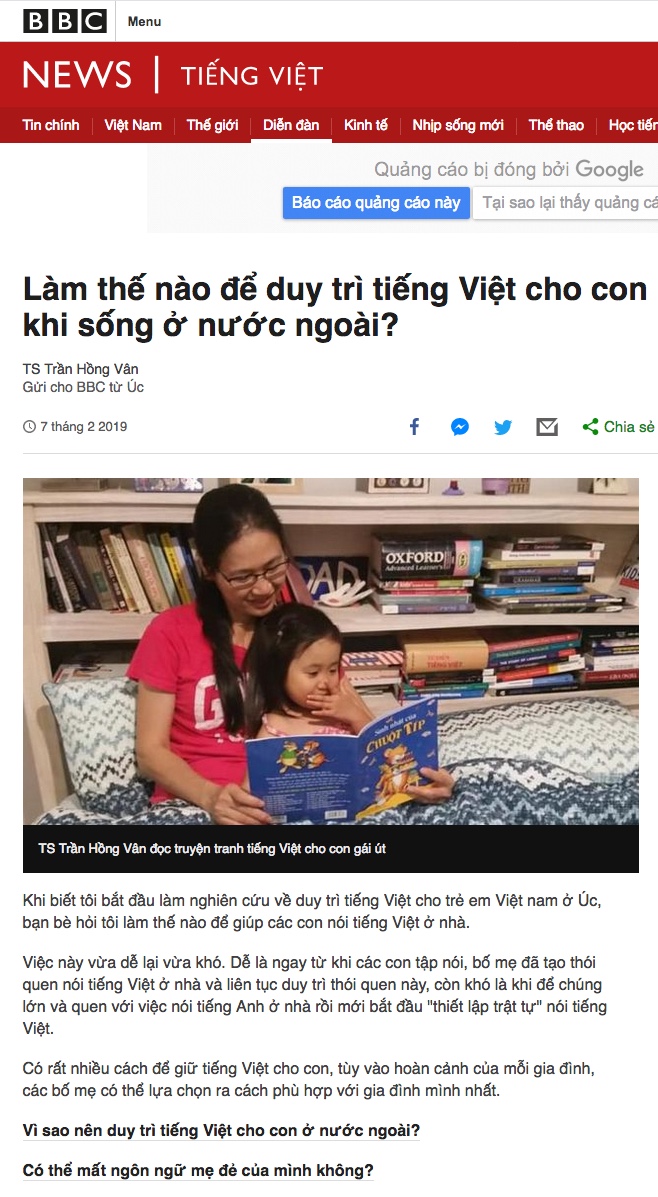
Dr Van Tran has written two excellent articles (in Vietnamese) for the BBC
- The benefits of maintaining Vietnamese as a home language (https://www.bbc.com/vietnamese/forum-47028662)
- How to maintain Vietnamese when living overseas (https://www.bbc.com/vietnamese/forum-47147158).
February 4, 2019
2019 students and postdocs
I am very fortunate to be working with some amazing women in 2019:
PhD students
Postdoctoral scholar
Research fellows
PhD students
- Helen Blake (CSU)
- Anna Cronin (CSU)
- Nicole McGill (CSU)
- Dr Van Tran (CSU)
- Natalie Hegarty (Ulster University, Northern Ireland)
- Anniek van Doornik (Utrecht University, The Netherlands)
Postdoctoral scholar
- Dr Michelle Brown
Research fellows
- Dr Audrey Wang
- Dr Ben Pham
- Dr Kate Crowe
- Dr Sarah Verdon
- Dr Suzanne Hopf
- Dr Sarah Masso
- Dr Jane McCormack
- Kate Margetson
Happy lunar new year
Today is the day many people around the world celebrate lunar new year.
Other members of the team are:
- Chúc Mừng Năm Mới (Happy New Year - Vietnamese)
- 恭贺新禧 (gōng hè xīn xǐ) (Happy New Year - Chinese)
Other members of the team are:
- Dr Sarah Verdon (Chief investigator)
- Dr Audrey Wang (Project Officer 1 day/week)
- Dr Van Tran (PhD student)
- Dr Ben Pham (Consultant, based in Viet Nam).
 |
| Kate Margetson (with Dr Audrey Wang and Prof Sharynne McLeod) |
January 25, 2019
Want to research speech pathology in Australia? CSU is the place
Charles Sturt University recently has written an article titled "Want to research speech pathology in Australia? CSU is the place" and has promoted it via social media. I was not aware of them writing it, but it is a great summary of our work, and encourages new students to come and work with our team: https://insight.futurestudents.csu.edu.au/want-to-research-speech-pathology-in-australia-csu-is-the-place. I look forward to hearing from passionate, hardworking students who wish to join us.
January 15, 2019
Congratulations Natalie on your PhD submission
Today Natalie Hegarty submitted her PhD at Ulster University in Northern Ireland. Her thesis was titled: "Supporting speech and language therapists' application of evidence-based practice in the management of phonological speech sound disorders". Congratulations Natalie!
I have been fortunate to be on Natalie's supervisory team with Dr Jill Titterington and Laurence Taggart from Ulster University. Her viva will be held in March.
Here is the abstract:
I have been fortunate to be on Natalie's supervisory team with Dr Jill Titterington and Laurence Taggart from Ulster University. Her viva will be held in March.
 |
| Natalie Hegarty (image from Twitter @UlsterUniPhD) |
Here is the abstract:
Background: Speech and language therapists (SLTs) often use two elements of evidence-based practice in their management of children with phonological impairment (i.e., internal clinical data and child/parent preferences integrated through SLTs’ experiences), but do not regularly use the third element: research evidence. Indeed, SLTs often use long-standing approaches with developmental target selection criteria (e.g. conventional minimal pairs) despite some research suggesting that interventions with more complex target selection criteria (e.g. the complexity approaches or multiple oppositions) may provide greater system-wide change. Moreover, recent research has found that SLTs’ intervention intensity provision is lower than provision in the literature. Narrowing this research-practice gap is necessary to achieve evidence-based practice.
Aim: To support SLTs’ use of evidence-based practice in the clinical management of children with phonological impairment.
Methods: This thesis used an explanatory sequential mixed methods design. There were five stages: (1) systematic review; (2) online survey; (3) focus groups and interviews; (4) resource co-production workshops and; (5) face validity exploration. This thesis was guided by the Medical Research Council, the Knowledge to Action framework and the Intervention Mapping framework, including the use of logic modelling and the socio-ecological model.
Findings: Using information gathered throughout this thesis and through co-production with SLTs, this work resulted in the development of an online, evidence-based resource that aims to support SLTs’ use of research in practice in the clinical management of children with phonological impairment. The resource is called SuSSD (Supporting and understanding Speech Sound Disorder) and was found to have high face validity.
Conclusion: Integrating SuSSD into SLTs’ decision-making should support their use of research in practice and improve outcomes for children with phonological impairment. Further research is necessary to determine if SuSSD can effectively increase SLTs’ use of research in practice and improve speech outcomes for children with phonological impairment.
What do children with speech sound disorders think about their talking?
The following manuscript has been accepted for publication
McCormack, J., McLeod, S., & Crowe, K. (in press). What do children with speech sound disorders think about their talking? Seminars in Speech and Language.
Here is the abstract:
McCormack, J., McLeod, S., & Crowe, K. (in press). What do children with speech sound disorders think about their talking? Seminars in Speech and Language.
Here is the abstract:
Investigating children’s feelings and attitudes toward talking assists speech–language pathologists (SLPs) to understand experiences of communication and the impact of speech sound disorders (SSD). This, in turn, can assist SLPs in identifying appropriate intervention for children with SSD that addresses the needs of children, and their communication partners. This paper draws on data from the Sound Start Study in Australia to explore the attitudes toward talking of 132 preschool-aged children with SSD and the relationship between children’s attitudes, speech accuracy, and parent-reported intelligibility and participation. Most of these children with SSD had a positive attitude toward talking. There was a significant relationship between children’s attitudes toward talking and speech accuracy. Furthermore, there was a significant relationship between speech accuracy and parents’ perceptions of intelligibility and participation. However, there was no significant relationship between children’s attitudes and parents’ perceptions. These results highlight similarities and differences between attitudes and experiences of preschool-aged children, their performance on clinical measures, and their parents’ perspectives, indicating the need for SLPs to consider each of these areas during assessment and intervention.
January 11, 2019
Communication milestones
Last year Speech Pathology Australia produced a Communication Milestones Poster. Recently we have been invited to contribute sections on multilingual speech acquisition as they plan to have it translated into a number of different languages.
Here are some references we used to update it:
Here are some references we used to update it:
- McLeod, S., & Crowe, K. (2018). Children’s consonant acquisition in 27 languages: A cross-linguistic review. American Journal of Speech-Language Pathology, 27, 1546–1571. doi:10.1044/2018_AJSLP-17-0100
- McLeod, S., Crowe, K., & Shahaeian, A. (2015). Intelligibility in Context Scale: Normative and validation data for English-speaking preschoolers. Language, Speech, and Hearing Services in Schools, 46, 266-276. doi:10.1044/2015_LSHSS-14-0120
Subscribe to:
Posts (Atom)