April 21, 2018

Children’s consonant acquisition in 27 languages: A cross-linguistic review

The following manuscript has been accepted for publication:
McLeod, S. & Crowe, K. (2018, in press April). Children’s consonant acquisition in 27 languages: A cross-linguistic review. American Journal of Speech-Language Pathology.

We believe that this will be a landmark publication - providing the most comprehensive cross-linguistic account of consonant acquisition ever undertaken in the world.

Here is the abstract:
Purpose: To provide a cross-linguistic review of acquisition of consonant phonemes to inform speech-language pathologists’ expectations of children’s developmental capacity by (1) identifying characteristics of studies of consonant acquisition, (2) describing general principles of consonant acquisition, and (3) providing case studies for English, Japanese, Korean, and Spanish. Method: A cross-linguistic review was undertaken of 60 papers describing 64 studies of consonant acquisition by 26,007 children from 31 countries in 27 languages: Afrikaans, Arabic, Cantonese, Danish, Dutch, English, French, German, Greek, Haitian Creole, Hebrew, Hungarian, Icelandic, Italian, Jamaican Creole, Japanese, Korean, Malay, Maltese, Mandarin (Putonghua), Portuguese, Setswana (Tswana), Slovenian, Spanish, Swahili, Turkish, and Xhosa. Results: Most studies were cross-sectional and examined single word production. Combining data from 27 languages, the majority of the world’s consonants were acquired by 5;0 (years;months). By 5;0 children produced at least 93 percent of consonants correctly. Plosives, nasals, and non-pulmonic consonants (e.g., clicks) were acquired earlier than trills, flaps, fricatives, and affricates. Most labial, pharyngeal, and posterior lingual consonants were acquired earlier than consonants with anterior tongue placement. However, there was an interaction between place and manner where plosives and nasals produced with anterior tongue placement were acquired earlier than anterior trills, fricatives, and affricates. Conclusion: Children across the world acquire consonants at a young age. Five-year-old children have acquired most consonants within their ambient language; however, individual variability should be considered.
Here is a graphic we have created to summarize the English consonant acquisition data

April 17, 2018

Chatting with colleagues

This morning my colleague Dr Tamara Cumming organised a morning tea so that the people in our building (who work in different departments) all had a chance to chat with one another. It was a happy occasion where we shared our interests. Events such as this are so important for collegiality and wellbeing.

April 14, 2018

Media attention regarding our teacher-child relationships paper

The following journal article has been profiled by Charles Sturt University's media department this week:

Wang, C., Harrison, L. J., McLeod, S., Walker, S., & Spilt, J. L. (2018). Can teacher–child relationships support human rights to freedom of opinion and expression, education and participation? International Journal of Speech-Language Pathology, 20(1), 133-141. doi:10.1080/17549507.2018.1408855

It is freely available (open access) here:
https://www.tandfonline.com/doi/full/10.1080/17549507.2018.1408855

The CSU media release is here: http://news.csu.edu.au/latest-news/education/teacher-education/early-teacher-child-relationships-vital-to-a-childs-ability-to-effectively-communicate-in-life

Cen (Audrey) has been interviewed about the journal article here:
The article and media release also has received attention on social media too:

Here is Audrey's summary of our findings that she presented on the radio (and available at Kudos https://goo.gl/uAZzMD):
Communication is a fundamental human right. We believe it is important for children, especially children with speech and language difficulties to have the ability to express themselves and debate in the public domain. Therefore, we wanted to study what factors are helpful for children with speech and language difficulties to overcome these challenges. In this particular research, we studied teacher-child relationships. We all remember or know teachers who made us feel valued, loved, warm and safe. We are more likely to share our feelings/experience with them and have a warm affectionate relationship. This positive relationship provides children a wonderful language context to freely express themselves and develop language skills. This can be especially important for children with speech language difficulties.

We analysed the data from a government collected dataset called Growing Up in Australia: The Longitudinal Study of Australian Children. It is a study that spanned a number of years. In this study, we were able to examine teacher-child relationships when children were 4-5 years, then  6-7 years, then again 8-9 years and finally 10-11 years. The total number of participants is over 4000.

We found a few interesting findings:
  1. First of all, we have good news.  For both children with speech language difficulties and children without speech language difficulties, the majority had consistently higher levels of closeness and consistently lower levels of conflict with their teachers over time.
  2. However, children with speech and language difficulties tend to have slightly higher levels of conflict and lower levels of closeness with their teachers over time, compared to children without speech language difficulties.
  3. An important and interesting finding is that children with speech and language difficulties who had positive relationships with teachers did better on all the outcomes compared to children who had NO speech language difficulties but had negative relationships with their teachers. This suggests that teacher-child relationship quality matters and a positive relationship is an important buffer against the negative effects associated with speech and language difficulties. The outcomes we examined in this study include children’s literacy and language skills, their sense of school belongingness, their peer relationship quality and their school engagement.
There are a few suggestions for teachers, parents and schools:
  1. Forming positive relationships need to start early. This is because early close relationships with teachers can put children at a low conflict trajectory with their teachers; equally importantly, it helps children who started school with moderate/high initial levels of conflict to be on a trajectory of decreasing conflict.
  2. One aspect to note is that children with speech language difficulties may have difficulties expressing themselves, understanding concepts and social cues. They have also been shown to have reduced capacity to understand their emotional experiences, express their needs effectively, and regulate their behaviours. Therefore, some of these children may appear more disruptive and show behavioural issues in the school environment. It is important to look beyond the behaviour issues and investigate whether the underlying cause could be speech and language difficulties. There are certain tools out there for teachers and family to make this identification.  My colleagues Prof. Sharynne McLeod and Prof. Linda Harrison have developed a very short, easy to use checklist, called Intelligibility in Context scale to help with early identification. This scale can be found at CSU’s website: http://www.csu.edu.au/research/multilingual-speech/ics
  3. There are free speech pathology services provided at local hospitals and community health centres that families can access. Families and schools can also go to the Speech Pathology Australia website to type in their postcode to locate local speech pathology service.

April 11, 2018

PhD meetings via Skype

Tonight I met with Anniek van Doornik and her supervisors Prof Ellen Gerrits and A/Prof Hayo Terband from HU University of Applied Sciences and Utrecht University (via Skype). I am a co-supervisor for her thesis. We were discussing Anniek's first publication from her PhD. She has worked very hard on this paper and it was a pleasure to meet and discuss her work.

April 10, 2018

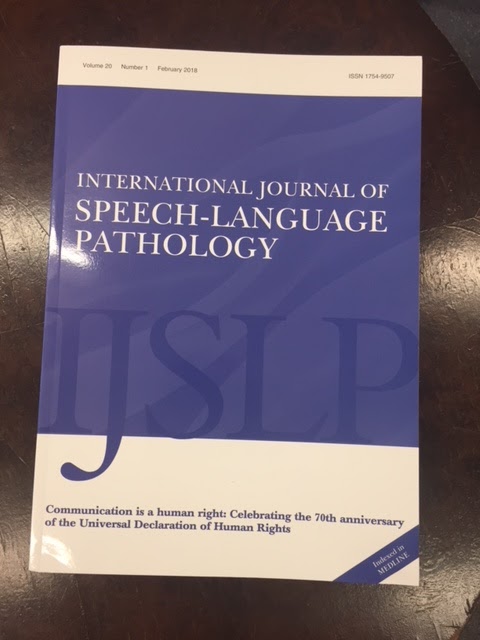
Special issue of IJSLP has been published in hard copy

Today I received my copy of the special issue of the International Journal of Speech-Language Pathology (volume 20, issue 1) on the topic of Communication Rights. I was the guest editor for the special issue, and it was published to celebrate the 70th anniversary of the Universal Declaration of Human Rights. The 31 articles are published across 190 pages, and are also available as open access articles online here: https://www.tandfonline.com/toc/iasl20/20/1


March 23, 2018

Welcome Van

Last week Van Tran commenced her PhD at CSU. She will be supervised by Dr Sarah Verdon and myself and is studying via distance education. This week was her first visit to Bathurst. Van is part of our VietSpeech team and comes with a wealth of experience. She already has been awarded a PhD in linguistics from the University of Wollongong and is a NAATI accredited Vietnamese-English interpreter. Welcome Van!
Dr Van Tran with her PhD supervisors Dr Sarah Verdon and Prof Sharynne McLeod
Ben Pham, Vice Chancellor Andy Vann, Dr Van Tran
Van at the Carillion in Bathurst

March 22, 2018

First VietSpeech team meeting

Last year we were awarded an Australian Research Council Discovery grant titled "Vietnamese-Australian children's speech and language competence" (for 2018-2020). Since this time we have been recruiting project officers and a PhD student and preparing our ethics application. Our team live in Bathurst, Sydney and Albury, so today (and tomorrow) marks our first face-to-face team meeting. We have enjoyed meeting one another and planning the studies. Van Tran, our VietSpeech PhD student, met the Vice Chancellor on her first day on campus at CSU! He wished us well in our project (along with members of Academic Senate and Faculty Board who applauded during the respective meetings over the past 2 weeks when our project was announced). We hope that our work will have an impact on Vietnamese language maintenance in Australia, and will support Vietnamese-English children's speech and language competence. 

Van Tran, Vice Chancellor Andy Vann, Sarah Verdon, Ben Pham, Audrey Wang, Sharynne McLeod
Audrey, Ben, Sharynne, Van and Sarah

March 14, 2018

Farewell Professor Linda Harrison

Professor Linda Harrison has worked at Charles Sturt University for 25 years in the field of early childhood education. She developed the Early Years Learning Framework for Australia (EYLF) with Prof Jennifer Sumsion and was on the advisory group for the Longitudinal Study of Australian Children (LSAC). She has has a strong influence on researchers and research at CSU, including in her role as the inaugural Associate Dean Research for the Faculty of Arts and Education. We have worked together for 14 years (see here). She is moving to Macquarie University and tonight was her farewell party. It was a wonderful time of celebration. We will miss her greatly.
Some of the people celebrating Linda's contribution to CSU
Carol Burgess (Head, School of Teacher Education), Dr Peter Wilson, Prof Linda Harrison, Prof Sharynne McLeod
Prof Linda Harrison, Emeritus Prof Bob Meyenn (previous Dean of Education), Prof Sharynne McLeod
Dr Shuka Sikder, Dr Audrey Wang, Prof Linda Harrison, Mark Situ

March 13, 2018

Reviewing ICPLA abstracts

Over the past few days I have been reviewing abstracts submitted to be considered for presentation at the upcoming conference of the International Clinical Phonetics and Linguistics Association. I have reviewed them in my role as vice president and member of the scientific committee. Over 180 abstracts have been submitted - and the ones I have reviewed have been excellent. I am looking forward to seeing the final program and to hearing them presented at the conference in Malta in October.

March 10, 2018

Teaching year 2 students about working with children with speech sound disorders

I have been invited to teach SPH201: Speech Impairment in Children to the year 2 students at Charles Sturt University in Albury due to the illness of their allocated lecturer. They were using the textbook that Elise Baker and I had written titled "Children's Speech", so it seemed sensible that I teach them when the vacancy arose. I met some of the class while I was in Albury last week (they are great!) and will teach them via distance from Bathurst. I look forward to working with them to unpack the evidence underpinning clinical practice for working with children with speech sound disorders.

Visiting Albury

Last week I visited the Albury campus of Charles Sturt University. While there I
  • attended Academic Senate as the Professorial Representative, 
  • worked with Dr Sarah Verdon on the ethics for our VietSpeech Australian Research Council Grant, 
  • gave a public lecture to celebrate 20 years of the speech pathology program at CSU
  • worked with my PhD student Nicole McGill on data protocols, 
  • met with Dr Jane McCormack and discussed our invited journal article on children's perspectives on their speech,
  • visited the staff and students in the School of Community Health, 
  • and drove 5.5 hours each way between Bathurst and Albury. 
It was a busy but fulfilling few days.
Meeting with Nicole McGill
(before we got our computers out and started typing into spreadsheets!)

March 8, 2018

Public lecture to celebrate 20 years of speech pathology at Charles Sturt University

I was honoured to be invited to present a public lecture to celebrate 20 years of speech pathology at Charles Sturt University on Wednesday 7th March in Albury. I was a lecturer/senior lecturer in the speech pathology program from 1999-2003, so was involved in the establishment of the program.

The title of my lecture was "Communication as a Human Right: Celebrating the 70th Anniversary of the Universal Declaration of Human Rights" and I presented our current work to celebrate communication rights within the special issue of the International Journal of Speech-Language Pathology. The CSU media release about the event is here.
Some of the audience after the public lecture speaking up for communication rights

March 5, 2018

Increasing the reach of our research via Twitter

Over the past 2 weeks (20 Feb - 5 March) my tweets have earned "28.8K impressions" (even though I am only following 77 people and have 571 followers), with a daily average of 12 link clicks, 10 retweets, and 16 likes. It is so great to think that this many people are thinking about communication rights. Let's hope that they are also ensuring that people they come across in their daily lives have the right to communicate. #SpeakUp4CommRights


Speech Pathology Australia have launched a supporting website to promote communication rights: http://www.speechpathologyaustralia.org.au/SpeakUp

February 28, 2018

Ethical approval for NSW Translational Research Health Grant

This week we have received the final ethical approval in order to undertake our NSW Health Translational Research Grant about waiting for speech pathology. We have had to submit extensive applications (that were different in each case) to Charles Sturt University, NSW Health, and Health Victoria. Hooray - the research now can begin across all of our research sites.

February 26, 2018

PhD students for 2018

Semester 1, 2018 begins today - and it is going to be a productive year.
Here are my Charles Sturt University PhD students for 2018:
  1. Ben Phạm co-supervised by Prof Linda Harrison – to submit mid 2018 
  2. Helen Blake co-supervised by Dr Sarah Verdon – to submit mid 2018 
  3. Anna Cronin co-supervised by Dr Sarah Verdon – to undertake data collection and writing in 2018 
  4. Nicole McGill co-supervised by Dr Kate Crowe – to undertake data collection and writing in 2018 
  5. Van Tran co-supervised by Dr Sarah Verdon – to begin in 2018
Here are my PhD students that I am co-supervising at other universities
  1. Anniek van Doornik-van der Zee supervised by Prof Ellen Gerrits - Utrecht University, The Netherlands
  2. Natalie Hegarty supervised by Dr Jill Titterington - Ulster University, Northern Ireland
Here four of my most recent PhD graduates and their post-PhD roles:
  1. Dr Suzanne Hopf - Lecturer, School of Community Health, Charles Sturt University
  2. Dr Sarah Masso -Postdoctoral Research Fellow, Communication Sciences and Disorders, The University of Sydney 
  3. Dr Sarah Verdon - Research Fellow, School of Community Health, Charles Sturt University
  4. Dr Kate Crowe - Fulbright Postdoctoral Scholar, National Technical Institute for the Deaf, Rochester Institute of Technology, Rochester, NY, USA
I am privileged to work with such inspirational women who are working to support communicative participation of children and adults throughout the world.

Sharynne, Nicole, Ben, Anna, Helen, Sarah M, Sarah V, Suzanne
at the Speech Pathology Australia National Conference in May 2017

February 22, 2018

Special issue of IJSLP celebrating the 70th anniversary of the Universal Declaration of Human Rights published TODAY

The special issue of the International Journal of Speech-Language Pathology celebrating the 70th anniversary of the Universal Declaration of Human Rights was published TODAY as Volume 20, issue 1, 2018. It contains 31 papers that are available as open access (for free) and can be accessed via either of these links http://www.tandfonline.com/toc/iasl20/20/1 bit.ly/IJSLP-UDHR 

The CSU news release is here: http://news.csu.edu.au/latest-news/education/teacher-education/communication-is-a-human-right

We celebrated the launch today at Queensland University of Technology, Brisbane, Australia https://www.eventbrite.com.au/e/communication-is-a-human-right-celebrating-the-70th-anniversary-of-the-universal-declaration-of-tickets-42303600207

Additional presentations have been/are being planned in Sydney, Albury, Adelaide, Bathurst, Malta, New York and Boston.

Everyone has the right to freedom of opinion and expression; this right includes freedom to hold opinions without interference and to seek, receive and impart information and ideas through any media and regardless of frontiers. (Article 19, Universal Declaration of Human Rights, United Nations, 1948) 

There has been a lot of attention on Twitter throughout the day: #SpeakUp4CommRights @IJSLP @SpPathAust @UNHumanRights #StandUp4HumanRights


Invited lecture at Queensland University of Technology

Today I presented a lecture at Queensland University of Technology in Brisbane in an event titled "Communication is a human right: Celebrating the 70th Anniversary of the Universal Declaration of Human Rights". The event was co-hosted by the Faculty of Education’s Childhood in Changing Contexts (CCC) and the Student Engagement, Learning & Behaviour (#SELB) research groups and the details are here. The special issue was published this morning - so the event marked the launch of the 31 free articles focusing on Article 19 available here: http://bit.ly/IJSLP-UDHR

Here is a description and program from today
This year marks the 70th anniversary of the Universal Declaration of Human Rights. Article 19 of the UDHR supports communication as a human right and states "Everyone has the right to freedom of opinion and expression; this right includes freedom to hold opinions without interference and to seek, receive and impart information and ideas through any media and regardless of frontiers."
The International Journal of Speech-Language Pathology has joined the world in celebrating this milestone by publishing a special issue titled: "Communication is a human right: Celebrating the 70th anniversary of the Universal Declaration of Human Rights", guest edited by Professor Sharynne McLeod.
Professor McLeod will discuss the special issue and the right to communication. Her presentation will be followed by presentations by the authors of two papers published in the upcoming special issue, Dr Jenna Gillett-Swan and Ms Haley Tancredi.
  • Communication rights: Fundamental human rights for all - Sharynne McLeod
  • Assuring children’s human right to freedom of opinion and expression in education - Jenna Gillett-Swan & Jonathon Sargeant
  • Advancing the human rights of children with communication needs in school - A.L. Gallagher, Haley Tancredi, Linda J. Graham
QUT's facebook post abou the event is here: https://www.facebook.com/QUTEducation/posts/1509327996035226
Jenna Gillett-Swan, Sue Walker, Linda Graham, Haley Tancredi, Sharynne McLeod
Some of the attendees at the UDHR event @QUT

Visiting QUT

This week I have been visiting Queensland University of Technology. There are many wonderful people who work in the School of Early Childhood and Inclusive Education, so it has been great to catch up with many of them. The main purpose of my visit was to present an invited lecture on Article 19 of the Universal Declaration of Human Rights; however, I also mentored future ARC grant applicants, met with Anna Cronin my CSU PhD student, and celebrated submitting an ARC grant application with Dr Kate Williams.
Sharynne and Dr Kate Williams after our ARC Discovery grant submission

February 20, 2018

Happy International Mother Language Day

Happy International Mother Language Day (21st February). I have encouraged my team to take time today to read this wonderful paper titled "Mother tongue as a universal human right" that contains Shetlandic poetry by Christine De Luca, Edinburgh Makar (poet laureate) for the City of Edinburgh (2014-2017). Her inspiring paper will soon be officially published as part of our Universal Declaration of Human Rights special issue of International Journal of Speech-Language Pathology.

February 19, 2018

ASHA selects our tutorial for inclusion in a self-study package

The American Speech-Language-Hearing Association is developing a self-study product about assessment considerations for speech sound disorders and our article, “Tutorial: Assessment and Analysis of Polysyllables in Young Children,” has been selected for inclusion.