August 2, 2024

Indigenous Australian children’s speech and language in early childhood: Parent report as a predictor of school-age academic outcomes

Prof Linda Harrison and I have been working on revisions for our co-authored paper titled "Indigenous Australian children’s speech and language in early childhood: Parent report as a predictor of school-age academic outcomes". This is part of our current research with the Rural Health Research Institute.

August 1, 2024

SUBMITTED - Two papers for the International Conference on Sustainable Development (ICSD)

Today I submitted two 9 page papers for the International Conference on Sustainable Development (ICSD). Our abstracts were accepted for presentation some time ago, and today was the submission date for the full papers. The conference will be held in September. Our papers are titled: 

  • Communication for all: Amplifying all voices for SDG achievement 
  • Listening to children’s communication: Partnership for the goals (SDG17)

New door sign

A nice surprise!


July 31, 2024

SUBMITTED - The Oxford Handbook of Speech Development in Languages of the World

Today I submitted The Oxford Handbook of Speech Development in Languages of the World. HOORAY!

Thanks to the 172 chapter authors - my  CSU support team including DVC-R Prof Mark Evans, Dr Helen Blake, Dr Carolyn Gregoric, Mark Filmer, Craig Poynter, and my family.

Here is an overview of the book.

The Oxford Handbook of Speech Development in Languages of the World provides a thorough and updated overview of children’s speech development in 49 languages and 26 dialects. The 80 chapters are written by 172 of the world’s leading scholars. Each chapter follows the same structure to enable comparisons between languages: 

  • Overview: location, maps, varieties, writing 
  • Components: consonants, clusters, vowels, tones, phonotactics, prosody, anatomy) 
  • Typical acquisition: consonants, clusters, vowels, tones, percentage correct, intelligibility, phonological patterns, inventory, mismatches, word structure, prosody, perception, phonological awareness 
  • Supporting children’s speech: children with speech sound disorders (SSD), assessments, interventions 
  • Resources: terminiology, books, journals, websites, professional associations, universities. 

The Handbook upholds communication as a fundamental human right and presents a transformative social-justice approach to understanding languages cultures and communication.

 Here is the Table of Contents and more details:

https://speakingmylanguages.blogspot.com/2024/07/oxford-handbook-of-speech-development.html

Now it is over to Oxford University Press who will take 12 months for production.

Dr Helen Blake, Prof Sharynne McLeod and Vicki Sunter
from OUP celebrating submission of the Handbook

Certificate of Recognition for Outstanding Contributions in International Achievement

I have been informed that I was nominated and will receive the Certificate of Recognition for Outstanding Contributions in International Achievement https://www.asha.org/about/awards/certificate-of-recognition-for-outstanding-contributions-in-international-achievement/ at the American Speech-Language-Hearing Association Convention in Seattle, WA in December. The ASHA website states:

The Certificate of Recognition for Outstanding Contribution in International Achievement is designed to recognize distinguished achievements and significant contributions in the area of communication disorders revealing great international impact from their work. ASHA members and non-members are eligible based on their work in one or more of the following areas: international education publications research program development administration service delivery to persons with communication disorders

What a huge honour. I am very grateful to my nominator and the committee who have chosen me to receive this award for doing this work with amazing people around the world.

July 30, 2024

Covidence review of services and resources to support Indigenous children's communication

Today Dr Carolyn Gregoric, Sarah Bartlett and I met to advance our Covidence review of services and resources to support Indigenous children's speech, language and communication.

Here is our PRISMA diagram from our work so far. We have gone from 2100 articles to 75 to be included in our review.

Carolyn, Sarah and Sharynne


ECV2024 - Abstract submission closed

Abstract submission has closed for the ECV2024 conference. We have had 74 abstracts submitted from 23 countries: Australia, Bangladesh, Bulgaria, Canada, China, Fiji, Hong Kong (SAR China), Iceland, Iran, Ireland, Israel, Mongolia, Nigeria, Pakistan, Philippines, Poland, Portugal, Spain, Sri Lanka, Sweden, United Kingdom, USA, Uzbekistan. 

We have another 50+ abstracts for our multilingual children's speech stream. We hope to have a diverse range of quality papers presented at the conference in November.

Dr Carolyn Gregoric (ECV2024 conference secretary) closing off abstract submission

The chairs of the ECV2024 Scientific Review Committee met and have allocated the papers for review.

ECV2024 Scientific Review Committee Chairs:
Dr Suzanne Hopf, Prof Sharynne McLeod, Dr Leanne Gibbs

We have 427 registrations for ECV2024 and the quality and range of papers look amazing.

July 29, 2024

Congratulations Kate Margetson on finalising your PhD for graduation

Today the Charles Sturt University Graduate Research Office acknowledged that Kate Margetson's PhD has been finalised and she is ready for graduation. Congratulations Kate!

Her PhD is titled: Moving Beyond Monolingual Practices with Multilingual Children: Learning from Vietnamese-English–Speaking Children, Families, and Professionals

Here is the synopsis: This thesis explored multilingual children's speech development through the analysis of Vietnamese and English speech from 66 children and 83 adults. The research focussed on speech assessment, transcription, analysis, and differential diagnosis of speech sound disorder. A new evidence-based clinical protocol, the Speech Assessment of Children's Home Language(s) (SACHL), was created to assess multilingual children's speech in their home languages. 


Here is the abstract:

Multilingual children’s speech assessment and differential diagnosis of speech sound disorders can be challenging for speech-language pathologists (SLPs), especially if they do not speak the same language as the children they are working with. While best practice recommendations include assessing children in all the languages that they speak, in many English-dominant contexts SLPs often rely on English assessments for diagnostic decision-making. There are few guidelines for how SLPs can assess, transcribe, and analyse speech in children’s home languages. This doctoral research aimed to explore assessment, transcription, speech analysis, and diagnosis of speech sound disorders in multilingual children involving direct speech assessment of children’s home languages. Vietnamese-English–speaking children and their families were the focus of this research.

The thesis contained four parts, which included five publications. Part One, Monolingual Speech-Language Pathologists in Multilingual Contexts (Chapter 1), included an orientation to the thesis, situated the researcher, presented a literature review, and outlined methodology. Linguistic multicompetence (Cook, 2016) and the emergence approach (Davis & Bedore, 2013) were presented as the theoretical frameworks underpinning the research.

Part Two, Vietnamese-English–speaking Children’s Speech described similarities and differences between Vietnamese and English phonology, Vietnamese-English–speaking children’s speech acquisition, and current resources available to SLPs for assessment and intervention with Vietnamese-English–speaking children (Chapter 2). The interaction between Vietnamese and English phonology was explored in a cross-sectional study (n = 149) of Vietnamese-English–speaking children’s and adult family members’ speech in Vietnamese and English (Chapter 3) and found that direction of cross-linguistic transfer in children’s speech was significantly associated with children’s age and language proficiency.

Part Three, Diagnosis of Speech Sound Disorders in Vietnamese-English–speaking Children presented in-depth case studies of Vietnamese-English–speaking children’s speech. Case studies of four children considered the impact of assessing both languages on differential diagnosis (Chapter 4). All four children appeared to have speech sound disorder based on English assessment only, but analysis of children’s speech in both languages revealed that only two children had a speech sound disorder. A longitudinal case study explored four influences on a Vietnamese-English–speaking child’s speech over time (Chapter 5) and found that most speech mismatches could be explained by development, dialect, cross-linguistic transfer, and ambient phonology, and that cross-linguistic transfer reduced over time.

Part Four, Moving Beyond Monolingual Speech-Language Pathology Practices with Multilingual Children presented an evidence-based research protocol, the VietSpeech Multilingual Transcription Protocol, for assessing and transcribing multilingual children’s and adults’ speech, that ensured consistent and reliable transcription (Chapter 6). A clinical protocol, the Speech Assessment of Children’s Home Languages, was proposed, for SLPs to assess, transcribe, and analyse multilingual children’s speech, to account for the idiolects of children, their families, and their SLPs (Chapter 7). The Speech Assessment of Children’s Home Languages will enable SLPs to collaborate with family members and interpreters to assess speech in children’s home languages, providing opportunities to consider children’s entire phonological repertoires during diagnostic decision-making. Finally, conclusions, contributions of the doctoral research, limitations, and future directions were presented (Chapter 8). 

This doctoral research sought to bridge a gap between research and practice in multilingual children’s speech assessment by demonstrating the importance of speech assessment of home languages, describing ways of analysing multilingual children’s speech to identify four potential mismatches (development, dialect, cross-linguistic transfer, ambient phonology), and outlining how SLPs move beyond monolingual practices in the way they assess, transcribe, and analyse multilingual children’s speech using the VietSpeech Multilingual Transcription Protocol and the Speech Assessment of Children’s Home Languages.

<

Here are the papers in her thesis: 

PAPER 1 (Chapter 2)

Margetson, K., McLeod, S., Verdon, S., Tran, V. H., & Phạm, B. (in press). English + Vietnamese speech development. In S. McLeod (Ed.), The Oxford handbook of speech development in languages of the world. Oxford University Press.

PAPER 2 (Chapter 3)

Margetson, K., McLeod, S., Verdon, S. (2024).

Cross-linguistic transfer in Vietnamese-English–speaking children’s and adults’ speech [Manuscript in preparation]. School of Education, Charles Sturt University.

PAPER 3 (Chapter 4)

Margetson, K., McLeod, S., Verdon, S. (2024). Diagnosing speech sound disorder in bilingual Vietnamese-English–speaking children: Are English-only assessments sufficient? In E. Babatsouli (Ed.), Multilingual acquisition and learning: An ecosystemic view to diversity (pp. 217-245). John Benjamins Publishing Company.

PAPER 4 (Chapter 5)

Margetson, K., McLeod, S., & Verdon, S. (2023). Cross-linguistic transfer and ambient phonology: Impact on diagnosis of speech sound disorders in a longitudinal bilingual case study. Journal of Monolingual and Bilingual Speech, 4(3), 311-339. https://doi.org/10.1558/jmbs.23672

PAPER 5 (Chapter 6)

Margetson, K., McLeod, S., Verdon, S. & Tran, V. H. (2023). Transcribing multilingual children’s and adults’ speech. Clinical Linguistics and Phonetics, 37 (4-6), 415-435. https://doi.org/10.1080/02699206.2022.2051073

July 27, 2024

Focus on English and Western-centric literature in child language/development/speech research

The famous wake-up call to resesearchers and practitioners highlighted that our knowledge is biased: 

  • Henrich, J., Heine, S. J., & Norenzayan, A. (2010). The weirdest people in the world? Behavioral and Brain Sciences, 33(2-3), 61–83. https://doi.org/10.1017/S0140525X0999152X 

Here are more papers providing additional information on the same theme: 

  • Schneider, J. M., Behboudi, M. H., & Maguire, M. J. (2024). The necessity of taking culture and context into account when studying the relationship between socioeconomic status and brain development. Brain Sciences, 14(4), 392. https://www.mdpi.com/2076-3425/14/4/392 
  • Draper, C. E., Barnett, L. M., Cook, C. J., Cuartas, J. A., Howard, S. J., McCoy, D. C., Merkley, R., Molano, A., Maldonado-Carreño, C., Obradović, J., Scerif, G., Valentini, N. C., Venetsanou, F., & Yousafzai, A. K. (2023). Publishing child development research from around the world: An unfair playing field resulting in most of the world's child population under-represented in research. Infant and Child Development, 32(6), e2375. https://doi.org/https://doi.org/10.1002/icd.2375
  • Kidd, E., & Garcia, R. (2022a). How diverse is child language acquisition research? First Language, 42(6), 703–735. https://doi.org/10.1177/01427237211066405   
  • Paradis, J. (2022). What can journals do to increase the publication of research on the acquisition of understudied languages? A commentary on Kidd and Garcia (2022). First Language, 42(6), 794–798. https://doi.org/10.1177/01427237221089171
  • Nielsen, M., Haun, D., Kärtner, J., & Legare, C. H. (2017). The persistent sampling bias in developmental psychology: A call to action. Journal of Experimental Child Psychology, 162, 31-38. https://doi.org/https://doi.org/10.1016/j.jecp.2017.04.017

"less than 3% of the participants contributing to the expansion in our knowledge of children’s psychological development came from all of Central and South America, Africa, Asia, and the Middle East and Israel combined (which notably contain ∼85% of the world’s population" (Nielsen et al., 2017, p. 34)

Here is some evidence for why considering a variety of cultural viewpoints is important

  • Clegg, J. M., Wen, N. J., & Legare, C. H. (2017). Is non-conformity WEIRD? Cultural variation in adults’ beliefs about children’s competency and conformity. Journal of Experimental Psychology: General, 146, 428–441. https://doi.org/10.1037/xge0000275 

A transformative theory is needed to center experiences of marginalized communities, acknowledge power differentials and create actions intended to mitigate disparities (Jackson et al., 2018)

  • Mertens, D. M. (1999). Inclusive evaluation: Implications of transformative theory for evaluation. The American Journal of Evaluation, 20(1), 1-14. https://doi.org/10.1016/S1098-2140(99)80105-2 
  • Jackson, K. M., Pukys, S., Castro, A., Hermosura, L., Mendez, J., Vohra-Gupta, S., Padilla, Y., & Morales, G. (2018). Using the transformative paradigm to conduct a mixed methods needs assessment of a marginalized community: Methodological lessons and implications. Evaluation and Program Planning, 66, 111-119. https://doi.org/10.1016/j.evalprogplan.2017.09.010


Orange Aboriginal Medical Service Continuous Quality Improvement Day

Our research team was invited to attend, participate in, and present at the Orange Aboriginal Medical Service (OAMS) Continuous Quality Improvement (CQI) Day on Friday. There were over 50 of the 132 OAMS staff in attendance (a number had to attend sorry business). It was a warm, friendly, and impressive event where the work of many of the teams was presented. The day included reports from the Holistic Healing team, Early Years team, Marketing & Communication team, a Clinical update, IT update, and team building.

Dr Liz Pressick (CSU RHRI) organised for Emily-Jane and I to present with Liz, Hazel and Benedict. Liz is an important bridge builder and for our team. It was wonderful to be welcomed as a part of the OAMS family and for the CSU team to receive applause and unsolicited public thanks (including for Benedict’s data presentation) from a number of the OAMS team during the open mic sharing.

This was a milestone in our relationship with the OAMS team and will enable the next phases of our research to co-design impactful resources and services to support children’s communication.

OAMS and CSU team: Dillon, Hazel, Emily-Jane, Liz, Christine, Benedict, Sarah, Sharynne

CSU RHRI team: Emily-Jane Woodhead, Dr Liz Pressick, Dr Hazel Dalton, Dr Benedict Osei Asibey, Prof Sharynne McLeod

A Kahoot quiz at the end of the day

Emily-Jane presenting our research

Emily-Jane, Benedict, Hazel and Liz

Sarah introducing Liz and the CSU team


Congratulations Julie Malone - Board Member at Large in Speech-Language Pathology

Congratulations to my colleague Julie Malone who has been elected to the American Speech-Language-Hearing Association  as:

Board Member at Large in Speech-Language Pathology
Julie D. Malone, CCC-SLP

Here are the other position holders:

President-Elect
Linda I. Rosa-Lugo, CCC-SLP

Vice President for Academic Affairs in Speech-Language Pathology
Rachel Glade, CCC-SLP

Vice President for Audiology Practice
Kevin Kock, CCC-A

Vice President for Government Affairs and Public Policy (one-time, two-year term)
Lou Malerba, CCC-SLP

Vice President for Science and Research
Nidhi Mahendra, CCC-SLP

Julie and I first began working together in 1997 when she spent time at The University of Sydney.


July 26, 2024

American Speech-Language-Hearing Association Board of Directors

Congratulations to my long-time colleague Julie D. Malone, CCC-SLP who has just been announced as Board Member at Large in Speech-Language Pathology for after her election to the 2025 Board of Directors of the American Speech-Language-Hearing Association. https://www.asha.org/news/2024/2024-board-of-directors-election-results/ Julie came from the US as a volunteer to work with me at The University of Sydney over 20 years ago. Congratulations Julie.

July 25, 2024

Child Language Teaching and Therapy editorial board meeting

Tonight I attended the annual Child Language Teaching and Therapy (CLTT) editorial board meeting. 

One interesting topic that was covered included the use of AI in publishing: https://us.sagepub.com/en-us/nam/using-ai-in-peer-review-and-publishing.

There was a great discussion about sourcing and incentivising reviewers.

I am excited to work with CLTT to initiate a special issue based on my summer lecture. The lecture was sold out - and apparently there has been a lot of discussion throughout the world about it. The recorded version of the talk will be uploaded on the CLTT website soon.

Research higher degree students are great

It's time I had another blog about my research higher degree students. I love working with them. This week: 

  • Suzanne Hopf and I met with Holly McAlister to discuss her ethics variation, her paper being accepted at the ASHA convention, and her ongoing work. 
  • I met with Sarah Bartlett to work on her PhD endorsement document and plans.
  • Libbey Murray, Julian Grant and I sent back a draft of Cathie Matthews' thesis. Cathie is having another writing week - so we have worked on her updated literature review and results tables.
  • I met with Kate Margetson to finalise her thesis being included in the CSU library, her synopsis for her graduation, and her postdoctoral plans.
  •  We've also submitted a number of conference abstracts too.
Sarah B and Sharynne

Cathie and Sharynne

Holly, Sharynne and Suzanne

RHRI team preparation for our presentation

Today our RHRI team have met online to finalise our first presentation to the Orange Aboriginal Medical Service (OAMS) tomorrow. We are collaborating on the research titled "Evidence-informed practice development in rural Aboriginal Community Controlled Health Organisations: An action research approach – Phase 1 and 2". Our substudy is titled "Improving access to speech pathology services for rural children with speech, language and communication needs".
Dr Benedict Osei Asibey, Dr Hazel Dalton, Dr Liz Pressick, Emily-Jane Woodhead, Prof Sharynne McLeod

Children on campus - Scoping review + preparing for ethics

Today we had two meetings to advance our work about children on campus.

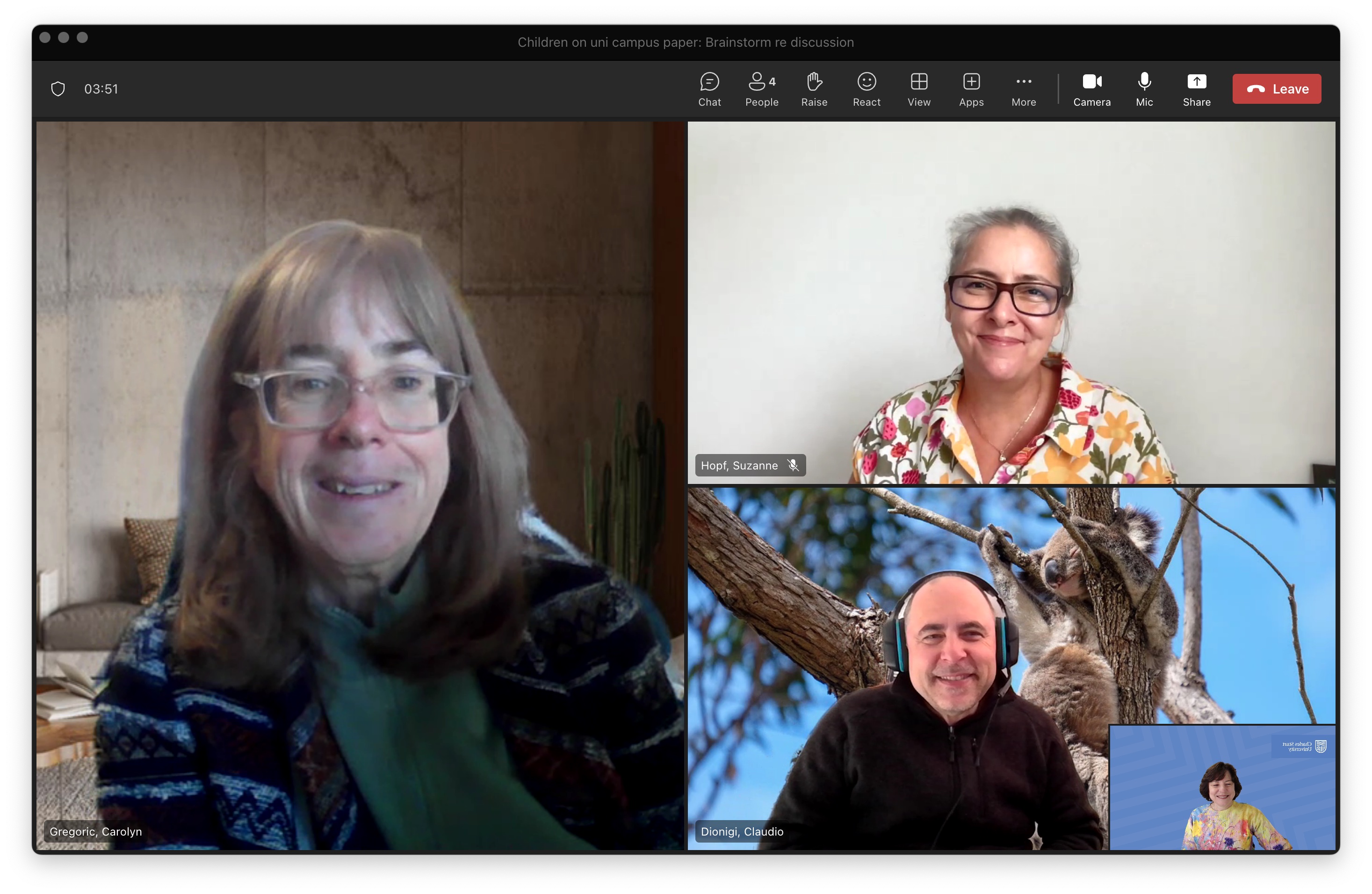
This morning, our review team (Carolyn Gregoric, Suzanne Hopf, Claudio Dionigi and I) worked on the discussion of our paper that includes a scoping review of international literature and rapid review of Austrailan university policies and guidance documents.

Carolyn, Suzanne, Claudio and Sharynne

This afternoon, our broader group met to discuss writing the ethics application for undertaking research to co-create The Treehouse (virtual and physical) and include children as research participants in our new Children's Voices Centre.

ECV2024 Scientific Review Committee

The abstracts for the ECV2024 Conference are due on 29th July - so today we had the ECV2024 Scientific Review Committee meeting and learned how to review abstracts.
ECV2024 Scientific Review Committee chairs: Dr Suzanne Hopf, Prof Sharynne McLeod, Dr Leanne Gibbs

July 24, 2024

Mentoring - Congratulations Belinda on achieving most of your mentoring goals by July!

Congratulations A/Prof Belinda Cash on submitting a grant yesterday, finalising 5 projects, having 3 papers accepted in 2024, 3 under review, and 5 in draft mode. I am really proud of your management strategies to make a huge difference in the area of in rural mental health and ageing. I also learn a lot from our conversations.

July 23, 2024

Preparing our new research with Tasmania

Today Dr Nicola Ivory and I spent time working on our invited research proposal with an education department in Tasmania. It is such an exciting project.

Our VietSpeech team is writing a lot of chapters

The work of our VietSpeech team (https://www.csu.edu.au/research/vietspeech/overview) continues to have impact across the world. We have been invited to write a number of different book chapters based on our research. We are currently working on these chapters:

  • Tran, V. H., Margetson, K., Pham, B., Verdon, S., McLeod, S., Blake, H. L., & Faulks, S. (in preparation). Vietnamese English. In Y. Holt, K. N. Washington, & E. Babatsouli (Eds.) Linguistic varieties in North America: A primer for speech and language practitioners. Multilingual Matters.
  • Margetson, K., McLeod, S., & Verdon, S. (in preparation). Diagnosing speech sound disorders in multilingual children who speak Vietnamese and English. In K. N. Washington, K. Crowe, T Másdóttir (Eds.). Diagnosing speech sound disorders in multilingual children. Routledge.

These chapters have just been accepted for publication:

  • Margetson, K., McLeod, S., Verdon, S., Tran, V. H., & Phạm, B. (2025). English + Vietnamese speech development. In S. McLeod (Ed.), The Oxford handbook of speech development in languages of the world. Oxford University Press.
  • Phạm, B. & Margetson, K., McLeod, S. + Tran, V. H. & Verdon, S. (2025). Vietnamese speech development. In S. McLeod (Ed.). The Oxford handbook of speech development in languages of the world. Oxford University Press.

Dr Van Tran, Prof Sharynne McLeod, Dr Helen Blake,
Dr Ben Phạm, Dr Kate Margetson, A/Prof Sarah Verdon

These chapters have been published in 2024:

  • Tran, V. H., McLeod, S., Verdon, S., Margetson, K., & Phạm, B. (2024). Vietnamese-Australian families: Children’s language competence and home language maintenance. In L. Mahony, S. McLeod, A. Salamon, & J. Dwyer (Eds.), Early childhood voices: Children, families, professionals (pp. 135-150). Springer International Publishing. https://doi.org/10.1007/978-3-031-56484-0_1015 
  • Margetson, K., McLeod, S., & Verdon, S. (2024). Diagnosing speech sound disorder in bilingual Vietnamese-English-speaking children: Are English-only assessments sufficient? In E. Babatsouli (Ed.). Multilingual acquisition and learning: A ecosystemic view to diversity. (pp. 217-245). John Benjamins Publishing. https://doi.org/10.1075/sibil.67.08mar